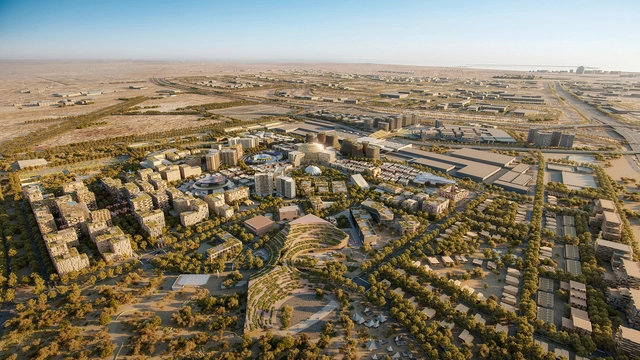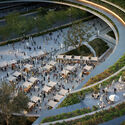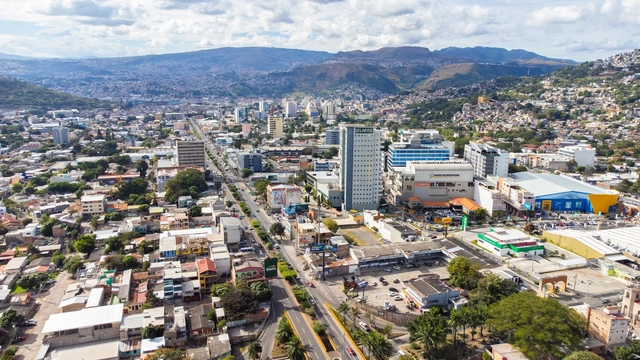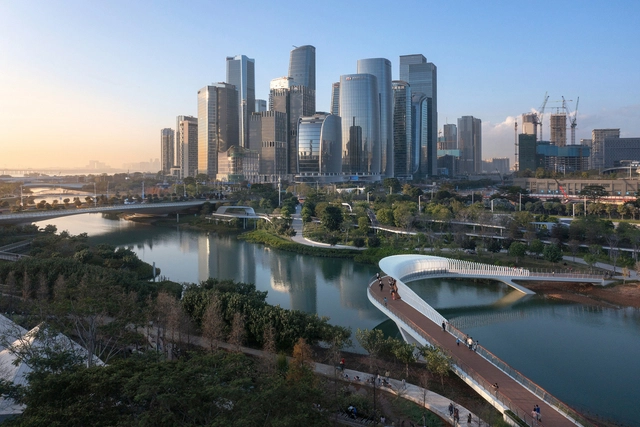
Rendering of the proposed La Rambla redevelopment project. Image Courtesy of Barcelona City Council, under policy of fair use
La Rambla, a 1.2-kilometer-long promenade in Barcelona, was established in 1766 along the old city walls. Embraced by locals, it became the only spacious area for strolling in a city of narrow streets and grew into a central meeting place for all social classes. Over time, leisure and cultural sites, like the Gran Teatre del Liceu and Boqueria Market, emerged, making it a vibrant, cultural hub. In 2017, Barcelona's local government launched a competition for the revitalization of this beloved urban space. Km_ZERO, a 15-member interdisciplinary team that also relied on the input of community groups was declared the winner. Now the first phase of the urbanization process has been almost completed, led by Lola Domènech and Olga Tarrasó. A hundred trees still remain to be planted in this phase, postponed due to drought conditions. The entire project is expected to be finished in 2027.

There is growing awareness of the importance of developing pedestrian infrastructure. Bridges and elevated structures enhance the quality of cities by connecting spaces and reducing distances. Their use benefits pedestrians and the thousands of cyclists seeking a more sustainable mode of transportation.
Pedestrian infrastructures, such as bridges, walkways, and widened sidewalks, not only promote sustainable mobility but also contribute to the revitalization of urban areas. Their design can transform underused spaces into active, safe, and accessible places for everyone, enhancing social cohesion and fostering community. By incorporating elements such as greenery, smart lighting, and urban furniture, these structures become more than just thoroughfares: they transform into meeting points and spaces for social interaction.
CRA-Carlo Ratti Associati, in partnership with real estate group IPI, has revealed plans to transform the iconic modernist Palazzo Micca in Turin, Italy. Originally the headquarters of RAI, Italy's national broadcaster, the 19-story building will undergo a comprehensive adaptive reuse project. A significant feature of the redesign is the creation of an elevated public plaza at 26.5 meters, offering views of Turin's Baroque rooftops, the surrounding hills, and the Alps. The project also integrates sustainable design principles by converting parts of the office spaces into residential units and reusing existing materials.
The relationship between architecture and naval design has been a fascinating interplay of form and function that has evolved significantly. Both disciplines have a shared history of innovation, aesthetics, and functionality that have informed and inspired each other. This "love affair" has seen architects drawing inspiration from boats, particularly in the modernist era when ships' streamlined, efficient designs influenced the aesthetic of buildings. Conversely, architectural principles have also been adapted to enhance the functionality and form of boats, demonstrating a reciprocal exchange that continues to shape both disciplines.
The India Autism Center (IAC), situated in Sirakole, West Bengal, represents a new perspective in accessible design and inclusivity. Designed to meet the specific needs of individuals with autism spectrum disorder (ASD) and related conditions, the center embodies a comprehensive approach to neurodiverse living. Developed by Practice Design, an architectural firm based in Mumbai and Kolkata, the 52-acre project is expected to be completed by 2030. It aims to create a supportive community where individuals with autism can realize their full potential through a variety of tailored services.
British architect and planner Colin Fournier, co-founder of conceptual architecture studio Archigram and Professor of Architecture and Urbanism at the Bartlett School of Architecture, has passed away at the age of 79. Fournier was best known for his co-design of the Kunsthaus Graz in Austria, also known as the "Friendly Alien." This project, completed together with Sir Peter Cook, is celebrated as one of the most distinctive cultural landmarks of its time. For his contributions to this work, Fournier was awarded Austria's Goldener Ehrenzeichen medal in 2005, a recognition of his impact on the architectural landscape.
Following the devastating earthquake that hit central Turkiye and northwest Syria in February 2023, the province of Hatay, Türkiye, was left with large sections of its urban fabric destroyed and thousands of residents displaced. Türkiye Design Council has commissioned design studio SOUR to contribute to the regeneration initiative as part of a wider design-led revitalization process.
In a significant win for historic preservation, two landmark Chicagoskyscrapers, the Century and Consumers Buildings, have been saved from demolition. These iconic structures, located on State Street, were initially set for destruction due to security concerns, given their proximity to the Dirksen U.S. Courthouse. However, after extensive advocacy and public pressure, the U.S. General Services Administration (GSA) has shifted toward an adaptive reuse plan, ensuring the preservation of these architectural landmarks.
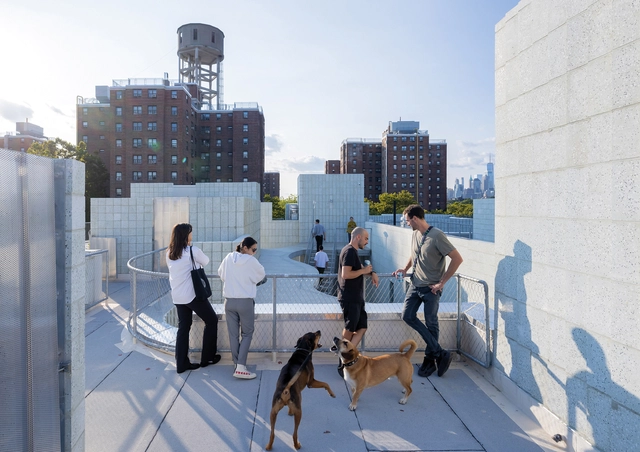
With escalating land values in urban centers, there has been a growing trend to float public spaces from ground level to elevated locations, such as rooftops or podiums between buildings. From a development perspective, maximizing floor area has become crucial as urban environments expand. Ground-level spaces are highly sought after for retail use due to their strategic location, which attracts foot traffic and potential customers and drives city development and economics.
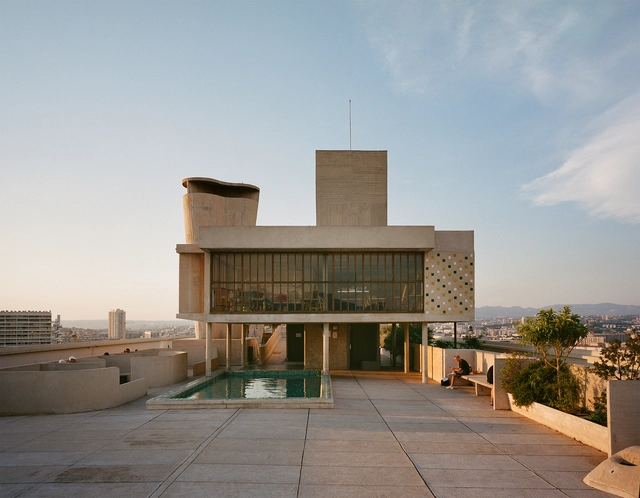
This financial consideration, which often guides building activities and directions in urban centers, contradicts design principles advocated during the modernist era for the benefits of better outdoor space for the public, such as the concept of 'Freeing the Ground'. Architects like Le Corbusier championed this concept through projects like Villa Savoye and Unite d' Habitation. These modernist designs envisioned a future where buildings were elevated to restore open, accessible outdoor ground-level spaces for its users. However, for the reasons above, many contemporary projects instead seek to replicate the function of public grounds within the building's structure.
In Timișoara, Romania, Beta Architecture Biennial opens to the public today, September 13, under the curatorial direction of Oana Stănescu. Now in its 5th edition, thus celebrating 10 years since its inauguration, the 2024 biennial proposes a wide-ranging program of debates, exhibitions, guided tours, and artistic performances. The two main components of the biennale are the Main Exhibition, cover me softly, led by Stănescu, and the Beta Awards, aiming to highlight architects and professionals from Romania, Hungary, and Serbia who actively contribute to the improvement of the built environment. The biennale is open between September 13, and October 27, 2024.
From the 1930s to the 1990s, Burle Marx's work anticipated many of today's concerns about sustainability and urban well-being. Long before terms like "sustainable design" or "green infrastructure" became commonplace, Burle Marx was already advocating for the use of native plants, recognizing their role in creating self-sustaining ecosystems that required minimal intervention. His projects often transformed neglected urban areas into vibrant, ecologically balanced spaces that not only improved the environment but also enhanced the quality of life for city dwellers.
As a landmark of contemporary religious architecture in Portugal, the Church of the Sacred Heart of Jesus stands in contrast to traditional models, representing a work free from historicist stigmas. Resulting from a design competition organized in 1960, the church is notable for its civic dimension, urban role, and its anti-monumental and social significance. Integrated into the regular grid of the Avenidas Novas neighborhood, this example of the Movement for the Renewal of Sacred Art is part of a larger parish complex that often goes unnoticed by passersby. Its external street creates an unexpected public space, inviting people to enter and engage in a courtyard where architecture and the city merge. Finely crafted in terms of spatiality, detail, and light, the church holds many surprises for those who venture inside.
The Transamerica Pyramid Center has just announced the completion of the long-awaited Foster + Partners led renovation in San Francisco, United States. An iconic landmark of San Francisco's skyline since its completion in 1972, has been undergoing its most significant renovation to date. Originally designed by American architect William Pereira in a Brutalist style, the 48-story tower was the tallest building in San Francisco for nearly 50 years. This renovation will also include enhancements to the adjacent buildings.
Cheongye Stream, known as Cheonggyecheon (청계천) in Korean, runs eastward through the heart of Seoul, passing through 13 neighborhoods in four districts of the capital of South Korea. Throughout its history, the stream played different roles in the city until it was covered by an elevated highway in the 1970s. For over 30 years, this natural artery remained hidden. It was not until 2003 that the city government launched a restoration project to reintegrate this urban waterway into the city fabric, revitalize the local economy, and revive the area's history and culture. The revitalization efforts were led by Mikyoung Kim Design. Since the project's completion in 2005, it quickly became one of Seoul's most visited tourist attractions. Moreover, it has become a focal point for ample urban research, with many studies offering positive assessments of the impact it had on Seoul's urban, economic, and ecological context.
On the morning of September 11, 2001, two hijacked commercial jetliners struck the Twin Towers in Lower Manhattan, a third plane struck the Pentagon, and a fourth crashed in rural Pennsylvania. A total of 2.977 people were killed in the terrorist attacks. In the face of this unprecedented loss, the city of New York promised to rebuild Lower Manhattan as a lively neighborhood while honoring and maintaining the memory of this day. Thus began one of the largest reconstruction projects in New York City, a process that is still ongoing now, 23 years after the tragedy.
Borderless Studio, “Kohn School in Roseland,” Chicago, 2023. Digital photograph. Photo: David Schalliol. From the 2024 grant to Borderless Studio and MAS Context for the publication “Beyond Closure: Reimagining Possibilities for Chicago’s Closed Schools” . Image Courtesy of Graham Foundation
The Graham Foundation, based in Chicago, has allocated $390,000 in grants to support 33 innovative projects worldwide. These initiatives include exhibitions, publications, and presentations aimed at enriching the discourse in architecture and its role in society. The projects, undertaken by architects, artists, curators, and educators, span various cities such as Johannesburg, New York, Chicago, and others, reflecting a global perspective on contemporary architectural issues.
In dense urban living, the ability to connect with the outdoors for enjoyment and for wellbeing becomes starkly important. This became particularly apparent in the COVID-19 pandemic when millions of people across the globe had to be confined to their homes for long periods. Notwithstanding that, as the world increasingly urbanizes, good quality housing design is vital and this includes access to the outside. In a city like London, this need was recognized, and providing an outside space in every dwelling became mandatory around the year 2010. In multi-storey housing, providing outside space usually takes the form of a balcony. The design possibilities are endless, so what are the key considerations when incorporating balconies in an urban residential building?
Porto, Portugal's second-largest city, is a captivating blend of historical charm and contemporary innovation. Perched along the Douro River, this UNESCO World Heritage site boasts a rich architectural tapestry that spans centuries. Porto's urban landscape is a testament to its evolving identity from its medieval Ribeira district with narrow cobblestone streets to the iconic Luís I Bridge. The city's skyline is punctuated by Baroque churches, neoclassical palaces, and modernist structures, creating a visually striking contrast that reflects its dynamic history.
Porto has undergone a remarkable architectural renaissance in recent years, becoming a magnet for local and international talent. The city has evolved into a dynamic canvas where bold contemporary designs seamlessly integrate with its rich historical fabric. The influence of renowned architects like Álvaro Siza Vieira and Eduardo Souto de Moura, both Pritzker Prize laureates and native to Porto, has solidified the city's status as a key player on the global architectural stage. Among the city's most striking contemporary landmarks is the Casa da Música, a futuristic, diamond-shaped cultural center designed by Dutch architect Rem Koolhaas, which stands as a testament to Porto's forward-thinking spirit. This sophisticated blend of tradition and modernity, coupled with a strong commitment to urban regeneration, has transformed Porto into a vibrant hub of architectural innovation, making it a must-visit destination for architecture enthusiasts and cultural explorers