-
Architects: Roland Baldi Architects
- Area: 1404 m²
- Year: 2026


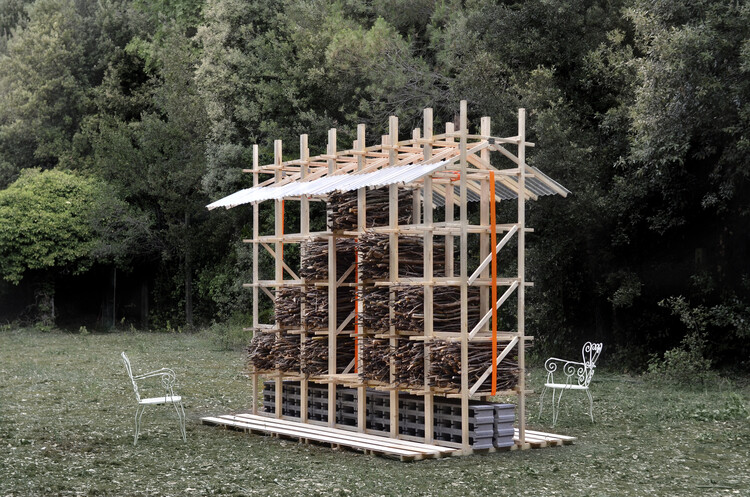
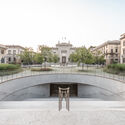
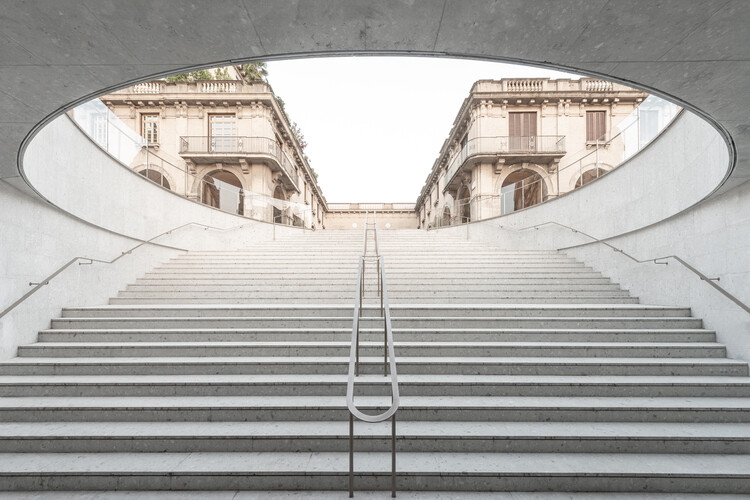
Hidden Forces is a research project dedicated to the less visible dimensions that contribute to shaping architecture. Through an exhibition and a public programme of talks, the project transforms Bologna's Pavillon de l'Esprit Nouveau into a space for investigating the processes, conditions and relationships that give form to architecture.
Every project is, in fact, the outcome of a complex system of forces that directs its choices, defines its limits and determines its possibilities. Beyond the built form, economic, political, environmental, regulatory, cultural and social dynamics contribute to defining what can be designed and built. Conceived and curated by Atelier Atollo and Politi Perugini, Hidden Forces brings these conditions to the foreground, reflecting on how architecture takes shape within the broader transformations of our time.
The exhibition brings together Federico Perugini's Relics series and four authored columns, which establish a bridge between the works and the themes of the exhibition.
Relics draws on an unpublished drawing by Le Corbusier in which the architect depicts, at full scale, the invisible section of the columns of one of his villas. The works take up this intuition but replace pictorial matter with the materials of construction: concrete and steel. They do not represent but rather present an infinitesimal section of the structure of six emblematic buildings by Le Corbusier, Mies van der Rohe, Letrosne, Shinohara, Nishizawa and Koolhaas, tracing a history of the reinforced-concrete frame in architecture. All six buildings are constructed and still exist today. Beyond revealing the hidden area within their columns, the Relics reproduce the invisible forces and tensions that, even now, run through their structural frames.
Organised in pairs, the works act as conceptual columns, bringing together different authors, periods and geographies to reveal affinities, contrasts and questions, synthesised through the exhibition's four themes: Tools, Relationships, Regulations and Intentions. Each theme is made tangible through an authored column conceived as a spatial and interpretative device.
Beyond their structural function, the columns reveal their capacity to produce architecture: a represented column by Archizoom Associati; a commissioned column by Duccio Maria Gambi; a construction-site column by architecten jan de vylder inge vinck / A JDVIV / A DVVT; and a column as a point of view on reality by Le Corbusier himself. These works extract and amplify the themes embedded within the exhibited pieces, connecting them to the broader economic, political, environmental, social and cultural conditions that shape architectural practice today, thereby reconstructing a map of forces and tensions that usually remain imperceptible.

The international festival of city making returns for Part 2 of its Ten Years Edition after a successful event in Rotterdam last May.
Over two days, the festival will bring together architects, developers, urban practitioners, community organisers, policymakers and people working in and around cities to look at some of the questions increasingly shaping urban life: who gets to make cities, how existing spaces and infrastructure can be used differently, what climate change means for public space and mobility, and how citizens can claim greater agency over the places in which they live.