New Technology May Double the Height of Skyscrapers

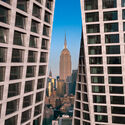
Finnish elevator manufacturer KONE has unveiled a new hoisting technology that will enable elevators to travel heights of one kilometer – twice the distance than currently possible. The new development implies that the Burj Khalifa, whose longest elevator travels a distance of 504 meters, will not remain the world’s tallest building for very long.
Join us for more after the break.
The Timber Tower Research Project: Re-imagining the Skyscraper

SOM has come up with a structural system for skyscrapers that uses mass timber as the main structural material and minimizes the embodied carbon footprint of the building. The firm believes that their proposal is technically feasible from the standpoint of structural engineering, architecture, interior layouts, and building services and would revolutionize the traditional skyscraper as we know it.
Read on to learn more about The Timber Tower Research Project.
VIDEO: Five Great Buildings in Chicago
A short and sweet animation displaying 5 of Chicago’s great buildings – including, the John Hancock Center, by SOM, The Willis Tower (formerly known as the Sears Tower), also by SOM, and Marina City by Bertrand Goldberg. Enjoy!
Video via Sebastian Rodriguez
Strawscraper / Belatchew Arkitektur

Belatchew Arkitekter has presented a concept for transforming high-rise towers into power-generating factories. The Swedish firm’s proposal involves covering a Stockholm skyscraper with “electricity-generating bristles”. The tower in question is Henning Larsen’s Söder Torn tower on Södermalm in Stockholm. Belatchew has designed a wind farm that will top the existing building with a 16-story extension, covering the facade with “hairy-looking plastic straws designed to move with the wind”.
Join us after the break for more details and images of this proposal.
Through the Lens: Why High-Rises Need A Hero

Since the emergence of the modern multi-storey building in the late 19th century, screenwriters and art directors have embraced the high-rise building as both backdrop and prop in the drama of feature films. It’s easy to understand the fascination. The precarious nature of a skyscraper – their height, their reliance on competent engineering and emergency systems, and their all-controlling security – provide abundant opportunities for action and disaster. And all with a built-in view.
But while Hollywood loves a high rise, it hasn’t treated them well. Plot lines usually tap into a general scepticism about the kind of engineering feats which make them possible and often carry some underlying moral message about the dangers of technology and advancement.
Adrian Smith and Gordon Gill Architecture Unveils Proposal for Mumbai’s Tallest Tower

Adrian Smith and Gordon Gill Architecture has unveiled a competition-winning prototype in which they hope will become Mumbai’s tallest skyscraper. Standing 400-meters about the crowded city streets, the 116-story Imperial Tower’s curvilinear form is aerodynamically shaped to “confuse the wind.” Its 132 “spacious and luxurious” residential units are punctuated by north- and south-facing sky gardens, which break up wind currents around the tower and provide unprecedented access to natural light and views of the Arabian sea.
One World Trade Center Will Soon Top Out at 1,776 Feet
After weather conditions refused to cooperate on Monday, the final two sections of Freedom Tower have been lifted to the summit of the One World Trade Center. Construction of the gargantuan 758-ton, 408-foot spire – a joint Canadian-U.S. venture – began in December 2012, when 18 separate pieces were shipped to Manhattan from Canada and New Jersey. This final addition, including a steel beacon, means that the height of the building will soon rise from 1,368 feet to a more patriotic 1,776 feet once the segments are permanently installed within the next few weeks. However, it’s not yet certain that the building will officially be the tallest in the U.S.
Read more after the break…
PowerWINDows: A Proposal for Skyscraper-Compatible Wind Turbines

Could a new revolution in wind-turbines be on its way? A team from Australia’s University of Wollongong (UOW) have collaborated with leading marine engineering firm Birdon Pty Ltd, to develop PowerWINDows – a new type of wind-to-energy converter that could potentially be appearing on skyscrapers near you soon.
Read more about this new idea after the break…
A Brief, Interesting History of the Otis Elevator Company

What do the Eiffel Tower, the Empire State Building, the Kremlin, and the Burj Khalifa have in common?
Elevators from the Otis Elevator Company. The company, which is celebrating its 160th anniversary today, has an interesting history: it was founded in 1853, the year Elisha Otis invented the elevator safety brake. Before Otis’ invention, buildings rarely reached seven stories (elevators were considered just too dangerous to implement).
But it was Otis’ elevator that would allow for the creation, and proliferation of, the skyscraper – an explosion that would for ever alter the 20th and 21st century skylines.
Read more about the Otis Elevators influence on skyscraper design (and how Otis performed a death-defying feat to increase the invention’s popularity), after the break…
Report Suggests Demolishing Unsustainable Mid-Century Skyscrapers in New York

Mayor Bloomberg’s controversial plans to rezone midtown New York, allowing for bigger and bolder skyscrapers, has found an unlikely ally in the form of environmentalists.
Re-zoning midtown would ultimately lead to the demolition of the corporate steel and glass skyscrapers, which preservationists argue are emblematic of the cutting edge modernism that swept 1950′s America. However, landlords contest that – for the most part – they are poorly built copycats of seminal landmarks such as the Seagram and Lever buildings and are not particularly significant or suited for modern needs.
More information after the break..
Melbourne Set to Build Tallest Skyscraper in Southern Hemisphere

Melbourne, Australia is about to reach new heights with Australia 108, a hotel and apartment tower designed by Fender Katsalidis. Last week the government of Victoria gave Australia 108 the green light to be built in the Southbank area. Upon completion, the tower will rise up 108 levels and 388 meters tall, which would make it the tallest building in the Southern Hemisphere.
More about Australia 108’s design after the break…
Construction of China’s Tallest Building On Hold Due to Concrete Scandal

Scheduled to be the tallest tower in China and the second tallest building in the world by 2015, Kohn Pedersen Fox’s 660-meter-high Ping’an International Finance Center has received a major unexpected set back. Following an industrywide inspection conducted last week, Shenzhen government officials have discovered a low-quality sea sand has been used by developers to create substandard concrete for KPF’s supertall skyscraper and at least 15 other buildings under construction.
Although sea sand lures contractors by costing significantly less than standard river sand, it contains a deadly mixture of salt and chloride that corrodes steel in concrete and threatens the structural integrity of a building over time.
According to Bloomberg, Shenzhen’s Housing and Construction Bureau found 31 companies violated industry rules and ordered eight of them to suspend business for one year in the city for using substandard sea sand to make concrete.
Can We Please Stop Drawing Trees on Top of Skyscrapers?

Tim De Chant is the senior digital editor at NOVA and editor of NOVA Next. He also writes at Per Square Mile, the blog where this article originally appeared.
Just a couple of years ago, if you wanted to make something look trendier, you put a bird on it. Birds were everywhere. I’m not sure if Twitter was what started all the flutter, but it got so bad that Portlandia performed a skit named, you guessed it, “Put a Bird on It.” (“What a sad little tote bag. I know! I’ll put a bird on it.” Etc.)
It turns out architects have been doing the same thing, just with trees. Want to make a skyscraper look trendy and sustainable? Put a tree on it. Or better yet, dozens. Many high-concept skyscraper proposals are festooned with trees. On the rooftop, on terraces, in nooks and crannies, on absurdly large balconies. Basically anywhere horizontal and high off the ground. Now, I should be saying architects are drawing dozens, because I have yet to see one of these “green” skyscrapers in real life. (There’s one notable exception—BioMilano, which isn’t quite done yet.) If—and it’s a big if—any of these buildings ever get built, odds are they’ll be stripped of their foliage quicker than a developer can say “return on investment.” It’s just not realistic. I get why architects draw them on their buildings. Really, I do. But can we please stop?
Find out why it’s not a good idea to put trees on skyscrapers, after the break…
Foster + Partners Approved for Mixed-Use Development on London’s Albert Embankment
Foster + Partners have received the green light from the Lambeth Council for three mixed use towers on the 20-21 Albert Embankment in London. Ranging from 15 to 27 stories, the curved steel and glass structures will provide the area with 253 apartments, including affordable homes for senior living, along with offices, restaurants and a residents’ bar, gym, pool and spa.
Grant Brooker, Senior Partner at Foster + Partners: “We are absolutely delighted that 20-21 Albert Embankment has received planning permission – working alongside our clients at St. James and with great support from Lambeth and the GLA, we hope to transform this important and highly visible site into a vibrant riverside community that sets a benchmark for the regeneration of this part of the river.”
More after the break…
Air: A Hot Commodity in New York City

“There’s a price on everything in New York, and the air is no exception.” - Ross F. Moskowitz, Strock & Strock & Lavan
All of us are familiar with the practice of buying and selling property in the form of land, residential and commercial space, but the buying and selling of the air surrounding these spaces is a concept well-understood by few. With the recovery of the condominium market in New York City, residential development is at an all-time high, and this means taller and even more luxurious towers are fighting each other tooth and nail for the best possible views of the city. Because of this, the price of air above and around these potential developments is becoming more and more expensive, since a room with a view is worth a whole lot more than one without. Is it possible that these empty, vertical pockets are now worth more than the ground below them?
Read more about New York City’s air rights to find out.
In Progress: CityLife Milano / Zaha Hadid Architects

CityLife Milano is an ambitious commercial and residential development on Milan’s historic former trade fair grounds: the Fiera Milano. On the surface, over half of CityLife Milano will be covered with upwards of 168,000 square meters of landscaped parkland dedicated to pedestrians and bicycles. This lush, pedestrianized space will be centered around a grand new piazza - named ‘piazza delle tre torri’ - shaped by a trio of towers and surrounded by a cluster of residences, all designed by three world-renowned architects. As previously mentioned, Arata Isozaki and Andrea Maffei has contributed the Isozaki Tower, which is planned to become the tallest skyscraper in Italy at 202 meters and will be built alongside the curved, 150 meter Libeskind Tower by – you guess it – Daniel Libeskind. To complete the triad, Zaha Hadid has designed a twisting, glazed tower, which will rise 170 meters into the skyline.
More on the Hadid Tower and surrounding development after the break…
Two Short Films Capture the Essence of Steven Holl Architects’ Sliced Porosity Block
Steven Holl Architects collaborated with Spirit of Space to create two short films that capture the essence of Chengdu’s newest sustainable micro-city: Sliced Porosity Block. Shaped by the distribution of natural light, this multi-use complex of five sun-carved concrete towers defines itself by the formation of three large public valleys that, not only supports a hybrid of different functions, but anchors the building into the surrounding urban fabric.
View an intimate account of these poetic spaces in the film above and then discover the ideas that inspired them in a conversation with Steven Holl below. The interview also includes an exclusive take on Holl’s post-completion thoughts of Lebbeus Woods’ last built installation: the Light Pavilion.
More information and images of Sliced Porosity Block can be found here on ArchDaily.
Four Renowned Practices Battle it Out to Design Sydney’s Next “Masterpiece”

Four of architecture’s finest has been shortlisted to design what Australian businessman James Packer hopes to be the most iconic building in Sydney since the Opera House. Italian Pritzker Prize-laureate Renzo Piano will compete against Chicago-based Adrian Smith + Gordon Gill Architecture, New York-based Kohn Pedersen Fox Associates and London-based Wilkinson Eyre Architects to design a $1 billion, six-star Crown Sydney resort on a 6000 square meter site in the inner-city waterfront precinct of Barangaroo.
“Sydney deserves one of the world’s best hotels and with these amazing architects I’m confident we will see the most iconic building constructed here since the Opera House,” Packer told The Daily Telegraph. “I want this hotel resort to be instantly recognizable around the world and feature on postcards and memorabilia promoting Sydney. That’s how you attract international tourists, create jobs and put Sydney on the map.”
More after the break…
City Design Panel Endorses BIG’s Mixed-Use Vancouver Tower

A BIG step forward for Vancouver’s latest mixed-use tower making international headlines, as the 497-foot tall Beach and Howe proposal has received an “enthusiastic endorsement” from the city’s design panel.
Commissioned by Canada’s real estate mogul Ian Gillespie of Westbank, the Bjarke Ingles Group-designed tower promises to add a foreign twist to Vancouver’s skyline and create a new identity for an undefined section of town at the fringe of the city’s residential area. The 700,000 square foot complex – which contains shopping, social housing and market rental apartments – was praised by the panel for anchoring itself on a nine-story podium that occupies the disused, interstitial spaces found between the Granville Street Bridge’s entry and exit ramps.
More after the break…
In Progress: Infinity Tower / SOM

Architects: Skidmore, Owings & Merrill
Civil, Electrical, Mechanical, Structural And Plumbing Engineering: SOM
Site Area: 3,026.50 m2
Project Area: 111,484 m2
Building Height: 307m (73 stories)
Year: 2013
Photographs: Courtesy of SOM
BIG’s West 57th “Pyramid” Wins Final Approval

After an “arduous” public review and a heated debate over affordable housing, New York’s City Council has unanimously awarded final approval to BIG’s tetrahedral-shaped West 57th apartment building in Manhattan. As reported by Crain’s New York Business, a compromise has been made to include 173 affordable housing units within the 32-story, 750-unit residential building and the neighboring industrial building that will be converted into 100 additional rental apartments. As you may recall, the community board and Councilwoman Gail Brewer initially threatened to “torpedo the project” if the apartments were only made affordable for a 35 year period. However, Durst apparently won them over by contributing one million dollars into an affordable housing fund.
“The good news, which is the mantra of my office and community board No. 4, is there will be, yes, by law, 35 years of income-restricted affordable housing,” stated City Councilwoman Brewer, who represents the area.