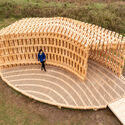
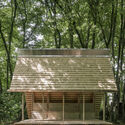
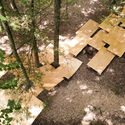
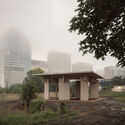
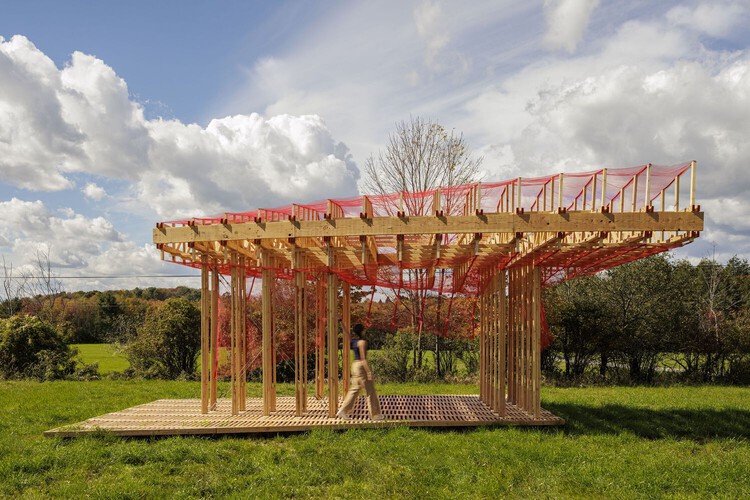
Bethel Woods Art & Architecture Festival (BuildFest) 2026 Poster, art by Neal Lucas Hitch
The Bethel Woods Art & Architecture Festival (BuildFest) 2026, titled "Acts of Construction – Act One: Staging" invites proposals for timber pavilions and multimedia activations to be installed on the historic grounds of the 1969 Woodstock festival.
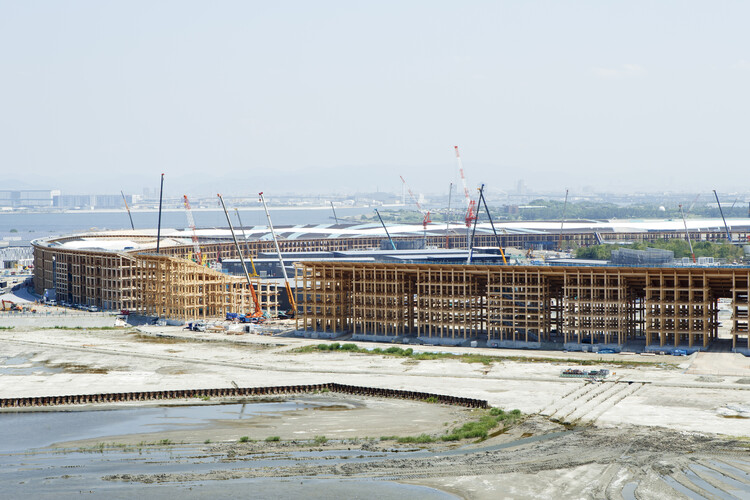
Exhibitions can be an opportunity to extend architectural discourse beyond professional circles, opening conversations with broader publics and serving as an interface between architecture and society. Within this concept, major international events such as the Osaka International Expo 2025 and the Venice Architecture Biennale have adopted the idea of the circular economy as one of their organizational objectives. The idea of circularity in events can be reflected in, for example, their energy consumption, the impact of the displacement they generate, their waste, or the useful life of their infrastructure. The site destined for the last World Expo, held in Osaka from 13 April to 13 October 2025, was surrounded by a massive timber structure designed by Sou Fujimoto Architects, one of the world's largest wooden constructions. The Japan Association for the 2025 World Exposition committed to reusing building materials "as much as possible," with concrete plans for their reuse to be finalized by March. In the meantime, some relocation alternatives are already emerging for the pieces of the World Expo structure.
Second Prize Winner + Buildner Student Award: Silent Equilibrium
Buildner is pleased to announce the results of its Architect's Chair Competition Edition 4, an annual international competition that invites architects and designers worldwide to submit designs for a signature chair. Following in the footsteps of iconic figures like Charles and Ray Eames, Ludwig Mies van der Rohe, Marcel Breuer, and Arne Jacobsen, participants are tasked with creating custom chairs that reflect their unique design philosophies and visions.
The recently inaugurated exhibition matière en résonance ("resonant matter") brings together a wide range of models and a curated selection of photographs to present sauerbruch hutton's ongoing exploration of timber. The exhibition starts from the premise that while the age of concrete defined the twentieth century, the early twenty-first century has seen a worldwide resurgence of timber, a much older building material. Timber is presented as offering "a different version of modernity" and as the subject of renewed interest that reawakens long-standing collective imaginaries. Over more than two decades, the Berlin-based architecture practice has explored the possibilities of timber construction, from façade elements to load-bearing structures and modular systems. The exhibition reflects the results of this sustained investigation, reinforcing both technical innovation and the embodied qualities of timber across a diverse range of European contexts. The exhibition will be on view from 3 to 28 February 2026 at the Galerie d'Architecture de Paris.
Shou Sugi Ban is a traditional Japanese technique for wood preservation that involves charring the surface of timber to create a protective layer. While its origins are rooted in practical durability, the method has been widely adapted into the modern built environment and shapes a unique and distinctive aesthetic. It is a material of contradiction: it remains bold in its visual language due to its dark tones, yet it simultaneously borrows from and complements its natural surroundings, allowing houses to settle quietly into their sites.
The charred finish among the 22 residences featured here across Canada and the United States serves as a common thread for navigating extreme climates. From humid lakefronts to dense forests, the carbonized skin acts as a resilient shield against diverse conditions. Beyond mere protection, these houses demonstrate how the material's texture changes with exposure to light, transforming from a flat matte in the shade to a silver-flecked, shimmering surface in direct sun. These projects also showcase the technique's ability to define architectural volumes, using the dark cladding to create sharp, monolithic silhouettes or to highlight the voids in a building's mass, such as recessed entryways and sheltered terraces.
The most comprehensive reference on building with mass timber, extensively covering its sustainability, materials, building conceptualization, structural design and construction processes
"Feeling at home" is more than just an expression—it is the sense of warmth and comfort that transforms a space into a true refuge. To achieve this, elements like color, texture, lighting, and materials play a crucial role in shaping an environment that fosters relaxation and well-being. Backed by research in environmental psychology and neuroscience, the connection between physical spaces and human behavior highlights how architecture can directly influence the atmosphere, turning chaos into tranquility.
Building Frame of the House. Image Courtesy of IGArchitects
Founded in 2020 by Masato Igarashi, IGArchitects is an architectural practice based in Tokyo and Saitama, Japan. The studio, one of the winners of the ArchDaily 2025 Next Practices Awards, explores enduring architecture through a careful yet assertive treatment of structure, scale, and materiality. Prior to establishing his own practice, Igarashi worked at the large-scale firm Shimizu Sekkei as well as the Suppose Design Office, gaining experience across projects ranging from major developments to smaller, concept-driven works. This breadth of experience continues to inform IGArchitects' current focus on residential and commercial architecture across Japan.
In much of China, concrete remains the dominant construction material. Despite growing concerns over its environmental impact, concrete continues to align with the priorities of many developers and clients—it is fast, cost-effective, and highly durable. As a result, most building types in China still rely heavily on concrete. This reliance is further reinforced by China's position as the world's largest producer of Portland cement. A deeply entrenched supply chain, rooted in raw material manufacturing and economic infrastructure, ensures that concrete remains the default choice in the construction industry.
Yet historically, Chinese architecture was built upon a rich tradition of timber construction. The Forbidden City is a prime example: not only is it emblematic of China's architectural heritage, but it also remains one of the largest and best-preserved collections of ancient wooden structures in the world. This legacy prompts an important question: does timber construction have a meaningful future in China's contemporary building industry?
As 2025 approaches its end, we look back at an eventful year in the world of interior design. Last year, designers favored reserved, modest approaches, a trend that continued from previous years. The emergence of artificial intelligence generated intense discussions on digital equity and misinformation, which continued into 2025, especially with the topic of the Venice Architecture Biennale, Intelligens. This opened the conversation to the opportunities of digital technologies, attempting a more hopeful outlook. On the other hand, completed interior design projects over the year focused more on the tangible and the pragmatic, with expressed raw materials and an appreciation of history.
While adaptive reuse has been increasingly acknowledged as a vital architectural strategy worldwide, its discourse and implementation in Asia are still expanding—driven by growing ecological awareness and a shifting understanding of architectural knowledge. Rather than accelerating a developmentalist model centered on demolition and new construction, architects today are confronted with a different approach to the built environment: treating the existing structure as a resource—an archive of materials, spatial organizations, and informal histories.
Adaptive reuse is often associated with the preservation of historic buildings and culturally significant heritage. Yet the vast field of seemingly 'less-valued' structures—abandoned houses, standard yet old dwellings, non-conforming office buildings, and overlooked urban voids—has become ground for experimentation. These sites challenge architects and designers to reconsider prevailing standards of efficiency and market-driven development, and to imagine spatial and ecological practices that avoid the continual loss of embodied material and cultural knowledge inherent in constant rebuilding.
Few commissions allow architects to focus on non-human users, and fewer still involve horses. While domestic pets like cats and dogs are common muses, the particular needs of horses present a unique challenge when designing stables. Since the horses, who are the stable's primary inhabitants, cannot articulate their needs, design relies on the rigorous requirements dictated by human caretakers, requiring a balance between streamlined human operations and maximized horse comfort and safety. Architects often seem to address this through three core principles: Equine Comfort & Well-being, Contextual Materiality, and Operational Efficiency. Thus, the resulting layouts are characterized by rigorous zoning that clearly separates the programs into residential (stalls), service (tack, storage, wash, feed), and training spaces (arenas, walkers). The designs also address visual well-being: Horses are social animals, so they strategically position stables to promote sightlines between animals and to the exterior, often employing louvered or open-frame systems. Furthermore, lighting is kept diffuse using materials such as translucent panels to prevent sharp, stress-inducing shadows in arenas. Similarly, circulation paths are designed for the safe, efficient movement of both people and animals.
Interior design has been characterized by infinite alternatives in coatings, finishes, and furniture to achieve unique and unrepeatable spaces. Designers are constantly coming up with innovative solutions and materials specifically created for a distinctive spatial perception. However, there is also a trend that seeks the warmth of the interior spaces by exposing the raw building materials as they are. The richness of materials such as wood and concrete gives that feeling of durability and low maintenance that, combined with an attention-to-detail design, makes spaces look warm yet stay true in essence. See below for 35 examples of interior spaces where concrete and wood appear in their almost purest state.
What is architecture? For some, its traditional role is to bring together imagination, technical knowledge, and problem-solving, allowing architects to design and construct while balancing ideas with the means to realize them. From the stone and wood of early buildings to the steel and concrete of the 20th century, each era demanded not only an understanding of form but also of the properties and potential of the materials in use. This grasp of materials has always been a core part of the creative process, though its scope was limited by the know-how and technologies available.
Over time, that balance has begun to shift. Architects have moved from merely using materials to actively designing them, applying scientific principles and experimenting with biological, chemical, and computational processes. This evolution has expanded the possibilities of architecture, intersecting nature, technology, and art, while pushing the role of the architect into a more experimental, science-driven dimension, where the manipulation and creation of materials becomes central to the creative act rather than merely a means to achieve forms or structures.
Foster + Partners Gstaad House project in Switzerland. Render. Image Courtesy of Foster + Partners
Foster + Partners has received planning permission for a new timber residential building in Gstaad, Switzerland. Designed as a house in the Alpine resort town, the project combines residential use with exhibition, storage, and social spaces. According to the architects, it will be the first purpose-built facility in Gstaad to accommodate the specialised requirements of fine art, cars, fashion, and antique collections.
Innovation is at the core of architecture, expressed through new approaches to design, material experimentation, and, of course, ways of living. As a result, the conception of buildings and indoor spaces is constantly evolving. This evolution is especially evident in regions with a rich cultural heritage, such as Spain, where innovation reinterprets traditional ways of relating to space. This attentiveness to memory and daily life extends into interiors, where each intervention has the potential to actively reshape how people experience a space and open new possibilities for living and interaction.
Example of the Nested Floor System capacities. Courtesy of Offsite Wood and Quebec Wood Export Bureau
The latest release of Offsitewood.org marks a significant step forward in making offsite wood construction more approachable for architects. Version 2.0 introduces a set of digital resources aimed at helping designers model, plan, and collaborate more efficiently.
Free downloadable libraries are a central and expanding feature of the site. Additionally, new applications and services are now available that include wood material e-sample viewers, an advanced panelization and framing toolbar for Revit, and a collaborative workspace for project optimization.
Spain combines cultural diversity and a long constructive tradition that is directly reflected in its architecture. The country is home to influential schools, a consistent body of theoretical production, an active generation of architects, and a well-established construction industry with strong capabilities in innovation, standardization, and export. Contemporary Spanish architecture is marked by a plurality of approaches and by the articulation between material tradition, technology, and performance.
In this context, materials play a central role in the conception, expression, and functionality of buildings. Steel, glass, brick, stone, and wood remain essential inputs in architectural practice, but their role goes far beyond raw matter. Once industrially processed, these materials unfold into a wide range of products and systems such as technical panels, ventilated façades, structural components, extruded cladding, and brise-soleil systems.