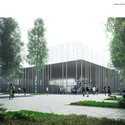
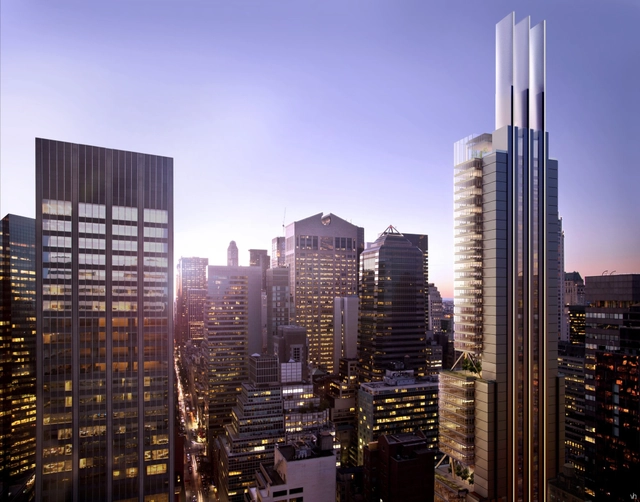
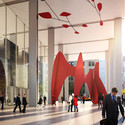
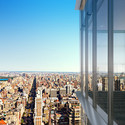
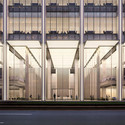
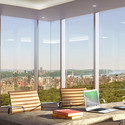
Foster + Partners has released new images of 425 Park Avenue in New York, the project which turned heads in 2012 when videos of the four competing architects presenting their proposals were released to Youtube. The new images show a slightly altered design for the glazed entrance, where a mezzanine on either side replaces what was originally a double height space in the entire lobby. The new images also give a glimpse into the building's interiors, where curtain glass walls make the most of spectacular views across Manhattan and Central Park. Read on after the break for all the images.
A mere twenty-five years after its inauguration, the Glass Music Hall at the former Exchange of Berlage in Amsterdam is looking for a new home, where it will be relocated and reassembled for free. The innovative space, originally designed for the Dutch Chamber Music Orchestra, has garnered international attention and multiple awards, but sadly no longer meets the needs of the facility.
Designed by architect Pieter Zaanen and structural designer Mick Eekhout, the Glass Music Hall sits in the center of an existing space, defying stereotypes about what glass can do. Being a hard material, the reverberation time in a blunt glass hall would be approximately 5 seconds. However, this number was brought down to 1 or 2 seconds in this instance, proving glass can be used to create a fantastical acoustical environment.
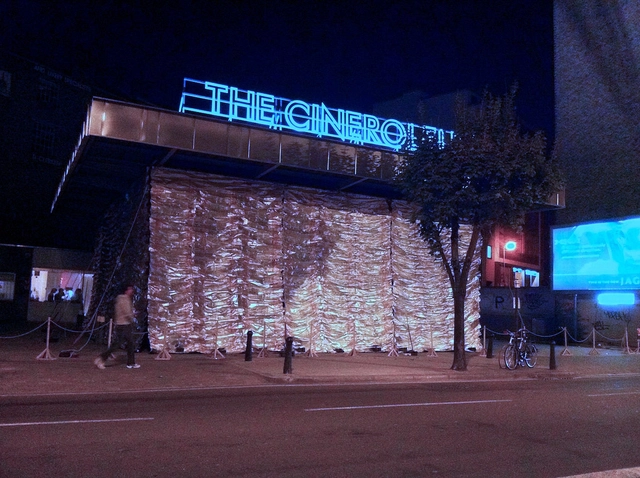
In his interesting profile of the young London-based practice Assemble, Rowan Moore of the Observer investigates the work of arguably the best collective of designers to emerge from 2010's "Autumn of Pop-Ups" - examining how they have stayed true to the more noble aspects of pop-up architecture despite the concept's increasing commercialization. From their first project, a temporary cinema in a petrol station, to their recent Yardhouse project in Stratford, Moore finds an architecture that values exuberance and fun, yet is mature and refined. You can read his article in full here.
Videos
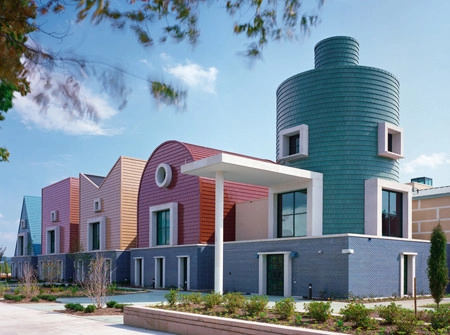
AD Classics: St. Coletta School / Michael Graves. Image Courtesy of Michael Graves
Today is the 80th birthday of renowned architect Michael Graves. Famous for his bold, symbolic references to classical architecture and his use of geometry, Graves is also known as one of the New York Five. His work bridged the abstraction of Modernism and the Postmodernism of the current era.
Graves started his own practice in 1964 in Princeton, New Jersey, and has taught at Princeton’s school of architecture for more than 40 years. A prolific architect, Graves has also met with considerable success as an industrial designer, producing products for companies such as Target and Black & Decker. He is highly decorated, having won such prestigious honors as the Nation Medal of the Arts (1999), the AIA Gold Medal (2001), and the Driehaus Prize for Classical Architecture (2012). On the anniversary of his birth, we invite you to look over our collection of some of his best work and check out our video interview with him, after the break.
Videos
Arrette Scale: perspective. Image Courtesy of Arrette Scale
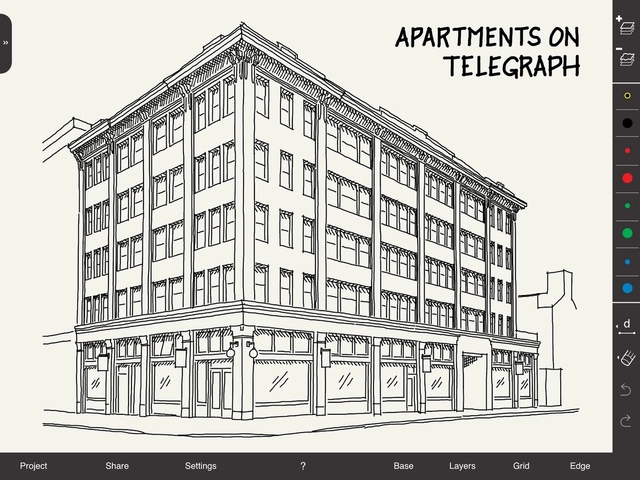
Building upon our Top 10 Apps for Architects, this collection brings together some of the best quality and most valued technical apps for designing, sketching, calculating and collaborating. Although the majority of those featured here are designed solely for the iOS platform, every time we collate lists such as these it's clear that more and more high quality apps for the Android and Windows platforms are being developed. From condensed versions of large scale software packages that architects and designers use every day, to blank canvases to scratch ideas down onto, you might just find an app that could improve the way you work.
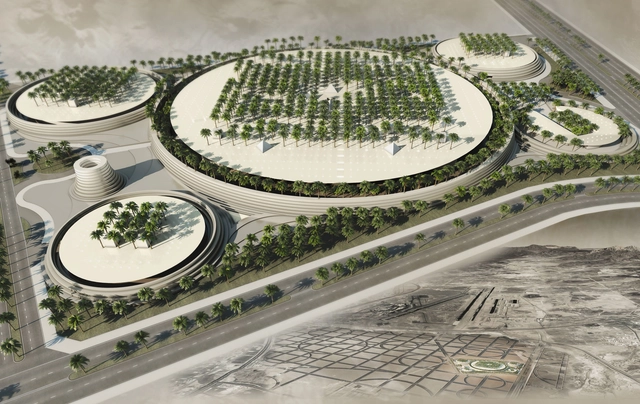
Ricardo Bofill's proposal for the center, which is meant to foster the research, study and transmission of the Qur'an, takes geometric inspiration from traditional Islamic cities:
"The first Islamic city had a circular plan, with all spaces being enclosed in the circle representing the elemental symbol of unity and the ultimate source of diversity in creation. This traditional city, or rather the idea of this city, serves as the base and the essence for the creation of the Islamic modern city. Such a background has led us to choose a circular concept as the main representational shape of the project for The Noble Qur'an Oasis. This unique civic and cultural landmark, with its sleek, minimalist design, is a symbolic container where the Islamic science and culture will be displayed."
Read the architect's description of their design, after the break.
“We were sensitive to the way in which society was becoming more consumption-oriented and gave serious thought to how we ought to respond to that change without simply accommodating ourselves to it.” -Toyo Ito “I was entering a dead world, which would never see the light of the day. I wanted to treat that dead world as if it were alive, or to put it another way, to try to create a different reality.” - Terunobu Fujimori
Under the title of Fundamentals, Koolhaas’ Biennale asked national pavilions to focus on their respective countries’ relationships with modernity, the movement that has, for better or worse, shaped the contemporary city. In the case of Japan, modernity was expressed in a unique way, as architecture was instrumental to the rapid industrialization and growth that the country experienced after World War II. This growth resulted in the first architectural avant-garde outside of the Western world. By the 70s, as this movement reached its peak, local architects, historians, artists and urbanists began to look at modernism in a critical way, questioning its impact.
In “The Real World,” the Japan exhibit at the Biennale, curator Norihito Nakatani unearths how this critical movement expressed itself through Osamu Ishiyama, Toyo Ito, Terunobu Fujimori, and other Japanese masters whose works strove to connect to the human of “the real world” rather than contribute to the failed utopias of modernism. Interviews with this group of architects bring to light the desire that they had to positively impact society, and how they attempted to materialize that desire in their early works. The objects found inside the pavilion articulate the storytelling behind the process, leaving their interpretation open to visitors.
“You’ve got to try to make an impact on the times you live in, and you’ve got to do it through your work, not through words.” - Osamu Ushiyama “Actual objects continue to possess tremendous energy - much more so than photographs or models.” - Tsutomu Ichiki
More about the "In the Real World" after the break:
Dutch practice Bekkering Adams Architecten, in cooperation with ABT and BeersNielsen, recently unveiled an installation at the Palazzo Mora, Venice as part of a collateral event with this year's Venice Biennale. Entitled Form-ContraForm, the sculptural piece reflects on the conceptual and human perception of space - something which they describe as "a space that surrounds and envelops." Distilling architecture's fundamentals (which is also the theme of this year's Biennale) down to the definition of co-ordinates in space, the experience created by Bekkering Adams is akin to the notion of "the mass versus the cavity."
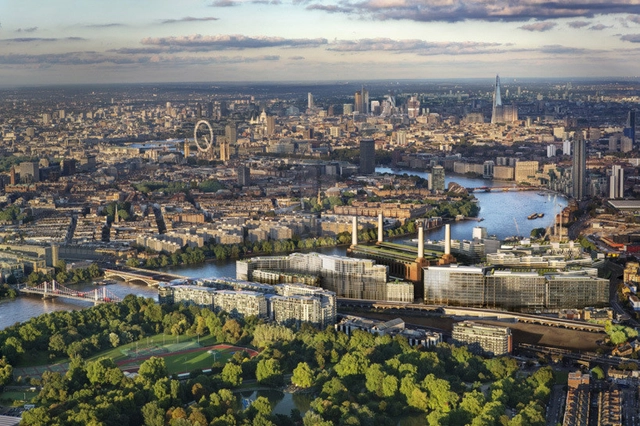
The area of Nine Elms in London. Image Courtesy of Battersea Power Station Development Company
Wandsworth Council has announced that it plans to hold an international design competition for a new pedestrian and cylist bridge across the Thames, connecting Nine Elms on the South of the river to Pimlico on the North. The announcement comes in response to a feasibility study by Transport for London which concluded that a bridge at this location could handle around 9,000 walkers and 9,000 cyclists a day at a construction cost of £40 million.
"We consider Bakema not so much an architect of buildings, but an architect of a new idea of what Holland could be--a new national identity, a new national landscape…with an architect in the center of this particular ambition." - Guus Beumer, co-curator of the Dutch Pavilion at the 14th Venice Biennale
Guus Beumer and Drik van den Heuvel, curators of "Open: A Bakema Celebration," sat down to speak with us about this year's Dutch Pavilion at the Venice Biennale. With the help of graphic designers Experimental Jetset, Beumer and van den Heuvel created an emblematic, stripped-down, research-focused display of a particularly Dutch idea: the "Open Society." This was all conveyed within and around a 1:1 model of architect Jaap Bakema's Lijnbaan Shopping Centre (Rotterdam 1954), constructed within the Netherlands Pavilion.
The hope, as Dirk van den Heuvel explains, is that "the elements of Bakema...may be useful, inspiring for our own practices today. Elements that he developed in questions to housing, planning, modernizing… I think when you come here you will recognize that there's lots of affinities, interesting things that we still work with and that we will work with in the future."
After you watch the video, make sure to read the curator's statement, and see images of the pavilion, after the break.
Civic, Culture + Transport Category: Cine Times/ One Plus Partnership Limited. Image Courtesy of Jordan Lewis/INSIDE Festival
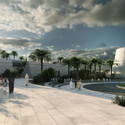
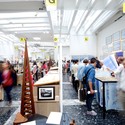
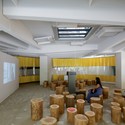
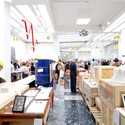
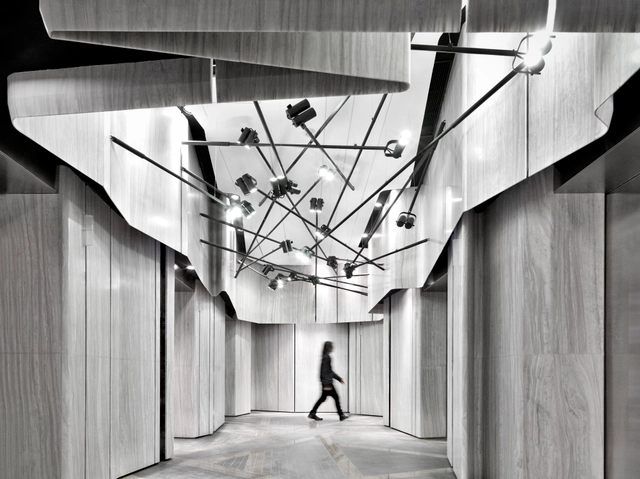
The INSIDE World Festival of Interiors has announced the nominations for their Interior of the Year award for 2014. This award is an international honor that covers nine categories. This year’s 60 nominations span the architectural spectrum, from schools to airports, and include well-known firms, such as MAKE Architects and a21 Studio.
The nominees will compete against each other from October 1st to the 3rd at the World Architecture Festival in Singapore (see this year's architecture shortlist here). More on the interior nominees, after the break.
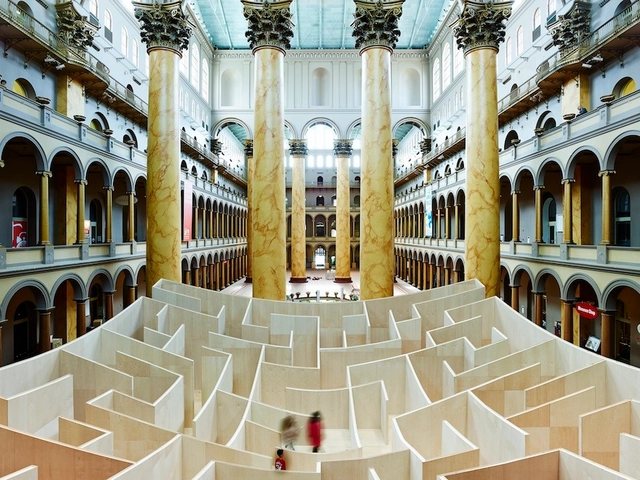
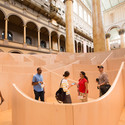
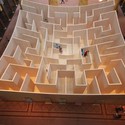
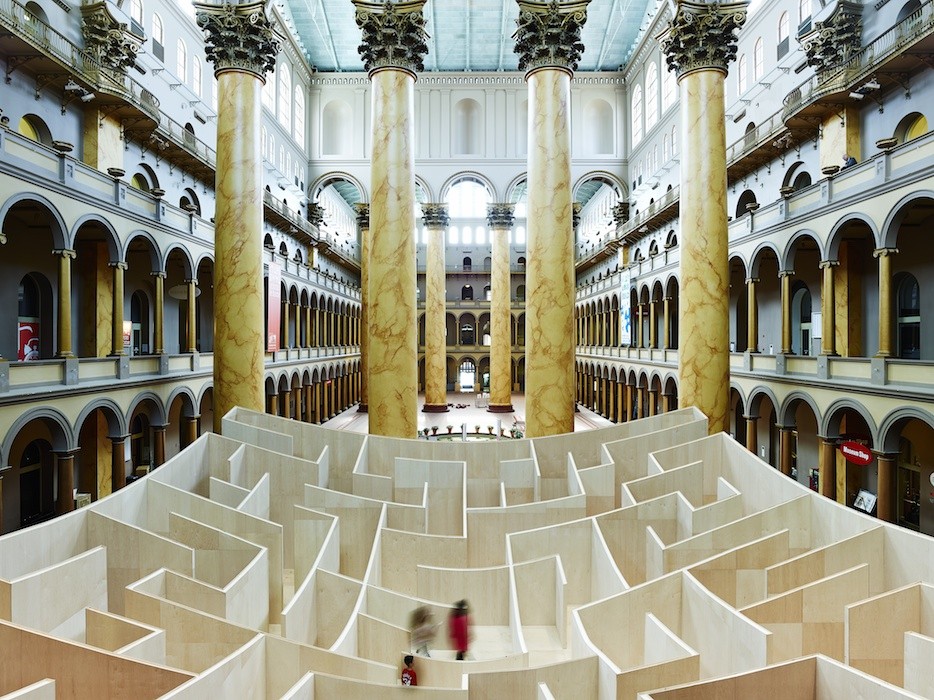
Images and video of the BIG Labyrinth have begun to appear on social media since it opened on July 4th at the National Building Museum (NBM) in Washington, DC.
The 61×61 foot maze, housed in the building’s grand atrium, will be open to visitors until September 1st. See more images and video, after the break...
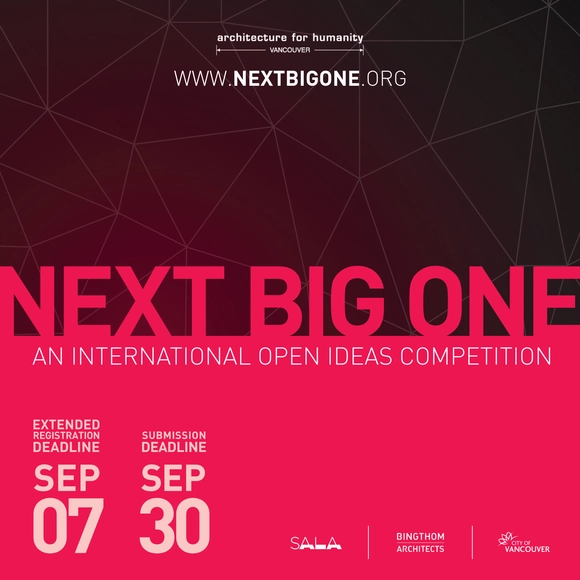
“NEXT BIG ONE” – an international open ideas competition organized by Architecture for Humanity Vancouver Chapter – raises awareness on the high-magnitude earthquake and tsunami events that plague cities around the world. The competition hopes to call upon the design community to offer fresh perspectives and innovative ideas in designing for disasters.
Winner of the competition, Dacha in a Dvor by Megabudka. Image Courtesy of The Morton Group
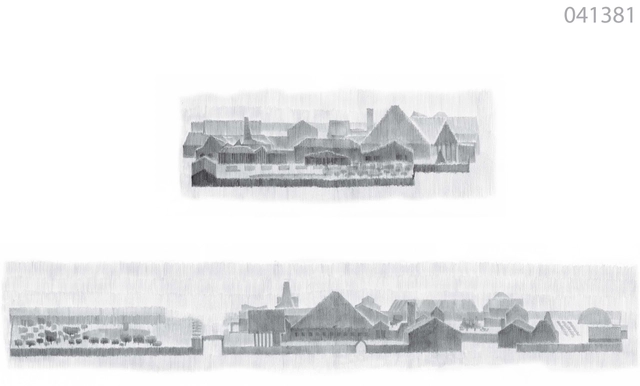
Design studio Megabudka has won the Russian Character competition, an open contest to design a culture and education centre for the Moscow suburb of Butovo Park. Their concept, entitled "Dacha in a Dvor" plays on the typically Russian idea of the Dacha, a seasonal home located outside the city that has been a part of Russian culture since the reign of Peter the Great.
The design by Megabudka consists of a cluster of buildings arranged around a "Dvor", or central courtyard containing apple trees and recreational spaces. As a whole, the design aims to bring the joys of seasonal rural life to the outskirts of Moscow, with a single flexible space shared by the whole community.
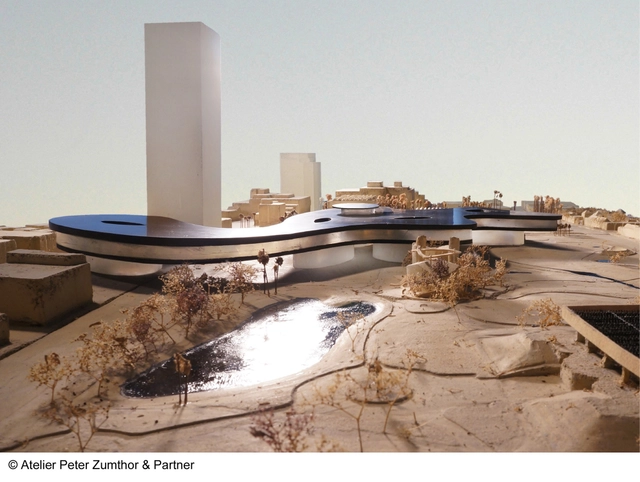
Peter Zumthor and the Los Angeles County Museum of Art (LACMA) have revealed a revised design for the museum's $650 million new home on Museum Row in Los Angeles. The new design still features the sinuous glass and grey concrete slab raised a full story off the ground, but under the new proposal part of the museum would bridge Wilshire Boulevard to touch down on what is currently a car park opposite.
The change comes in response to criticisms that the previous design would put the neighboring La Brea Tar Pits at risk, threatening their status as an active paleontological research site and a popular tourist destination. The shape of the new design removes this risk by withdrawing from the boundary with the adjacent tar pits, without compromising on floor space in the museum.
Arguing that the previous thirteen Biennales have, "more or less, tried to predict what is going to happen over the next five years," "Rem Koolhaas has changed the paradigm:" Rem's Biennale is about "the past of the present". Jencks, who describes Koolhaas as "the Corbusier of our time", suggests that his Biennale is about analysis rather than total synthesis. He has, however, "shown that research can be creative."
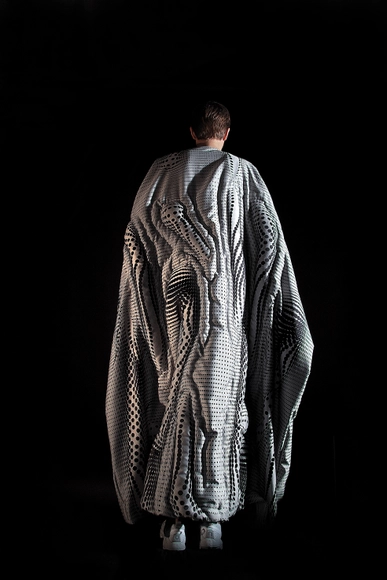
The Austrian firm Coop Himmelb(l)au has designed a wacky quilted coat that blocks electronic surveillance. With pockets to protect your collection of phones and tablets, the Jammer Coat was commissioned for the Workwear exhibition at the Triennale in Milan.
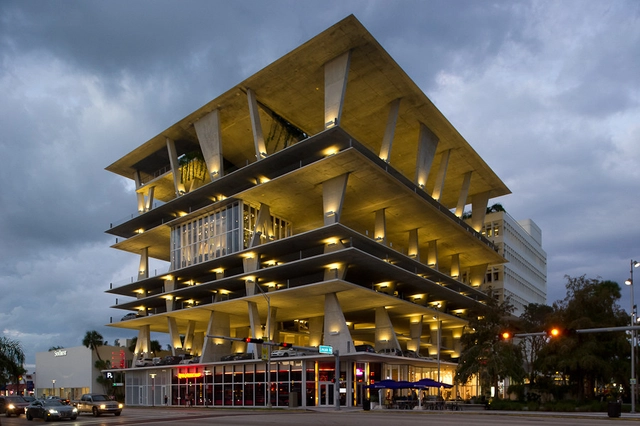
Herzog & de Meuron’s 1111 Lincoln Road, Miami Beach, Florida, USA (2005-2008, realisation 2008-2010). Image Courtesy of Xavier de Jauréguiberry
The following is an essay that originally appeared in Australian Design Review as "Beyond the Wall, the Floor." In it, Michael Holt and Marissa Looby describe the evolution of Herzog and de Meuron's work. Using numerous examples of recent projects (such as VitraHaus and 56 Leonard Street), they point out that Herzog and de Meuron have, increasingly, relied on the floor slabs of their buildings to suggest the building’s shape. By removing the façade’s prominence in favor of a more suggestive way of creating mass, they have turned their original design signature on its head.
Simple adjustments, slight alterations, subtle illusions. These are not tagline descriptions of the 1111 Lincoln Road, Miami Beach project, or a synopsis for a body of work. Instead they operate as retroactively projecting the course of professional development in the works of Swiss architects Herzog & de Meuron. The practice is known, from its earliest built projects, as a firm who produced artistically driven facade treatments where the vertical plane — the ‘nominal façade’ — would define form through the visually stimulating surface or skin. As the practice has evolved, it is argued here, they have crafted a new strategy: the horizontal plane as vertical facade generator.
In its progression the practice has deviated from facade ornamentation and fabrication towards the removal of the facade altogether; allowing for the floor plate — as a visual element — to operate as inadvertent facade and thus doubling its structural and visual importance. The placing of floor plates becomes the force creating the form – the ‘inverted structural skin’. The stripped back architectural form does not remove the facade, but removes the idea of a facade, paradoxically creating a building mass almost by default.
https://www.archdaily.com/523080/from-facades-to-floor-plates-and-form-the-evolution-of-herzog-and-de-meuronMichael Holt and Marissa Looby
Great Arthur House, 2014. Plexiglas, paper, cork, corrugated polystyrene, balsa wood, birch and walnut veneers, bronze colored card and acrylic paint on board. Image Courtesy of McKee Gallery
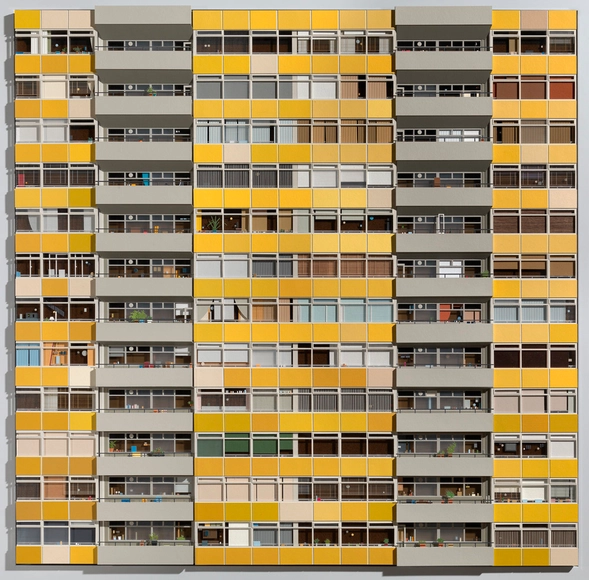
Neither photographs nor renders, all of the images in this post are actually the intricately handcrafted creations of British artist Lucy Williams, a skilled paper-cutter with an incredible amount of patience. Luckily for us architecture fiends, the stars of Williams’ mixed-media works are her 20th century modernist designs. Check out more of her amazing work after the break.
What can you do with a business district that has an office vacancy rate of 40%, is completely separated from its surroundings and is facing increasing competition from business centers emerging throughout the city? These are questions that are increasingly being asked about Moscow's International Business District, the symbol of capitalism that was planned in 1992 after the fall of the Soviet Union, yet is still under construction today.
Eduardo Cassina and Liva Dudareva, founders of METASITU and researchers at the Strelka Institute, have proposed a provocative idea in response to this dilemma: envisaging the business district's future in 2041, they imagine a scenario where the district is linked by underground metro to Sheremetyevo And Domodedovo airports in the North and South - forming the world's first mega-airport, and the first one where it is possible to live in the terminal building without ever leaving.
Read on after the break for more explanation of idea
Videos
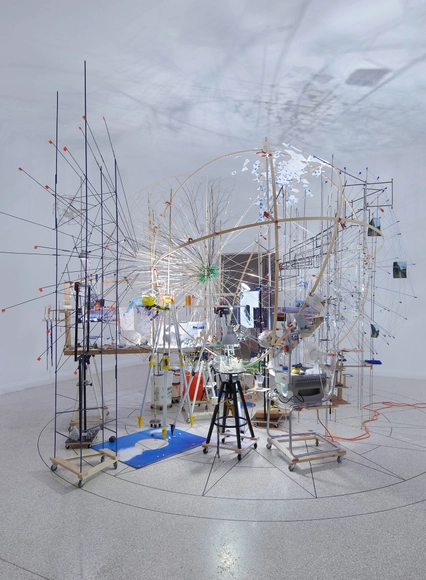
Wood, steel, plastic, stone, string, fans, overhead projectors, photograph of rock printed on Tyvek, mixed media at Triple Point (Planetarium), 2013. Image courtesy of Sarah Sze, Tanya Bonakdar Gallery, New York, and Victoria Miro Gallery, London. Photograph by Tom Powel Imaging
Is that rock inside or outside? Wait, is it even a rock? If not, then what is it? As bizarre as these questions may seem, they are the exact ones Sarah Sze wanted people to ask themselves when visiting her Triple Point (Planetarium) exhibit in the United States Pavilion at the 2013 Venice Biennale. Sze, whose work tends to distort the viewer's perception of reality, "transformed the U.S. Pavilion into a chain of immersive experiences through a series of interrelated installations."
Although the project was specifically designed to engage the Neoclassical Pavilion, part of it will be on display at the Bronx Museum of the Arts from July 3rd through August 24th of this year. For more on the artist and the exhibit, keep reading after the break.
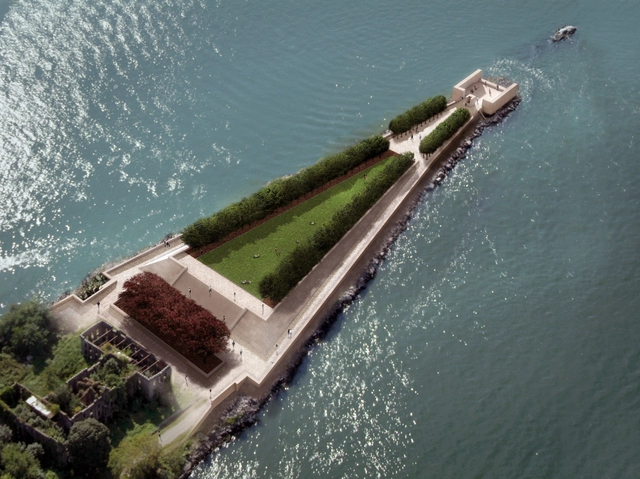
Aerial Rendering Prior to Completion. Image Courtesy of Franklin D. Roosevelt Four Freedoms Park, LLC
Built four decades after Louis Kahn's death, New York City'sFour Freedoms Park - the architect's posthumous memorial to Franklin D. Roosevelt and his policies - is becoming one of the architect's most popular urban spaces. In a recent article for the Guardian, Oliver Wainwright investigates what he describes as perhaps Kahn's "best project". Wainwright's spatial description of the monument is interweaved by fragments of Kahn's personal history, building up a picture of a space with "the feel of an ancient temple precinct" and "a finely nuanced landscape". Although Gina Pollara, who ultimately realised the plans in 2005, argues that Four Freedoms Park "stands as a memorial not only to FDR and the New Deal, but to Kahn himself", can a posthumous project ever be considered as an architect's best? Read the article in full here.
The Australian Institute of Architects has announced the winners of its 2014 South Australia Awards. This year, the star of the show was the South Australian Health and Medical Research Institute (SAHMRI) by Woods Bagot, which won a total of five awards: COLORBOND® Award for Steel Architecture, the Keith Neighbour Award for Commercial Architecture, the Robert Dickson Award for Interior Architecture, Jack McConnell Award for Public Architecture, and the Derrick Kendrick Award for Sustainable Architecture.
The jury commended Woods Bagot's project, saying that it "operates as a catalyst on multiple levels – a catalyst for the urban regeneration of the precinct; a catalyst and new exemplar for the city; and a catalyst for the state, evidencing step change in attitudes to both design and research."










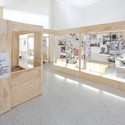
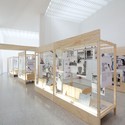
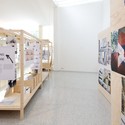
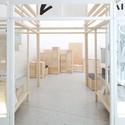


.jpg?1404772115 "Creative Re-use Category: Architects office at Kim Yam Road/ Park and Associates PTE LTD. Image Courtesy of Jordan Lewis/INSIDE Festival")