-
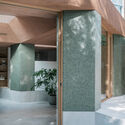
Architects: Common Ground Workshop
- Area: 175 m²
- Year: 2024




Representing 32% of the global population, Generation Z (those born between 1995 – 2010) accounts for a healthy chunk of the workforce (27% by 2025 and rising every year). These are the fresh young minds employers are fighting to attract. With prospective employers’ impact on society (93%) and a healthy work/life balance (77%) the two biggest motivators in deciding where Gen Z’ers want to work, a large part of any new office building’s design brief is green space.
While hybrid working and flexible hours represent the most obvious ways to improve work/life balance for many, because of the missed social interactions and the lack of space or functionality at unproductive home workspaces, the majority of 16-24-year-olds are the only age group who prefer to work from the office.


Allford Hall Monaghan Morris (AHMM)’s architectural studio has revealed the plans to convert a 1950s London office building into a co-living residential scheme. Initiated by developer HUB and Bridges Fund Management, “Cornerstone” is nestled on the fringes of the iconic Barbican estate, hoping to seamlessly transform the original office building to integrate 174 co-living residences.

On February 21st, 2024, American Hotelier MCR Hotels acquired the renowned BT Tower in London. The tower, a Grade II listed marvel, is nestled within London’s Fitzrovia, standing as a testament to the city’s heritage. Initially used as the British Telecommunications Tower and was known as the Post Office Tower, the BT Tower will be repurposed by Heatherwick Studio, with plans underway to breathe new life into this iconic structure.


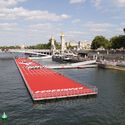
In 1988, Jacques Chirac made a never-fulfilled promise to make swimming accessible in the Seine River within 5 years. With swimming in the Seine officially banned by the French government in 1923, the river has been neglected for decades, flooded with high levels of bacteria and pollution resulting from industrialization and urbanization. With the XXXIII Olympic Games happening in Paris, Mayor Anne Hidalgo has drafted a “Swimming Plan,” aiming to finally transform the Seine River into a swimmable urban waterway. The billion-dollar effort outlines the river as a venue for this summer’s aquatic Olympic events.
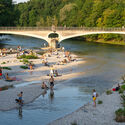
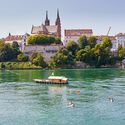
Throughout history, rivers played a crucial role in the social structures of cities. Along riverbanks, communities often congregated for socializing, swimming, and fishing. Swimming in rivers was a popular summertime activity enjoyed by people of all ages. Whether it was the Thames in London or the Seine in Paris, rivers were bustling with swimmers; integrated into urban lifestyles.

Unoccupied office buildings in major US cities are sending their downtowns into a so-called “urban doom loop.” With the widespread adoption of hybrid work, the influx of office-goers to central business districts has drastically dwindled. As a result, retail and restaurant businesses in these areas are struggling, urban transit systems are losing ridership, and city governments are grappling with the loss of tax revenue necessary to maintain public safety and sanitation. So, how can cities bring people back into their central business districts? While discussions on transforming offices into housing have given fruition significant city and federal incentives across the United States, what solutions exist for offices that aren't viable for such conversions?

Usually defined by their open-air settings, diverse offerings, local and independent sellers, temporary nature, and acting as social hubs, street markets have been around for thousands of years. From the days of the Roman Forum to the Silk Road and the markets of ancient Greece, they are undoubtedly essential parts of urban life, or “the center of all that is unofficial.” Mostly categorized under the informal economy due to lack of regulations and authorization, street markets in the global south have often been seen as a threat to urban development. However, these erratic and adaptive urban spaces serve core functions in any developing city, acting as pillars of community in many different facets of society.
Policymakers and city officials have long struggled with informality, considering it the “antithesis of modernity.” Conventionally, the informal economy consists of activities with market value but are not formally registered, often unregulated, undocumented, and operating outside the incentive system offered by the state. Street vendors, specifically in the global south, constitute a substantial portion of the informal economy. Moreover, as cities grow and approach development, public spaces become more contested and privatized, leading to an overall mission to remove street markets or push them into formalization.

Seoul-based Korean architect Minsuk Cho and his firm Mass Studies have been selected to design the 23rd Serpentine Pavilion, to open on June 5, 2024, in London’s Kensington Gardens. Titled “Archipelagic Void,” this iteration of the iconic commission will consist of five ‘islands’ displayed around an open space, breaking down the structure into a series of smaller elements intertwined with the park’s natural ecology. The pavilion will be open to the public from June 7, until October 27, 2024, with a press preview two days before the opening.

In architectural design, our interactions with non-human organisms have predominantly involved creating barriers to exclude them from the human realm. What if we were to adopt a different approach? Interspecies design is a movement that puts non-human organisms—fungi, insects, and various animals—on an equal footing with humans. This design philosophy provides frameworks that foster non-hierarchical relationships with other species. By doing so, it cultivates empathy for other life forms and shifts our perspective on the world around us. It aims not only for a net-zero approach but also seeks collaboration with non-human organisms to develop environments beneficial to all. Below, explore some emerging material technologies designed to benefit both humans and other life forms.

Madison Square Garden Entertainment (MSG), the developer behind the recently opened The Sphere at the Venetian Resort in Las Vegas, has announced that plans for a similar project in London have been withdrawn for lack of support from London’s planning officials, as reported by The Guardian. The plans were initially announced in 2018, with planning permission filed in March 2019. The 300ft-tall structure, having a capacity of 21,000 seats, was to be located in Stratford, east London. In November 2023, following a combination of unfavorable comments in planning officer reports and opposition from residents, London’s mayor Sadiq Khan withdrew his initial support.






Regarding urban development, the choice between demolition and adaptive reuse holds far-reaching implications. From debates around the cultural and historical significance of structure to the environmental impact of the process of razing and rebuilding, compared to the cost of preserving and adapting, the matter of demolitions has ignited the architectural community to come together and ask for more responsible assessment strategies in hopes of rediscovering the value of existing structures. This article gathers some of the stories of buildings facing the threat of demolition and the processes that led to their rescue.