Zaha Hadid is Coming to San Diego

Courtesy of Zaha Hadid Architects

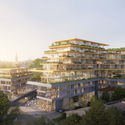
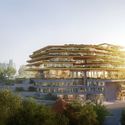
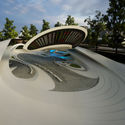
San Diego Planning Commission has approved Zaha Hadid’s Residence. Along with the San Diego firm Public, Hadid will demolish an existing house on a half-acre site at 8490 Whale Watch Way, replacing it with a 12,700 square foot home comprised of four bedrooms, six bathrooms, and an indoor pool. The firm has described the home as an “introverted sculptural structure.”

The La Jolla Community Planning Association responded to unsupportive neighbors by appealing the owners’ application for a Coastal Development permit. Residents were concerned by the radical appearance in comparison to the rest of the neighborhood homes. Association member Dale Naegle stated, “If we approve this we might as well abandon our La Jolla Shores Planned District Ordinance…It is a beautiful house, but it doesn’t fit.”

The project still risks being appealed again by the La Jolla Community Planning Association. If that were to occur, the project would then be in the hands of the much more challenging city council.

Reference: The Architect’s Newspaper

Zaha Hadid Architects Launch iPhone & iPad App

© Zaha Hadid Architects

On October 2nd Zaha Hadid Architects launched their much anticipated (to us architecture nerds anyways) iPhone and iPad , made available through Apple and iTunes. This new App will allow users to browse through ZHA current portfolio of design and architecture. In a future update to the App there will be exclusive access and insight into some of the award winning buildings in the form of interactive guides (coming soon) to be used when visiting Zaha Hadid’s buildings.

ROCA London Gallery / Zaha Hadid Architects

Courtesy of ROCA

Architect: Zaha Hadid Architects
Location: Station Court Imperial Wharf, ,
Client: ROCA
Project Area: 1,100 sqm
Project Year: 2011
Photographs: Courtesy of ROCA

Video: Chanel Mobile Art Pavilion / Zaha Hadid Architects

Photographer Onnis Luque recently shared with us an interesting video he shot of the Chanel Mobile Art Pavilion by . The form of the 700 sqm Chanel Pavilion is a celebration of the iconic work of Chanel, unmistakeable for its smooth layering of exquisite details that together create an elegant, cohesive whole. For more on this project click here.

Over 500,000 visitors to the Riverside Museum in its First Weeks

© McAteer Photograph/Alan McAteer

In June we shared with you a first look at Zaha Hadid Architects‘ Riverside Museum in Glasgow, . Opened officially on June 21st the museum in a short seven week time period has already welcomed over half a million visitors!

“It is wonderful to see that the new museum has captured everyone’s imagination,” said Zaha Hadid. “Such passion for innovation and discovery from all members of the community is very exciting.”

“The Riverside Museum has been a huge hit since the day it opened to the public. We knew just how much visitors loved the old Museum of Transport at Kelvin Hall but even so, the reaction to the Riverside Museum has been phenomenal. The feedback from people has been overwhelmingly positive and we are already seeing visitors returning time and again to enjoy Glasgow’s latest attraction,” shared Councillor Gordon Matheson.

More about the Riverside Museum, photographs and drawings following the break.

London Aquatics Centre for 2012 Summer Olympics / Zaha Hadid Architects

© Hufton + Crow

Architects: Zaha Hadid Architects
Location: London, England
Client: Olympic Delivery Authority
Main Contractor: Balfour Beatty
Project Team: Alex Bilton, Alex Marcoulides, Barbara Bochnak, Carlos Garijo, Clay Shorthall, Ertu Erbay, George King, Giorgia Cannici, Hannes Schafelner, Hee Seung Lee, Kasia Townend, Nannette Jackowski, Nicolas Gdalewitch, Seth Handley, Thomas Soo, Tom Locke, Torsten Broeder, Tristan Job, Yamac Korfali, Yeena Yoon
Project Area: 15,950 sqm (Legacy), 21,897 sqm (Olympic)
Project Year: 2011
Photographs: Hélène Binet, Hufton + Crow

Architecture City Guide: London

This week, with the help of our readers, our is headed to . This is our second stop in Europe, and once again I had to capitulate and double the number of buildings that we normally feature. We could not feature all of the suggestions, and will be adding to the list in the near future. We really appreciate those readers who offered their suggestions and the use of their pictures to make up this list.

Samuel Johnson famously said, “When a man is tired of London, he is tired of life.” As home to a long tradition of kings and queens, the Royal Society, and the roots of the Industrial Revolution, it is not surprising that there is a rich tension and collaboration between the historic and contemporary architecture in London. This reflects a city and culture that has a strong history of celebrating the past while also moving forward. Conflicts often emerge, as the goals of one side clash with those of the other. This relationship, however, is why I find walking the streets of London so appealing - those beautiful moments when history and progress collide.

Once again, thanks to all our readers for your help. We encourage you to add more of your favorites in the comment section below.

The Architecture City Guide: London list and corresponding map after the break.

Chanel Mobile Art Pavilion / Zaha Hadid Architects

© Stefan Tuchila

Photographer Stefan Tuchila recently shared with us his images of the Chanel Mobile Art Pavilion by Zaha Hadid Architects. Designed for Chanel the pavilion traveled all over the world, Hong Kong, Tokyo, New York until reaching it’s final stop at L’Institut du Monde Araba in Paris.

Materials for the pavilion include: a façade constructed from fibre re-inforced plastic, the roof PVC, ETFE roof lights, the primary structure was created from 74t and has over 1752 different connections, and the secondary structure consists of aluminium extrusions.

Architects: Zaha Hadid Architects
Location: Paris, France
Client: Chanel; Chanel Mobile Art
Project Area: 29 x 45 m, a total of 700 sqm
Project Year: 2008-2010
Photographer: Stefan Tuchila

A First Glance at Zaha Hadid’s Glasgow Riverside Museum of Transport

© Culture & Sport

Here is the first look at Zaha Hadid Architects latest project, Glasgow Riverside Museum of Transport. Slated to officially open later this week the museum in Glasgow, has 7,000 sqm of exhibition area and also includes cafe, retail and education spaces within its program. Following the break are more photographs and description.

Guangzhou Opera House / Zaha Hadid Architects

© Iwan Baan

Architects: Zaha Hadid Architects
Location: ,
Project Director: Woody K.T. Yao, Patrik Schumacher
Project Leader: Simon Yu
Project Team: Jason Guo, Yang Jingwen, Long Jiang, Ta-Kang Hsu, Yi- Ching Liu, Zhi Wang, Christine Chow, Cyril Shing, Filippo Innocenti, Lourdes Sanchez, Hinki Kwong, Junkai Jiang
Local Design Institute: Guangzhou Pearl River Foreign Investment Architectural Designing Institute (Guangzhou, China)
Structural Engineering: SHTK (Shanghai, China); Guangzhou Pearl River Foreign Investment Architectural Designing Institute
Façade Engineering: KGE Engineering (Zhuhai, China)
Building Services: Guangzhou Pearl River Foreign Investment Architectural Designing Institute (Guangzhou, China)
Acoustic Consultants: Marshall Day Acoustics (Melbourne, Australia)
Theater Consultants: ENFI (Beijing, China)
Lighting Consultant: Beijing Light & View (Beijing, China)
Project Management: Guangzhou Municipal Construction Group Co. Ltd. (Guangzhou, China)
Construction Management: Guangzhou Construction Engineering Supervision Co. Ltd. (Guangzhou, China)
Main Contractor: China Construction Third Engineering Bureau Co. Ltd. (Guangdong, China)
Project Area: 70,000 sqm
Project Year: 2003-2010
Photographs: Iwan Baan

Update: Opera House / Zaha Hadid

© Sharwe

Tomorrow marks the opening day of Zaha Hadid’s Opera House.  The 70,000 sqm project consists of two solid geometric forms wrapped with a structural exoskeleton.  The two components, with their similar form, color and shared structural expression, create a strong artistic expression to house the cultural center.   Hadid’s angular exterior intentions are carried through the interiors, shaping dynamic gathering spaces and interstitial spaces.   For the main auditorium,  Hadid’s concept has manifested itself in the form of fluid ribbons that wrap the main stage.  Previously, we have featured some great photos showing the building further along in its construction process , thanks to our reader Sharwe, and we’re excited to share news of its opening!

“Overlooking the Pearl River the Guangzhou Opera House is at the heart of Guangzhou’s cultural sites development. Adopting state of the art technology in its design and construction it will be a lasting monument to the New Millennium, confirming Guangzhou as one of Asia’s cultural centers. Its unique twin boulder design will enhance urban function by opening access to the riverside and dock areas and creating a new dialogue with the emerging new town,” explains Hadid.

More images after the break.

Design for London Receives Backing from Hadid, Gehry, Piano

Courtesy of

With concerns rising about the future of Design for London, a lengthy list of high profile architects have assembled themselves submitting an open letter to the Mayor of . “As architects from many countries, we want to encourage the Mayor to secure the survival of this remarkable team. We hope that he is aware of how widely admired the efforts are of this small group of talented designers. should consider itself lucky to have a skilled, knowledgeable and creative organisation supporting efforts to make it a better city.”

A projected growth by around one million people over the next twenty years, confirms that Design for London‘s survival is crucial as it is an influential player in steering designs and new developments towards an environmentally responsible city. The protection of London’s existing green spaces, character, heritage, and established unique neighborhoods will be essential as the city builds to accommodate its expected growth, and Design for London‘s collaborative efforts, on behalf of the Mayor of London, verify that projects are focused on these factors.

Full public letter to the Mayor of London following the break.

AD Classics: Vitra Fire Station / Zaha Hadid

© Wojtek Gurak

After a devastating fire in 1981 that crippled the design campus in Weil am Rhein, , Vitra began an extensive mission to rebuild the campus as well as redesign the masterplan, which was designed by Nicholas Grimshaw. Almost a decade after the devastating fire in 1981, the company sought an architect to build a fire station for the Vitra campus to thwart any future reoccurrences and commissioned Zaha Hadid.  Completed in 1993, the Vitra fire station would be Hadid’s first realized project of her career, which would eventually launch her name and style to an international audience.

The Vitra fire station is Hadid’s showcased work that delves into the deconstructivist theoretical language that she developed through her paintings as a conceptual mediator of finding spatial relationships and form.  The Vitra fire station is a synthesis of philosophy and architecture that bridges the Vitra design campus to its surrounding context.

More on the Vitra Fire Station after the break.

Evelyn Grace Academy / Zaha Hadid Architects

© Luke Hayes

The Evelyn Grace Academy in , Borough of Lambeth, broadens not only the educational diversity of this active and historical part of but also augments the built environment in a predominantly residential area. This Academy presents itself as an open, transparent and welcoming addition to the community’s local urban regeneration process. The strategic location of the site within two main residential arteries naturally lends the built form to be coherent in formation. The building assumes a strong urban character and identity which is legible to both the local and neighboring zones.It offers a learning environment that is spatially reassuring thereby being able to engage the students actively. The design of the building to create a healthy atmosphere as a milieu for progressive teaching routines.

Architects: Zaha Hadid Architects
Location: Brixton, London, England
Design: Zaha Hadid with Patrik Schumacher
Project Director: Lars Teichmann
Project Architect: Matthew Hardcastle
Project Team: Lars Teichmann, Matthew Hardcastle, Bidisha Sinha, Henning Hansen, Lisamarie Villegas Ambia, Judith Wahle, Enrico Kleinke, Christine Chow, Guy Taylor, Patrick Bedarf, Sang Hilliges, Hoda Nobakhti
Project Manager: Capita Symonds
Engineers: Arup
Quantity Surveyors: Davis Langdon
Landscape: Gross Max
Acoustic Consultant: Sandy Brown Associates
Main Contractor: Mace Plus
Main Contractor’s Architects: Bamber & Reddan
CDM Co-ord: Arup
FF&E: Favourite Cat
Planning Consultants: DTZ
Employer’s Agent: EC Harris
Catering Consultant: Winton Nightingale
Client: ARK Education and DCSF
Project Year: 2010
Photographs: Luke Hayes

Design + Wine exhibit at SFMOMA

Zaha Hadid's Tondonia Vina Pavilion

“How Wine Became Modern: Design + Wine 1976 to Now” is a brand new exhibit at the San Francisco Modern Museum of Art.  Co-created and designed by , the exhibit was organized by Henry Urbach, SFMOMA’s Helen Hilton Raiser Curator of Architecture and Design.  Bringing attention to the wine industry and its integration with the latest artists, designers and architects the exhibit will be on display at SFMOMA until April. A main part of the exhibit is featuring the architectural spaces that house the wine making process, tastings, museums, etc.  Some big name architects who have developed designs for cutting-edge wineries include: Zaha Hadid, Frank Gehry, Norman Foster, Herzog and de Meuron, Renzo Piano and .

Mr. Urbach stated that the idea stemmed “from an observation and curiosity about why there was so much activity around wine in various design fields. There are probably a score of world famous architects who have done wineries in the last fifteen years and they’re not doing dairy farms or orange juice bottling plants.”

Here at ArchDaily we have featured many great wineries.  Be sure to take a look at  Zaha Hadid’s Tondonia Vina Pavilion, Norman Foster’s Faustino Winery, as well as AD Wineries Roundup I and Roundup II.

Architects: Diller Scofidio + Renfro
Principals-in-Charge: Elizabeth Diller, Ricardo Scofidio and Charles Renfro
Project Leader: Ilana Altman
Project Manager: David Allin
Project Team: Kumar Atre, Donna Pallotta, Jose Vidalon and Chris Hillyard

Rabat Grand Theatre / Zaha Hadid

Courtesy of Zaha Hadid Architects

Following a recent ceremony in , Morroco, Agence pour l’Aménagement de la Vallée du Bouregreg (The Bouregreg Valley Development Agency) verified that architectural designs will be provided by Zaha Hadid Architects.  The program will include three theater spaces, indoor spaces consisting of 2,050-seat and a 520-seat, and a fully-equipped outdoor amphitheater holding up to 7,000 people.   The theaters will share back of house facilities, efficiently reducing the size of the building services needed.  Creative studios will also be incorporated into this cultural venue.  Estimated cost is at 120 Million Euros for the Grand Theatre.

Follow the break for more renderings of The Rabat Grand Theatre.

Architects: Zaha Hadid Architects
Location: Rabat,
Design: Zaha Hadid with Patrik Schumacher
Associate: Nils Peter Fisher
Project Leader: William Tan
Project Team: Torsten Broeder, Martin Krcha, Hoda Nobakhti, Rafael Contreras, Yevgeniya Pozigun, Michal Treder
Structure Engineer: Adams Kara Taylor
MEP Engineer: MaxFordham
Acoustics & Theatre: Artec Consultant
Facade: Donnell Consultants Incorporated
Lighting: Office for Visual Interaction Inc
Client: Agence pour l’Aménagement de la Vallée du Bouregreg
Project Area: 47,000 sqm
Renderings: Methanoia, Courtesy of Zaha Hadid

Is China Architects’ New Dubai?

West Kowloon Cultural District Theater Village from Water © OMA

The latest buzz from China is all about the West Kowloon Cultural District, a large performing arts venue incorporating studios, theaters, performance venues, and cultural and public spaces.   We’ve brought you coverage on OMA’s proposal as well as Foster+Partners‘ and Rocco Design Architects‘ schemes, and as the master plan develops, we’ll be sure to bring you the latest updates.  As CNN reported, China has become “an increasingly attractive territory for leading architects.”  And, we couldn’t agree more.  Over the past few months, we’ve seen great projects from Holl emerging in China, such as his Horizontal Skyscraper in Shenzhen, as well as Hadid’s Guangzhou Opera House,  OMA’S CCTV Tower, Vector Architects + CCDIP’s Tianjin Elementary School, and, not to mention,  ’s Flowing Gardens.  Plus, in terms of experimentation, China’s recent Expo 2010 offered the perfect opportunity for architects across the world to demonstrate their newest concepts about space, materials and performance.  This explosion of architecture in the West has brought with it a sense of fresh experimentation of form and analysis of programmatic elements and organization.  Together, the buildings are forming a rich and diverse vocabulary of architecture sprinkled throughout China.   Koolhaas commented to CNN, “I think that any architect today has to be interested in China.”

What do you think of this growing “architectural playground”?

Video: King Abdullah Petroleum Studies and Research Center (KAPSARC) / Zaha Hadid Architects

YouTube Preview Image

Here is a video about one of Zaha Hadid‘s latest project, King Abdullah Petroleum Studies and Research Center (KAPSRC) in , Saudi Arabia.  This project has a holistic approach unifying architecture and engineering, landscape and building artist expression and environmental responsive design.  It is intended to not only be a leading research facility, but also a LEED Platinum certified building upon its completion.

We recently featured Zaha Hadid, as she won this years esteemed RIBA Stirling Prize for the design of the MAXXI National Museum in Rome. Full coverage of the RIBA Stirling Prize along with photographs of the MAXXI can be found here.

Also you can check our previous coverage of Saudi Arabai – in particular last year ArchDaily personally visited Saudi Arabia for the opening of the King Abdullah University of Science and Technology, an international graduate-level research institution.  Photographs and a write up on KAUST here.

RIBA Stirling Prize 2010: MAXXI Museum / Zaha Hadid

© Iwan Baan

A few weeks ago we told you about the short list for this years RIBA Stirling Prize. And once again our readers got it right, as the majority of your comments favorited Zaha Hadid’s in Rome, which has been announced as the winner of the prestigious british award.

You can check our previous coverage of the MAXXI Museum.

Structural Steel Design Awards 2010 / Zaha Hadid

© Zaha Hadid Architects

In addition to being asked to design  ’s newest banking headquarters as we reported previously, Zaha Hadid has also been recognized at the Structural Steel Design Awards.  The awards, which are in their 42nd year, are bestowed upon those who attain excellence in both architectural and structural design with the use of steel.  Hadid’s Legacy Roof (alongside Audi West , the Infinity Footbridge in Stockton-on-Tees, and Dublin Airport Terminal 2) was awarded for its “heroic engineering achievement”.   Working with Arup, Rowecord Engineering Ltd and Balfour Beatty Group Ltd, the team has designed an amazing structure to house the Aquatic Center for the Olympic Games in .   When we first introduced Hadid’s Legacy Roof, we were shocked by the fluidity the 160 m long and 3,000 ton roof could convey.  Its dynamic curvaceous form is definitely a feat of engineering.     The judges noted the project’s successful use of steel commenting that the roof  ”has overcome severe program and constructional problems. A necessarily complex structure delivers the form and shape at the heart of what will become the emblematic and beautiful icon of the London 2012 Olympics.”

Central Bank / Zaha Hadid

MAXXI Museum / © Iwan Baan

In what will be her first project for her native country, Zaha Hadid will design the new headquarters for the in Baghdad.  Earlier in the summer, Hadid prepared a conceptual presentation with a feasibility study, and this past month, Hadid travelled to Istanbul to discuss initial details with the bank’s governor, Sinan al-Shabibi.   The bank, which is one of the first central banks in the Arab world, has the sole right to issue the Iraq’s national currency – the dinar.