The Beam / MVRDV and de Alzua+
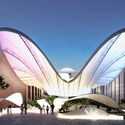
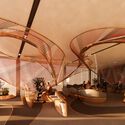
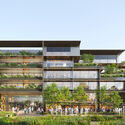
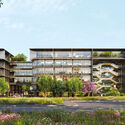
Development corporation ADIM Nord with MVRDV and de Alzua+ have been announced the winners of an urban renewal competition in the French town of Villeneuve d’Ascq. Dubbed ‘The Beam’, the winning proposal will transform a cluster of disused parking lots and a former petrol station into a dense, pedestrianized haven, whose 15,000 square meters of offices, retail space and lodging will hover over the adjacent motorway as a icon of a larger urban regeneration effort for the town center.
More information on The Beam after the break…
Architects Selected for Competition to Design Nobel Prize’s New Home

Out of 140 architects considered, 12 architects have been selected by the Nobel Foundation to compete to design their new home, a Nobel Center in Blasieholmen, Stockholm. The conspicuously European selection, chosen for their “design and artistic abilities and experience working in intricate urban environments,” includes some very big names – including BIG, David Chipperfield Architects, Herzog & de Meuron, and OMA. The only non-Europeans to compete will be SANAA’s Kazuyo Sejima and Ryue Nishizawa.
See the full list of competitors, and more information on the competition, after the break…
Foster + Partners Approved for Mixed-Use Development on London’s Albert Embankment
Foster + Partners have received the green light from the Lambeth Council for three mixed use towers on the 20-21 Albert Embankment in London. Ranging from 15 to 27 stories, the curved steel and glass structures will provide the area with 253 apartments, including affordable homes for senior living, along with offices, restaurants and a residents’ bar, gym, pool and spa.
Grant Brooker, Senior Partner at Foster + Partners: “We are absolutely delighted that 20-21 Albert Embankment has received planning permission – working alongside our clients at St. James and with great support from Lambeth and the GLA, we hope to transform this important and highly visible site into a vibrant riverside community that sets a benchmark for the regeneration of this part of the river.”
More after the break…
ABI Continues to Steadily Climb for Seventh Straight Month

An increasing demand for design services in the United States continues to strengthen the Architecture Billings Index (ABI). As a leading economic indicator of construction activity, the ABI reflects the approximate nine to twelve month lag time between architecture billings and construction spending. The American Institute of Architects (AIA) has reported the February ABI score as 54.9, up slightly from a mark of 54.2 in January. This score reflects a strong increase in demand for design services (any score above 50 indicates an increase in billings). In addition, the new projects inquiry index was 64.8, higher than the reading of 63.2 the previous month and its highest mark since January 2007.
“Conditions have been strengthening in all regions and construction sectors for the last several months,” said AIA Chief Economist, Kermit Baker, PhD, Hon. AIA. “Still, we also continue to hear a mix of business conditions in the marketplace as this hesitant recovery continues to unfold.”
Key February ABI highlights:
Fashion Retailer Commissions OMA to Convert Venice Palazzo

Both Le Corbusier and Frank Lloyd Wright can be found on a lengthy list of architects who have tried to build in Venice and lost their battle to conservationists. However, OMA has broke through this barrier, as the practice was recently approved – after five years pending – to go forth with a project to renovate a 16th century palazzo for the fashion retailer Benetton near the Rialto Bridge on the Grand Canal.
More details and statements from the architect after the break…
(more…)
Aerotropolis: The Key to a Prosperous, 21st Century City?

“The rapid expansion of airport-linked commercial facilities is making today’s air gateways anchors of 21st century metropolitan development where distant travelers and locals alike can conduct business, exchange knowledge, shop, eat, sleep, and be entertained without going more than 15 minutes from the airport. This functional and spatial evolution is transforming many city airports into airport cities.” - Dr. John Kasarda
Major international airports have developed over time into key nodes in global production and enterprise systems through speed, agility and connectivity. These transportation hubs are able to dramatically stimulate local economies by attracting a wide range of aviation-related businesses to their peripheries and resulting in what John Kasarda, a US academic who studies and advises governments on city planning issues, has dubbed the “Aerotropolis.” The Aerotropolis, like any other traditional city, consists of a central core with rings of development permeating outwards; unlike a traditional city, however, the city’s core is an airport and all neighboring development supports and is supported in turn by the airport industry. Several airports around the globe have organically evolved into these airport-dependent communities, generating huge economic profits and creating thousands of jobs, but what Kasarda is arguing for is a more organized and purposeful approach to the development of these Aerotropolises – what he believes to be the future model of a successful city.
Read on for more on the Aerotropolis vision.
2013 Pritzker Prize: Toyo Ito

“Although Mr. Ito has built a great number of buildings in his career, in my view, he has been working on one project all along, — to push the boundaries of architecture. And to achieve that goal, he is not afraid of letting go what he has accomplished before.” — Yung Ho Chang, Member of the Pritzker Jury for 2013
Toyo Ito has been announced as the Pritzker laureate for 2013. Ito is the thirty-seventh recipient of the Pritzker Prize and its sixth Japanese recipient.
The Pritzker jury applauded Ito for his ability to synthesize many architectural languages and functionalities in the expression of one personal “syntax,” inspired by the organic structures found in nature and the sensual nature of the human user.
Calling him a “creator of timeless buildings,” the Pritzker Jury further praised Ito for “infusing his designs with a spiritual dimension and for the poetics that transcend all his works.” Among those works, the Jury singled out his Sendai Mediatheque, whose innovative use of structural tubes “permitted new interior spatial qualities,” TOD’S Omotesando building in Tokyo, “where the building skin also serves as structure,” and Tokyo’s Tama Art University Library as particularly inspiring.
In response to the accolade, the highest award in the profession of architecture, Ito humbly expressed that, with each project, he only becomes more “painfully aware of [his] inadequacy, and it turns into energy to challenge the next project.” For that reason, Ito professed, “I will never fix my architectural style and never be satisfied with my works.”
Read more of the Jury’s selection of Toyo Ito as the 2013 Pritzker Laureate, after the break…
House Bill Proposes to Eliminate Funding for Eisenhower Memorial

The Dwight D. Eisenhower Memorial saga continues, as Rep. Rob Bishop (R-Utah) proposed legislation that would forego Frank Gehry’s controversial design and eliminate federal funding. Although Bishop’s radical bill would save $100 million in future funding, it ignores any possibility of compromise.
In response, the AIA stated:
Christo Unveils Inflatable, Light-Infused Installation in Germany

The internationally – and often controversial - acclaimed artist Christo has unveiled the “largest indoor sculpture ever made”. Prepared to debut in a public exhibition starting March 16, the inflated “Big Air Package” has been designed to occupy a 117-meter-tall former gas tank known as Gasometer Oberhausen in Germany. The 90-meter-high, 50-meter-wide sculpture is made from 20,350 square meters of semitransparent polyester fabric and 4,500 meters of rope, with a total weight of 5.3 tons and a volume of 177,000 cubic meters.
The seemingly endless, inflatable installation was conceived in 2010 and is Christo’s first major work after the passing of his wife and artistic partner Jeanne-Claude in 2009.
More on Christo’s “Big Air Package” after the break…
Predictions from the Past: New York 2012 and LA 2013

Throughout history, people have spent a great deal of time pondering what the future holds. Scientific discovery and technological innovation – along with rebellious androids, zombies, flying cars, hover crafts, visiting aliens – have been consistently used as stereotypes that emerge in predictions for our imagined future. And while Hollywood was busy exploring dystopian scenarios of this near-future, architects were composing utopian images of an optimistic vision for cities.
Architects have built careers upon predicting what cities can potentially become – developing forms, functions, plans and visions of possibilities in the social, political, economic and cultural realms through architecture. In 1962, Mayor Robert Wagner of NYC predicted a culturally diverse, economically viable, global city for New York in 2012. In 1988, Los Angeles Times Magazine gave its 25-year forecast for Los Angeles in 2013, predicting what a life for a family would be like, filled with robots, electric cars, smart houses and an abundance of video-conferencing. Find out how their predictions fared after the break.
Photography: Toyo Ito by Iwan Baan

“Whoever reviews Ito’s works notices not only a variety of functional programs, but also a spectrum of architectural languages.” — From the 2013 Pritzker Jury’s Citation
Toyo Ito has just been announced the winner of the 2013 Pritzker Prize. To commemorate this master architect, we’ve reached out to Iwan Baan, architecture’s premier photographer, and assembled a retrospective of some of Ito’s greatest works (all photographed, of course, by Baan) – including the Za Koenji Public Theatre, Toyo Ito’s Museum of Architecture, Silver Hut – TIMA, Ken Iwata Mother and Child Museum, Yaoko Kawagoe Museum, Suites Avenue Hotel, Huge Wineglass Project, Mikimoto 2, Tama Art University Library & White O. See them all, after the break…
Shigeru Ban’s Cardboard Cathedral Underway in New Zealand

Shigeru Ban just can’t get enough of paper tubes. The Japanese architect, renowned for his design of structures that can be quickly and inexpensively erected in disaster zones, is at it again in the city of Christchurch, New Zealand, which was hit hard by a devastating earthquake last February. The earthquake of magnitude 6.3 killed over 200 people and inflicted irreparable damage on the city’s iconic gothic cathedral of 132 years. The cathedral was a copy of one in Oxford, England, and was one of the most famous landmarks of the Christchurch, pictured on postcards, souvenirs and tea towels.
A pioneer in so-called “emergency architecture,” Shigeru Ban has begun construction on a highly anticipated, unique replacement: a simple A-frame structure composed of paper tubes of equal length and 20 foot containers. The tubes will be coated with waterproof polyurethane and flame retardants that the architect has been developing since 1986 – years before environmental friendliness and the use of inexpensive recycled materials were even a concern in architecture.
Read more about Ban’s visionary Cardboard Cathedral after the break…
Businessman Offers to Save Brutalist Landmark From Demolition

Divisive concrete behemoth Preston Bus Station may yet be saved from its planned demolition. On the heels of a well co-ordinated campaign to save the brutalist monument, local businessman Simon Rigby has stepped in and offered to relieve the council of the building planning refurbish and operate the bus station himself.
Read more about the controversy and Rigby’s plan after the break…
House Vision 2013 Exhibition Hits Tokyo

Graphic designer and curator Kenya Hara has put together a three week-long exhibition in Tokyo focusing on the future of the Japanese house. Hara argues that the housing industry can no longer be isolated but must be combined with other industries, technologies and ideas, including energy, transportation, communication, household appliances, the “vision of happiness” pursued by adults, the representation of Japanese traditions and aesthetics as well as a future vision of health. All of these elements he hopes to present and discuss at the House Vision Exhibition where more than ten types of futuristic houses are on display and daily seminars with expert urban planners, developers, contractors, architects, telecom and even gas organizations have been taking place.
Read more about the exhibition after the break.
Carla Juacaba Wins Inaugural arcVision Women and Architecture Prize

Brazilian architect Carla Juaçaba has been announced as the winner of the inaugural arcVision – Women and Architecture Prize, an international social architecture award instituted by the Italcementi Group. The prize honors Juaçaba’s work for exemplifying significant qualitative excellence and attention to the core issues of construction, such as technology, sustainability, social and cultural implications.
More on Carla Juacaba after the break… (more…)
Providence Wins Bloomberg’s Mayors Challenge

Bloomberg Philanthropies has announced the winners of the Mayors Challenge, a competition to inspire American cities to generate innovative ideas that solve major challenges and improve city life – and that ultimately can be shared with other cities to improve the well-being of the nation. Out of the 305 cities that competed in this inaugural competition, Providence, Rhode Island, was presented the Mayors Challenge Grand Prize for Innovation and a $5 million implementation award for its “cutting-edge early education initiative”. Mayors Challenge innovation prizes also were awarded to Chicago, Houston, Philadelphia, and Santa Monica, all of which will receive $1 million to support implementation.
SEED Evaluator 3.0 to Launch During PID Week

Design Corps – a partner of Public Interest Design Week – has announced that Version 3.0 of the Social Economic Environmental Design (SEED) Evaluator, an evolving web-based tool, will officially launch next Saturday, March 23, during the Structures for Inclusion (SFI) conference at the University of Minnesota’s Minneapolis Campus. SFI participants will receive the first peek at this new, collaborative design tool. Thereafter, it will be available free of charge, online at SEEDNetwork.org.
Based on SEED’s bottom-up approach to design problem-solving that truly activates community concerns, the SEED Evaluator 3.0 not only advocates, but also requires an inclusive and participatory process for achieving successful design projects with involvement from community stakeholders as well as designers and project planners. The tool offers specific steps for creating a collaborative approach to public interest design and for identifying and measuring the success of like-minded project goals focused on the triple-bottom line of social justice, economic development, and environmental conservation.
SEED Evaluator 3.0 breaks down the design process into three phases (application, details, and results) with review and evaluation required at the end of each phase. The tool helps to ensure that an effective process is followed, adequate participation is included and results are transparent. Projects completed with the Evaluator become SEED Certified, providing project accountability and proof that a project successfully addresses social, economic and environmental needs.
Click here to register to attend Structures for Inclusion and other Public Interest Design Week events, online atEventBrite.com, or click here to learn more about the SEED Network and Evaluator tool, online atSEEDNetwork.org.

UK Government Grants Approval to Liverpool Waters Scheme

A controversial plan to redevelop a large area of Liverpool’s waterfront has received an effective green light after the Communities Secretary of State, Eric Pickles, chose not to call in the scheme for a public inquiry. The £5.5 billion scheme is designed by Chapman Taylor and provides 9,000 homes, 300,000 square meters of office space and 50,000 square meters of hotel and other facilities. The scheme also includes the 55-story ‘Shanghai Tower’ and a cruise ferry terminal.
The plan has attracted criticism, in particular from English Heritage and UNESCO who worry that the size of the developments will negatively affect the Liverpool skyline, dominated for almost a century by the ‘Three Graces’ a trio of listed buildings that have come to define the view from the Mersey River. UNESCO has strongly opposed the development, placing Liverpool’s world heritage site on it’s ‘endangered’ list and threatening that if the scheme goes ahead, the area could lose its world heritage status.
Read more about the reaction to the scheme after the break…
The Fujimoto Experiment: Five Students, Five Days, One Model

Last week an online call was put out by Rome’s MAXXI museum promising the first five architecture students to respond a chance to travel to Rome and build a model of Sou Fujimoto’s latest project. The five selected entrants started on their work at MAXXI on Monday and their experience is being broadcast over the course of this week in a series of photos and videos detailing the ups, downs, opinions and thoughts of the students as they work.
Read more about the model and exhibition after the break…
2013 AIA New York Design Awards

After reviewing hundreds of projects submitted by New York City-based architects and firms, a jury of twelve eminent architects, landscape architects, educators, critics, and planners convened by the Center for Architecture in New York has selected 42 thoughtfully considered projects for the 2013 AIANY Chapter’s Design Awards. From small installations to large-scale projects, each awarded submission spanned a breadth of innovative ideas in a large variety of design solutions for projects throughout the world.
Winning submissions received either a “honor” or “merit” award in four different categories: architecture, interiors, projects and urban planning. All will be on view at a Center for Architecture exhibition designed by Kokoro & Moi, from April 18th through May 31st.
Join us after for the complete list of winning projects. Click on the project image for more information.
Yukio Futagawa, Influential Architectural Photographer and Publisher, Dies at 80

Japanese architectural photographer and editor Yukio Futagawa (1932-2013) lost his battle to cancer on March 5 at the age of 80 in Tokyo, Japan. Futagawa was best known as the founder of the distinguished Global Architecture (GA) Publishing Group, which he established in 1970, and director of Global Architecture (GA) magazine. Throughout his 60-year-long career, Futagawa photographed modernist works from some of the world’s most famous architects and presented them in elegant magazine and book series. Two of his most important works include a ten-volume collection of “Japanese Traditional Houses” in the 1950s and a lavish twelve-volume collection that illustrates the complete works of Frank Lloyd Wright.
GA will continue to operate under the direction of Yukio’s son Yoshio.
via Informador