Thanks to the increasing popularity of massive open online courses -- or MOOCs as they’re commonly referred to -- learning has never been easier (or more convenient). Sites like Coursera and edX offer free classes online from accredited and well-known universities across the globe, including Harvard, MIT and the University of Hong Kong. While some classes are more structured and include a set lesson plan, homework assignments, quizzes and the option to receive a certificate at the end, others can be set at your own pace and approached more independently.
Following our wildly popular article on Four Ways to Learn About Architecture for Free, we’ve compiled a list of upcoming online classes related to architecture, engineering, urbanism and design. So whether you’re looking to embark on a new topic or dive deeper into an already familiar subject, take a look at these free online courses after the break.
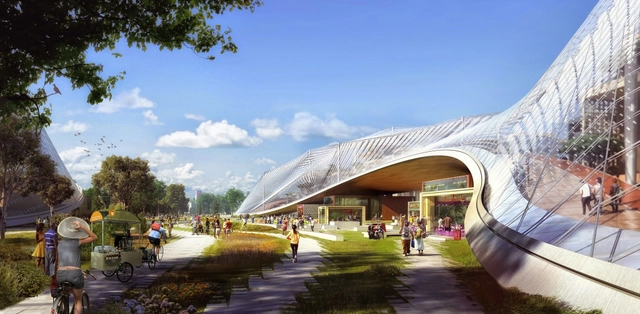
In their designs for Google's new headquarters, released last week amid much excitement, Bjarke Ingels and Thomas Heatherwick have taken cues from the utopian visions of the past to create a radical solution for the sprawling tech campus in Mountain View, California. Citing the lack of identifiable architecture in the technology sector, a promotional video on Google’s own blog reveals how the company plans to embrace nature, community, and flexibility with the new scheme.
Chief among the company’s concerns was creating a building capable of adapting to future uses in addition to serving as a neighborhood-enhancing environment to welcome visitors from the surrounding community. As with any news related to Google, the design has already attracted the attention of the media - read on after the break for our rundown of the most salient reviews so far.
The Negro Building Remembrance Competition invites architects, landscape architects, artists, playwrights, poets, musicians and writers from every discipline, as individuals, teams, students or professionals, to propose imaginative ways to commemorate the Negro Building, the forgotten landmark of the 1895 Cotton States and International Exposition in Atlanta, Georgia.
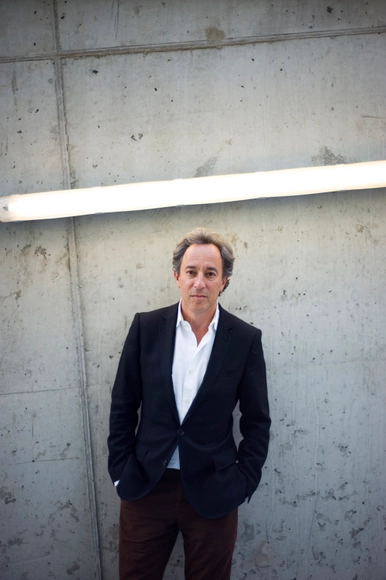
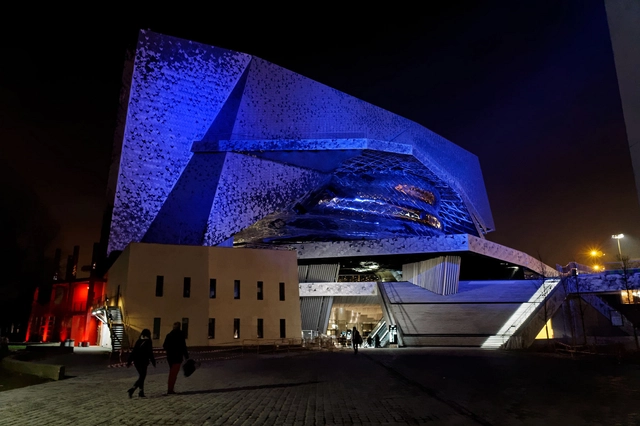
After boycotting the premature opening of the infamous Philharmonie de Paris, Jean Nouvel has taken his frustrations to court demanding that his name and image be removed from all references to the publicly funded €390 million concert hall. The French architect, who has claimed to be wrongly vilified as a “spoilt-star artist” and unfairly blamed for the project’s spiraling costs, does not “wish to express himself any further on the project.”
He has asked the court "to order amending work" to 26 "non-compliance" areas that do not comply with his original design. This areas include parapets, fireplaces, facades, the promenade and 2,400-seat concert hall itself.
Arup and GXN Innovation have been awarded with the JEC Innovation Award 2015 in the construction category for their development of the world's first self-supporting biocomposite facade panel. Developed as part of the €7.7 million EU-funded BioBuild program, the design reduces the embodied energy of facade systems by 50% compared to traditional systems with no extra cost in construction.
The 4-by-2.3 meter panel is made from flax fabric and bio-derived resin. Intended primarily for commercial offices, the glazing unit features a parametrically-derived faceted design, and comes prefabricated ready for installation. The panel is also designed to be easy to disassemble, making it simple to recycle at the end of its life.
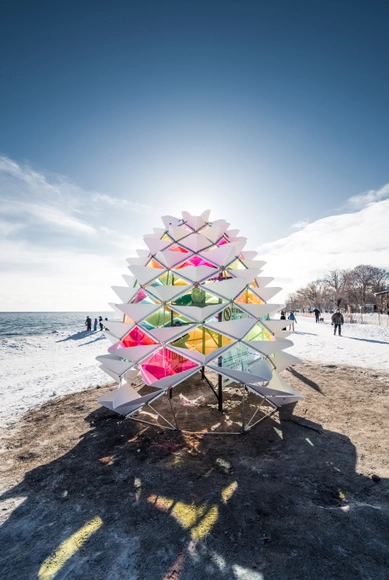
Five finalists have emerged from the 196 submissions of Toronto’s first international Winter Stations design competition. Drawing proposals from 36 countries around the world, the competition challenged entrants to transform the lifeguard stations on Toronto’s east beaches into public art pieces for the winter. The finalists’ designs were constructed in mid-February and will be displayed until March 20, 2015.
Take a look at the completed installations, after the break.
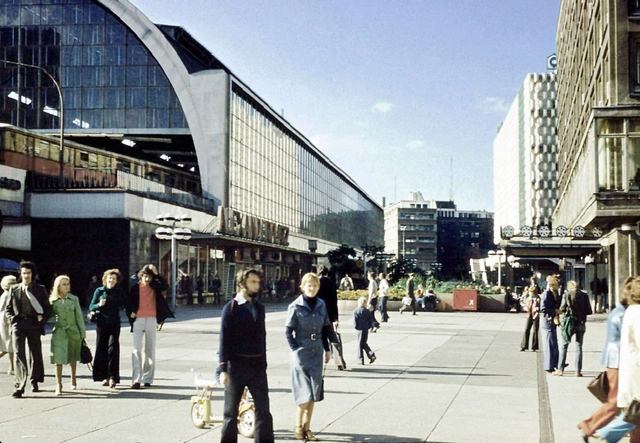
"Twenty-five years after the Berlin Wall’s demise, it is as though a large part of the twentieth century never happened," writes OMA principle Reinier de Graaf in his article for Metropolis Magazine "The Other Truth". "An entire period has been erased from public consciousness, almost like a blank frame in a film." Through the course of the article, de Graaf outlines how the West has rewritten the history of the cold war, erasing the "other truth" that existed for nearly half a century in East Berlin, the USSR, and other soviet-aligned states - a truth that we forget to our peril. It may not be immediately architectural, but the essay provides an interesting look into the political thoughts of de Graaf who, as the principle of one of architecture's most prominent research organizations in AMO, has an important influence on the profession's understanding of the wider world. Read the article in full here.
The Royal Institute of British Architects (RIBA)’s Future Trends Survey for January 2015 has revealed strong levels of optimism as workload forecasts remain strongly positive across all regions of the UK. Following little change in indexes between November and December 2014, the workload index has once again remained consistent at +29. Workload forecast balance figures have remained high, the highest numbers being reported from practices in Northern Ireland at +67 (from +50) and Scotland at +57 (from +75). Furthermore, practices of all sizes have been responding with positive workload prospects heading into the next quarter.
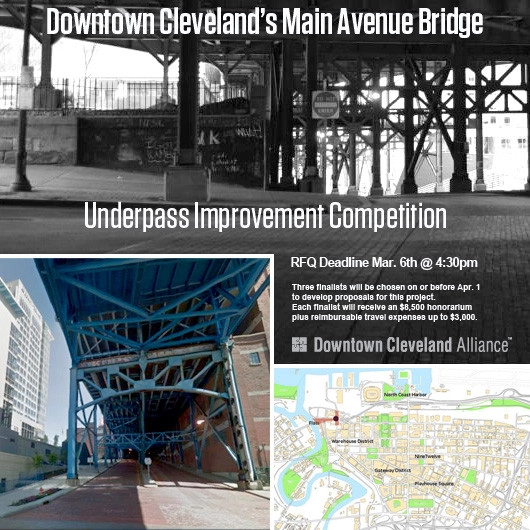
Downtown Cleveland Alliance seeks a creative professional or team (architect, designer, artist, engineer, landscape architect or combination thereof) to propose unique and attractive design solutions for the area under and around the Main Avenue Bridge Underpass, centered at the intersection of West 9th Street and Main Avenue in Downtown Cleveland. This location is a critical pedestrian, bicycle, and vehicular connection between the Warehouse District and the Flats East Bank, with infrastructure, history, and functional potential to inspire the highest level of creative treatments. Request for Qualifications are due Friday, March 6th by 4:30pm! More information, here.
Challenging the notion that beauty is subjective, Alain de Botton has made a case for attractive cities, believing that a city’s beauty is key to its success and citizens' quality of life. The Swiss philosopher, author and founder of London's The School of Life believes that attractiveness is the primary reason why many choose to vacation to Paris, and not Frankfurt.
"We think beauty is subjective, and so no one should say anything about it," says Botton. "It's a very understandable qualm, but it's also horribly useful to greedy property developers.”
So, what makes a city attractive? Find out Botton’s six points for beautiful cities, after the break.
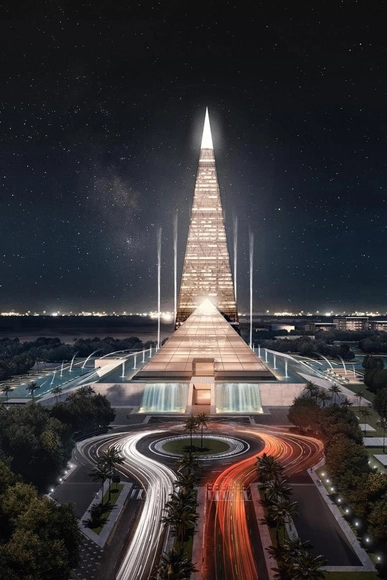
Egypt’s Minister of Housing Moustafa Madbouly has revealed plans to build the nation’s tallest tower in Cairo. The pyramid-like Zayed Crystal Spark tower will top out at 200-meters (656-feet) and occupy a 798,000-square-meter parcel in the city’s Sheikh Zayed district - a short distance from the historic pyramids of Giza.
UPDATE: Congratulations to Colin from Philadelphia and Guillaume from France - you've been randomly selected as the winners! Thank you everyone for participating.
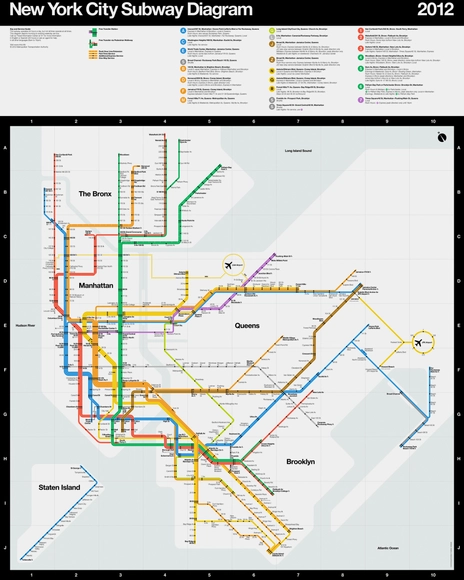
SuperWarmRed Designs has offered our readers a chance to win Massimo Vignelli’s limited-edition (unsigned) MTA New York City Subway Diagram. Designed in 2012 by Vignelli, in collaboration with Vignelli Associates Beatriz Cifuentes and Yoshiki Waterhouse, the diagram is the first Vignelli subway map to be printed by the MTA since the 1970s and is slated to be made part of the Museum of Modern Art’s permanent collection this year.
Using concepts from Vignelli’s iconic Subway Map design of 1972, the new diagram was informed by satellite data and rebuilt for greater clarity and legibility. Revised to reflect the current subway system, colors and nomenclature, the poster has been printed in vivid Pantone and Hexachrome inks on acid-free archival cover-weight paper.
SuperWarmRed has agreed to giveaway one 36” x 45” Subway Diagram and one 16” x 24” Subway Diagram Detail Series. Read on after the break for the official rules.
With a recently released animation entitled “We Start the Future of Construction,” Coop Himmelb(l)au announced their intention to take digital fabrication to a radical new scale, demonstrating how technology is impacting almost every aspect of the architectural profession. The advent of building information modeling and other modeling software has transformed how architects and engineers navigate the construction process, allowing us to achieve increasingly complex forms that can be modeled with the aid of CNC machining and 3D Printing, but still there remains a wide gap between the technologies available to architects and those employed by builders. When it comes to a building’s actual construction we have been limited by the great costs associated with non-standard components and labor - but now, the automated practices that transformed manufacturing industries could revolutionize how we make buildings.
Last week, ArchDaily sat down with co-founder, Design Principal and CEO of Coop Himmelb(l)au, Wolf D. Prix for his thoughts on the future of construction and the role of the architect in an increasingly technological practice. Read on after the break to find out how robots could impact architectural design, construction, and the future of the profession.
From bricks grown from bacteria to cement derived from the reef building process of coral, biomimicry has taken the world by storm. A collection of products inspired by this phenomenon are showcased in Bloomberg’s article “14 Smart Inventions Inspired by Nature: Biomimicry,” ranging from transportation breakthroughs to ingenious feats of engineering. Read on after the break for two highlighted architectural inventions inspired by the natural world.
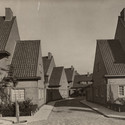
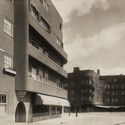
The Netherlands Builds in Brick is one of the latest exhibitions at Het Nieuwe Instituut (formerly the NAi) in Rotterdam. It seeks to modify the "assumed triumph of Modernism" in the interwar period, drawing upon two photographic collections from the Institute's extensive archives. The exhibition has been curated to highlight that brick remained the favoured construction material throughout the advocacy of the Modernist movement, even for experimental construction.
"Istanbul is exotic and modern," says architect Yener Torun, who has spent the last year documenting Istanbul's most contemporary and brightly colored spaces on Instagram. "It is funny, because my photos of Istanbul do not really look like Istanbul. And that is what I exactly wanted to do - to show a different site of the city, a side that was never focused on."
Critiquing Istanbul's recent explosion of growth and "bad" architecture, Torun set out to discover the city's lesser known, brightly colored spaces that have had a positive influence on day-to-day life. Now with nearly 40,000 followers, his quest is proving to have an affect and is inspiring him to spread his explorations beyond Istanbul to Ankara, Bursa, Izmir and Kocaeli.
See a selection of Torun's images, after the break.
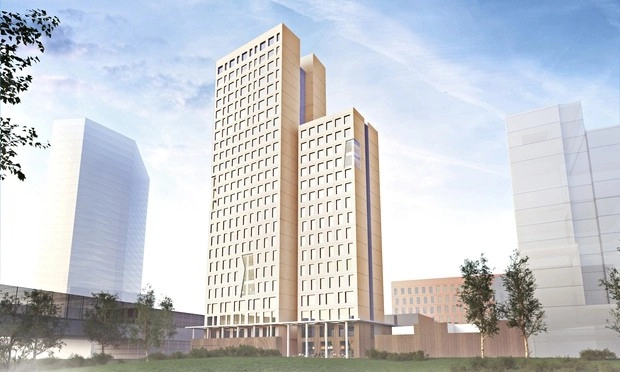
Rüdiger Lainer and Partner plans to construct the world’s tallest wooden skyscraper next year in Vienna’s Seestadt Aspern area. 76 percent of the 84-meter tower is expected to be made from wood rather than concrete, saving approximately 2,800 tonnes of CO2 emissions (equivalent to driving a car 25 miles a day for 1,300 years).
“I think it is important everyone now in 2014 thinks in different ways. We have wood, which is a perfect construction material for building,” she said. “It was used 200 years ago and it was perfect then and is perfect now,” says Kerbler project developer Caroline Palfy, commenting on the architects’ decision to use wood due to its environmental benefits.
An interior loft view and more details, after the break.
Already one of the simplest ways to share 3-D models around the web, Sketchfab has recently announced a new development that will make it even easier for architecture firms to share their latest work with their fans and students to spread their ideas among their friends: Facebook embed functionality. Simply by pasting the link to your Sketchfab work in a Facebook post, your model is instantly accessible to your friends and fans, and easy to share.
The Wienerberger Brick Award is a biannual architectural award that is presented to outstanding examples of modern and innovative brick architecture. In 2016, Wienerberger will present this internationally established award for the seventh time, and the award is now open for submissions. Architecture critics, journalists and for the first time also architects themselves can submit projects online until March 31, 2015. The official Brick Award ceremony will take place in Vienna in spring 2016.
The Award acknowledges innovative brick buildings of international quality that show the varied and diverse ways brick can be used in contemporary architecture. At the same time, the award, and in particular the accompanying architectural book, gives people with an interest in architecture, as well as experts, an overview of current developments and trends in international brick architecture with its remarkable range of applications.
https://www.archdaily.com/603902/brick-award-2016-call-for-entriesSponsored Post
Videos
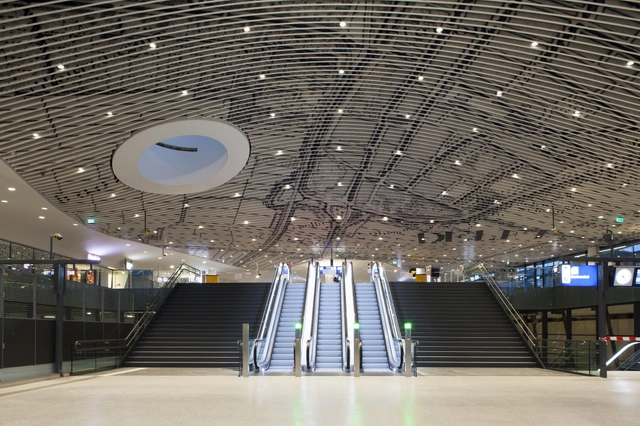
Arrival into the 'vaulted' station hall. Image Courtesy of Mecanoo
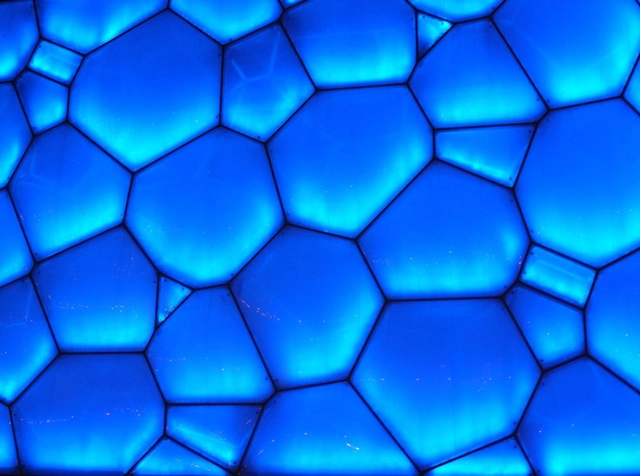
Six years after the original announcement of the project, the first phase of Mecanoo's new Train Station and City Hall complex in Delft, The Netherlands, has been opened to the public. Within the new station hall an undulating 'vault', which has been designed to evoke an "unforgettable arrival experience", features a scaled 1877 map of the Dutch city rendered in blue and white. Columns wrapped in a mosaic of Delft-blue titles, also reminiscent of the colours of Delftware, one of the city's most famous global exports. The station platforms below ground have been designed by Benthem Crouwel, the Dutch practice behind Rotterdam Centraal Station.
The Jacques Rougerie Foundation is now accepting registrants for its annual international architecture competition. Open to architects, engineers, and designers, the competition aims to inspire socially and environmentally conscious designs that utilize developing techniques for a sustainable future, enabling society to grow with its built environment. Composed of three categories in keeping with the foundation's focus - Innovation and Architecture for the Sea, Innovation and Architecture for Space, and Architecture and Sea Level Rise - the registration period ends June 2, 2015 and the winning proposals from each category will be announced at an award ceremony in December 2015. For full rules and registration information, visit here.
The objective of the "Re-Structuring Seunsangga Citywalk" competition in Seoul is to renovate the deck and nearby public space of Seunsangga Complex to improve the pedestrian environment and connect with surrounding areas of various nature and thereby re-establish a pedestrian axis from north to south through Bukaksan Mountain, Jongmyo~Seunsangga Complex, and Namsan Mountain. Not only is Seunsangga Complex Seoul's "urban-architectural heritage," it is a compound of history, culture and industry that connects the surrounding area and various activities.







_lichtzeit.com2.jpg?1425480334&format=webp&width=640&height=580)