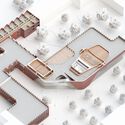
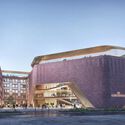
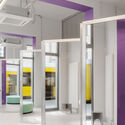
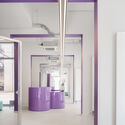
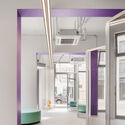
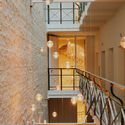
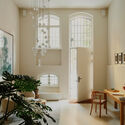
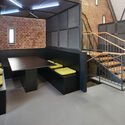
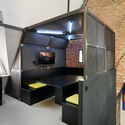
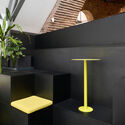
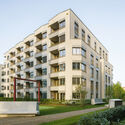
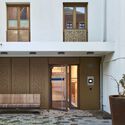
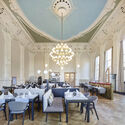
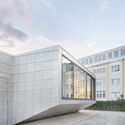
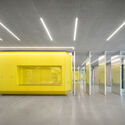
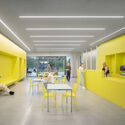
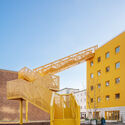
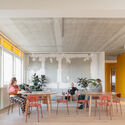
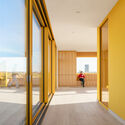
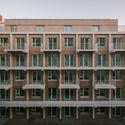
Restaurant Tour Total / Leyk Wollenberg Architects

Architects: Leyk Wollenberg Architects
Location: Jean-Monnet-Straße 2, Berlin, Germany
Architect In Charge: Leyk Wollenberg Architects
Design Team: Dietmar Leyk, Petra Wollenberg with Inken Blum, Florian Spaelty, André Rossmann
Area: 320 sqm
Year: 2012
Photographs: diephotodesigner.de
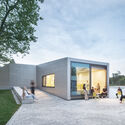
Tchoban Foundation – Museum for Architectural Drawing / SPEECH Tchoban & Kuznetsov
Architects: SPEECH Tchoban & Kuznetsov
Location: Christinenstraße 18a, 10119 Berlin, Germany
Architects In Charge: Sergei Tchoban and Sergey Kuznetsov
Planning, Project Management: nps tchoban voss GmbH & Co. KG, Berlin
Project Team: Philipp Bauer, Nadja Fedorova, Katja Fuks, Ulrike Graefenhain, Dirk Kollendt
Area: 498.0 sqm
Year: 2013
Photographs: Patricia Parinejad
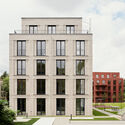
Artis Headquarters / Roswag Architekten

Architects: Roswag Architekten
Location: Berlin, Germany
Architect In Charge: Eike Roswag
Project Leader: Jan Schreiber
Planning: Maria Scheicher, Oriol Domínguez Martínez
Area: 1,978 sqm
Year: 2010
Photographs: Courtesy of Roswag Architekten
New Central Library in Berlin Winning Proposal / Envés Arquitectos

Designed by Envés Arquitectos, their proposal for the New Central Library in Berlin was named as one of the winners of the competition, which is conceived as an open, public, free and comfortable meeting place; summing up, an urban lobby. This flexible place is able to interact with a changing user (from a kid to an ancient), but simultaneously ensures the area’s accessibility and right usage. The library also aims to become an activity catalyst, a landmark to be perceived from far away. More images and architects’ description after the break.
50Hertz Headquarters Winning Proposal / LOVE

Designed by LOVE architecture and urbanism, the main goal of their winning proposal for the 50Hertz Headquarters in Berlin was to develop an innovative, transparent, open headquarters for the company that above all flows from inside to outside. The focus became to create flexible,versatile, and unique working environments, which are traversed by spacious outdoor spaces in the form of terraces, balconies and atriums. More images and architects’ description after the break.
New Central Library of Berlin Winning Proposal / FAR frohn&rojas

Mediating between iconic metaform and the human scale, this proposal by FAR frohn&rojas is one of the winners of the architectural competition for the new central library of the state of Berlin at the airfield of the former Tempelhof Airport in Berlin. By twisting a three dimensional grid from horizontal to vertical, the three key urban drivers of the site – the runway, the motorway and the former airport building – are resolved. More images and architects’ description after the break.
Living on Kunstcampus Winning Proposal / Léon Wohlhage Wernik Architekten
Léon Wohlhage Wernik Architekten was recently announced as the first prize winner for their proposal in the Living on Kunstcampus competition. Situated in the heart of Berlin, on the estate of the Hamburger Bahnhof, a new quarter will be created there, including the dominant urban planning element called the “Kunstkubus”. A lengthy building with a faceted surface gives the residential area its own urban planning presence. All apartments radiate spaciousness, and can be freely partitioned and enter into a relationship with the city through large loggias, or so-called “green rooms”. More images and architects’ description after the break.
AIV-Schinkel-Wettbewerb Competition Winning Proposal / David Weclawowicz + Dagmara Sietko- Sierkiewicz

The architecture student team collaboration of Dagmara Sietko- Sierkiewicz and David Weclawowicz of the Wroclaw University of Technology shared with us their first prize winning proposal in the AIV Schinkel- Wettbewerb 2013 competition. With this year’s topic of “TXL transformation”, their challenge was to develop a quarter made from a new typology of hybrid-buildings, containing a manufacture (production hall), flats and retail services after closing the airport Berlin Tegel in the year 2014. This winning concept focuses on using the production facilities after hours as a leisure destination. More images and architects’ description after the break.
‘THE:SQUARE³’ Mixed-Use Development Proposal / Moritz Gruppe + LAVA

Conceived by visionary developer Moritz Gruppe and designed by internationally acclaimed architects, LAVA, the three towers of gold, silver, and bronze and three diagonal shaped city blocks make up THE:SQUARE³, a new mixed use development inspired by sport that revitalizes a unique urban quarter in Berlin. With the theme, ‘Life, Nature, Sports’, their mixed-use concept is perfectly adapted and related to the nearby environment and reflects the local centre of excellence for high-performance sport, promotes local, national and global sports, generating positive social, health and economic benefits to the area. More images and architects’ description after the break.
‘Culture:City’ Exhibition

Taking place March 14-May 26, the ‘Culture:City’ exhibition encourages us to think consistently about the future of our cities from this perspective. Curated by Matthias Sauerbruch for the Akademie der Künste, the exhibit takes a critical eye to the relationship between architecture and the social reality of the 21st century and shows the impact of art and culture on cities and architecture. Art and culture have in many ways become key motors of innovative and successful urban design and planning, without which the world’s metropoles would no longer be worthy of the name. More information on the exhibition after the break.
Crematorium Baumschulenweg / Shultes Frank Architeckten

Architects: Shultes Frank Architeckten
Location: Berlin, Germany
Architect In Charge: Axel Schultes Architekten, Frank Schultes Witt
Design: Axel Schultes, Charlotte Frank
Project Management: Margret Kister, Christoph Witt
Collaborators: Daniela Andresen, Bob Choeff, Patrick Dierks, Christian Helfrich, Andreas Schuldes, Till Waninger
Area: 9,339 sqm
Photographs: Mattias Hamrén
Call for Proposals: ‘SMART CITY: The Next Generation’ Exhibition

Architects, Urban Planners, Engineers, and Activists with projects in Malaysia, Vietnam, Thailand, Cambodia, Indonesia, Singapore, Philippines are invited to send their proposals for an exhibition titled ‘SMART CITY: The Next Generation’. Organized by Aedes Architecture Forum, with the Goethe Institut/South-East Asia, under the guidance of curator Ulla Giesler, the exhibition will be held in Berlin at the their Architecture Forum between May and July 2013 within the framework of the Asia-Pacific-Week Berlin 2013. More information after the break.
‘Wolf D. Prix & Partner: 7+ Projects, Models, Plans, Sketches, Statements’ Coop Himmelb(l)au Exhibition

On the occasion of Wolf D. Prix’ 70th birthday, the Architekturforum Aedes in Berlin is devoting an exhibition to Coop Himmelb(l)au entitled “Wolf D. Prix & Partner: 7+ Projects, Models, Plans, Sketches, Statements”. The event began on December 12 and ends January 24. The event highlights 70 years, 7 projects, the 7 lives of an architect as the magical number 7 has been integrated into the exhibition concept in a variety of ways. This show, which opened just one day before the 70th birthday of Coop Himmelb(l)au founder Wolf D. Prix, begins with a backward glance at the founding year of 1968 and the theoretical roots of this architectural partnership. For more information, please visit here.
Moleskine Debate: Wiel Arets, Peter Wilson and Cino Zucchi

The Sketch, Script, Score. Figures of Architectural Thinking event is a conversation between Wiel Arets, Peter Wilson and Cino Zucchi presenting the “Inspiration and Process in Architecture” Moleskine book series. The event takes place at ANCB The Metropolitan Laboratory in Berlin on December 14th at 6:00pm. Which role does drawing still have in the design process? Which are the most frequent sources of inspiration to influence the theoretical work that is behind the making of architecture? The debate means to investigate the role that tools like drawing, sketching, taking notes, still have in the design process of contemporary architects. The discussion will encourage debate on what could be the tools of architectural thinking and design, in relation to drawing which remains the most powerful means of conceptualizing and representing architecture.
Platoon Kunsthalle Berlin / Platoon Cultural Development

Architects: Platoon Cultural Development
Location: Berlin, Germany
Area: 435 sqm
Year: 2012
Photographs: Courtesy of Platoon Kunsthalle Berlin
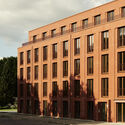
Hamburger Hof / NPS Tchoban Voss

Architects: NPS Tchoban Voss
Location: Berlin-Mitte, Germany
Area: 2,338 sqm
Year: 2010
Photographs: René Hoch
Daniel Libeskind’s Academy of the Jewish Museum Berlin Opens Today

It’s been nearly twelve years since visitors first experienced the emotionally charged design of Daniel Libeskind’s Jewish Museum Berlin. Since then, the museum has become an world-renowned icon whose public and education programs have more than doubled in size. With an ever-expanding archive and library, it was decided the museum should be supplemented by an additional facility.
Today, alongside museum officials, Daniel Libeskind celebrates the opening of the Academy of the Jewish Museum Berlin. The facility was created from a former Berlin Flower Market (Blumengrossmarkt), whose shell undergirds the new structure. It’s 25,000 square foot, one story space now houses a library, archives and education center, along with additional office, storage and support space.
A sneak peak and the architects’ description after the break…
Haus der Zukunft Competition Entry / Project Architect Company

Located around the Hauptbahnof in Berlin, the proposal for the Haus der Zukunft competition by Project Architect Company capitalizes on the site’s potential which lies between the Reichstag and the main railway station along the River Spree. The site is experiencing a surge in development, transforming a previously underused area into a new city-wide destination. The architects propose to use the building as an ‘urban activator’ to link the city and waterfront. More images and architects’ description after the break.