Yes Is More: The BIG Philosophy

Yes is more: an archicomic on architectural evolution – Bjarke Ingels presents his extraordinary architecture in cartoon-form

Anders Møller is the co-founder of GRASP Magazine, where this article was originally published.

What has the internationally awarded () to do with Friederich Nietzsche and Charles Darwin? Quite a lot, according to founder Bjarke Ingels, who has created a powerful mixture of Nietzsche and Darwin as the philosophical foundation of ’s architecture.

Read Anders Møller’s fascinating article on BIG’s unusual philosophy, after the break…

LEGO® Announces BIG Commission

Courtesy of BIG

It’s official! Danish architect Bjarke Ingels of BIG has been commissioned to collaborate with Ralph Appelbaum Associates () and COWI to design the first public LEGO® museum in the company’s hometown of BillundDenmark. The “LEGO® Brand House” and “experience centre” is intended to compliment the non-public “LEGO® Idea House”, which is also located in .

Bjarke Ingles, founder of BIG stated: “It’s going to be looking at LEGO® from all its different aspects—LEGO® as an art form, its cultural impact. When we were doing the research for it [the LEGO® house], we realized, if you would consider it just an art museum, you would be able to fill it with so much user content of such a high quality…it is one of our great dreams at BIG that we are now able to design a building for and with the LEGO® group. I owe a huge personal debt to the LEGO® brick, and I can see in my nephews that its role in developing the child as a creative, thinking, imaginative human being becomes ever stronger in a world in which creativity and innovation are key elements in virtually all aspects of society.”

More on LEGO®’s BIG commission after the break…

BIG’s Waste-to-Energy Plant Breaks Ground, Breaks Schemas

© BIG-

There are many things that set BIG’s latest project, Amager Bakke, apart. The plant, which broke ground yesterday, will be the cleanest waste-to-energy plant in the world. It will be the tallest and biggest building in . It will house Denmark’s first ski-slope (on the roof of the plant, no less). It will emit its CO2 emissions – not as a continuous stream of smoke, oh no – but in sudden, bursting smoke rings. 

However, the Amager Bakke waste-to-energy Plant is far more than the sum of its rather remarkable features. As an urban “destination in itself” and a landmark in environmental design, it’s one of the most radical representations of architecture as a means of public engagement of our time. And, what’s more, it’s a signal that BIG has finally reached maturity, truly coming into its own as a firm.

Read more about BIG’s remarkable Amager Bakke waste-to-energy plant, after the break….

Jury Announced for Lisbon Architecture Triennale 2013: Close, Closer

Courtesy of closecloser.com

The Lisbon Architecture Triennale has announced the panel of judges for this year’s projects. The panel will be composed of important architects like Bjarke Ingels of BIGMinsuk Cho of Mass StudiesPhillippe Rahm of Philippe Rahm Architects and Luis Santiago Baptista of the journal Arqa.

The theme of the Triennale this year is “Close, Closer” and it intends to initiate a discussion regarding the changing role of the contemporary architect. There will be three exhibitions, a lecture program, a series of electronic publications, student awards, a Debut Award for young architects and a career achievement award.

Bjarke Ingels in Sydney for HASSELL and AIA

Slussen in Stockholm / Courtesy of BIG

Bjarke Ingels, who heads up the Bjarke Ingels Group (BIG), was in Sydney recently and did a talk at the Australian Institute of Architects, which was sponsored and organized by HASSELL. With the common design values and easy fit between BIG and HASSELL, they make a powerful team. So BIG, whose projects we have published here, visited Sydney to explore the potential for future project collaborations. More information and a video after the break.

“My Playground: A Film about Movement in Urban Space” Documentary

A couple of years ago, we mentioned an interesting documentary about Parkour, and how such contemporary discipline is able to make reading the urban space in a different way.

The film was recorded mainly in , using locations such as the Mountain Dwellings designed by BIG. It also includes some conversations with , discussing about his understanding of urban space. It has been selected as part of the films program of the RIBA 2012. If you’re in London, you will have the chance to watch it next June 26th.

More info after the break

ArchDaily at the Center for Architecture! Going Viral: Blurred Borders

Via AIANY

Mark your calendars! In less than three weeks, ArchDaily founders David Basulto and David Assael will join of BIG, Toru Hasegawa of Morpholio and Columbia University, and Carlo Aiello of eVolo for a lecture and panel discussion that will explore the impact of social media, technology and device culture on the way we design and practice. Moderated by Ned Cramer, editor-in-chief of Architect, Going Viral is part of the AIANY 2012 Global Dialogues that has been dedicated to “uncovered connections” with the intention to investigate issues that are similarly impacting multiple regions, cultures and individuals. In addition, selected game changing blogs and websites will be exhibited as Voices Going Viral on the evening of the event.

Going Viral will take place at the NY Center for Architecture on May 21st at 6:00 pm. It is free to join, but please RSVP. Continue after the break for more information.

Video: Bjarke Ingels Exposes His Roots

As we have shared with you earlier, ’s The Next List has profiled the young, Danish architect Bjarke Ingels. Originally aspired to be a cartoonist or graphic novelist, Ingels quickly became fascinated with architecture when a Fall storm rolled through his hometown in North , knocking over trees and leaving him a surplus of lumber. It was then that he was inspired to design his first project, the ultimate childhood “fantasy fort” with a moat, drawbridge and all.  In Ingels first experience with value engineering, he quickly learned that “unless you really begin with the perimeters of reality you’ll end up sort of amputating your ambitions quite quickly.” Enjoy the video and be sure to check out CNN’s recent video focusing on the bold ideas behind BIG.

Additionally, Ingels contributed an essay entitled Rethinking social infrastructure” on CNN’s What’s Next blog. You can check it out here.

Reference: CNN, Archinect

Video: Bjarke Ingels, BIG


Danish architect Bjarke Ingels of -based group BIG tells Crane.tv that yes is more. His design philosophy, which he outlines in his latest graphic book, Yes is More, states that incorporating input from all elements of society, both elite and popular, allows the extraordinary to shine through in the everyday.

Video: Bjarke Ingels featured as a CNN “Next Lister”

Dr. Sanjay Gupta of ’s “The Next List” features the bold and innovative ideas of Bjarke Ingels, focusing on the West 57th project that is transforming Manhattan skyline. Ingels states, “In the big picture, architecture is the art and science of making sure that our cities and buildings fit the way we want to live our lives.” The video also features comments from Robert A. M. Stern, Dean at Yale School of Architecture, and Douglas Durst, the developer of West 57th. Check it out!

Reference: CNN

TEDx: Hedonistic Sustainability / Bjarke Ingels

In this video Bjarke Ingels shares his enlightened view on Hedonistic sustainability, challenging the misconception that one must give up a portion of their comfortable lifestyle in order to live sustainability. Ingels counteracts that delusion with examples that illustrate the possibilities of sustainable buildings and cities increasing life quality. He encourages architects to embrace their expanded roles of becoming “designers of ecosystems” by creating a world where our presence is not seen as detrimental to our environment through the integration of our “consumption patterns and leftovers” into our natural world. Ingels is optimistic as he shares Hollywood’s copy of ’s Denmark Pavilion for the Shanghai 2010 Expo in Iron Man 2. Ingels states, “If Hollywood starts ripping off sustainable architecture to portray science fiction it could be a sign we are moving towards Hedonistic sustainability.”

Reference: TEDxEast

WSJ. Magazine’s 1st Annual Innovator of the Year Awards

'Mountain Dwellings' by architect, Bjarke Ingels

WSJ. Magazine recently announced its inaugural Innovator of the Year Awards, honoring the most creative, disruptive, and influential individuals in the world today. In conjunction with the November issue of WSJ., seven winners will be honored at a dinner on Thursday, October 27, at the Museum of Modern Art in City. The November issue of WSJ. will hit newsstands on Saturday, October 29, as part of WSJ Weekend.

The winners of the 2011 WSJ. Magazine’s Innovator of the Year Awards are: Ai Weiwei (Art); Katie Grand (Fashion); Elon Musk (Technology); Bjarke Ingels (Architecture); Steve Ells (Food); Joris Laarman (Design); and The Giving Pledge, founded by Warren Buffet and Bill Gates (Philanthropy). More information on the awards after the break.

Lecture: Bjarke Ingels at A+D Museum

is the founding partner of Bjarke Ingels Group (BIG), which he started in 2005. You can check his projects right here.

The lecture will take place this Thursday, March 3 at 7:30 pm. Presented by LACMA and the A+D Architecture and Design Museum, Los Angeles; organized by Francesca Garcia-Marques, Hon. AIA/LA and Ann Videriksen, Hon. AIA/LA.

For more information go to the ’s official website.

Video: BIG’s Website as Presentation Tool

Bjarke Ingels recently appeared on CNN’s series Idea, very fitting for his architecture firm Bjarke Ingels Group or . Utilizing the firm’s website, Ingels turns it into a presentation tool, and with ease discusses the design process, sharing diagrams and photographs for four of their projects:  Mountain Dwellings, their submission to the Shanghai Expo complete with video of Ingels himself riding through the Danish Pavilion, the recently unveiled designs for West 57th in New York City, and the winning design for a new Waste-to-Energy plan in .   The quick, straightforward, and stylish presentation beckons the question, is there still a place for powerpoint?

Lecture: Bjarke Ingels at NSAD

Bjarke Ingels, award winning Danish architect and author and recently winner of our Building of the Year Award in the Cultural category, will deliver a lecture to NewSchool of Architecture and Design () students on his architecture and how the evolution of political, economic, and social issues in today’s society is manifested in architecture designs.

The insightful and at times humorous presentation, “YES is More”, will highlight the evening presentation, Friday, February 25 at 6 p.m. at the Museum of Natural History in Balboa Park. For more information on this lecture, please click here.

Update: West 57th / BIG

Courtesy of BIG

In the past few years, Bjarke Ingels’ architecture has slowly, but steadily, been gaining international attention. From housing projects to commercial entities to design ideas, Northern European countries have found themselves host to an abundance of angular geometries, bold forms, and straightforward approaches characteristic of Ingels. As we reported early last week, BIG will now take its signature style to Manhattan with a not-so-typical response for the design of a apartment building for client Durst Fetner Residential (be sure to read our coverage here).

After the excitement of seeing BIG’s fresh architectural idea respond to the character and context of New York, now, the harsh reality of board meetings and zoning regulations are the project’s next obstacle to overcome in the quest for final approval.

More about W57th’s approval process after the break.

A BIG New York Debut: West 57th

Courtesy of BIG

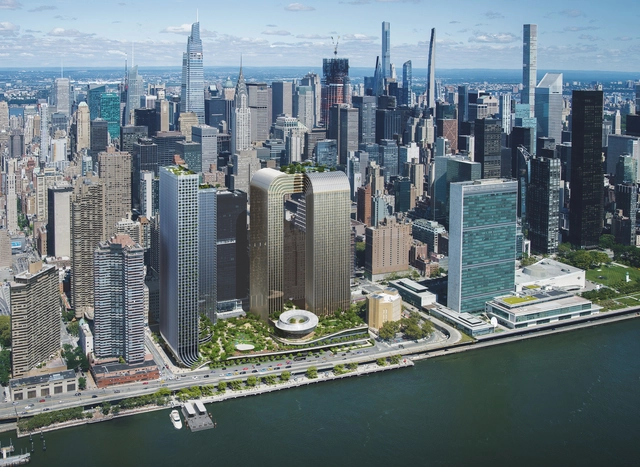
The awkwardly shaped large site at West Side Highway and 57th Street is about to get a whole lot more attention. and BIG will finally make their architectural debut in North America, with an unusual apartment building design in none other than New York City. The asymmetrical peak almost pyramid in shape is the result of blending the mismatched forms of a typical Manhattan tower podium and a low-rise apartment block European in style.

BIG’s reinvention of the ‘New York apartment building’ somehow is able to check all of the boxes, providing a connection to the waterfront and the Hudson River Park, acknowledging the surrounding context both in relationship to building size and neighbors’ views, and alleviating traffic noise. The leafy green courtyards that pop up within this new residential typology help to balance a steeply sloped facade, 450-feet at its peak. Designed for client Durst Fetner Residential, the building offers both a cultural and commercial program and will accommodate 600 residential units varying in size.

Follow the break for the architect’s description and more photographs.

Architects: BIG-Bjarke Ingels Group
Location: Manhattan, New York, USA
Partner in Charge: Bjarke Ingels
Project Leader: Beat Schenk
Project Architect: Sören Grünert
Project Team: Thomas Christoffersen, Celine Jeanne, Daniel Sundlin, Alessandro Ronfini, Aleksander Tokarz, Alessio Valmori, Alvaro Garcia Mendive, Felicia Guldberg, Gabrielle Nadeau, Ho Kyung Lee, Julian Liang, Julianne Gola, Lucian Racovitan, Marcela Martinez, Maria Nikolova, Minjae Kim, Mitesh Dixit, Nicklas Rasch, Riccardo Mariano, Stanley Lung, Steffan Heath, Thilani Rajarathna, Xu Li
Architect of Record: SLCE Architects
Landscape Architects: Starr Whitehouse
Structural: Thornton Tomasetti
MEP: Dagher Engineering
Civil: Langan Engineering
Construction Manager: Hunter Roberts
Transportation: Philip Habib & Assoc.
Building Envelope: Israel Berger & Assoc.
Marketing: Nancy Packes
Vertical Transportation: Van Deusen & Assoc.
Acoustical: Cerami & Assoc.
Wind: CPP
Environmental: AKRF
Client: Durst Fetner Residential
Project Area: 870,000 sqf
Renderings & Animation: German Glessner

Holcim Awards Juries Showcase Leading Experts on Sustainability

Yes is more: an archicomic on architectural evolution – Bjarke Ingels presents his extraordinary architecture in cartoon-form

Selecting the most outstanding projects in sustainable construction from several thousand submissions will be the challenging task of more than fifty leading experts on sustainability. The jury members for the 3rd International competition include architects Bjarke Ingels (Denmark), Keller Easterling () and Michel Rojkind (Mexico) – all independent experts of international stature engaged in the sustainable development of society, building processes, construction materials, and building projects.

Entries in the USD 2 million competition are evaluated using five “target issues” to define sustainable construction. Three of these stem from the triple bottom line of balanced social, environmental and economic performance. The two remaining issues pay homage to contextual and aesthetic impact, along with innovation and transferability. A series of five jury panels will meet in June/July 2011 in each of the five world regions: Europe, North America, Latin America, Africa Middle East, and Asia Pacific.

Video: Bjarke Ingels at ETSAM: Yes is More

Bjarke Ingels: Kazakhstan, Rio de Janeiro, NY and more

Our friend Cliff Kuang, editor of Co.Design, sat down with after his (second) arrival to NY. During the interview, Bjarke talks about his new teaching position at Harvard GSD, focused on the potential of the 2016 Olympics and the 2014 World Cup for Rio de Janeiro. They also talk about BIG’s National Library in Kazakhstan, and hint us on a new project currently in the boards for Manhattan, a “cross breed [between] the perimeter block and the high rise, to allow a communal garden in the heart of a building”, a building that we really want to see more about.

CK: It seems like things might be a lot different here, than in your home country. What can teach a young architect like yourself?

BI: As an architect, you’re always trying to accommodate different interests in a single building, from the residents to the developers to the city planning officials. In Manhattan, the density makes that even more extreme, and there’s something in the American culture about bringing together competing interest groups. I mean, this is the country that invented surf & turf! I mean, steak and lobster! What other country would thing to combine those two extremes? I sense some interesting possibilities here.

CK: A lot of your buildings — such as the 8 House apartments and the Mountain Dwellings project, or the Astana National Library and the Danish pavilion look like evolutions of a theme. Is that part of BIG trying to develop an aesthetic, or a signature?

BI: No, we don’t have a commitment to certain forms or styles. But as we develop stuff we learn how things relate and connect, and we learn how those forms can be reinterpreted to create new possibilities. So for example, the basic form of the 8 House, which allowed both a courtyard and views and a sloping green roof, has become in TED [pictured below] which attempts to bring street life up to the level of the penthouse.

It’s a bit like in nature how some fish developed bigger flippers that could be used as legs. It’s not like the fins had a purpose for walking, but through an act of relocation and misinterpretations, they became legs. A major part of design evolution is that things developed for one purpose can be used in other ways. And that’s why you see diversity and continuity in design.

Read the whole interview at Co.Design »

8 House: BIG win for BIG

Photo Courtesy of

BIG has proven in the past to be a source of innovating projects. Their idea is far beyond the superficial: it´s about improving the city, as you can see on this presentation by Bjarke Ingels for 8 House.

For this project -which will open in October-, BIG has been honored by the Scandinavian Green Roof Association as the Best Green Roof in the Scandinavia for its 1.700 m2 sloping green roof at an award ceremony held at 8 House in Oerestad, .

More information about this award after the break.