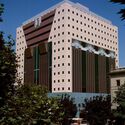
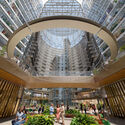
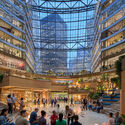
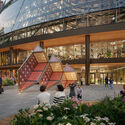
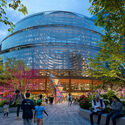
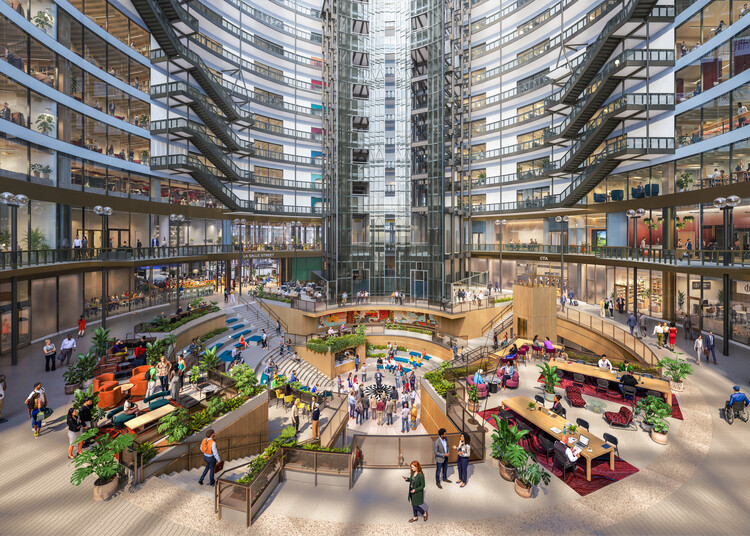
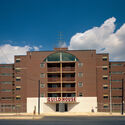
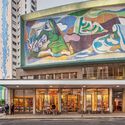
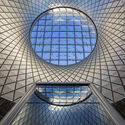
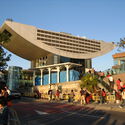
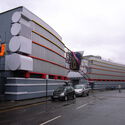
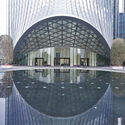
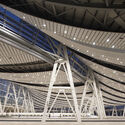
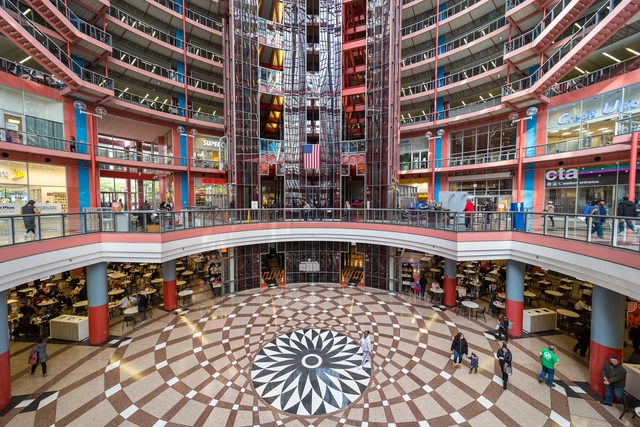
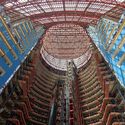
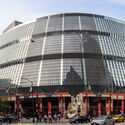
On September 16, 2026, Google announced the redevelopment of Chicago's Thompson Center as a space for work, culture, and community. The James R. Thompson Center is a postmodern architectural landmark designed by Helmut Jahn and completed in 1985. Commissioned by Illinois Governor James R. Thompson, the building reinterprets the classical state capitol by turning the traditional dome-and-public-plaza concept inside out. Occupying an entire city block in Chicago's Loop, it features a multicolored, curved glass atrium and a sloping, transparent corner entry. Controversial from day one, it has been criticized for poor climate control, high maintenance costs, and structural and leak issues. To restore it rather than demolish it, the company collaborated with Architecture Plus Information (A+I) to design a project that would integrate the building into the urban life of Chicago's Loop.
In a slim volume with a yellow-edged cover, recently published by the Porto-based imprint Circo de Ideias, the architect Paulo Martins Barata (a founding partner of Promontório) makes a deceptively bold claim that the architecture produced in Europe since the Great Recession belongs to neither of the two camps that structured the twentieth century's fiercest disciplinary debate.
The Language of Metamodern Architecture borrows its title, with evident irony, from Charles Jencks' 1977 The Language of Post-Modern Architecture, the book that famously declared modern architecture dead at 3:32 pm on July 15, 1972, with the demolition of Pruitt-Igoe. His wager is that another death, never officially certified, occurred somewhere around 2008, and that architecture has been living, mostly unaware, in what grew up around the grave.
Dornbracht's Coya series designed by Sieger Design. Image Courtesy of Dornbracht
When is a form still circular or rectangular? In twentieth-century modernism, this question was largely absent. Architecture was built on clarity, reduction, and formal purity. Influenced by architects such as Le Corbusier and Ludwig Mies van der Rohe, modernist design established a visual order based on rational geometry, industrial materials, and the rejection of ornament. Circle and square, function and expression, were kept strictly apart—a logic that dictated the rigid, modular layouts of traditional bathrooms for decades.
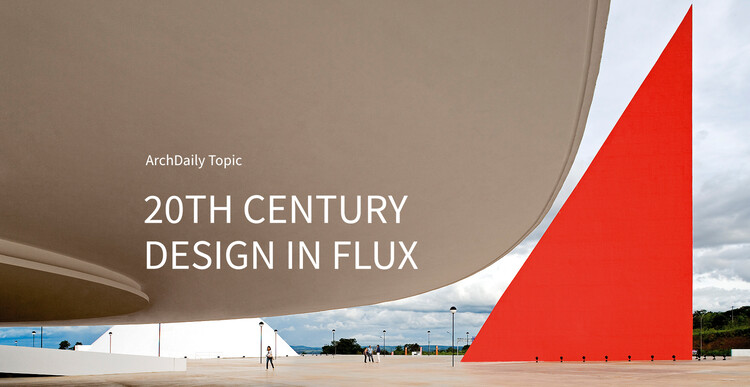
"The story of architecture is not wrong," argued Lesley Lokko in her introduction to the Venice Architecture Biennale 2023, "but it is incomplete." For most of the 20th century, architectural history spoke in one tongue: a singular, dominant narrative centered on a handful of movements, names, and cities, whose reach and influence appeared universal precisely because alternative voices were rendered inaudible. Design movements, however, rarely traveled intact across borders. They were frequently absorbed, resisted, reinterpreted, and transformed depending on geography, politics, economy, climate, and available materials. What arrived in one place as doctrine became, somewhere else, something entirely different.
This month, ArchDaily explores 20th Century Design in Flux: A Global Reinterpretation of Architectural History, a topic that traces the century's design languages not as a single canon but as a constellation of evolving, intersecting, and continually reinvented trajectories. The theme challenges the assumption that regional and non-Western architectures were merely derivative — positioning them instead as sites of active reinterpretation, where global ideas were filtered through local materials, climates, labor, and cultural practices to produce something entirely distinct.
"We know we are not born to die," often said Brazilian architect Paulo Mendes da Rocha. "We are born to continue." In architecture, this idea of continuity lies at the heart of heritage, not as a static inheritance, but as something that endures, transforms, and is constantly reinterpreted. Yet what continues, and what is allowed to disappear, is never neutral. Decisions about preservation are shaped by power, memory, and value, raising a fundamental question for contemporary practice: who defines what is worth carrying forward, and for whom?
Every year brings new ideas, projects, and shifts in architectural culture, but it also marks the loss of voices that have shaped the discipline across decades. Architecture moves forward, but it also advances through absence. When figures who helped articulate its language and its ambitions disappear, they leave behind more than completed works or influential texts. Their absence becomes a threshold, a moment in which the discipline pauses to understand what remains, what evolves, and what continues to guide us. These moments of loss remind us that architecture is a long, collective construction, carried not only by those shaping the present but also by those whose visions continue to orient how we think about cities and landscapes.
The architects and thinkers we lost in 2025 came from remarkably different worlds, yet the questions that shaped their work often intersected. Some approached the city through identity, symbolism, and historical continuity, seeking to ground the built environment in cultural memory. Others interpreted it through engineering precision, ecological systems, or radical experimentation, expanding what architecture could be and how it could be experienced. Their work spans contexts as diverse as postwar Britain, rapidly urbanizing China, Central European avant-gardes, and the evolving cultural institutions of Berlin and New York. Together, they form a spectrum of responses that defined, and continue to define, architectural culture over the last half-century, revealing the multiplicity of ways in which architecture can engage with society, technology, and the environment.
Architecture has never been confined to the act of building. It constantly negotiates between material practice and intellectual reflection, yet throughout the twentieth and twenty-first centuries, many architects felt that the built project alone was insufficient to address the full range of questions facing the discipline. Economic pressures, political contexts, and programmatic demands often narrowed the scope of practice.
Exhibitions and curatorial platforms, by contrast, created spaces of experimentation and critique, opening arenas where architecture could interrogate itself, where its past could be reinterpreted, its present challenged, and its future projected. In this tension, the figure of the architect-curator emerged, treating curating itself as a form of design — not of walls or facades, but of discourse, narratives, and frameworks of meaning.
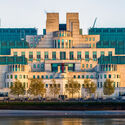
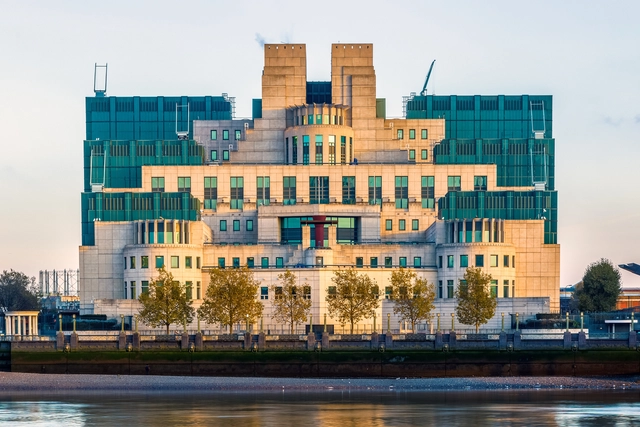
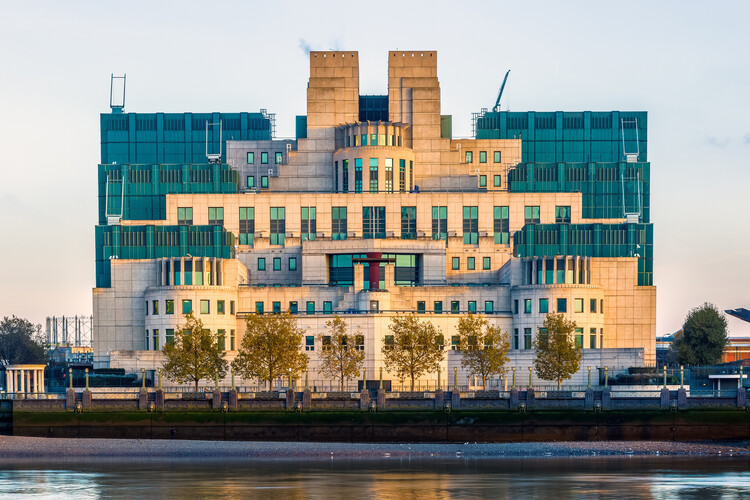
Farrells, the London-based architecture and urban design practice, announced earlier today the death of its founder, architect Sir Terry Farrell. The firm highlighted Farrell's commitment to questioning architectural convention and his advocacy for more responsible, contextual, and community-driven approaches to urban development, seeking creative alternatives to wholesale demolition and rebuild. His death follows that of his early collaborator Nicholas Grimshaw, with whom he founded the Farrell/Grimshaw Partnership in 1965. Together they produced functionalist, modern buildings defined by their structural clarity, before Farrell established his independent voice as one of the leading figures of British Post-Modernism, designing some of the movement's most recognisable works, including London's MI6 Building and the TV-am studios in Camden.
Modernism, a movement that sought to break away from traditional forms and embrace the future, laid the groundwork for many technological and digital advancements in contemporary architecture. As the Industrial Revolution brought about mass production, new materials, and technological innovation, architects like Le Corbusier, Walter Gropius, and Mies van der Rohe championed the ethos of "form follows function" and a rational approach to design. Their principles resonate in the digital age, where computational design and high-tech materials redefine form and construction.
The 20th century's modernist ideals — efficiency, simplicity, and functionality — created a foundation for architects to experiment with structural clarity and material honesty. High-tech architecture, which emerged in the late 20th century, evolved from these principles, merging modernism's clean lines with advanced engineering and technology. This paved the way for parametricism and algorithm-driven design processes, revolutionizing architecture and enabling complex forms previously thought impossible.
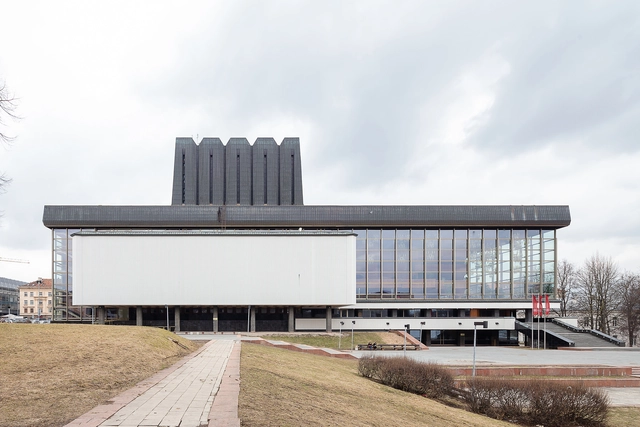
Standing out among the array of cultural programs, the opera and theater typology is often understood as encompassing the luxurious and elitist spirit of a bourgeois society focused on entertainment. Across the Soviet Union, this represented the opposite of the principles to be promoted. However, despite the opposition of the political class, the program remained widely popular. As the historical structures, symbols of the previous regime could no longer be promoted, the search began for a new image of the Opera House, one aligned with Socialist ideals and the concept of "art belonging to the masses."
This is the case of Soviet Lithuania, which, in the 1940s, began the process of developing a new Opera and Ballet Theater in Vilnius to replace the theatre in Pohulianka. The process resulted in an unusual commission, as young architect Elena Nijolė Bučiūtė won the 1960s competition for architectural design, turning the initial socialist realist proposals into a welcoming and expressive design, blending elements of early and late modernism. This also represents a surprising accomplishment for a young architect who was a woman and not a member of the Communist Party. Open House Vilnius featured the project in its program for several editions.
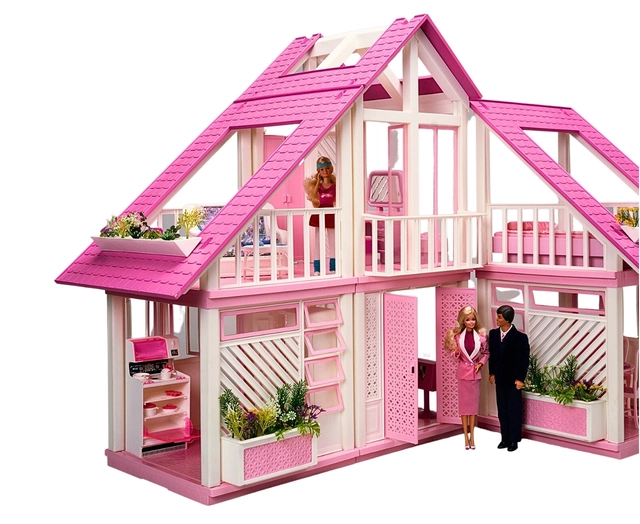
In her 1959 debut by Mattel, Barbie became a doll that transformed the toy industry and has been a popular culture icon ever since. 3 years later, the first accompanying Barbie Dollhouse was created, a home for Barbie representing her domestic, habitual, and day-to-day life. Over the past 60 years, Barbie Dreamhouses have changed and evolved, each iteration adopting the architectural and design fads of the eras in which they were produced. In fact, each dollhouse is an artifact of the unique blend of history, politics, popular culture, trends, and design styles that define architecture as we know it.
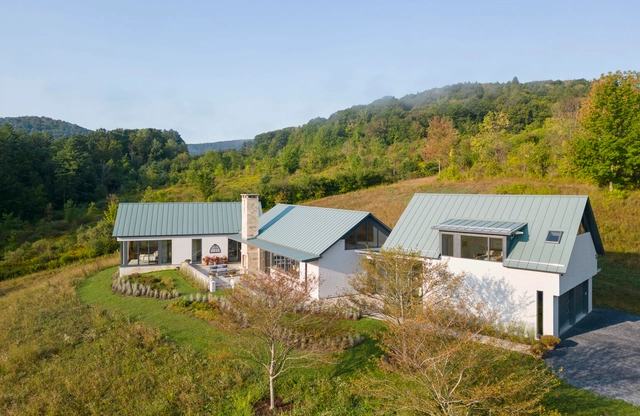
About 50 years ago, the renowned architect, educator, and author Charles Moore was hired by Frederick and Dorothy Rudolph to design a vacation house on Captiva Island, Florida, and about a decade later, in the late 1970s, they hired him again to design their permanent residence in Williamstown, Massachusetts.
Moore was often called the father of Postmodernism and was a prolific proponent through such books as The Place of Houses. With the exception of his small houses, however, I was never a big fan of his work. But I still have a tattered copy of that book, because when I read it, it was the first time that someone had articulated the process of designing a house, including a programmatic checklist to follow.