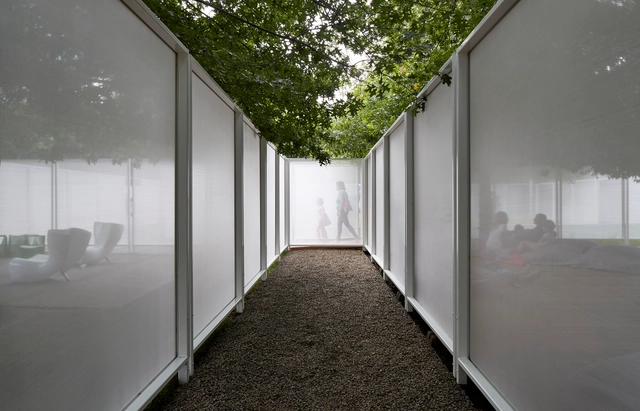
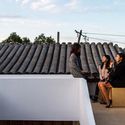
With an interplay of light and water, the pavilion seeks to evoke the sensation of the domestic architecture of Mexico, from where Escobedo hails. The stacked cement tiled visible in the photographs form a "celosia," a type of permeable wall common in Mexico.
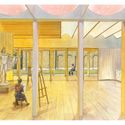
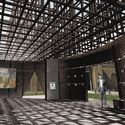
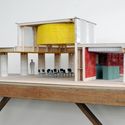
Following deliberation from a judging panel of industry experts, six emerging architecture firms have been shortlisted for the design of the DulwichPavilion 2019 in London, chosen from over 150. In collaboration with the London Festival of Architecture, the six schemes will be displayed at the Dulwich Picture Gallery throughout June and July of 2018.
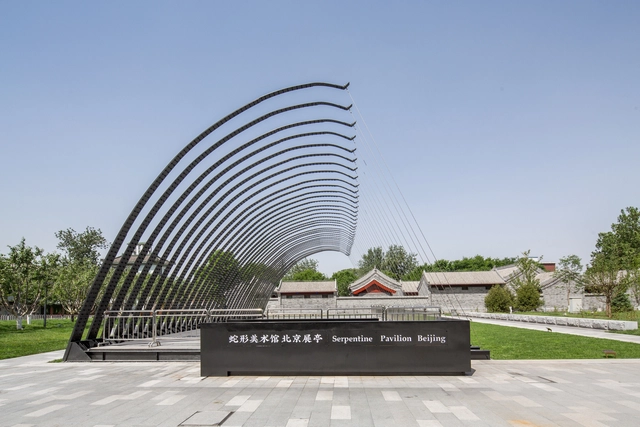
A new Serpentine Pavilion has opened in Beijing, China, marking the first time the prestigious program has been implemented away from its usual home at the Serpentine Gallery in Hyde Park, London. Designed by JIAKUN Architects, the pavilion was commissioned by The Serpentine Galleries working in partnership with WF CENTRAL, and is located just 600 meters away from Beijing's Forbidden City.
Continuing towards its goal of creating design-forward structures that are available to the public and installable anywhere, Revolution Precrafted's series has unveiled its latest pavilion design by Ben van Berkel, founder and principal architect of UNStudio. The limited edition Ellipsicoon (a portmanteau of Ellipse and Cocoon) is available now through Revolution Precrafted’s website, joining the selection of prefabricated pavilions and single-family home designs by the likes of Zaha Hadid, Jean Nouvel, and Daniel Libeskind.
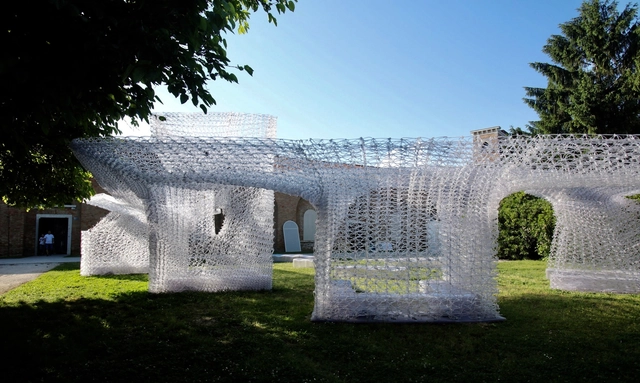
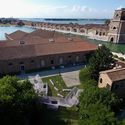
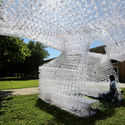
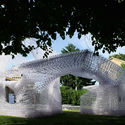
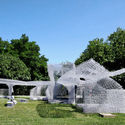
The Chinese Pavilion at the 2018 Venice Architecture Biennale, themed "Building a Future Countryside", is endeavored to explore new technology and ideas to make better of China's rural areas. A digitally-fabricated outdoor pavilion "Cloud Village" has been set up in addition to the national exhibition at the Venetian Arsenale. The Cloud Village has a twisting form which creates a sequence of open and semi-enclosed spaces under its roof. It seeks to convey an abstraction of the everyday life in Chinese countryside where boundaries of private and public realms are not always defined.
The Cloud Village is structurally made possible by the robotic printing technology developed by Philip F. Yuan and his team. Read below for a detailed account of the project from the architects.
Interior view of Pavilion designed by Francis Kéré at Tippet Rise Art Center in Montana. Image Courtesy of Kéré Architecture
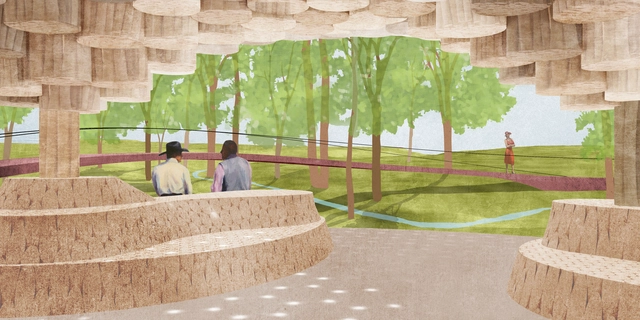
Tippet Rise Art Center has announced the commissioning of architect Francis Kéré to design a 1,900-square-foot pavilion for the center’s 10,000-acre grounds in Montana, USA. Envisioned as a “communal gathering space nestled among a cluster of aspen and cottonwood trees,” new renderings by Kéré Architecture depict the scheme featuring a locally-sourced log canopy.
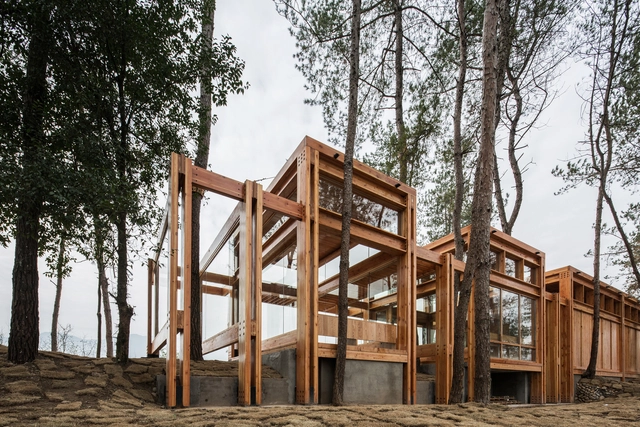
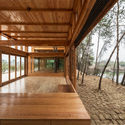
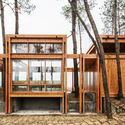
Travel seven hours by car in a Southwest direction from Shanghai and you will arrive in Songyang County. The name is unfamiliar to many Chinese people, and even more foreign to those living abroad. The county consists of about 400 villages, from Shicang to Damushan.
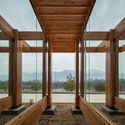
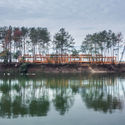
Here, undulating lush green terraces hug the sides of Songyin river valley, itself the one serpentine movement uniting the lands. Follow the river and you will see: here, a Brown Sugar Factory; there, a Bamboo Theatre; and on the other side, a stone Hakka Museum built recently but laid by methods so old, even the town masons had to learn these ways for the first time, as if they were modern methods, as if they were revolutionary.
And maybe they are. Songyang County, otherwise known as the “Last Hidden Land in Jiangnan,” may look like a traditional Chinese painting with craggy rock faces, rice fields and tea plantations, but it has also become a model example of rural renaissance. Beijing architect Xu Tiantian, of the firm DnA_Design and Architecture, has spent years surveying the villages of Songyang, talking to local County officials and residents, and coming up with what she calls “architectural acupunctures.”
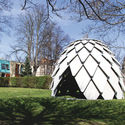
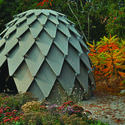
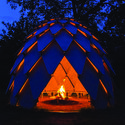
Designed by Czech designers Atelier SAD and distributed by mmcité1, this mobile, nature-inspired gazebo is a playground must-have for children and adults alike. 109 waterproof, plywood scales are treated with resistant glaze and connected by galvanized joints to create a self-supporting, sustainable structure.
UK-based design studio NEWSUBSTANCE has debuted at the Coachella Valley Music & Art Festival with a seven-floor pavilion taking visitors on an “ever-changing journey of light, color and perspective.” The 75-foot-high (23-meter-high) pavilion named “Spectra” consists of a spiral form featuring an observation deck at its peak, projecting a rainbow band of color.
The dazzling color scheme is produced by the separation of light waves by their varying degrees of refraction, embodying the lively spirit of the Coachella festival. Through this manipulation of the physical properties of light, Spectra is capable of producing over 16 million colors.
https://www.archdaily.com/892652/newsubstances-coachella-pavilion-takes-visitors-on-a-journey-of-light-and-colorNiall Patrick Walsh
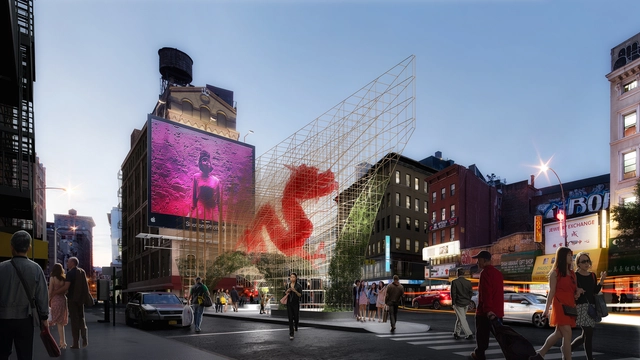
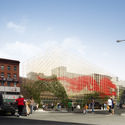
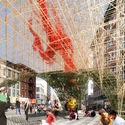
ODA New York has released images of its proposed “Dragon Gate” pavilion for New York’sChinatown, seeking to act as a symbolic gateway to the famous Manhattan neighborhood. Using modern materials and forms to invoke symbols of traditional Chinese culture, the scheme seeks to capture Chinatown’s remarkable duality: a community of tradition resistant to change, yet one regarded as a uniquely contemporary phenomenon showcasing New York’s inclusive diversity.
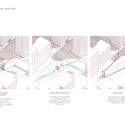
Situated on a triangular traffic island at the intersection of Canal, Baxter, and Walker Streets, ODA’s scheme seeks to activate a currently-underused pedestrian space. The Dragon Gate consists of a triangular form adhering to a three-dimensional, gridded structure formed from interwoven, tubular, bronze steel inspired by bamboo scaffolding. As the structure densifies, selected pieces will be painted red to create the illusion of a dragon in mid-flight.
https://www.archdaily.com/891930/oda-unveils-images-of-bamboo-inspired-dragon-gate-for-new-yorks-chinatownNiall Patrick Walsh
OMA New York has released initial details of its design for the Audrey Irmas Pavilion, a new addition to the Wilshire Boulevard Temple in Los Angeles, California. The OMA scheme, currently seeking planning approval, seeks to “forge new connections within the existing campus and create a new urban presence to engage Los Angeles.”
Having won a competition for the pavilion's design in 2015, the OMA scheme represents the firm’s first commission from a religious institution and their first cultural building in California. Designed in collaboration with Gruen Associates, the Audrey Irmas Pavilion will form the newest addition to the Wilshire Boulevard Temple, the oldest Jewish congregation in Los Angeles. The scheme will serve as a multi-purpose gathering space in what Rabbi Steve Leder regards as “the city’s most diverse neighborhood.”
https://www.archdaily.com/891674/oma-reveals-pavilion-design-for-wilshire-boulevard-temple-in-los-angelesNiall Patrick Walsh
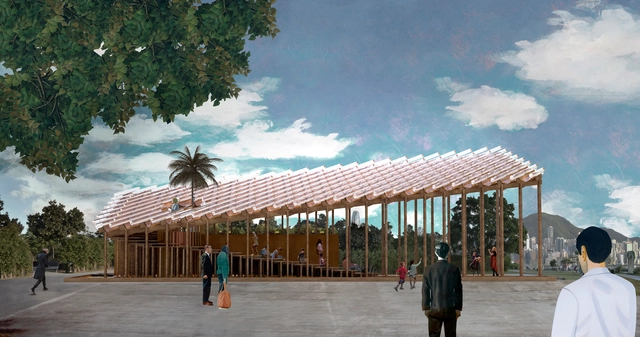
The West Kowloon Cultural District Authority (WKCDA) has announced the winning design for the inaugural Hong Kong Young Architects and Designers Competition. The competition asked local architects and designers emerging in their careers to design a "temporary pavilion that promotes sustainability and addresses economic and natural resources." The winning design, titled Growing Up, by New Office Works is a timberpavilion that sits on the waterfront in Nursery Park at West Kowloon. Paul Tse Yi-pong and Evelyn Ting Huei-chung from New Office Works will serve as Design Advisors with the project set to open in fall 2018.
For students of architecture, few things are as thrilling as seeing one of their designs physically built. For a group of Polish and Norwegian-based students, this dream has become a reality.
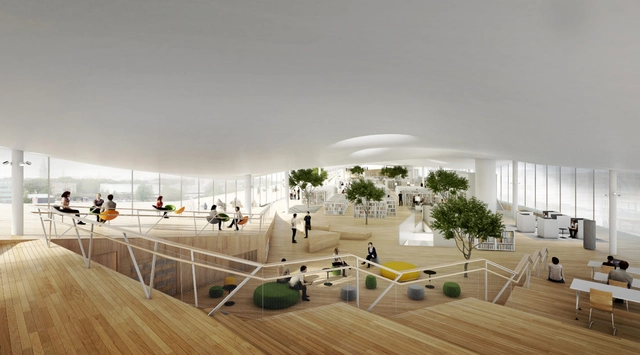
As part of our 2018 Venice Architecture Biennale coverage we present the proposal for the Finnish Pavilion. Below, the participants describe their contribution in their own words.
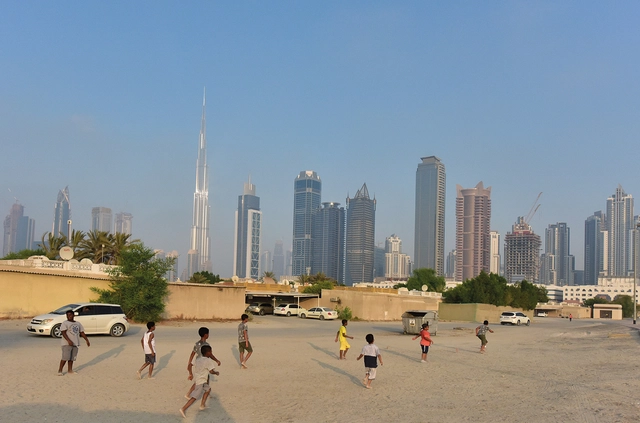
Children playing soccer on sandy street outside the boundaries of bigness. Image Courtesy of National Pavilion UAE - la Biennale di Venezia
As part of our 2018 Venice Architecture Biennale coverage we present the proposal for the UAE Pavilion. Below, the participants describe their contribution in their own words.
The National PavilionUAE will present “Lifescapes Beyond Bigness,” an exhibition exploring human-scale architectural landscapes, at the 2018 Venice Biennale. The exhibition aims to highlight the role of architecture and urban design in forming the choreography of people’s daily routines. It particularly investigates the role of ‘quotidian’ (every day) landscapes in accommodating, enhancing, and facilitating social activities across different places in the UAE.


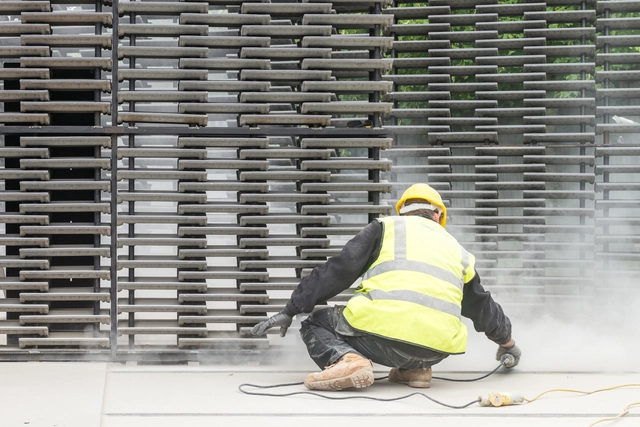


_copy.jpg?1528216145 "© e10 Studio")

.jpg?1527130515&format=webp&width=640&height=580)
.jpg?1527130564 "Courtesy of UNStudio")
.jpg?1527130554 "Courtesy of UNStudio")
.jpg?1527130539 "Courtesy of UNStudio")
.jpg?1527130531 "Courtesy of UNStudio")
.jpg?1527130515)




.jpg?1524158077)
.jpg?1524158077&format=webp&width=640&height=580)
.jpg?1524158612 "Brown Sugar Factory. Image © Wang Ziling")
.jpg?1524163466 "Teahouse, Damushan Tea Valley. Image © Chen Hao")
.jpg?1524164629 "Teahouse, Damushan Tea Valley. Image © Jiang Xiaodong")
.jpg?1524158127 "Bamboo Pavilion. Image © Zhou Ruogo")
.jpg?1524158212 "Bamboo Pavilion. Image © Zhou Ruogo")
.jpg?1524163398 "Bridge at Shimen Village. Image © Han Dan")
.jpg?1524163448 "Bridge at Shimen Village. Image © Wang Ziling")
.jpg?1524163483 "Bridge at Shimen Village. Image © Wang Ziling")
.jpg?1524163637 "Wang Jing Memorial Hall. Image © Wang Ziling")
.jpg?1524158077)