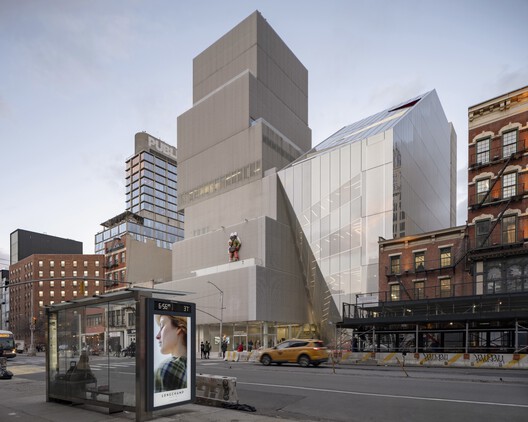
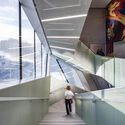
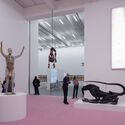
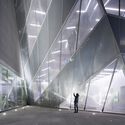
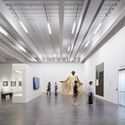
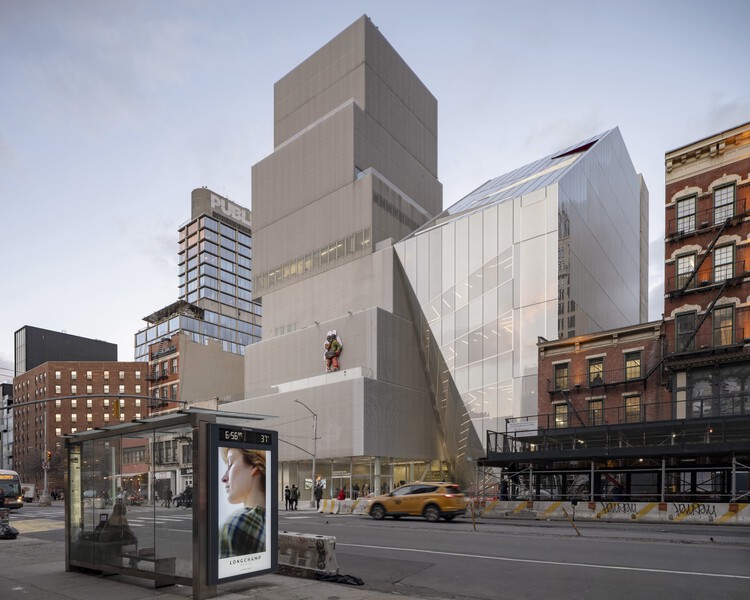
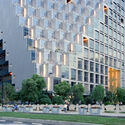
When the New Museum's original SANAA-designed building, a stack of shifted opaque boxes wrapped in a metal mesh skin, opened in 2007, it already seemed destined for some form of expansion to relieve the vertical pressure created by its constrained circulation and limited footprint. In March, the museum unveiled its long-anticipated addition, designed by OMA's Shohei Shigematsu and Rem Koolhaas. The angular and slightly set-back companion building doubles the museum's exhibition capacity while reshaping the institution's relationship to the city and to the original SANAA structure by Kazuyo Sejima and Ryue Nishizawa.
At the building's press opening, Koolhaas described the project "not simply as an extension but as a complement or counterpart." Shigematsu later elaborated: "We thought about designing a pair composed of two distinct and yet highly connected buildings. One is more vertical and introverted. The other is more horizontal and extraverted."
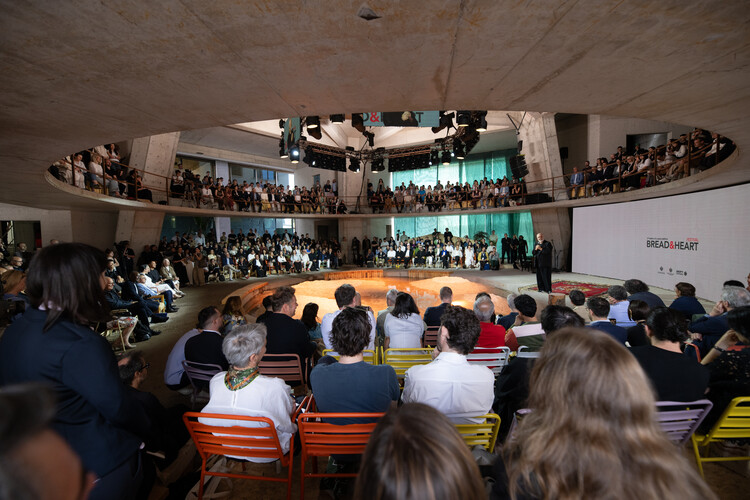
Bread & Heart Festival 2026. Image Courtesy of Bread & Heart Festival
Something has been happening in Tirana that the architectural world has not quite found the language for. In the space of a few years, a city of less than a million people in one of Europe's least-known countries has become the site of an extraordinary concentration of architectural ambition — a place where offices that rarely work in the same city, let alone the same decade, are building simultaneously, and where the questions that preoccupy contemporary architecture seem to arrive with an unusual urgency.
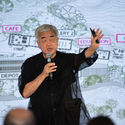
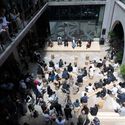
The second edition of the Bread & Heart Festival, held in Tirana from June 3 to 5, brought together more than two hundred architects, urban planners, developers, and professionals from across Europe, the Americas, Asia and beyond to discuss "Landscapes of Abundance", a theme organized around the curatorial premise of moving from portrait to landscape, from the individual building to the territory as a whole. The room it assembled would be difficult to replicate anywhere else in the architectural calendar: Francis Kéré, Jeanne Gang, Sumayya Vally, Pierre de Meuron, Bjarke Ingels, Reinier de Graaf, Stefano Boeri, Kersten Geers, Benedetta Tagliabue, Ma Yansong, among them.
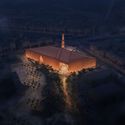
Covering a broad array of subjects, this week's headline stories have reflected the wide scope of architecture's practice: its potential to respond to the climate crisis, the construction and renovation of cultural infrastructure around the world, and events that promote contemporary disciplinary reflection. This does not preclude questions about the contradiction between the technical and creative skills demanded by the discipline and the role it has come to occupy in today's market. Alongside these reflections, this week we feature projects that reinforce architecture's cultural significance in preserving knowledge, hosting collective entertainment, and supporting new forms of living: a comic book museum in Taiwan, a membership club for families in London, and the renovation of a landmark stadium in Riyadh.
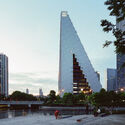
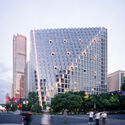
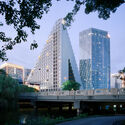
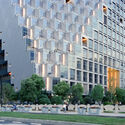
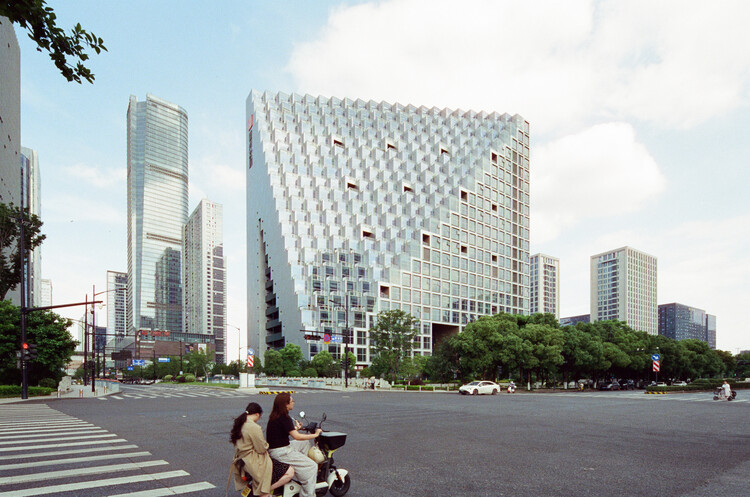
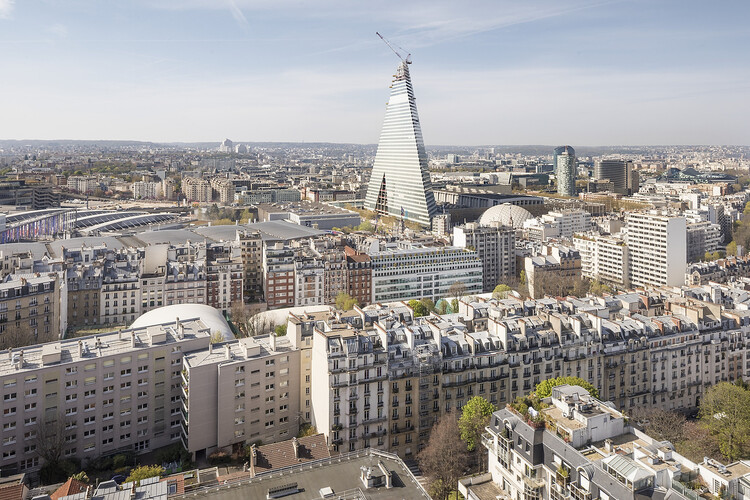
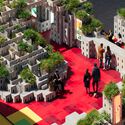
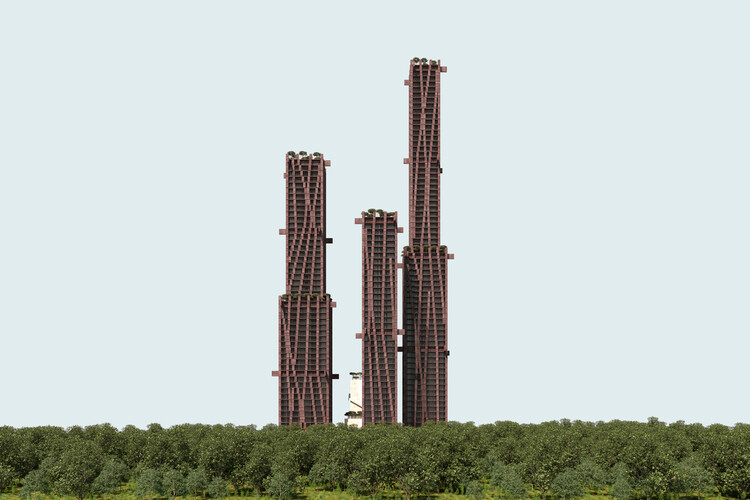
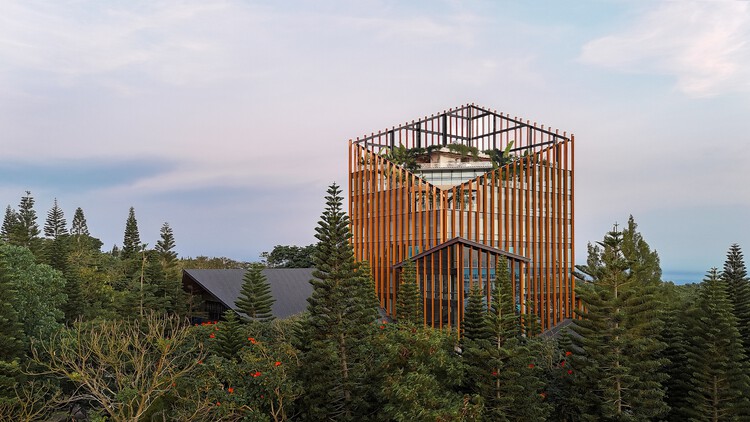
OMA has completed the Hangzhou Prism, a large-scale mixed-use development in Hangzhou's Future Tech City district, China, following a design and development process that began in 2016. Commissioned by Xinhu Real Estate Group and led by OMA Partner Chris van Duijn, with Michael Hadjistyllis serving as project architect, the project combines residential units, a hotel, offices, commercial spaces, and public amenities within a single building volume. Marking OMA's first completed project in Hangzhou, the development occupies a central site within one of the city's emerging innovation and business districts.
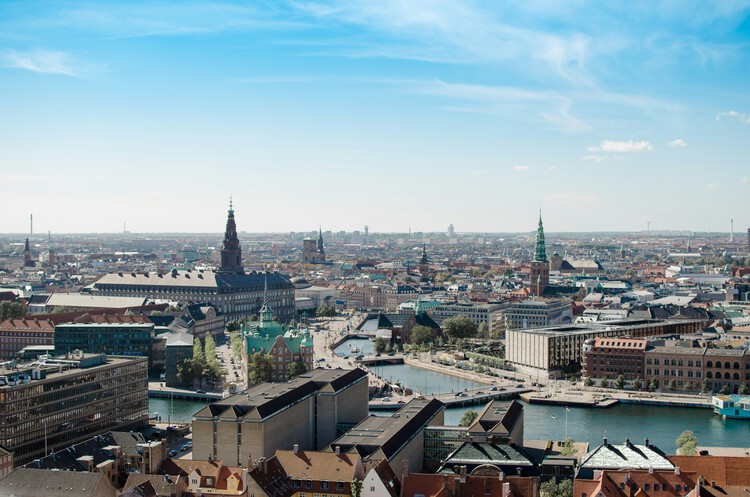
Copenhagen, Denmark. Image Courtesy of Lindsay Martin via Unsplash
Copenhagen is long famous as the global capital of human-scale design and livability. Today, the city has widened its focus and is an active space where mid-century Scandinavian modernism meets the modern demands of climate adaptability, material circularity, radical conservation, and neighborhood density. During the first-ever Copenhagen Architecture Biennial, in 2025, the city transformed into a global platform for dialogue under the theme "Slow Down," exploring how architecture can respond to global pressures by rethinking the pace of change. And this year's 13th edition of the 3daysofdesign Festival will explore the theme of "Make This Moment Matter", encouraging the global design community to step away from digital noise and mass production to focus on the present.
This week, we revisited the ideas currently shaping the design of 21st-century cities, with a view toward a longer timeframe than that which characterised modern design. These examples of today's urban design point toward the cities of tomorrow, seeking to reflect collective memory and social identity while addressing the climate challenges we face today. From a new museum in Panama drawing on Latin American architectural tradition to an inflatable installation on Paris's oldest bridge over the Seine, built and not-yet-built projects rescue architecture as a repository of collective memory, while others explore its transformative potential through the lens of contemporary well-being. In this weekly news compilation, we present ongoing projects from Panama, numerous African countries, France, Canada, Italy, Australia, and the United States.
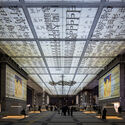
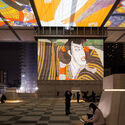
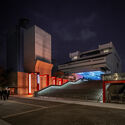
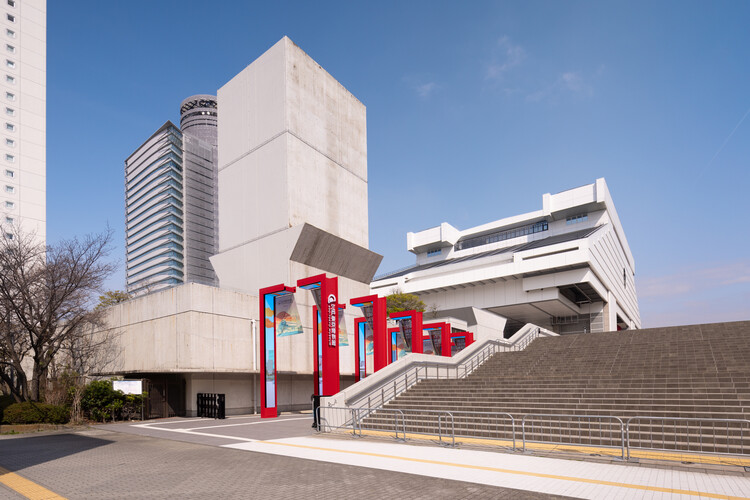
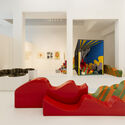
The Edo-Tokyo Museum has reopened to the public following a multi-year renovation, unveiling a series of scenographic interventions and installations designed by OMA under the direction of Shohei Shigematsu. Marking the firm's first public project in Japan, the commission forms part of the broader renewal of the museum's iconic building by Metabolist architectKiyonori Kikutake. Originally opened in 1993 as the first museum dedicated to the history of Tokyo, the institution traces the city's evolution from the Edo period to the present day, and the new interventions aim to strengthen its relationship with contemporary audiences while preserving the identity of Kikutake's architecture.
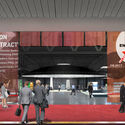
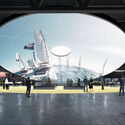
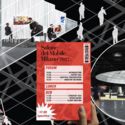
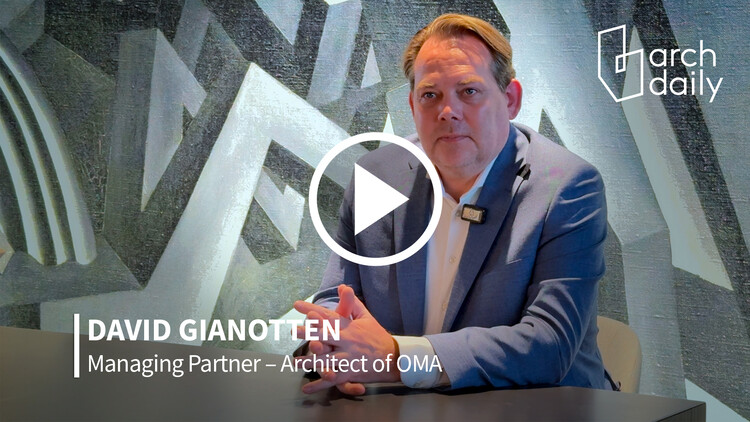
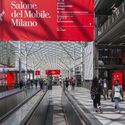
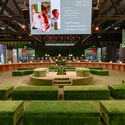
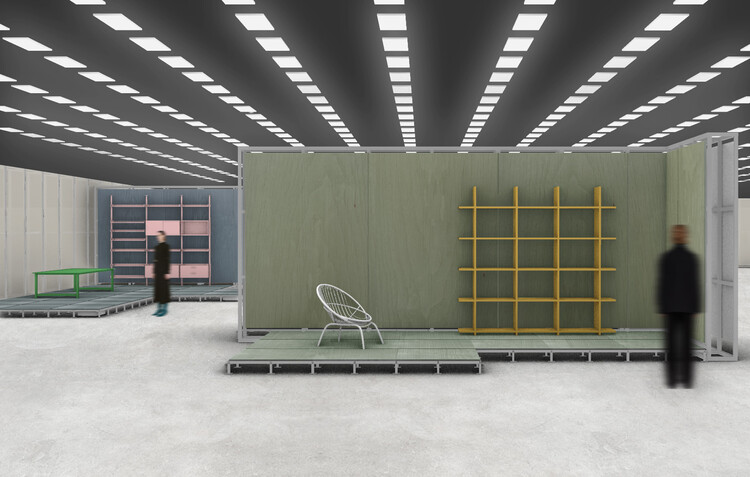
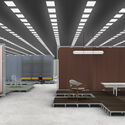
At Salone del Mobile 2026, the 64th edition of the fair unfolded at a moment of transition for the global design industry, where questions of production, collaboration, and long-term performance are reshaping established formats. Held at Rho Fiera Milano and extending across the city during Milan Design Week, this year's edition brought together over 1,900 exhibitors while introducing new curatorial and strategic layers. Among the most significant developments was the first public iteration of "Salone Contract," a long-term initiative developed through a master plan by Rem Koolhaas and David Gianotten of OMA. During the event, ArchDaily's Managing Editor Romullo Baratto and Editor-in-Chief Christele Harrouk met with David Gianotten. In the conversation, Gianotten reflected on how the project responds to broader shifts in design practice, moving from object-based production toward integrated systems and collaborative frameworks.
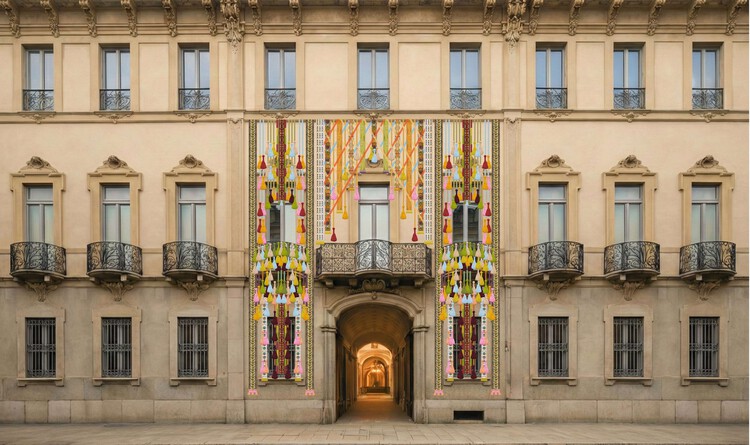
Entrance to Palazzo Citterio, indicative render. Image Courtesy of ACDF and Bethan Laura Wood Studio
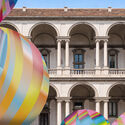
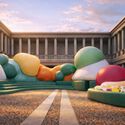
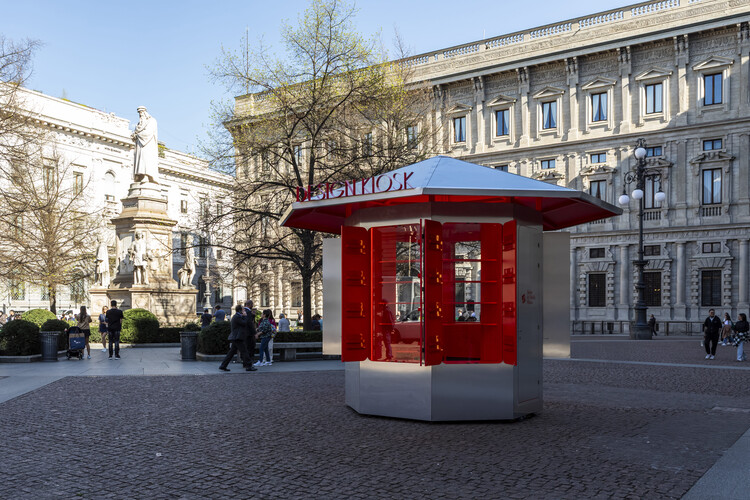
From April 20 to 26, Milan Design Week 2026 returns as a citywide platform where design operates as both a cultural practice and a form of exploration. Framed by the Fuorisalone theme "Be the Project," this year's edition shifts the focus from outcome to process, positioning design as a dynamic, human-centered act shaped by intuition, responsibility, and transformation. Installations and exhibitions across the city foreground making as an open-ended condition, one that embraces error, temporality, and experimentation as integral to creative production. Within this context, design becomes a space of exchange between disciplines, materials, and intelligences, reflecting broader conversations around sustainability, emerging technologies, and the evolving relationship between the physical and the digital.
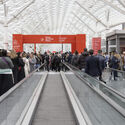
From April 21 to 26, the 64th edition of Salone del Mobile.Milano returns to Rho Fiera Milano, bringing together over 1,900 exhibitors across more than 169,000 square meters of sold-out exhibition space. Yet beyond its scale, the 2026 edition signals a more structural shift through collaborations with figures such as Rem Koolhaas and David Gianotten (OMA) and Formafantasma, the Salone continues to reposition itself as an evolving cultural infrastructure rather than a conventional trade fair. This year introduces new curatorial and strategic layers, most notably the preview phase of Salone Contract and the debut of Salone Raritas, alongside immersive installations and exhibitions, while the Salone's footprint across Milan grows further through city-wide interventions during Milan Design Week.
In recent years, Albania has undergone a rapid and visible transformation, emerging as one of the most active urban environments in Southeast Europe. This growth is not only reflected in the expansion of its built fabric but also in the scale and ambition of new architectural interventions that seek to redefine the country's image. Across its territory, a series of large developments, cultural institutions, and infrastructural projects are being introduced as part of a broader effort to reposition Albania and its capital, Tirana, within regional and international networks.
A significant number of these interventions are being designed by internationally recognized architectural offices, whose presence has become a defining characteristic of the city's current phase of development. Rather than relying primarily on incremental or locally embedded processes, Tirana's transformation is increasingly shaped through externally authored visions that introduce new formal languages, typologies, and urban strategies. These projects often operate as singular objects or large-scale fragments, contributing to a landscape where the city is assembled through distinct and highly visible gestures.
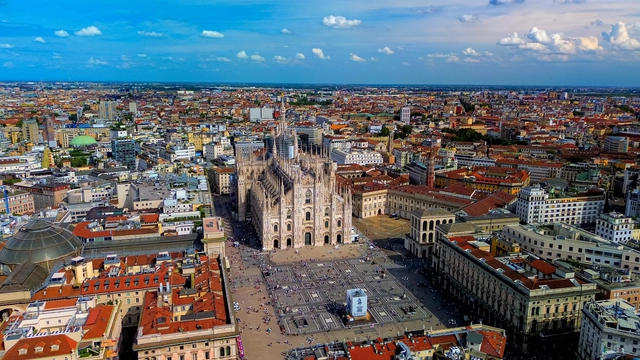
Milan, a global hub of fashion and finance, increasingly asserts itself as a leading center for architecture and design. Its status as Italy's second-largest city underpins its vibrant cultural scene, attracting both established and emerging creative talent. Additionally, Milan is home to esteemed educational institutions recognized for their focus on heritage preservation and conservation. Its cultural and design significance is increasingly pronounced, as a growing number of creators are relocating to establish their presence in this vibrant creative hub.
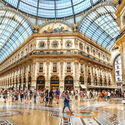
Among Milan's most iconic landmarks are the flamboyant Gothic Duomo di Milano, the historically and artistically significant Santa Maria delle Grazie, and the ornate Galleria Vittorio Emanuele II, along with numerous Renaissance and Baroque sites. The city also boasts some of the most innovative modern and contemporary architecture, showcasing a unique dialogue between tradition and modernity. This synergy is exemplified by the contributions of architects like Aldo Rossi,Gio Ponti,Stefano Boeri, Mario Cucinella, Zaha Hadid, Grafton Architects, Herzog & de Meuron, and Foster and Partners.
The following guide highlights key historical landmarks alongside exemplary contemporary architecture curated by ArchDaily. This guide serves as an indispensable resource for those planning to explore Milan during the 2026 Design Week, presenting a blend of essential sites designed by renowned local and international architects.
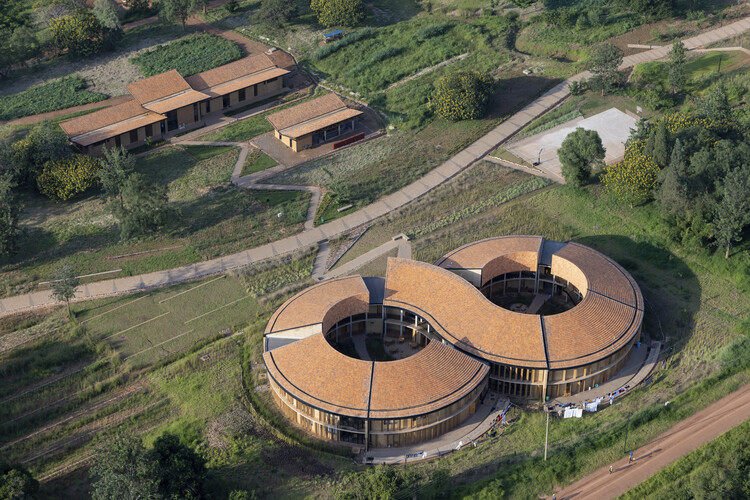
RICA, MASS Design, Rwanda. Image Courtesy of Pan-African Biennale (PAB)
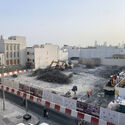
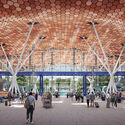
This week, architecture presents new visions of the future across a geographically diverse landscape, with landmark projects and renewal initiatives emerging in Saudi Arabia, Taiwan, Bahrain, Germany, Italy, Australia, Morocco, and Burundi. New platforms for discussing urban futures highlight decolonization and the climate crisis as central priorities for contemporary architectural practice. At the same time, contrasting perspectives on urban regeneration are reflected in both the demolition of recent landmark structures and the large-scale transformation of industrial sites. On another note, the Olympic Games continue to act as catalysts for architectural production, as seen in the proposal for a new sports center in Australia for Brisbane 2032. This momentum coincides with major international infrastructure developments in Africa, including a new airport terminal in Morocco, as well as projects that rethink spaces for research and public engagement, such as a new building for the German Language Forum.
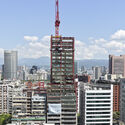
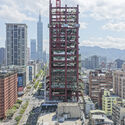
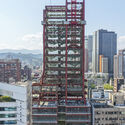
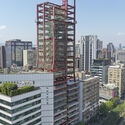
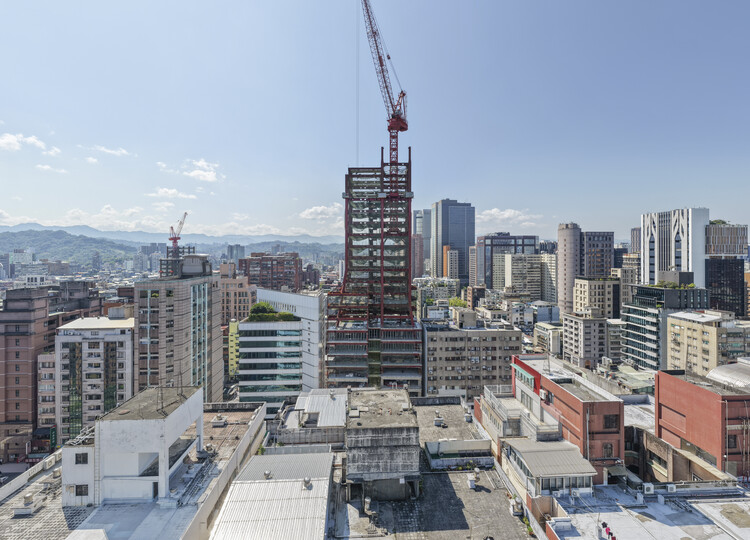
OMA's Metropolitan Village, also known as Taipei Xinyi–Wenchang Residence, is a new high-rise residential tower located in Taipei's Xinyi Central Business District. The project, led by David Gianotten and Chiaju Lin, with HCCH & Associates Architects Planners & Engineers as local collaborator, provides 11,961 m² of residential floor area on a 736 m² site. The 95 m, 23-storey building follows the concept of a "vertical village," reflecting the increasingly fluid boundary between living and working identified by the architects in post-pandemic Taipei. Commissioned by Continental Development Corporation, the project broke ground in 2024 and is scheduled for completion in 2027. Recent images show construction progress, with the highest structural element now being installed.
A domed, ellipsoidal pavilion for mushroom production designed by OMA for Fundación Casa Wabi opened on March 4, 2026. The building is located within Casa Wabi's 25-hectare site in Oaxaca, Mexico, on the Pacific coast, about 30 minutes from the city of Puerto Escondido. Casa Wabi is a foundation created by artist Bosco Sodi that promotes the exchange of ideas between artists of various disciplines and local communities. The foundation's flagship building was designed by Japanese architect Tadao Ando and completed in 2014. The OMA-designed pavilion adds a new space for cultivating mushrooms and fostering exchange between food, art, nature, and local communities to the foundation's facilities, which include a multipurpose palapa, six bedrooms, two enclosed studios, six open studios, a screening room and auditorium, a 450-m² exhibition hall, and various workspaces.
Tagaytay City Hall / WTA Architecture and Design Studio. Image Courtesy of WTA Architecture and Design Studio
This week's architecture news brings together a series of announcements that reflect how the discipline is engaging with larger structural and institutional frameworks. The OBEL Foundation's introduction of Systems' Hack as the theme for its 2026 cycle foregrounds architecture's relationship to the systems that organize contemporary life, from infrastructure to resource flows. At the scale of the design industry, Salone del Mobile.Milano's outline of its 2026 framework, including OMA's involvement in the Salone Contract master plan, signals an evolving understanding of major fairs as long-term cultural and economic infrastructures rather than standalone events. Running alongside these agenda-setting developments, the final days of nominations for the 2026 ArchDaily Building of the Year Awards underscore the role of collective evaluation and public participation in shaping contemporary architectural discourse.
Salone del Mobile.Milano has announced the framework for its 64th edition, scheduled to take place from April 21 to 26, 2026, at Fiera Milano, Rho. The upcoming edition will bring together more than 1,900 exhibitors from 32 countries across over 169,000 square meters of exhibition space, highlighting the fair's continued scale and international reach. Beyond its quantitative dimension, the 2026 Salone positions itself as an evolving cultural and economic infrastructure, increasingly structured around long-term strategies rather than isolated events. The program reflects a growing emphasis on accessibility, curatorial depth, and cross-sector dialogue, pointing at the Salone's role not only as a marketplace for the industry but also as a platform where architectural thinking, industrial production, and global dynamics intersect within a single, coordinated framework.