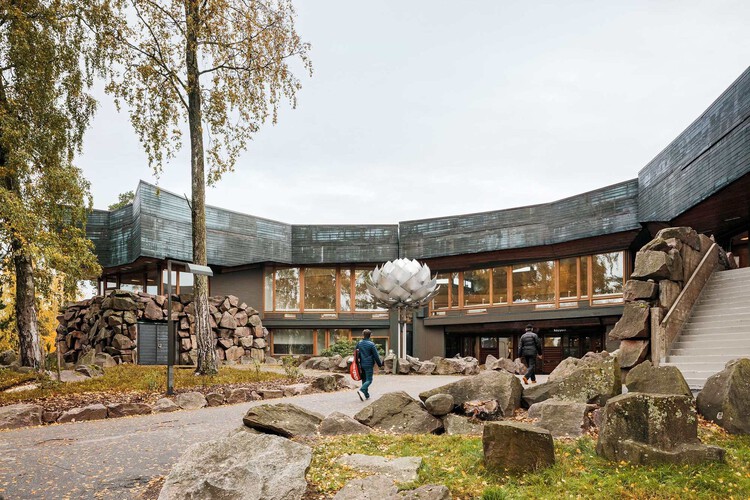
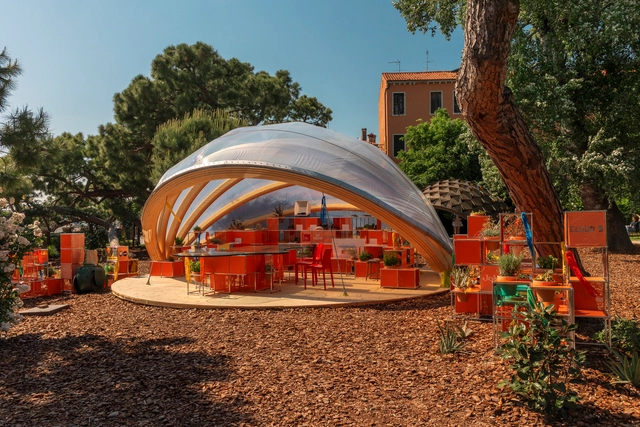
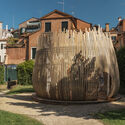
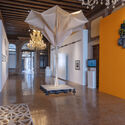
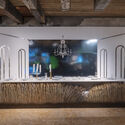
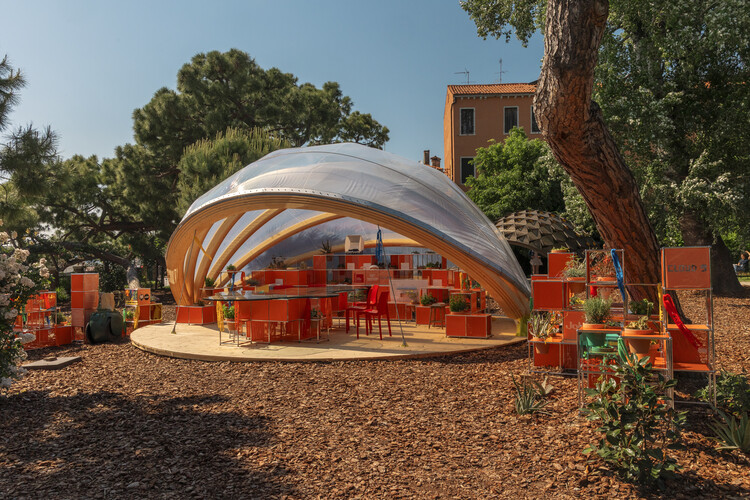
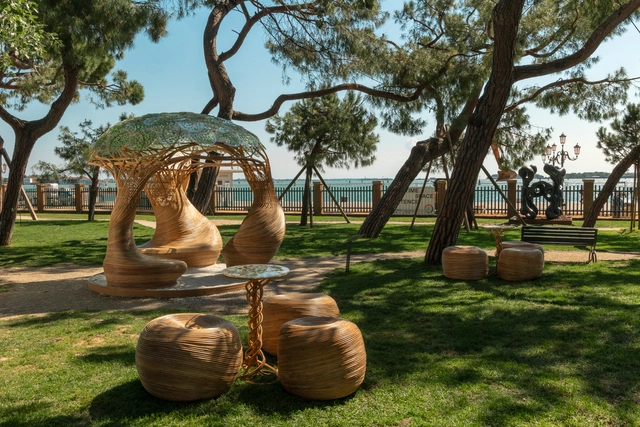
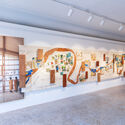
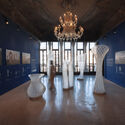
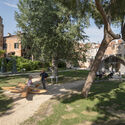
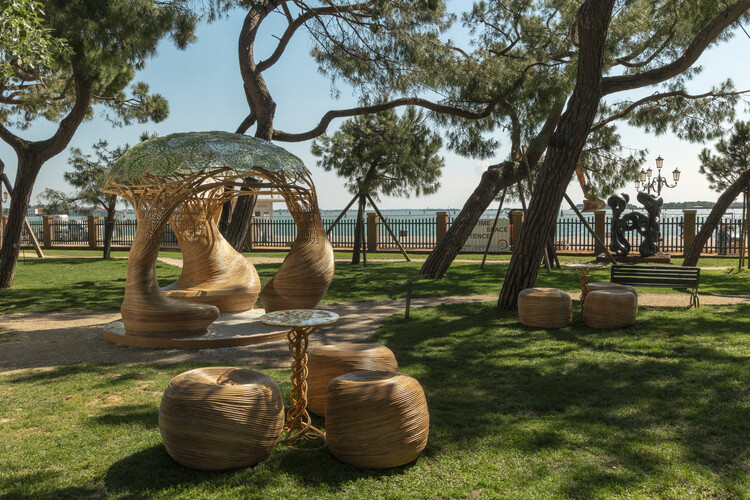
The European Cultural Centre Italy has organized the ECC Awards since 2010 to recognize artists, architects, designers, and academics in their respective fields. The Awards highlight projects featured in the Time Space Existence exhibition, which runs in parallel with the Venice Architecture Biennale and showcases tangible approaches to building more sustainably, aiming to position architecture as a force for environmental and social repair. The seventh edition of Time Space Existence is a group exhibition spanning three Venetian venues: Palazzo Bembo, Palazzo Mora, and the Marinaressa Gardens. This year, the exhibition focuses on the themes of Repair, Regenerate, and Reuse, emphasizing the essential role of architects and designers as agents of positive change in shaping sustainable, inclusive, and regenerative ways of living.
The 2025 edition of the European Cultural Centre's (ECC) Time Space Existenceexhibition in Venice is guided by the mandate to "Repair, Regenerate, and Reuse." Aiming to move beyond surface-level solutions and overused terminology, the exhibition showcases a cohort of practitioners who interpret architecture as an active agent of repair. The most compelling works presented in Venice demonstrate that "repair" is a multifaceted practice, operating across material, social, and historical registers. The varied approaches showcase a shift in the role of the architect, from a master builder and designer of physical objects, to that of a mender, able to combine technology, community, and material intelligence to restore narratives and build stronger cultural systems.

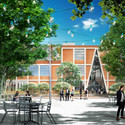
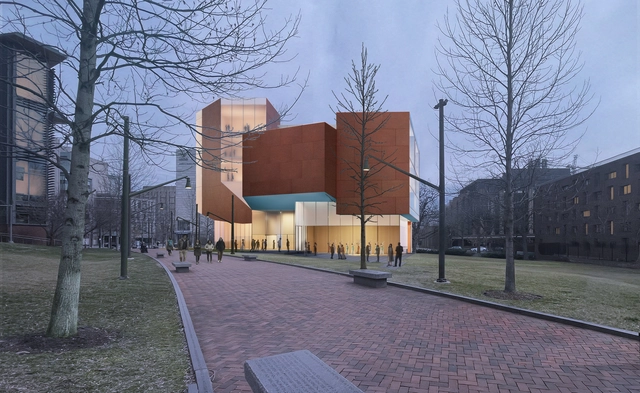
The University of Pennsylvania has unveiled Steven Holl Architects’ design for its new Student Performing Arts Center. The 37,300-square-foot building is set to offer dedicated and flexible spaces for over 70 student performing arts groups on campus, including dance, theater arts, a cappella groups, and musical ensembles. The proposal was informed by a study completed in 2019 by Penn’s University Life, which concluded that additional performance and rehearsal space was needed to meet current and future demand. The project is set to begin construction in 2024, with anticipated occupancy starting in winter 2027.
In a letter published on MIT's School of Architecture and Planning’s website, 16 deans from prominent architecture schools in the U.S, explain their position to stop participating in the annual survey that ranks universities. "Design education is not a popularity contest. Although generally our schools have been highly ranked in past DesignIntelligence reports and benefitted from the attention, we believe that it is time to stop participating", declares the statement signed by scholars, deans, and department chairs of MIT, Harvard, Columbia, Princeton, Yale, Rice, and UCLA, to name a few.
Stating clearly their position to boycott future ranking, the decision came after two years of informal discussions where the methodologies used behind these academic surveys were questioned, as well as their consequences. In fact, the letter adds that "however well-intentioned they may be, we believe that the DI rankings have the potential to create a disservice to the public".
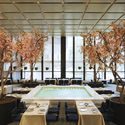
Belmont (Monty) Freeman (b. 1951) founded his New York-based, currently eight-person practice, Belmont Freeman Architects in 1986. Its active projects are half institutional and half residential, with a special focus on adaptive reuse, predominantly in New York and nearby states. Among the firm’s most exemplary projects are the LGBT Carriage House on the University of Pennsylvania campus, a series of restorations at the Four Seasons restaurant in the Seagram Building, renovations at the Yale Club in Manhattan, and the renovation of the Ezra and Cecile Zilkha Gallery at Wesleyan University in Connecticut, designed by Kevin Roche. Current projects include an expansive but minimalist residential compound on Martha’s Vineyard, branch library renovations in New York City, and redevelopment of a former meatpacking building into a new Innovation Hub for Columbia University’s Business School.
The annual DesignIntelligence architecture school ranking for 2020 classified the establishments according to the “most admired” rather than the “best”, for the second year in a row. The subjective classification is based on the responses of hiring professionals.
Past recipients of the award have included Bjarke Ingels, Norman Foster, Peter Bohlin, Daniel Libeskind, Robert A.M. Stern, Rafael Viñoly and César Pelli.
https://www.archdaily.com/892460/david-adjaye-honored-with-2018-louis-kahn-memorial-awardNiall Patrick Walsh
With schools around the country starting back up again, it’s time for the latest edition of DesignIntelligence’s yearly rankings of the Top Architecture Schools in the US for both undergraduate and graduate programs. This year, CEOs, managing partners, and human-resource directors from more than 2,000 firms were asked to list the 10 programs from each category they felt best prepared students for success in the profession of architecture.
This information, along with detailed accounts on the best programs that teach skills in design, computer applications, sustainability and construction methods & materials, factored into the creation of the 2017 rankings. In addition, over 2,785 students were polled on the quality of their program and their plans for post-graduation. The two top schools, Cornell for undergraduates and Harvard for graduates, were once again named the best programs to attend, according to the study.
Read on to see the list of the top 10 undergraduate and graduate programs in the US.
Frederick Steiner. Image Courtesy of University of Texas at Austin
Frederick Steiner has been named the new dean of the University of Pennsylvania School of Design (Penn Design). Effective July 1, the appointment comes after Steiner announced his departure from the School of Architecture at the University of Texas at Austin, which, according to The Texas Tribune, was partially due to the school's new gun law that will allow students to carry concealed firearms.
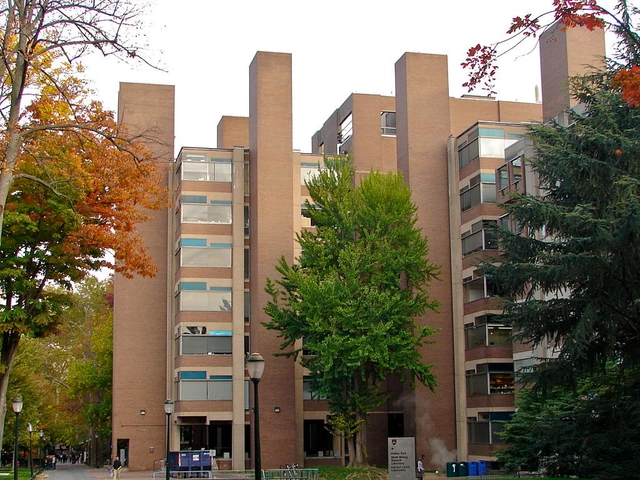
Louis Kahn's Richards Medical Research Laboratory at the University of Pennsylvania, once deemed "the most consequential building constructed in the United States" since World War II by MoMA, has been notoriously hated by its users; scientists claim the building lacks privacy, has too much exposure to sunlight and is not suitable for lab experiments. Thus, the University's architect has just completed a full renovation of Richards' four brick towers, converting them into offices and computer labs for researchers, while, as Philly.com reports, restoring the structure to its original essence.
"The renovation has pared Kahn's spaces down to their essence, restoring a Zenlike calm, and revealing the muscular concrete structure that made the design such a revelation in the early 1960s, when International Style glass towers were all the rage," says Philly.com. Read the complete article here.
Vesely was born in Prague in 1934, five years before the Nazi occupation of Czechoslovakia. Following World War II, he studied engineering, architecture, art history and philosophy in Prague, Munich, Paris and Heidelberg. He was awarded his doctorate from Charles University (Prague) having been taught and supervised by Josef Havlicek, Karel Honzik, and Jaroslav Fragner. Although later he would be tutored by James Stirling, it was the philosopher of phenomenology Jan Patočka who, in his own words, “contributed more than anyone else to [his] overall intellectual orientation and to the articulation of some of the critical topics” explored in his seminal book, Architecture in the Age of Divided Representation, published in 2004.
New York-based firm HWKN have revealed the design for what is to become the University of Pennsylvania's latest hub for entrepreneurs, researchers, and innovators. Dubbed "The Pennovation Centre," the project is the first major development within the Pennovation Works, and will occupy a 58,000-square-foot footprint on the campus' south.
A rejuvenation of the former DuPont laboratory, it is hoped that The Pennovation Centre will become an "iconic landmark" for pen, providing a "dynamic environment" for innovation in varied fields.
At last week's Mextrópoli conference we spoke with Winka Dubbeldam about the challenges of architecture education. We also asked her to elaborate on why she thinks architecture should embrace industrial design tools. Watch the short clip to hear Winka's thoughts on making technology a more integral part of our built environment.
The Cultural Landscape Foundation recently launched its newest documentary as part of the ongoing Oral History series, this time focusing on the ideas and career of Laurie Olin, a recipient of the National Medal of the Arts and one of the greatest landscape architects of our time. Olin's influential work as a practitioner, educator and author over the past forty years has helped to guide the future of landscape architecture and shape urban life around the world.
With the guidance of their instructor Matthias Hollwich, students Andreas Tjeldflaat and Greg Knobloch from University of Pennsylvania’s School of Design have proposed an alternative to the traditional prisons seen throughout the United States. The innovative high-rise penitentiary acknowledges the fact that nearly two-thirds of the 14,000 inmates released annually from New Jersey correctional facilities will return to prison within five years. 499.SUMMIT offers a solution that intends to reverse that statistic and help inmates successfully transition back into society.
You may remember our coverage on the Flight Assembled Architecture exhibit by Gramazio & Kohler and Raffaello D’Andrea, in collaboration with ETH Zurich, that featured a team of flying drones constructing an architectural structure at the scale of a 600m high “vertical village” out of foam blocks. Well, check this out! Roboticists at the University of Pennsylvania’s GRASP Lab, along with developer Kmel Robotics, have created these autonomous Nano Quadrotors capable of flying in formation and flawlessly performing complex maneuvers. Imagine the possibilities!
Immersive Kinematics, a new research group at the University of Pennsylvania, shared with us their newly launch website. The research agenda expands the roles of architecture and engineering focusing on integrating robotics, interaction, and embedded intelligence in our buildings, cities, and cultures.
In recognition of his contributions to architecture in both theory and practice Fumihiko Maki was recently named the 2011 AIA Gold Medal Winner. Maki, arguably one of Japan’s most distinguished living architects, will be honored with the award in New Orleans at the AIA National Convention.