For millions of displaced children and young people, education unfolds amid conditions of forced mobility, administrative uncertainty, and prolonged precarity. Schools situated in borderlands, refugee settlements, and sites of climate-induced displacement therefore operate as more than educational facilities. They become spatial infrastructures that negotiate the contradictory demands of emergency and continuity, offering environments where learning persists despite the instability of legal status, living conditions, and the very feeling of being at home.
The UNESCO World Heritage Committee has announced 25 new inscriptions to the World Heritage List during its 48th session, expanding the international register with sites that reflect a wide range of architectural, cultural, and natural heritage. The 2026 additions include 19 cultural properties, five natural sites, and one mixed property, alongside approvals for two significant boundary modifications and one revision to the criteria of an existing inscription. Spanning every inhabited continent, the newly recognized places range from archaeological landscapes and historic urban centers to modernist architecture and industrial heritage, underscoring the diversity of the built environment and the evolving scope of heritage conservation.
In December 2024, art curator Koyo Kouoh became the first African woman selected to curate the 61st International Art Exhibition of La Biennale di Venezia. She proposed an introspective and sensitive approach to the exhibition, shaped by themes of grief, memory, spirituality, and global exhaustion. Following her premature passing in May 2025, the Biennale decided to continue with the same curatorial project, titled In Minor Keys. Wolff Architects was appointed by Kouoh in early 2025 to realize the exhibition design and scenography, focused on "the transformative spatial power of the threshold as a portal to alternative comprehension and experiences." The event was inaugurated on Saturday, May 9, and will run until Sunday, November 22, 2026, across the Giardini della Biennale, the Arsenale di Venezia, and other locations throughout Venice.
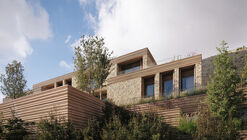
Set within the mountainous landscape of Zabbougha, Lebanon, Capsule Retreat by EAST Architecture Studio is shaped through the process of its making. The project unfolds through material decisions, on-site adjustments, and evolving conditions, allowing construction itself to guide its spatial logic.
On February 28th, 2026, the news of the loss of human lives, the operational pattern of military strikes, damage to infrastructure, communication disruptions, and international responses following US-Israeli military attacks on Iranconfirmed to the world that there was a new focus of war in Southwest Asian territory. This military conflict has also had a human and infrastructural impact on Lebanon, Syria, Iraq, and Jordan, with active combat zones in their territories, and the Gulf States, where damage particularly affected US military bases and energy infrastructure. This adds a new site of armed conflict in the area, following over two years of systematic destruction of life, habitat, and essential facilities in the Gaza Strip, reaching a near total of 81% destroyed structures by the end of 2025. These territories are currently involved in the deliberate destruction of their normality, including essential, everyday, and cultural infrastructure of global value. Although information is currently scattered and partial, it is possible to assess some of the damage to cultural heritage caused by this new outbreak of armed conflict.
Hospitality-driven programs, specifically coffee shops and social hubs, are partly defined by their role as "third places": social anchors that bridge the gap between private and public life. Unlike residential or commercial office programs that require rigid partitioning for privacy and utility, they rely on expansive, open-plan environments. This allows for an architectural strategy of minimal intervention, allowing the structural envelope to remain intact. By avoiding the subdivision of space, architects maintain uninterrupted sightlines to original masonry, timber frames, or decorative ceilings, ensuring the building's historical narrative remains the protagonist. Simultaneously, the commercial activity provides the necessary maintenance and public engagement to ensure the site's continued existence.
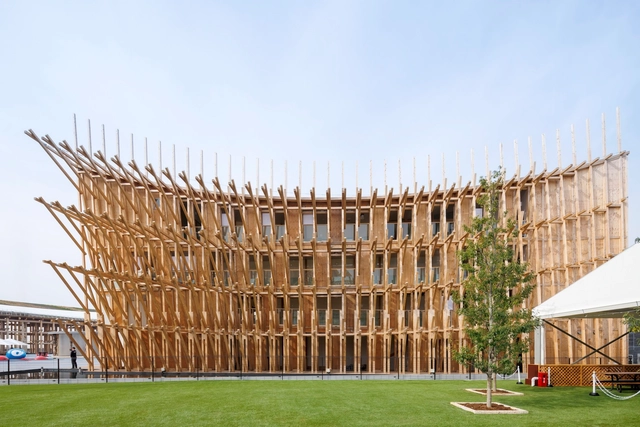
In a global landscape marked by accelerated change, 2025 emerged as a decisive year for architecture—not only because of the major events that animated the international circuit, but above all because of the voices that stood out within them. From the Venice Architecture Biennale to Expo Osaka, pavilions and installations from the Global South ceased to function as mere exhibition gestures and instead asserted themselves as territories of memory, resistance, and imagination, articulating narratives that expand the horizons of contemporary architectural debate.