The Royal Institute of British Architects (RIBA) has launched a call for applications for the 2015 RIBA Boyd Auger Scholarship. The generous scholarship, which has been awarded since 2008, supports the personal, professional and academic development of its student recipients by contributing towards their "imaginative and original research and travel."
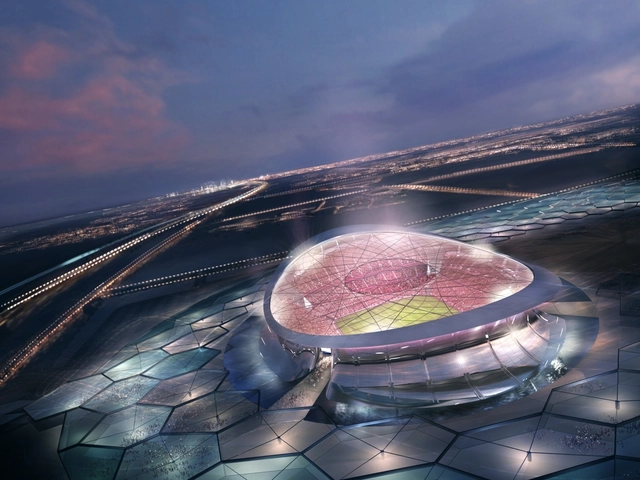
“It is an honor to design this centerpiece stadium – we are delighted to have won the international competition. This is an exciting step forward in stadium design – it will be the first to break the mould of the free standing suburban concept, and instead anticipates the grid of this future city, of which it will be an integral part,” said Norman Foster, founder of Foster + Partners.
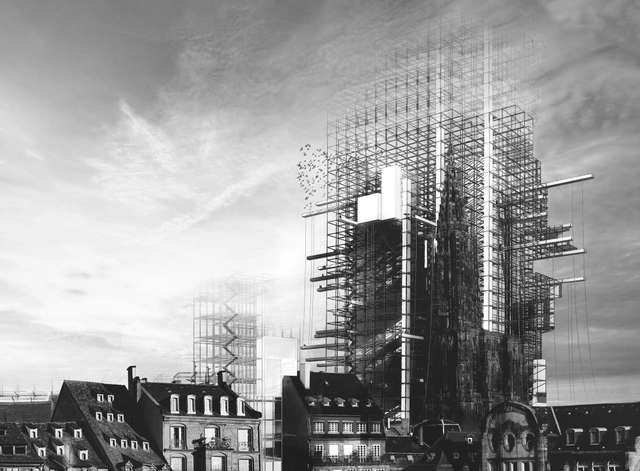
Grand Prize: ‘Radical Conservation: A Hyper-Cathedral in Strasbourg’ / Simon Oudiette. Image Courtesy of d3
Three grand prize winners and seven special mention recipients of d3'sUnbuilt Visions 2014 (UV2014) competition have been revealed. Open to professionals and students alike, the annual competition challenges participants to use stellar unbuilt concepts as vessels for conversation. Spanning the realm of architecture, urbanism, interiors, and designed objects, Unbuilt Visions recognizes projects that spark interdisciplinary debate and exploit the innovative spirit of the 21st Century.
Learn more about UV2014 and check out the winning projects, after the break.
In the United States alone, more than 125 million plastic bottles are discarded each day, 80 percent of which end up in a landfill. This waste could potentially be diverted and used to construct nearly 10,000, 1200-square-foot homes (taking in consideration it takes an average of 14,000 plastic bottles to build a home that size). Many believe this process could be a viable option for affordable housing and even help solve homelessness.
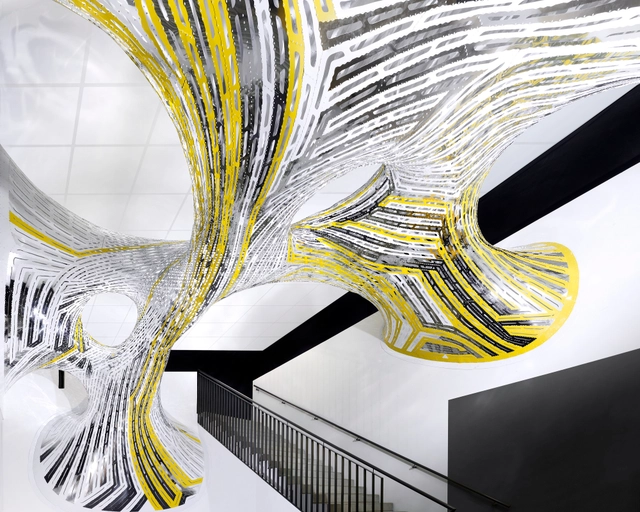
Marc Fornes / THEVERYMANY has realized two permanent installations - “Under Stress” and “Sous Tension” - in the public areas of the Department of Computer Science at the French Institute for Research in Computer Science and Automation (INRIA). Both structures “utilize programming techniques inherent in computer science to optimize the form and creating a pattern on the surface.”
“The structures engage the spaces with their intricate and gestural movements that effortlessly travel over the areas,” says the practice. “They provide visitors with iconic hubs for informal and spontaneous social gatherings while expressing the tension between the dynamic interactions from the multi-directional and converging paths within the public spaces. More than a signal for the school, they become elements of enhancement for the school's identity.”
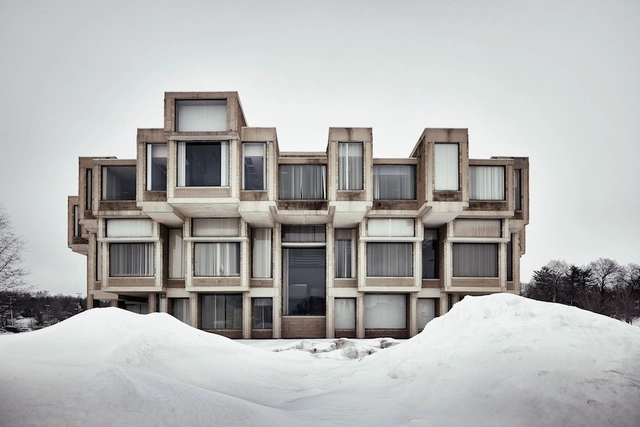
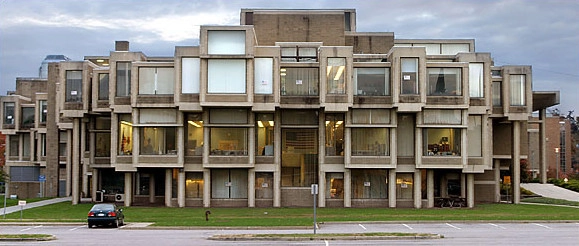
The 44-year-old brutalist landmark has been the center of a preservation debate for years; lawmakers argue that the building is “not easy to love” and expensive to maintain, while preservationists declare the building is an important piece of modern history and blame its state of disrepair on neglect. The council vetoed an offer last summer to allow a New York architect to purchase the property and transform it into artist studios. More on the decision, and more of Matthew Carbone's images for Architect Magazine, after the break.
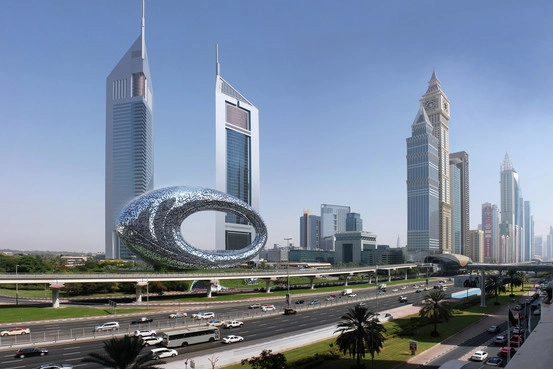
“See the future, create the future,” this is the motto of Dubai’s newly unveiled “Museum of the Future.” The metallic oblong-structure, planned for a corner lot in Dubai’s central financial district next to the Emirates Towers on Sheikh Zayed Road, is said to become “an incubator for ideas and real designs, a driver for innovation and a global destination for inventors and entrepreneurs.”
"The world is entering a new era of accelerated knowledge and great technological revolutions,” tweeted United Arab Emirates prime minister Sheikh Mohammed Bin Rashid Al Maktoum. "We aim to lead in that era, not to follow and lag behind. The Museum of the Future is the first step of many to come, marking the beginning of great achievements."
Holograms, robotics and 3-D printing will play a crucial role in the structure’s realization. Learn more and watch a video fly-through the building after the break.
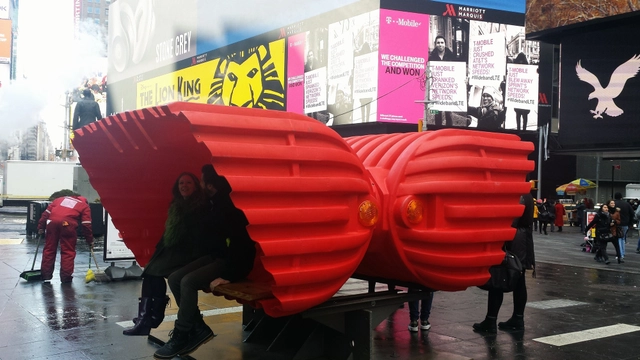
Stereotank’s HeartBeat filled the air in Times Square this past Valentine’s Day. Now that the love season is over, the Brooklyn-based practice has turned their clever installation into a welcoming “HeartSeat” by simply opening up their heart-shaped sculpture to the public and transforming it into a bench. The installation will remain on view through Sunday, March 8th. See a video of HeartSeat, after the break.
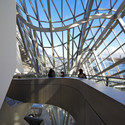
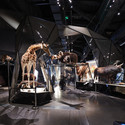
Edmund Sumner has shared with us images from his recent visit to Lyon, France, where he photographed Coop Himmelb(l)au’s newly completed Musée des Confluences. Perched on a century-old artificial peninsula at the confluence of the Rhône and Saône rivers, the “museum of knowledge,” as Coop Himmelb(l)au affectionately refers to it, is distinct for its “iconic gateway” - an openly traversable “Crystal” that provides multi-level access to the museum’s exhibition spaces and views of the building's unique context. Step inside, after the break.
Thanks to the increasing popularity of massive open online courses -- or MOOCs as they’re commonly referred to -- learning has never been easier (or more convenient). Sites like Coursera and edX offer free classes online from accredited and well-known universities across the globe, including Harvard, MIT and the University of Hong Kong. While some classes are more structured and include a set lesson plan, homework assignments, quizzes and the option to receive a certificate at the end, others can be set at your own pace and approached more independently.
Following our wildly popular article on Four Ways to Learn About Architecture for Free, we’ve compiled a list of upcoming online classes related to architecture, engineering, urbanism and design. So whether you’re looking to embark on a new topic or dive deeper into an already familiar subject, take a look at these free online courses after the break.
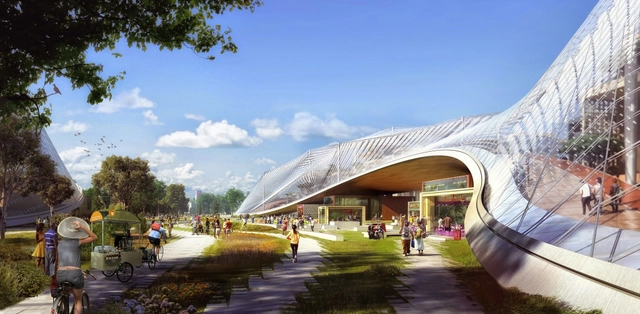
In their designs for Google's new headquarters, released last week amid much excitement, Bjarke Ingels and Thomas Heatherwick have taken cues from the utopian visions of the past to create a radical solution for the sprawling tech campus in Mountain View, California. Citing the lack of identifiable architecture in the technology sector, a promotional video on Google’s own blog reveals how the company plans to embrace nature, community, and flexibility with the new scheme.
Chief among the company’s concerns was creating a building capable of adapting to future uses in addition to serving as a neighborhood-enhancing environment to welcome visitors from the surrounding community. As with any news related to Google, the design has already attracted the attention of the media - read on after the break for our rundown of the most salient reviews so far.
The Negro Building Remembrance Competition invites architects, landscape architects, artists, playwrights, poets, musicians and writers from every discipline, as individuals, teams, students or professionals, to propose imaginative ways to commemorate the Negro Building, the forgotten landmark of the 1895 Cotton States and International Exposition in Atlanta, Georgia.
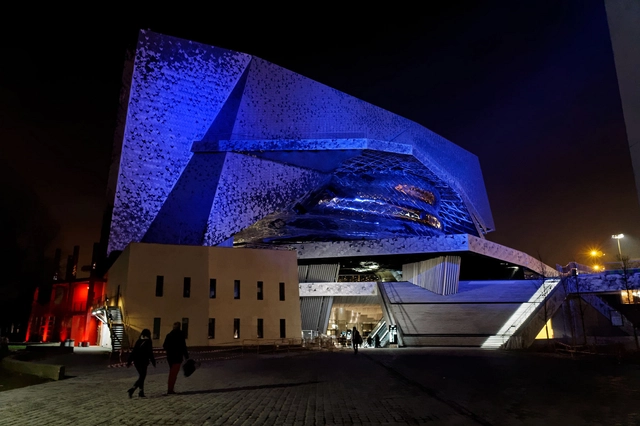
After boycotting the premature opening of the infamous Philharmonie de Paris, Jean Nouvel has taken his frustrations to court demanding that his name and image be removed from all references to the publicly funded €390 million concert hall. The French architect, who has claimed to be wrongly vilified as a “spoilt-star artist” and unfairly blamed for the project’s spiraling costs, does not “wish to express himself any further on the project.”
He has asked the court "to order amending work" to 26 "non-compliance" areas that do not comply with his original design. This areas include parapets, fireplaces, facades, the promenade and 2,400-seat concert hall itself.
Arup and GXN Innovation have been awarded with the JEC Innovation Award 2015 in the construction category for their development of the world's first self-supporting biocomposite facade panel. Developed as part of the €7.7 million EU-funded BioBuild program, the design reduces the embodied energy of facade systems by 50% compared to traditional systems with no extra cost in construction.
The 4-by-2.3 meter panel is made from flax fabric and bio-derived resin. Intended primarily for commercial offices, the glazing unit features a parametrically-derived faceted design, and comes prefabricated ready for installation. The panel is also designed to be easy to disassemble, making it simple to recycle at the end of its life.
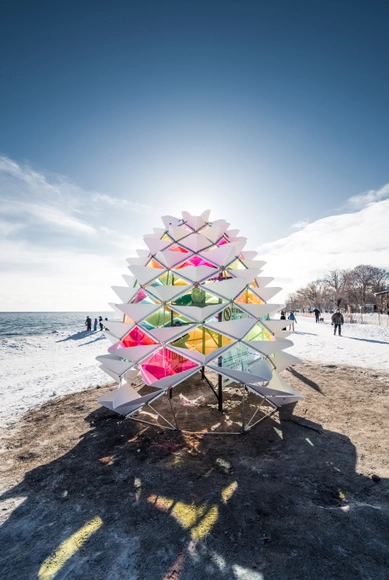
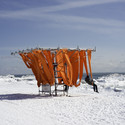
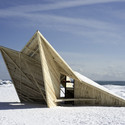
Five finalists have emerged from the 196 submissions of Toronto’s first international Winter Stations design competition. Drawing proposals from 36 countries around the world, the competition challenged entrants to transform the lifeguard stations on Toronto’s east beaches into public art pieces for the winter. The finalists’ designs were constructed in mid-February and will be displayed until March 20, 2015.
Take a look at the completed installations, after the break.
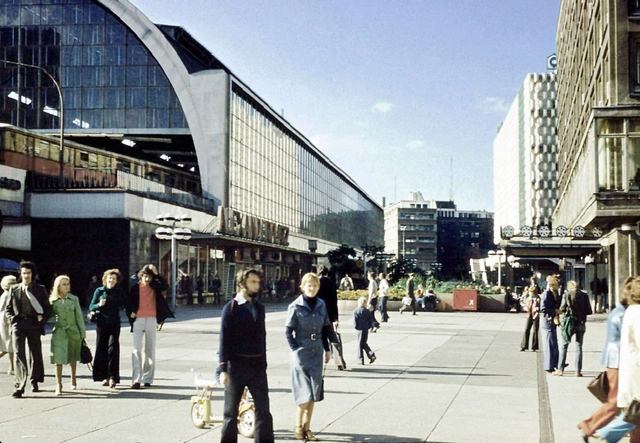
"Twenty-five years after the Berlin Wall’s demise, it is as though a large part of the twentieth century never happened," writes OMA principle Reinier de Graaf in his article for Metropolis Magazine "The Other Truth". "An entire period has been erased from public consciousness, almost like a blank frame in a film." Through the course of the article, de Graaf outlines how the West has rewritten the history of the cold war, erasing the "other truth" that existed for nearly half a century in East Berlin, the USSR, and other soviet-aligned states - a truth that we forget to our peril. It may not be immediately architectural, but the essay provides an interesting look into the political thoughts of de Graaf who, as the principle of one of architecture's most prominent research organizations in AMO, has an important influence on the profession's understanding of the wider world. Read the article in full here.
The Royal Institute of British Architects (RIBA)’s Future Trends Survey for January 2015 has revealed strong levels of optimism as workload forecasts remain strongly positive across all regions of the UK. Following little change in indexes between November and December 2014, the workload index has once again remained consistent at +29. Workload forecast balance figures have remained high, the highest numbers being reported from practices in Northern Ireland at +67 (from +50) and Scotland at +57 (from +75). Furthermore, practices of all sizes have been responding with positive workload prospects heading into the next quarter.
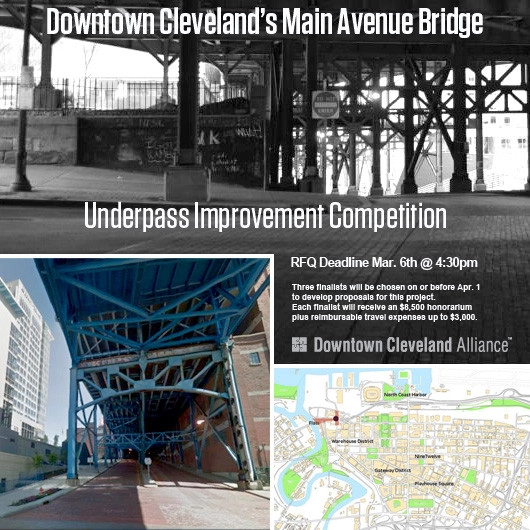
Downtown Cleveland Alliance seeks a creative professional or team (architect, designer, artist, engineer, landscape architect or combination thereof) to propose unique and attractive design solutions for the area under and around the Main Avenue Bridge Underpass, centered at the intersection of West 9th Street and Main Avenue in Downtown Cleveland. This location is a critical pedestrian, bicycle, and vehicular connection between the Warehouse District and the Flats East Bank, with infrastructure, history, and functional potential to inspire the highest level of creative treatments. Request for Qualifications are due Friday, March 6th by 4:30pm! More information, here.
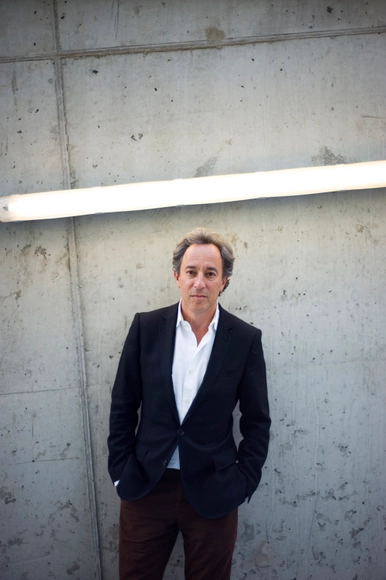
Challenging the notion that beauty is subjective, Alain de Botton has made a case for attractive cities, believing that a city’s beauty is key to its success and citizens' quality of life. The Swiss philosopher, author and founder of London's The School of Life believes that attractiveness is the primary reason why many choose to vacation to Paris, and not Frankfurt.
"We think beauty is subjective, and so no one should say anything about it," says Botton. "It's a very understandable qualm, but it's also horribly useful to greedy property developers.”
So, what makes a city attractive? Find out Botton’s six points for beautiful cities, after the break.

























_lichtzeit.com2.jpg?1425480334&format=webp&width=640&height=580)