Arup Documentary: Traces of Peter Rice

YouTube Preview Image

has been described as both one of the best and architects of the twentieth century. Unhappy with the role that play in designing buildings, Rice dedicated his life to championing brave innovation and poetry through structure in a way that helped bridge the gap between engineering and architecture. His desire to work in tandem with architects, towards a shared vision, made him one of the most in-demand of the twentieth century.

Read more about this amazing man and check out the video after the break…

Ashgabat Olympic Complex Proposal / Arup

© Polimeks

Developed by Arup and built to international sports federation standards, the  Olympic Complex in the heart of Turkmenistan will be one of the largest building projects on which has delivered the ‘total’ design and includes 750,000 square meters of sports and social buildings. Having just signed the contract for phase two of the project, which will add an aquatics center, indoor athletics arena, and a tennis center, the venues also include a velodrome, training halls, hotels, offices, a medical center and media facilities. More images and their description after the break.

Light Matters: What Media Facades Are Saying

© Patrick Bingham-Hall

, a monthly column on light and space, is written by Thomas Schielke. Based in Germany, he is fascinated by architectural lighting, has published numerous articles and co-authored the book „Light Perspectives“. 

Today we have permanent media façade installations worldwide that call for attention. With size, tempo, colour and brightness they stand up as individuals within the urban nightscape. Many of them send out their luminous messages in a broadcast mode. For this reason, neighbours, on occasion, demand an intense dialogue with regard to content and form of the media façade, especially as it’s often unclear whether light installations are architecture or advertisement.

However, in the same way a good book requires a storyteller, media facades demand curators to arrange exciting stories that fit into the site and suit the client. The following four examples show how media facades reflect the story of the buildings themselves – see them all, after the break…

Serpentine Gallery Pavilion 2002 / Toyo Ito + Cecil Balmond + Arup

© Sylvain Deleu

Architects: Toyo Ito, Cecil Balmond, Arup
Location: Kensington Gardens, London, UK
Area: 309.76 sqm
Year: 2002
Photographs: Sylvain Deleu

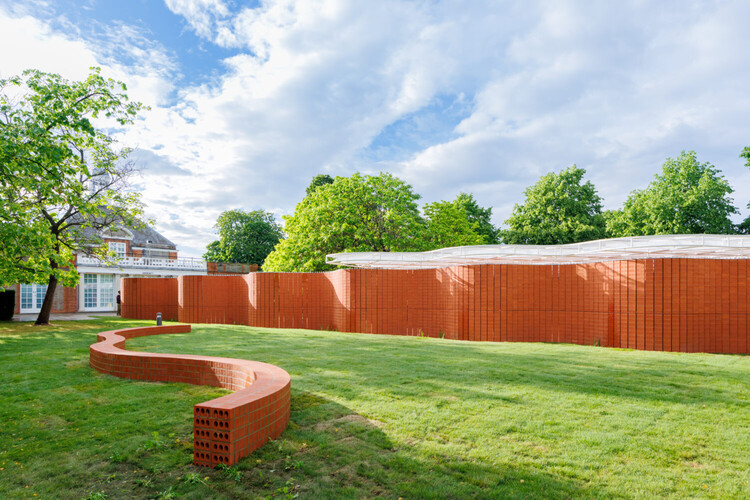
Toyo Itorecipient of the Pritzker Prize 2013, along with Cecil Balmond and Arup were in charge of the design of the Serpentine Gallery Pavilion back in 2002. What appeared to be an extremely complex random pattern was in fact derived from an algorithm of a cube that expanded as it rotated. The intersecting lines formed different triangles and trapezoids, whose transparency and translucency gave a sense of infinitely repeated motion.

You can see more images of the Serpentine Gallery Pavilion 2002 after the break. And don’t forget to check ArchDaily’s exclusive coverage of the 2013 Pritzker Prize.

World’s First Algae Bioreactor Facade Nears Completion

BIQ via GOOD

BIQ – the world’s first algae powered building – is set to be completed in Germany later this month. Built for the International Building Exhibition (IBA) in Hamburg, this zero-carbon apartment complex will sport a bright green facade-cum-algae farm, while its interior proposes a radical new theory on how we will live in the near future.

More about BIQ after the break…

Arup Envisions the Skyscrapers of 2050

Courtesy of

It is estimated that by 2050, 75 percent of the worlds – then 9 billion strong – population will live in cities. Urban Sprawl is already problematic and planners are faced with new challenges as they aim to build towards the sky rather than the horizon. In addition, cities are increasingly faced with climate change, resource scarcity, rising energy costs, and the possibility of future natural or man-made disasters. In response to these issues, Arup has proposed their vision of an urban building and city of the future.

In their proposal, titled “It’s Alive!”, they imagine an urban ecosystem of connected ‘living’ buildings, that not only create space, but also craft the environment. According to Arup, buildings of the future will not only produce energy and food, but will also provide its occupants with clean air and water.

More info on Arup’s vision after the break…

Helsinki Central Library Competition Entry / PAR + Arup

© Labtop

In contrast to the other buildings in the Töölönlahti District of , an essential component of the design by PAR and Arup for the Central Library involved creating a public space at the top of the library—visually connecting Töölönlahti to Senate Square and the city at large. The library is organized by six intersecting axes that afford spectacular vistas while creating a variety of spatial configurations for the library’s program. With it’s six floor levels each pointing toward a celebrated landmark, the Central Library becomes a symbolic center for city. More images and architects’ description after the break.

In Progress: Singapore Sports Hub / Arup

© Singapore Sports Hub, Oaker

Construction has commenced on the world’s largest dome roof at Singapore’s National Stadium. Once completed in 2014, the Arup-designed structure will provide shelter to the 55,000 seat stadium and surrounding ticketed community spaces in the heart of the 35ha sports precinct. Singapore’s National Stadium will be the only stadium in the world, custom-built to host football, rugby, cricket and athletic events in one venue.

The simple geometric form of the ultra-thin, retractable dome spans 310m and is designed to use only a fraction of the energy required for an equivalent fully enclosed stadium. Continue after the break to learn more.

Update: +Pool / Family + PlayLab

+

Over a year has passed since we first introduced you to the ideas of Family and PlayLab for a floating riverpool in ’s East River.  Since that time, the proposal has generated a lot of interest, and reached major milestones, such as completing a primarily testing of the filtration membranes to find the most effective methods to provide clean and safe riverwater for the public to swim in.  With an opening date set for  2015, the ambitious project seeks to improve the city’s natural resources by taking advantage of clean water to safely create a new kind of urbanistic public haven.

Early last week, the team celebrated the beginning of a six-month campaign to raise the first $1 million toward swimming in a clean river.  The campaign funds will go toward the design and engineering of +POOL so that it can obtain the required city and state permits, as well as support a prototype and public pavilion to fully test the + POOL filtration system.

More after the break. 

BE OPEN Sound Portal / Arup

Courtesy of Be Open

Located in Trafalgar Square in , the BE OPEN Sound Portal focuses on an experience that would be all about the sound. Designed by Arup, they thought it would be great if people could really concentrate on sound in Trafalgar Square, which would take people away form hustle and bustle into a space where they can concentrate and immerse themselves in sound. The original idea was that they would be able to take people away from London to another place, to hear the sound of a melting glacier or an acoustic model of the big bang. The plan is effectively two concentric circles: the inner circle for the sound and the outer circle forms the entrances. Both pieces mask the background noise. They are shells to shield the noise. More images and architects’ description after the break.

Nowa Huta of the Future Proposal / BudCud + Centrala + ARUP

Courtesy of BudCud + + ARUP

Nowa Huta of The Future, designed by BudCud, Centrala, and ARUP, is aimed at being a brand new direction of touristic experiences and a recreational map of Krakow. Their strategy has a potential of engaging new groups of potential investors and the residents of whole region. Nowa Huta of The Future is what the city needs to become world class metropolis. More images and architects’ description after the break.

Video: King’s Cross Western Concourse Lighting Design

YouTube Preview Image

In the video above, Simon King, lead MEP engineer for the King’s Cross Station Redevelopment by John McAslan + Partners, discusses the background and challenges that shaped Arup‘s unique design for the new western concourse of this famous London railway station. The transformation of the station represents a compelling piece of place-making for the city of London.

Donbass Arena / Arup

© Miller Hare

The Shaktar 50,000-seater stadium, the Donbass Arena, designed by Arup, will play host to the opening game in Group D between France and England, as well as several other matches, including the second semi-final. Arup, who played a key role in the design team that produced the €320 million Donbass Arena, will feature alongside the football talents of Ashley Young, Franck Ribery and the rest of the players at this year’s European Football Championships. More images and architects’ description after the break.

Urban Intervention Finalist Presentations

In-Closure / via Urban Interventions Design Competition

Urban Intervention challenged designers to conceive a fresh vision of environmental, social and economic opportunities on and beyond a nine-acre site at the heart of Seattle Center. 107 multidisciplinary teams from 24 countries entered designs. Each proposal harnessed Seattle’s history of innovation and civic engagement to inspire the next generation of great public spaces. Now, the three remaining finalists will present their ideas in a free, public lecture this Friday, May 11.

Continue after the break to learn more about the lecture and the top three proposals.

Krankenhaus Nord Wein Hospital / Arup

© Albert Wimmer

Arup recently won a major contract to design one of Europe’s largest hospitals in Vienna, Austria. The Krankenhaus Nord Wein hospital win marks another milestone in the international recognition of the firm’s expertise in the field of healthcare. Construction work has just started on the 800-bed facility, which will cost over €500m to build and a similar amount again to fit out to the world-class standard specified. Arup’s healthcare design team in Ireland worked in close collaboration with an Austrian partner to win the design contract for the facility, which will be sited on the east side of the River Danube. More images and architects’ description after the break.

The New Design Museum / John Pawson, OMA, West 8, Arup

© Alex Morris Visualisation

John Pawson, OMA, West 8 and Arup were all asked to come together to design The New Design Museum in London. Their design will accommodate up to 500,000 visitors per year. Notable for its superb complex hyperbolic paraboloid copper roof intended by the architects to symbolize a tent in the park, it is regarded by English Heritage as the second most important modern building in London, after the Royal Festival Hall. Plans to bring the new design to fruition is scheduled to be completed by 2014. More images and architects’ description after the break.

Metropol Parasol / J. Mayer H + Arup

YouTube Preview Image

The destruction of the Mercado de la Encarnacion in Seville left a huge void in the urban character of the city center which remained unfilled for over thirty years.  The market enriched the city with life, and with its absence, the vitality of the Plaza de la Encarnacion was soon challenged by the negative implications of economic downturn. In April of 2011,  Jürgen Mayer H and teamed to complete their solution for Seville’s central square – an architecture that brings a contemporary spirit to such a historical and traditional space.  Entitled Metropol Parasol, the massive timber structure (which is one of the largest timber structures built in the world)  draws residents and visitors back to the city center as its striking aesthetic provides a variety of markets and restaurants bounded by the dynamic shape of the parasols.  We enjoyed the video as it illustrates the impact architecture can bring economically and socially to enrich even one of the most established city centers in the world. The ability for the design team to look toward the future allows Seville to preserve its historic cultural prowress while not limiting itself for future greatness.  Special thanks to Marina from Arup for sharing the video with us!

Check out more images of the project after the break, and be sure to read our previous coverage on the project.

Updated Plans released for Foster + Partner’s new Apple Campus in Cupertino

© Foster + Partners, , Kier + Wright, Apple

Apple has released updated plans revealing an ambitions solar installation for their proposed campus in . Announced back in June, the campus will include an office, research and development building, research facilities, corporate auditorium, fitness center, a central plant and associated parking. Foster + Partners will collaborate with ARUP North America and local civil engineering firm Kier & Wright for the completion of the project.

Continue reading for more details.

Kurilpa Bridge / Cox Rayner Architects with Arup

© Christopher Frederick Jones

Architect: Cox Rayner Architects
Location: Tank Street, Brisbane,Queensland 4000
Project Year: 2009
Cost at completion of construction: $63M
Gross floor area (m2): Span 130 metres
Project Team:Michael Rayner, Antony Scott Pegum, Hang Ling, Casey Vallance, Philip Cox, TristramCarfrae ,Ian Ainsworth, Tom James
Consultant Team: Arup
Photographs: Christopher Frederick JonesRoger D’Souza


Richard Meier & Partners Design for the New Royal Alberta Museum

Courtesy of

Richard Meier & Partners have released their final design submission for the new Royal Alberta Museum in Canada.  Considered as one of the four finalists the firm, although not chosen as the winning entry, proposed “a timeless work of architecture that would engage the ongoing discourse of civility and urban place making while establishing a forward-looking museum destination and technologically advanced educational facility. While we are disappointed we won’t be working in Edmont this year, we are continuing to expand or work overseas. We thank the jury for their consideration,” commented design partner-in-charge Bernhard Karpf.

More about Foster + Partner’s new Apple Campus in Cupertino

© Foster + Partners, , Kier + Wright, Apple

The city of Cupertino has released more details about the new Apple Campus, revealed back in June.

The new documents confirm Foster + Partners as the architects, working with ARUP North America and Kier & Wright, a local civil engineering firm that has worked on Apple’s current campus and buildings for other tech companies (eBay, Nvidia, Cisco, Netflix and Sun, among others).

About the program:

  • An Office, Research and Development Building comprising approximately 2.8 million square feet for up to 13,000 employees
  •  A 1,000 seat Corporate Auditorium
  •  A Corporate Fitness Center
  •  Research Facilities comprising approximately 300,000 square feet
  • A Central Plant
  • Associated Parking

It’s a pretty amazing building. It’s a little like a spaceship landed. It’s got this gorgeous courtyard in the middle… It’s a circle. It’s curved all the way around. If you build things, this is not the cheapest way to build something. There is not a straight piece of glass in this building. It’s all curved. We’ve used our experience making retail buildings all over the world now, and we know how to make the biggest pieces of glass in the world for architectural use. And, we want to make the glass specifically for this building here. We can make it curve all the way around the building… It’s pretty cool.

- Steve Jobs

The round shape has also been cited as an important part of the campus’ security (better perimeter control) and to improve internal circulations.
It’s interesting to see that the objectives of the project are focused on reducing the use of electricity by generating its own energy on an on-site Central Plant, provide open green spaces “for Apple employees’ enjoyment” and to “exceed economic, social, and environmental sustainability goals through integrated design and development”. It seems Jobs choose the right firms for this.
By looking at the drawings it seems that the project is ready to go, and now it’s waiting for city approval. The city has revealed that they are very likely to approve the project, so it seems everything is on route for an opening in 2015.
Drawings and renderings after the break: