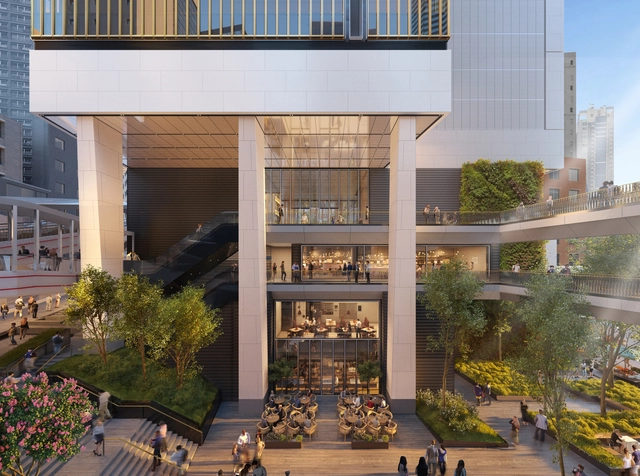
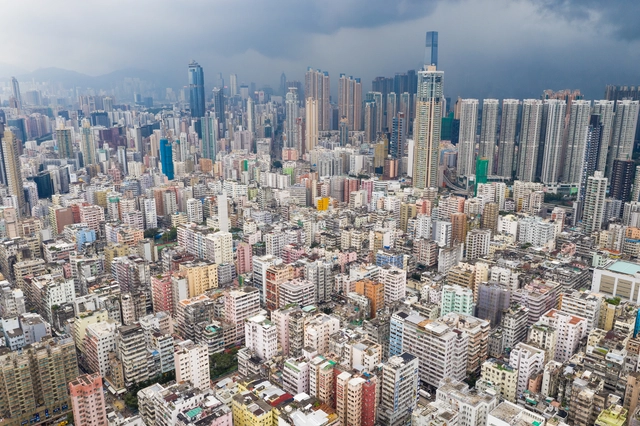
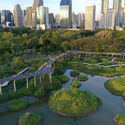
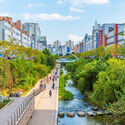
Transit-Oriented Development (TOD) is a comprehensive urban planning strategy aimed at creating dense, walkable, and vibrant neighborhoods centered around public transportation hubs. By seamlessly integrating residential, commercial, and recreational facilities within close proximity to transit nodes, TODs seek to reduce automobile dependency, increase public transit ridership, and stimulate local economic development. Government agencies play a pivotal role in supporting these developments through zoning reforms, easing floor area ratios (FARs), selling air rights, and facilitating public-private partnerships to secure capital for public infrastructure. While TODs have gained global traction, East Asia boasts some of the most successful examples. Conversely, efforts to replicate these models in different contexts—such as New York City—highlight the importance of adapting TOD principles to local conditions, geographical characteristics, and community needs.

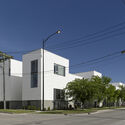
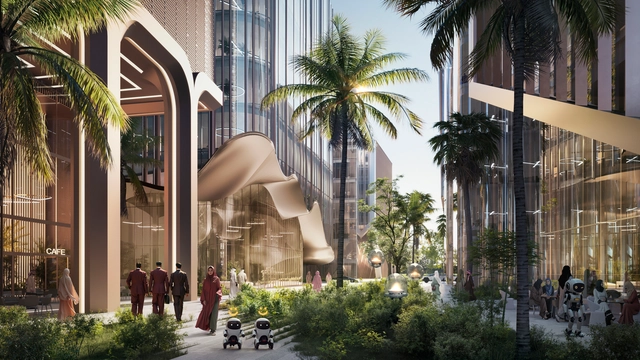
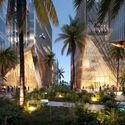
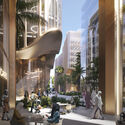
The site of Expo 2020 Dubai is scheduled to undergo a major transformation, developed by UNStudio in collaboration with several other firms. The master plan aims to reimagine the location of the first World Expo held in the Middle East, Africa, and South Asia into a new urban center, integrating the structures of the original Expo with new developments to create a cohesive and engaging new district. The development, part of Dubai's 2040 Urban Master Plan, leverages approximately 80% of the existing infrastructure and buildings from Expo 2020, minimizing waste and maximizing the value of previous investments.
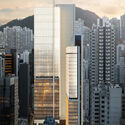
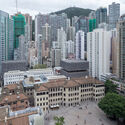
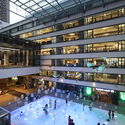
In Delirious New York, Rem Koolhaas vividly discusses the Downtown Athletic Club, a striking example of how an unassuming building exterior can conceal a vibrant mix of distinct, self-contained programs. Inside the uniform facade of this skyscraper, a private athletic club hosts an eclectic range of facilities—boxing gyms next to oyster bars and interior golf ranges below swimming pools—all segregated yet highly accessible. The Downtown Athletic Club epitomized the dynamism of New York's skyscrapers at the time, showcasing the thrill of capitalism through a selective, inward-focused world of leisure and privilege for the selected. This "machine of programs" operated independently of the external city as an isolated ecosystem within its walls. Yet, one might ask: could a similar model, designed for public use, create a more inclusive, lively community and neighborhood experience? This will activate the building within, instead of only serving the selected elites, and influence and transform the urban fabric and shapes around the building. In Hong Kong, a distant parallel can be drawn with the Municipal Services Buildings (MSBs)—publicly-funded structures that serve the community by integrating diverse functions within a singular vast building mass, much like the Downtown Athletic Club.
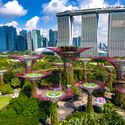
Air rights transactions have become essential in urban development, allowing cities to grow vertically while preserving limited land resources. Typically defined as the right to use or sell the space above a property, air rights enable property owners to transfer unused floor area ratio (FAR) to neighboring parcels, creating increased density and financial gain opportunities. However, the definition can vary based on locality and region, as each country interprets air rights and the ability to build or transfer them differently. As urban centers face mounting pressures from limited land supply and population growth, air rights continue to offer a creative solution that fosters architectural innovation and economic efficiency.
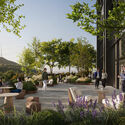
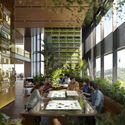
Büro Ole Scheeren has revealed their design for an 800,000 sq ft development following the concept of live-work-lay in Hangzhou, China. Titled Urban Glen, the project situated between West Lake and the Qiantang River comprises two towers connected by a central plinth. This feature, inspired by Hangzhou's hilly landscapes, becomes a built topography of terraces and exterior environments, aimed at optimizing natural light and the quality of both indoor and outdoor spaces. The Glen will house a variety of amenities, including ballrooms, meeting spaces, restaurants, and retail, all interwoven with public art from New World Development's extensive collection.
Foster + Partners have revealed their proposal for the Bilaj Al Jazayer Beach master plan, a new development aiming to introduce a new touristic destination along Bahrain's southwest coast. The 3.5-kilometer beachfront introduces a pedestrian-friendly infrastructure along with a mixed-use district fitted with residential areas, hotels, retail spaces, and public amenities.
India is often recognized for its thriving technology industry, with a reputation for producing a substantial number of skilled tech professionals each year. This has attracted a dynamic technology ecosystem that increasingly draws global companies to establish operations in the country. The rise of tech parks has become a key strategy for harnessing this talent and resources, cultivating an environment conducive to innovation. What impact do these tech parks have on the urban landscape of Indian cities?
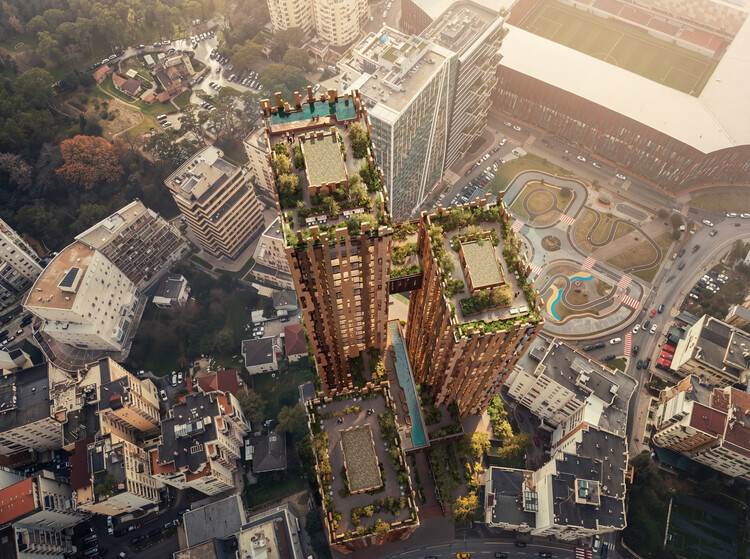
Portuguese architecture studio OODA has commenced construction on the Hora Vertikale Towers in Tirana, a city renowned for its urban revitalization and architectural innovation. The project aims to contribute to this dynamic landscape as a multi-functional, 55,000-square-meter "vertical village" rising 140 meters tall. The project is designed to also integrate a large-scale green public space, also designed by OODA. The project was first announced earlier this year.
Danish architecture firm Cobe has announced a new project to transform the historic 'Krulli' steelworks, a large-scale former industrial site in Estonia's capital, into a mixed-use city district. The strategy for the project is developed to optimize for material reuse, as materials, components and even entire buildings have been evaluated for their potential to be reintegrated into the scheme. This way, the decommissioned industrial area provides the foundation for an innovation hub, maintaining its history while adapting to the necessities of modern workspaces and city life.
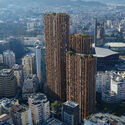
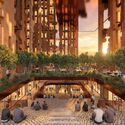
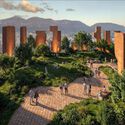
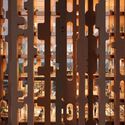
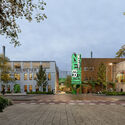
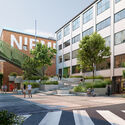
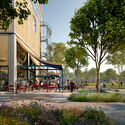
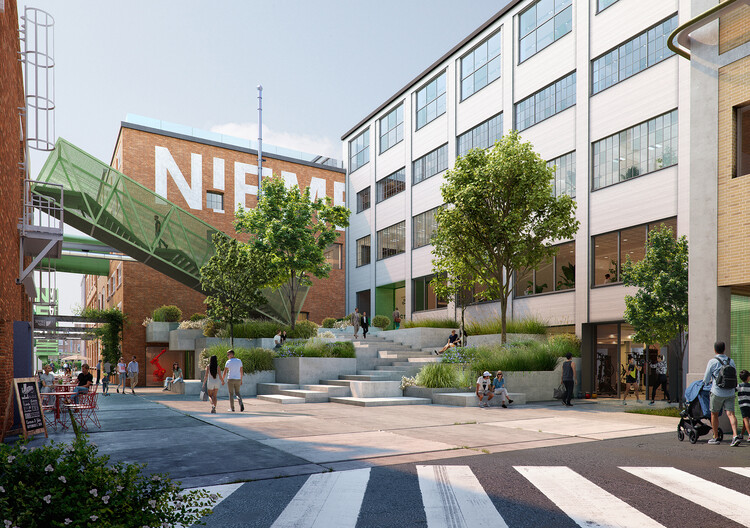
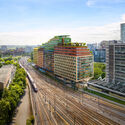
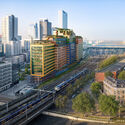
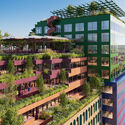
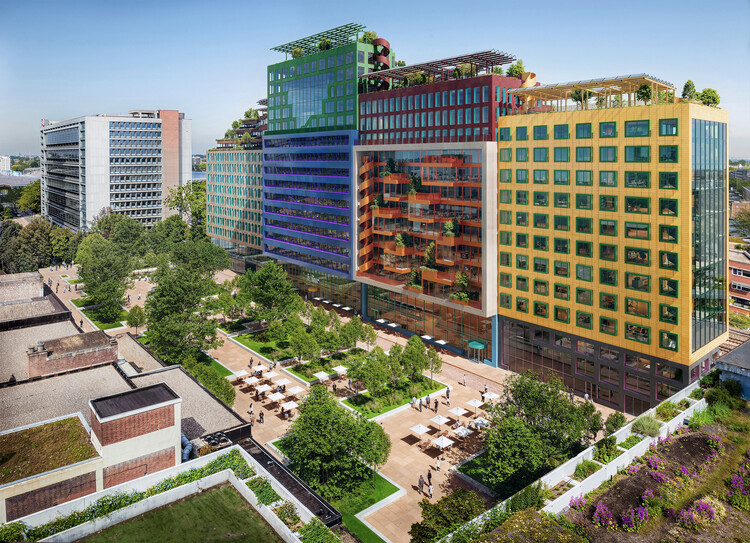
MVRDV has revealed its design for Monaco, a six-story office building situated in Munich's transforming Werksviertel neighborhood. This region, previously known for its industrial past and later as a cultural hotspot, has been evolving into a dynamic work-and-leisure district since 2016. Positioned near MVRDV's earlier project, WERK12, the Monaco building uses recycled materials and distinctive shapes to create a balanced "work and play" office environment, inspired by the color and creative spirit of the Kultfabrik era.
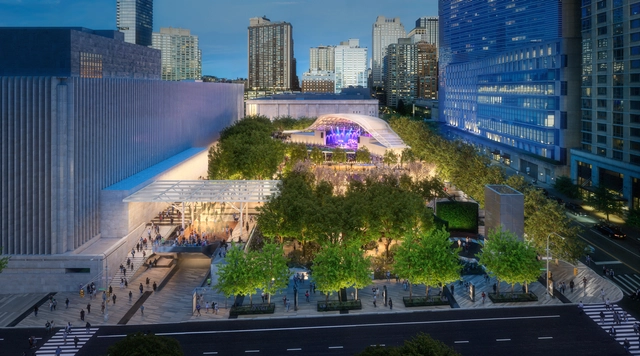
The New Jersey Performing Arts Center (NJPAC) has announced a three-year redevelopment of its 2-acre downtown Newark campus. The project, designed by architectural firms Skidmore, Owings & Merrill (SOM), and Weiss/Manfredi, has recently broken ground and is scheduled for completion in the fall of 2027. It integrates 350 mixed-income residential units, retail spaces, and a dynamic education and community center, in addition to rehearsal spaces, a new headquarters for jazz public radio station WBGO, and various outdoor gathering areas.
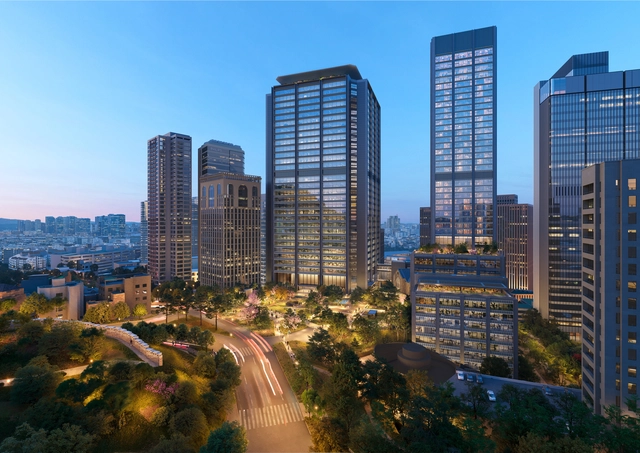
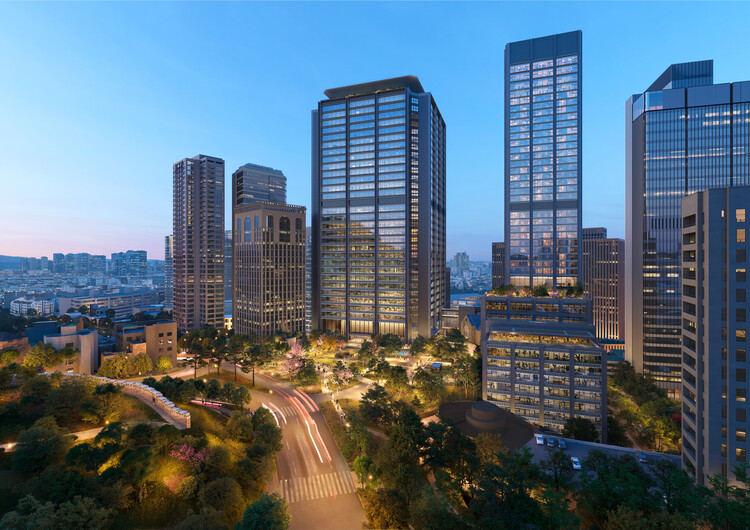
Situated in Hangzhou's Central Business District, the Euro American Innovation City is a mixed-use development designed by Foster+Partners to become a dynamic addition to the city. The 346,450 square-meter project includes two 200-meter-high office towers and four high-rise apartment buildings, complemented by a public plaza, an IT incubator, and a retail mall on the lower levels. Construction is currently progressing in phases, with the first phase nearing completion next month and the second set to finish by year-end, while the entire project aims for completion in September 2025.
WilkinsonEyre has unveiled their proposal to revitalize the 1950s constructivist Belgrade Fair Hall 1, a landmark location overlooking the river Sava. The project is set to transform the exhibition hall into a mixed-use destination comprising three cultural venues and retail spaces, in addition to redesigning the waterfront park. WilkinsonEyre’s design incorporates light-touch interventions to the existing building, as it strives to respect and highlight the architectural qualities of the existing structure, such as the exposed concrete soffit or the unique shape of the building.
Kohn Pedersen Fox (KPF) has announced an expansive project to redevelop and refurbish the Foster + Partners designed 8 Canada Square building, also known as HSBC Tower, in Canary Wharf, London. Following an international competition, the remodeling plans include removing large parts of the 42-story building to introduce terraces and additional functions. According to Canary Wharf Group and the Qatar Investment Authority, this represents the largest transformation of an office tower into a sustainable mixed-use building. The project is set to begin in 2027, after the expiry of the HSBC lease.
Stefano Boeri Architetti has been declared the winner of the international competition for the redevelopment of a former industrial site in downtown Bratislava. The project includes the transformation of one of the largest abandoned areas in the Slovak capital, with the aim of creating an active new central hub for the city, complete with parks and public spaces, residential units, and a variety of amenities. Stefano Boeri Architetti’s master plan proposal, titled “Urban Oasis,” has been appreciated by the jury for integrating familiar typologies, creating a “European matrix” of medium-density developments organized around accessible public spaces.
American architecture and engineering firm Skidmore, Owings & Merrill (SOM), in collaboration with Mexico City-based Estudio AMA and interior designer Esrawe Studio, has revealed a new 190-meter-tall mixed-use tower in Guadalajara, Mexico. The new addition, which broke ground on May 24, is slanted to become the tallest building in the Andares Zapopan district of the city, offering residential units, hotel rooms, and various amenities.
Located along Manhattan’s East River waterfront, the Freedom Plaza sets out to create a new civic and cultural hub, introducing a new open and green space in the crowded area, with plans to add an in-park Museum of Freedom and Democracy. Additionally, the scheme designed by BIG-Bjarke Ingels Group includes affordable housing units, two hotels, retail, and restaurants. Developed by Soloviev Group and Mohegan, the Freedom Plaza development reimagines one of the largest undeveloped plots in Manhattan, measuring 6.7 acres located south of the United Nations headquarters in the Midtown East neighborhood.