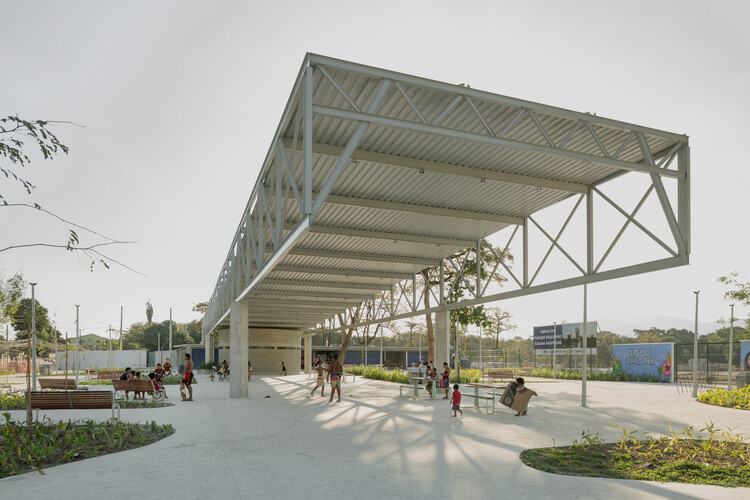
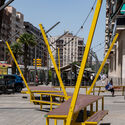
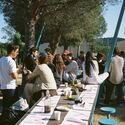
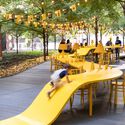
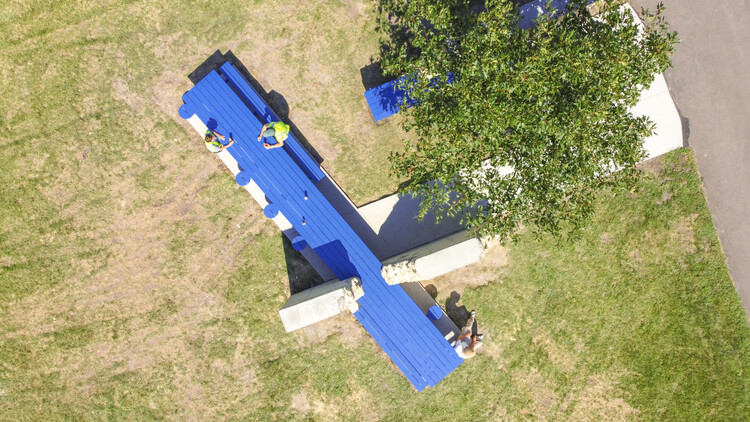
Courtesy of [applied] Foreign Affairs, Institute of Architecture, University of Applied Arts Vienna
Long before architecture took the form of walls, roofs, or cities, it gathered people around fire. The simple fire pit was one of humanity's earliest spatial devices: a place for warmth, food, storytelling, and ritual. Around it, space took shape through proximity rather than enclosure, through shared presence rather than prescribed use. The fire organized bodies in a circle, fostered alliances, and turned survival into collective life. Today, this ancestral logic persists: architecture has the potential of bringing people together not by commanding how they gather, but by creating the conditions that make togetherness possible.
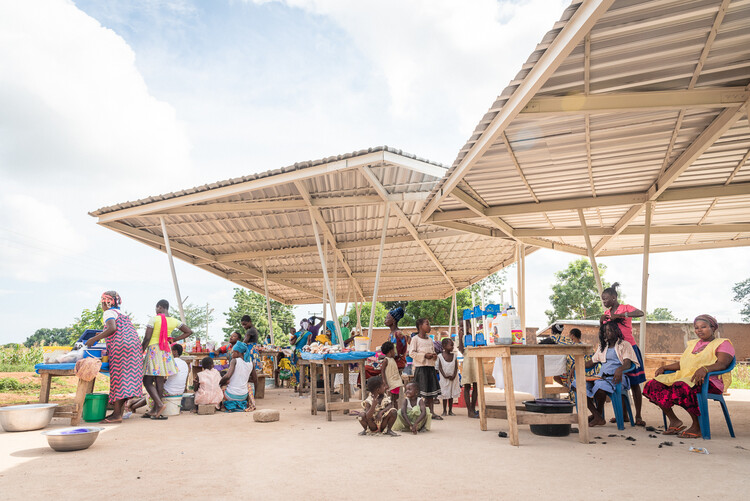
This month, ArchDaily explores Coming Together and the Making of Place, a topic that examines architecture as a framework for inclusion, care, and belonging. The theme aligns with the first edition of the ArchDaily Student Project Awards, which approach care from a collective perspective by focusing on spaces that nurture better ways of living together. Looking beyond iconic gathering spaces, the coverage considers everyday environments, from food markets, communal tables, and neighborhood plazas to third spaces, domestic settings, and digital or hybrid environments of remote togetherness. Rather than treating togetherness as a fixed program, it asks how spatial design can support openness, diversity, and collective life without enforcing uniform ways of gathering.
Public space is often understood as belonging to no one in particular, collectively accessible yet institutionally maintained, yet a growing number of initiatives are challenging this assumption by testing shared management and distributed ownership models. In Paris, Adoptez un banc introduces a sponsorship-based approach, allowing individuals and groups to support temporarily and symbolically claim responsibility for historic public furniture without compromising its collective use. Elsewhere in the city, community gardens operating under the Main Verte framework demonstrate a self-managed model, in which public and private landowners retain ownership while delegating day-to-day control to citizen associations for food production and shared use. In New York, Common Corner represents a third pathway, based on institutional collaboration and participatory design, where public agencies, nonprofits, designers, and residents co-produce public space within a public housing context. Taken together, these three cases suggest that care, authorship, and responsibility can be distributed across citizens and institutions, producing more resilient, locally grounded urban environments.
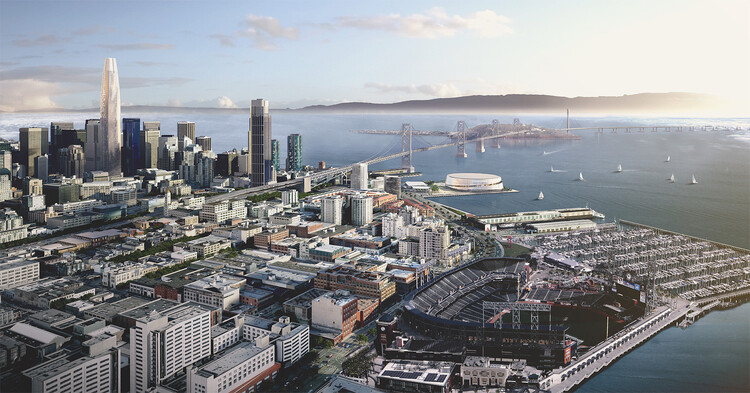
The exhibition Coming Together: Reimagining America's Downtowns, held at Washington, D.C.'s National Building Museum, explores the transformations underway in the United States' downtowns and the ways communities have organized to shape alternative urban scenarios. Curated by Uwe S. Brandes, Professor at Georgetown University, and designed by Reddymade and MGMT., it is the first of three major exhibitions within the Museum's Future Cities initiative, an interdisciplinary project examining the city as a hub, catalyst, essential building block, and reflection of society. Coming Together features examples from more than 60 U.S. cities, both large and small, highlighting lessons learned and opportunities embraced in the wake of the COVID-19 pandemic as communities adapt to lasting changes in work, housing, mobility, entertainment, and recreation. The exhibition is currently open to the public and will remain on view through Fall 2026.
India's built environment has, in recent years, gained visibility through a growing number of transformative architectural and infrastructure projects. Cities and towns scale faster each year, despite looming concerns around climate and economic volatility. The nation has shown resilience in balancing rapid urbanization with resource constraints; this is no small feat. India's architectural practices rarely rely on novelty alone; they are built on systems that have existed for centuries. Through ArchDaily's Building for Billions, recurring stories have highlighted the social intelligence and adaptive capacity embedded in these practices, revealing an architecture that operates less as isolated form and more as infrastructure.
Collective housing remains one of the most active areas for unbuilt architectural exploration, revealing how architects are rethinking domestic life, density, and shared living across different cultural and environmental contexts. In this curated Unbuilt edition, submitted by the ArchDaily community, the selected proposals investigate new forms of dwelling that span mobile units, vertical developments, adaptive reuse, and landscape-driven residential clusters. Rather than treating housing as a purely functional container, these projects position it as a social and spatial framework that shapes everyday life, community ties, and long-term urban resilience.
Across varied geographies, from Tirana and Athens to Monterrey, Chaloos, Roatán, Bhola, and the DRC, these proposals explore multiple approaches to collective living: transforming industrial shells into residential structures, extending existing masterplans through landscape integration, reimagining verticality in dense urban centers, and developing modular prototypes that can adapt to changing climates or patterns of mobility. Some projects prioritize ecological strategies and local materials, while others test new models for accessibility, community well-being, or incremental urban growth. Together, they reflect a broad spectrum of architectural responses to contemporary housing pressures.
What does optimism feel like in cities that can no longer rely on perfection as their ultimate ambition? Across the world, urban environments bear the weight of overlapping pressures: climate volatility, spatial inequality, political fragmentation, public distrust, and chronic infrastructural disinvestment. These realities render the idea of an ideal city increasingly detached from lived experience. Yet the hope for building better systems persists. While utopian visions may seem like an escape from the growing complexities of the modern world, the greater challenge for contemporary city-making is to confront those complexities rather than avoid them.
Public spaces remain some of the most dynamic sites for unbuilt architectural experimentation, revealing how cities and architects can imagine accessibility, gathering, and civic identity. In this curated Unbuilt edition, submitted by the ArchDaily community, the selected proposals examine parks, pedestrian corridors, cultural landscapes, and open-access urban environments that invite people to meet, move, rest, and participate in collective life. Rather than treating public space as leftover terrain, these projects position it as essential infrastructure—shaping urban health, memory, and social interaction.
Across South America, architecture is increasingly being understood as a collective act. Rather than imposing external views, many studios and designers are building with and for communities, learning from their local practices, materials, and ways of inhabiting. These projects are repositioning the architect's role from an author to a facilitator, transforming design into a participatory process that centers collaboration, care, and mutual respect.
What unites these efforts is not style or scale, but a shared belief: architecture emerges from collective dialogue, not imposition. From rural Ecuador to the urban peripheries of Brazil, Colombia, and Paraguay, these projects reveal how social engagement and local making produce spaces that are sustainable not only environmentally but also socially. They respond to inequality not through top-down solutions, but through co-authorship, offering spaces that reflect the needs, knowledge, and agency of the people who use them.
Edinburgh Castle in Scotland’s Capital. Image by 瑞丽江的河水, via Wikimedia Commons (CC BY-SA 4.0)
Edinburgh, Scotland's capital, has long been recognized for its rich cultural history and intricate urban fabric. The city thrives within its museums, tenement housing, and shops nestled in Georgian buildings. In 2022, Time Out ranked Edinburgh as the world's best city, citing its efficiency across community building and urban systems such as public transport. However, as climate change makes its effects progressively visible at an urban level, the city inevitably runs into a pressing dilemma: how to sustain this quality of life in increasingly difficult conditions.
The journey toward this balance unfolds through several interconnected strategies, such as retrofitting, adaptive reuse, circular design, and community collaboration, each contributing to Edinburgh's evolving vision of a sustainable urban future.
In many parts of the world, remoteness is not only defined by distance. It may describe a mountain settlement far from infrastructure or an urban and suburban neighborhood on the margins of visibility and opportunity. Across these diverse contexts, the library has been one of the most vital typologies—a space where architecture embodies the modes of accessibility, inclusivity, and community care.
Domestic workers in Hong Kong and Singapore are the city's quiet infrastructure. In Hong Kong alone, there are a total of roughly 300,000 domestic workers, serving a portion of the approximate 2.7 million households. Their care labor sustains dual-income family routines: childcare, eldercare, cooking, cleaning, and the everyday logistics that make professional life possible. Yet the people who hold this balance together remain largely invisible in policy—and, crucially, in space.
On Sundays in Hong Kong's financial district, that invisibility becomes visible. Elevated walkways and podium forecourts—underused on weekends—turn into ad-hoc commons. With cardboard mats, small tents, towels, food and water, and a music speaker or two, domestic workers assemble places to sit, rest, and socialize. These improvised rooms in the city are often their only chance to exercise spatial agency—something they rarely have in the homes they maintain or in formal public infrastructure. In the absence of sanctioned, serviced places for rest, quieter bridges and passages become practical stand-ins.
What should be taken into account when designing a fire station? The answer may seem obvious: functionality and efficiency. After all, every second counts in an emergency. But can a building designed for urgent operations also be aesthetically compelling, welcoming, and connected to its community? In recent decades, architects such as Zaha Hadid and Álvaro Siza have demonstrated that it can. By rethinking this building type, they have created spaces that go beyond emergency response—spaces that strengthen social ties, support the well-being of firefighters, and become urban landmarks.
The habit of sitting at the table and sharing a specific moment with other people has been present for centuries in the most diverse cultures. The Greek Symposium, Roman Convivium, Medieval Feasts and Banquets, and Parisian Salons are just a few examples of how this custom was historically built and has been relevant in social and political negotiations, intellectual discussions, and philosophical debates.
Commensality often serves as a ritual for bonding, negotiation, and celebrating important events. In many Spanish-speaking cultures, the stretch of time after the meal when the entire family stays seated and talks is so present that there is a word for it: sobremesa — literally translated as "upon the table" (though in Spanish it more accurately means "dessert" or "after-meal conversation"). But, despite often being associated with sharing a meal, the table can be considered a flexible platform open to many possibilities for appropriation and interaction.
Today, on the first Monday of October, we celebrate World Architecture Day. This year, the International Union of Architects (UIA) has set the theme "Design for Strength," a powerful call to action that resonates deeply with the UN's focus on urban crisis response. In a world facing unprecedented environmental and social disruptions, this theme challenges us to move beyond temporary fixes. It asks: How can our buildings and cities not only withstand shocks but also foster equity, continuity, and resilience?
While the concept of strength in architecture can easily evoke images of reinforced concrete and steel, a more profound interpretation is emerging, one that defines strength not as mere rigidity, but as a holistic capacity to endure and adapt. This includes many facets, from ecological resilience and stewardship to long-lasting concepts of social resilience or the long-lasting conservation of existing urban structures, all contributing to a built environment more able to respond to the multitude of crises faced by cities worldwide.
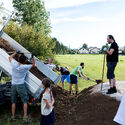
Working with the site instead of against it, the exhibition "Architecture is Cooperation," curated by Josep Ferrando, emphasizes the value of cooperation at the essence of architecture. Showcasing the work of professionals, organizations, and communities in cooperation projects driven from Spain, the installation takes shape through an exhibition design in earth and wood. The choice of these materials is understood not only from their aesthetic or symbolic qualities but also from their functionality and commitment to the principles of the circular economy. Until September 30, 2025, the exhibition will be on view at the Casa de la Arquitectura in Madrid, highlighting the necessary attention of architecture to the demands of the most vulnerable societies and communities by aligning the constructive language with the content of the exhibition.
As cities continue to develop, we are seeing ever more well-planned, thoroughly executed, and tightly regulated approaches to shaping urban centres and their surrounding spaces—for better and for worse. As codes, restrictions, and guidelines improve and tighten, urban environments become safer, more balanced, and less prone to surprise. Yet the flip side is that highly managed districts can drift toward over-order and sanitisation, shedding the messy, accretive character that once produced alleyways, residual spaces, and unexpected sequences of movement—conditions often born from ongoing community improvisation in the grey zones of regulation.
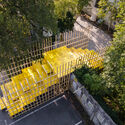
In response, a growing number of initiatives around the world are proposing short-term urban installations that test alternate futures for the city. These works aim to provoke dialogue between what the city is and what it could offer its communities through thoughtful, context-specific spatial practices. One notable example is Concéntrico, the international festival in Logroño, Spain, conceived as an urban innovation laboratory. Marking its tenth edition, the festival is about to publish Concéntrico: Urban Innovation Laboratory, a book that surveys a decade of urban design and collective transformation shaped through successive editions of the festival. Its launch is paired with an international tour designed to share a decade of insights on collective transformation and design.