

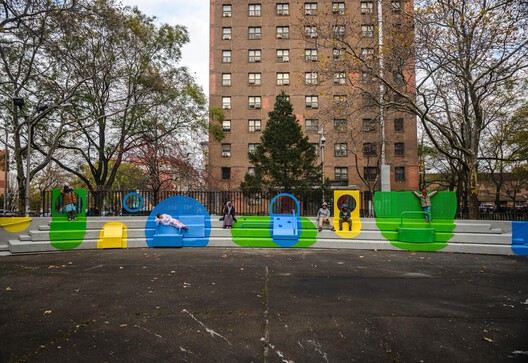
Public space is often understood as belonging to no one in particular, collectively accessible yet institutionally maintained, yet a growing number of initiatives are challenging this assumption by testing shared management and distributed ownership models. In Paris, Adoptez un banc introduces a sponsorship-based approach, allowing individuals and groups to support temporarily and symbolically claim responsibility for historic public furniture without compromising its collective use. Elsewhere in the city, community gardens operating under the Main Verte framework demonstrate a self-managed model, in which public and private landowners retain ownership while delegating day-to-day control to citizen associations for food production and shared use. In New York, Common Corner represents a third pathway, based on institutional collaboration and participatory design, where public agencies, nonprofits, designers, and residents co-produce public space within a public housing context. Taken together, these three cases suggest that care, authorship, and responsibility can be distributed across citizens and institutions, producing more resilient, locally grounded urban environments.
"Adoptez un Banc": Sponsored Public Furniture as a Model for Shared Ownership in Paris' Public Space
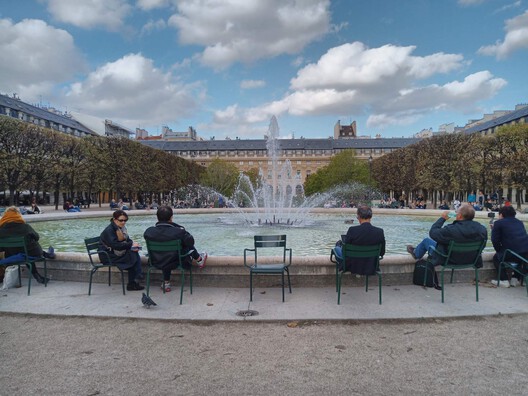
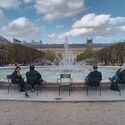
The Adoptez un banc initiative in Paris introduces a patronage-based model for public space stewardship, using sponsorship as a mechanism to fund and maintain everyday architectural elements within the Jardin des Tuileries, managed by the Musée du Louvre since 2005 and visited by millions of people each year. Through this program, individuals or groups are invited to sponsor the restoration or reproduction of historic cast-iron benches originally installed in the Tuileries since the 19th century, either in their own name, collectively, or through open-ended contributions to shared "donor benches." Each sponsorship is marked by a discreet plaque installed on the bench for a period of ten years, establishing a temporary and symbolic form of authorship without altering public access or use. The scheme supports a broader restoration effort involving 166 historic benches, to be carried out by a French artisanal foundry in 2025, with reinstallation planned for spring 2026. By linking private contributions to durable, widely used public infrastructure, Adoptez un banc reframes public seating as both heritage object and shared civic asset, sustained through voluntary, time-bound participation.
Community Gardens on Shared Urban Land: A Self-Managed Urban Food Production Model
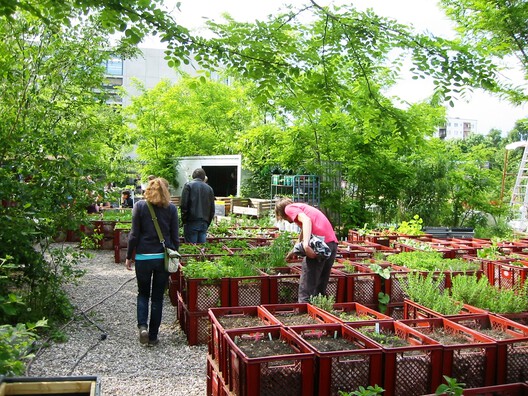
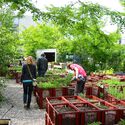
Also in Paris, a city often cited as a model of compact urbanism, community gardens operate as a form of self-managed public space on land owned by public and private institutions. Through the Main Verte Jardin Partagés program, launched in 2002, citizen groups and local organizations are granted access to plots ranging in size from approximately 70 m² to 1,000 m², located on land owned by the City of Paris, railway companies, or shared housing tenants. The program provides a structured framework for land availability, along with technical and land-related support delivered through the local association responsible for managing each neighborhood garden. Participation in Main Verte requires automatic adherence to the Charte Main Verte (Green Hand Charter), which establishes shared rules and best practices governing the collective use, maintenance, and openness of these gardens.
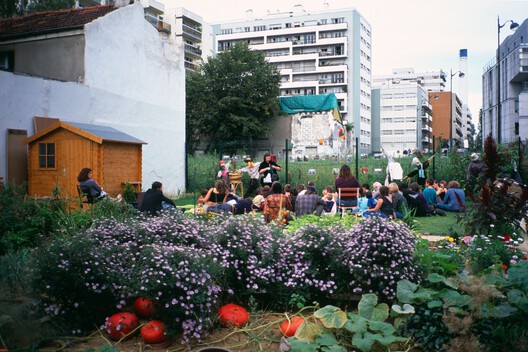
While not a novel concept, community gardens remain a widely adopted tool for urban revitalization and social cohesion worldwide, offering city residents access to locally grown food and shared gathering spaces under collective control. Under this model, public or private institutions retain land ownership while granting day-to-day management to various types of citizen associations, enabling the creation of long-term, collectively governed spaces dedicated to food production, gardening, and social exchange. Comparable approaches can be found in initiatives such as GreenThumb in New York, self-managed volunteer gardens in Berlin, including Prinzessinnengarten and Tempelhofer Feld, Poland's "Under the Stars" and "The Answer Is a Garden" projects, and the Slow Food Gardens network sponsored by Italy across Africa.
"Common Corner": A Public Space Renovation Project in New York Built Through Institutional Collaboration
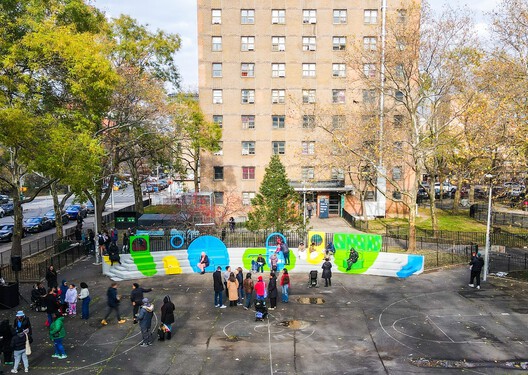
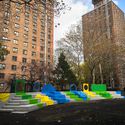
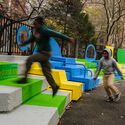
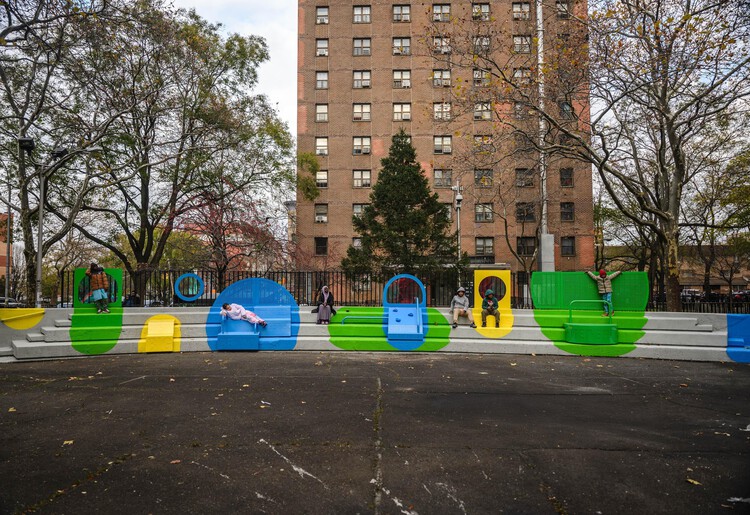
Common Corner is a permanent public space installation at Morris Houses residential complex located at 1477 Washington Avenue in the Bronx, developed as part of the New York City Housing Authority's Connected Communities program, which advances the modernization of open spaces through public–private partnerships grounded in participatory planning and design. Completed on November 22, 2025, the 600-square-foot project transformed an aging, underused concrete bleacher into a shared neighborhood asset supporting multigenerational activities and open-ended play. The bleachers were identified as a priority for redesign through a community-wide survey, positioning resident input as the starting point for investment in shared space.
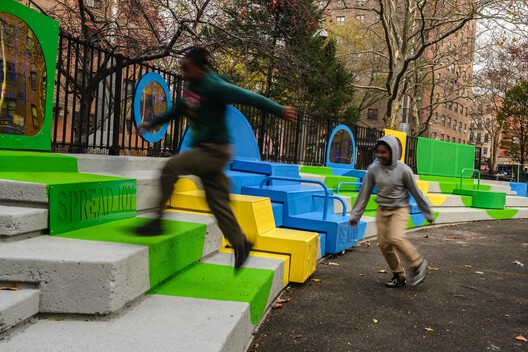
The project was co-designed by The Urban Conga, a multidisciplinary design studio, in close collaboration with residents of the Morris Houses, following a series of participatory workshops conducted with the Center for Justice Innovation. The resulting design incorporates resident-led ideas through spatial and material elements such as words of affirmation, reflective color-changing dichroic panels, a climbing wall, and a perforated panel for communal crafting. Development was supported through a partnership between the Public Housing Community Fund, the New York City Housing Authority (NYCHA), and the Center for Justice Innovation, demonstrating a model in which institutional collaboration enables community authorship of public space, while maintaining long-term public ownership.
In recent news, façade installation has commenced at the construction site of OPPO's new headquarters campus in Shenzhen's Greater Bay Area, designed by Zaha Hadid Architects and situated within a rapidly developing urban context. In central Taiwan, SANAA's Taichung Art Museum officially opened on December 13, 2025, combining a contemporary art museum, library resources, and public parkland as part of the Taichung Green Museumbrary project. Across Europe and North America, ongoing pedestrianisation initiatives are testing different pathways toward more resilient and walkable cities, ranging from statutory planning and capital construction to research-driven visioning. Meanwhile, in Japan, new technologies to support high-capacity data transmission are being integrated into the first phase of PLP Architecture's Tokyo Cross Park masterplan.


