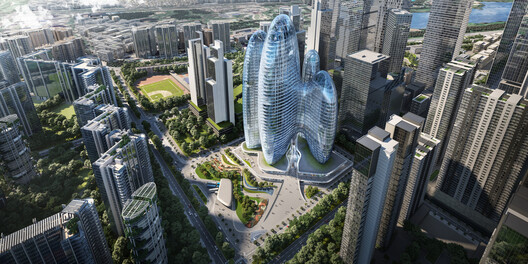
Facade installation has commenced at the construction site of OPPO's new headquarters campus in Shenzhen's Greater Bay Area, indicating visible progress on the project designed by Zaha Hadid Architects. Planned as a consolidated workplace for a China-based technology company, OPPO, the campus is situated within a rapidly developing urban context. The headquarters is intended to accommodate the company's expanding workforce while integrating office functions with publicly accessible spaces. Current construction activity involves the assembly of the external envelope, which reflects the project's established massing, tower configuration, and overall spatial organization.
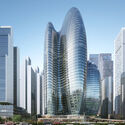
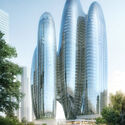
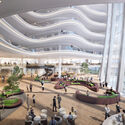

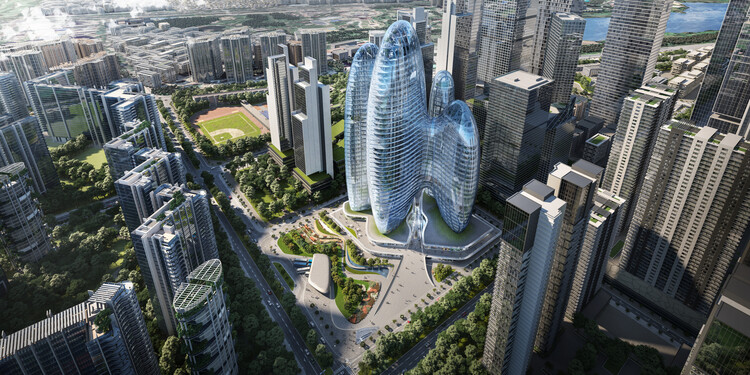
The project comprises four interconnected towers with a total gross floor area of approximately 185,000 square meters, reaching heights of up to 200 meters over 42 floors. Two of the towers contain flexible office spaces, while the other two house vertical circulation and service functions. A 20-storey vertical lobby links the towers, organizing internal movement and providing shared circulation space. The towers are oriented toward Shenzhen Bay, and their inward tapering at lower levels allows for larger open areas at ground level, shaping the relationship between the building and its surrounding urban fabric.

By placing service cores on the exterior of the towers, the project frees the interior floor areas from structural and mechanical obstructions. This approach allows for uninterrupted floorplates and continuous sightlines across workspaces, with large atrium spaces visually connecting different levels. Circulation routes are distributed vertically and horizontally, supporting movement through the building without relying on a single central core. According to the design team, this configuration prioritizes spatial clarity and adaptability, enabling departments to reconfigure layouts over time while maintaining visual connections across the campus.
At ground and podium levels, the headquarters is planned to function as a publicly accessible urban node rather than a closed corporate enclave. A diagonal pedestrian route traverses the site, linking a landscaped plaza with an art gallery, retail areas, restaurants, and direct access to a nearby subway station. Additional public programs are located above ground, including a sky plaza on the 10th floor and a rooftop terrace. The project targets LEED Gold certification and incorporates external louvers and energy management systems intended to reduce solar gain and improve operational efficiency.

In other recent news from Zaha Hadid Architects, the studio, in collaboration with RINA as team leader alongside Studio Plicchi, WSP, STI Engineering, and BC Building Consulting, has won the international competition to design the Malpensa Hospital in Italy. "Architecture of Possibility: Zaha Hadid Architects," exhibition currently on view at the Museum of Contemporary Art and Urban Planning (MOCAUP) in Shenzhen, presents an overview of the practice's work and its evolution over recent decades. Meanwhile, construction of Zaha Hadid Architects' Yidan Center in Shenzhen has reached full height; the building is planned to house the Chen Yidan Foundation and the Yidan Prize, organizations focused on education and lifelong learning.