

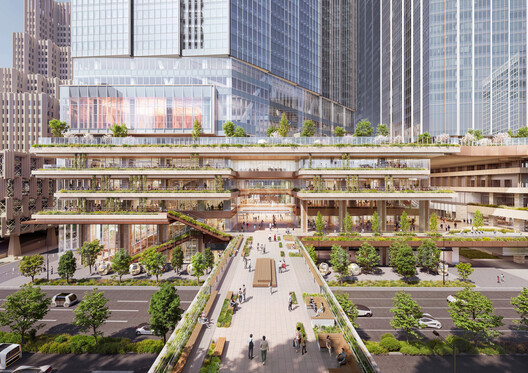
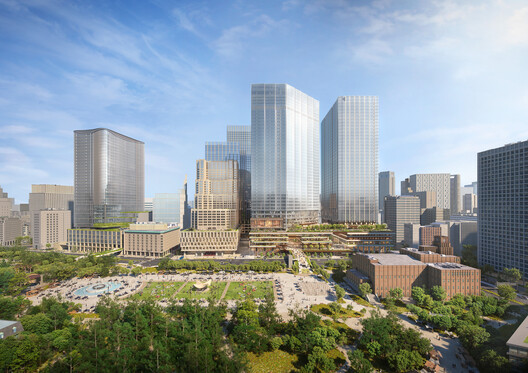
Construction has officially broken ground on Tokyo's new global headquarters for NTT, a major Japanese technology company. The project is a key component of PLP Architecture's Tokyo Cross Park masterplan, a large-scale regeneration development in the Tokyo metropolitan area, first announced in 2022. On December 5, 2025, construction began on the first stage of the scheme, one of four towers planned within the masterplan. The NTT Hibiya Tower, designed by PLP Architecture and developed by NTT Urban Development in collaboration with Tokyo Electric Power Company, is a 230-metre-tall, 361,000-square-metre mixed-use building and forms the central element of the 1.1-million-square-metre Tokyo Cross Park Vision. PLP Architecture serves as Design Architect for the tower, as well as Masterplanner and Placemaking Strategist for the wider development.


The project incorporates IOWN (Innovative Optical and Wireless Network), a digital infrastructure initiative led by NTT that uses optical technology to support high-capacity data transmission with reduced latency and energy consumption. IOWN is being developed as a next-generation communications network intended to improve efficiency in data transfer by replacing some electronic processes with optical ones. According to PLP Architecture, the system is designed to increase data capacity, reduce latency, and lower energy use compared to conventional networks. Within the NTT Hibiya Tower, this infrastructure is intended to support adaptable building systems and digitally responsive environments.
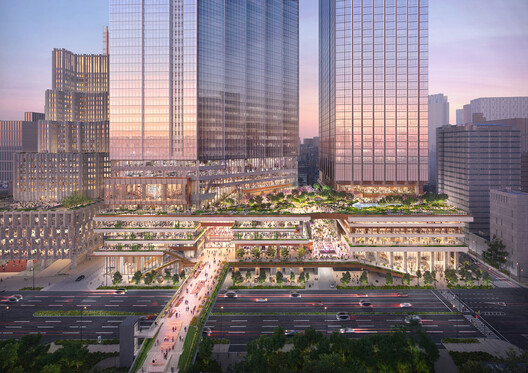
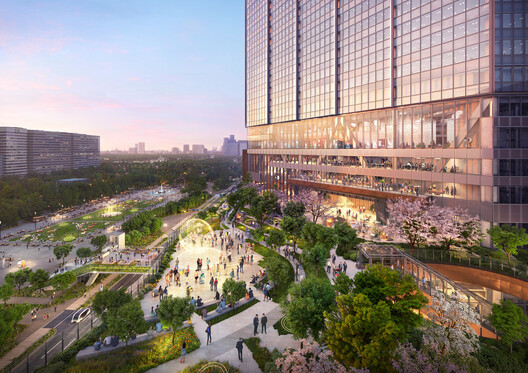
As one of Japan's largest mixed-use developments, the tower reconsiders the role of a corporate headquarters within a broader urban framework. It forms part of a 6.5-hectare masterplan in central Tokyo and includes approximately 150,000 square metres of workplace space. The design supports distributed working practices, enabling collaboration across locations through shared digital environments rather than relying solely on co-presence. Building systems are designed to respond to occupancy and use, with adjustable lighting, climate control, and spatial configurations intended to accommodate changing patterns of work and activity.
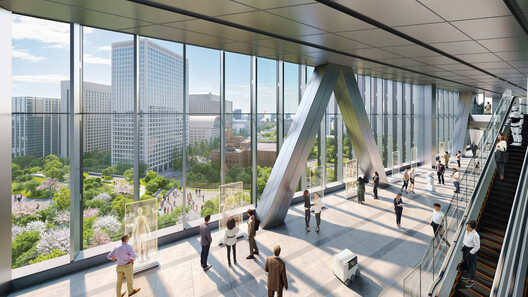
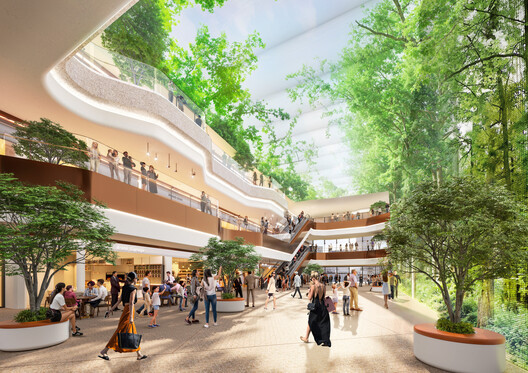
At ground level, the three-storey Cross Gate functions as a public-facing interface between the tower and the city. The space is designed to accommodate a range of events and daily activities, with adaptable interior surfaces intended for visual displays. Levels 7 to 10 house an innovation hub aimed at bringing together companies, researchers, and institutional partners working in fields such as urban development, information and communication technologies, and energy. A 400-seat cultural hall on Level 9 is planned to host live events overlooking Hibiya Park, with interior elements incorporating reclaimed materials from the former NTT building previously located on the site. The hall is also designed to support live connections to venues elsewhere in Japan.
Across the project, building performance and material choices are guided by environmental targets. Office areas are expected to achieve "ZEB Ready" standards, with projected energy reductions of more than 50 percent compared to conventional office buildings. The construction incorporates materials such as recycled aluminium, low-carbon concrete, and electric arc furnace steel. The design also explores the integration of emerging technologies for building management alongside the use of lower-emission energy sources, including hydrogen.
Other recent large-scale architectural projects worldwide include OODA's announcement of the House of Nassr, an integrated sports complex designed for Al Nassr FC in Riyadh, Saudi Arabia; Bechu & Associés' winning proposal for the masterplan of Hunnu City, a planned satellite city south of Ulaanbaatar, Mongolia; and White Arkitekter's bio-based timber neighbourhood proposal for Hoofddorp in the Netherlands. New approaches to future-oriented architecture are also reflected in conservation and renovation projects, such as Studioninedots' transformation of a former tobacco factory into a mixed-use urban complex in Groningen, the Netherlands, and MVRDV's renovation of the Plum Village Buddhist Monastery in southern Dordogne, France.


