

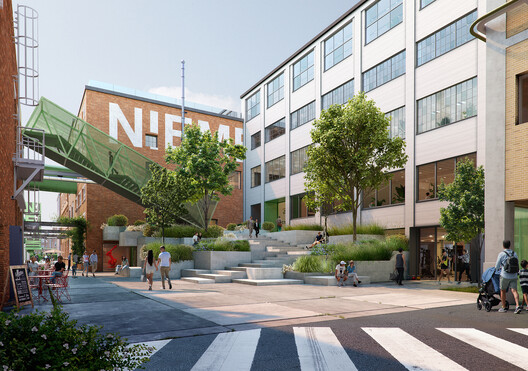
Studioninedots is leading the transformation of a 200-year-old tobacco factory site into Niemeyer, a mixed-use urban complex accommodating digital innovation, cultural venues, hospitality, education, and manufacturing within the existing industrial buildings. Located on Paterswoldseweg in Groningen, the Netherlands, the 38,000 m² project is commissioned by MWPO, with MWPO and Campus Groningen jointly acting as clients for the Shared Facilities. Currently in the design phase (2023–2025), the project's provisional timelines indicate a phased construction start beginning with the factory's southern section in 2026, followed by the northern section in 2027. The Amsterdam-based office's proposal opens the formerly closed industrial ensemble to the public, introducing cafés, galleries, workshops, and shared workspaces distributed across interior streets and adjacent park areas.
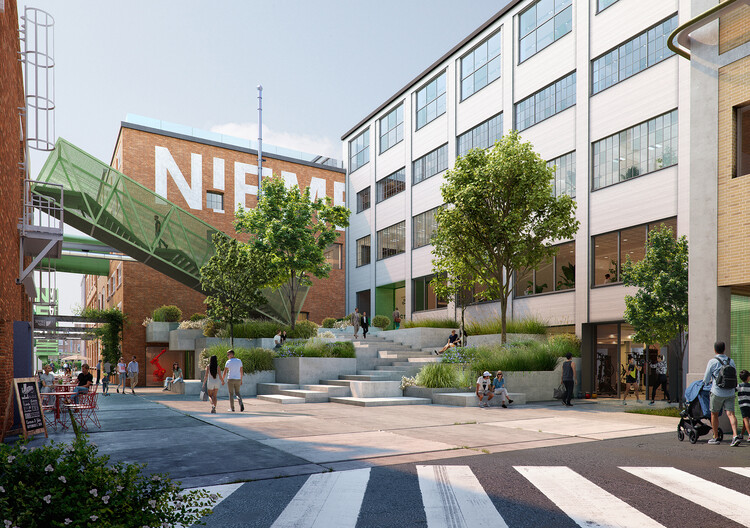
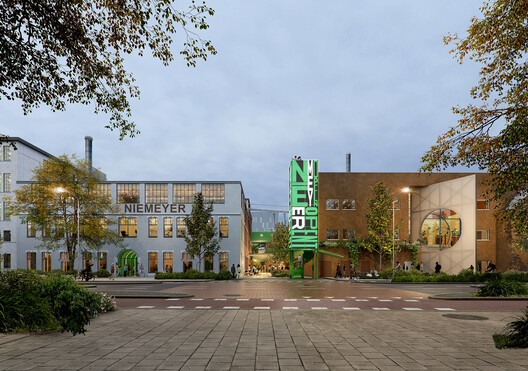
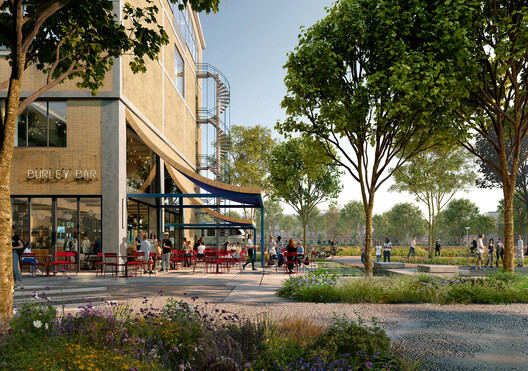
At the scale of the site, the design is structured around openness, connectivity, and a clearly articulated public realm. Four public zones define the open space: Spoorpark, Industriestraat, Buurtstraat, and Entreeplein. Together, these areas form the connective tissue between the buildings, programs, and surrounding neighbourhoods. Spoorpark follows the route of the historic railway line and incorporates embedded rails, rain gardens, and informal seating to support both movement and pause. Industriestraat, formerly used for logistics, is reconfigured as the site's primary social axis, accommodating pavilions, outdoor seating, and public events. Historic brick halls from 1904, later concrete additions, and visible traces of industrial use are preserved and restored where possible, allowing the site's layered history to remain legible within this new spatial framework.
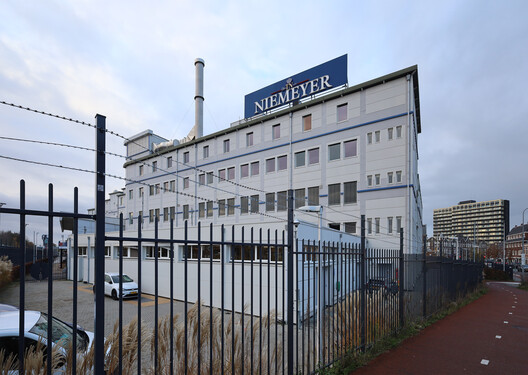
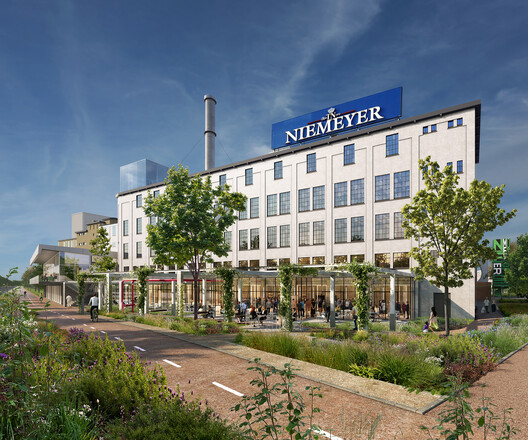
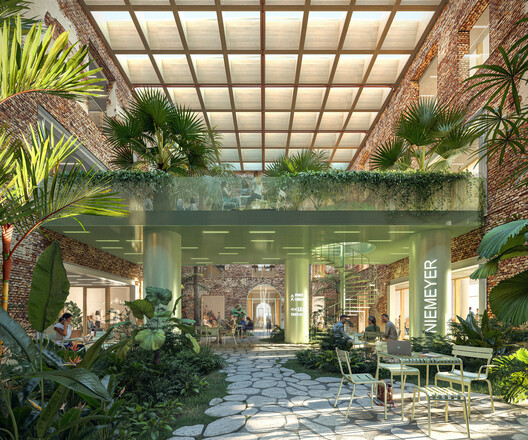
Within this structure, interior spaces have been reorganised to improve daylight, orientation, and circulation while retaining the character of the original factory. Interiors are transformed into accessible environments with clear routing and a mix of public and semi-public functions. Interventions include the DAK ART rooftop terrace, which repurposes an industrial roofscape as a cultural platform overlooking Industriestraat, and the Burley Bar, whose transparent façade extends activity into Spoorpark. The project also introduces Shared Facilities to support collaboration, including the Lab Pavilion along Spoorpark, conceived as a flexible and modular environment for digital makers, startups, and knowledge institutions. In the factory's oldest building, the Tabaksbos (Tobacco Forest) reclaims a former courtyard as an interior landscape, bringing daylight, planting, and informal seating into the core of the complex.
At a material, environmental, and infrastructural level, the design draws directly from the site's industrial DNA. Brickwork, steel window frames, and exposed structural systems are retained or reintroduced, while materials from dismantled structures are reused on site as paving, pergolas, and seating. Green roofs contribute to cooling and air quality, and permeable surfaces, rain gardens, and underground water buffers support long-term water management. An existing basement network is repurposed for bicycle parking and technical infrastructure, keeping the surface level free for pedestrians and public life. Cycling routes connect directly to the nearby train station and the surrounding urban fabric, reinforcing Niemeyer's integration into the city's mobility network.
Other recent urban transformations include the announcement of a new design for Malpensa Hospital (Grande Ospedale della Malpensa) in Italy, planned by a RINA-led team with Zaha Hadid Architects as a compact facility of approximately 90,000 square metres across five above-ground levels. Swedish practice White Arkitekter has also unveiled the design for The Erven, a bio-based timber neighbourhood in Hoofddorp inspired by the traditional Dutch farmstead. Meanwhile, Dutch architectural office UNS has released images of SeoulOne, a master plan for Hyundai Development Company (HDC) in Seoul, South Korea, conceived as a new model for multigenerational living and currently under construction. From a more tactical perspective, further urban initiatives and events are expected following the designation of Oulu in Finland and Trenčín in Slovakia as European Capitals of Culture for 2026.


