
-
Architects: Allford Hall Monaghan Morris
- Area: 376 ft²
- Year: 2010
-
Manufacturers: Trespa
-
Professionals: Faber Maunsell, Gill Associates, Nigel Rose LLP, Buro Happold, Grant Associates

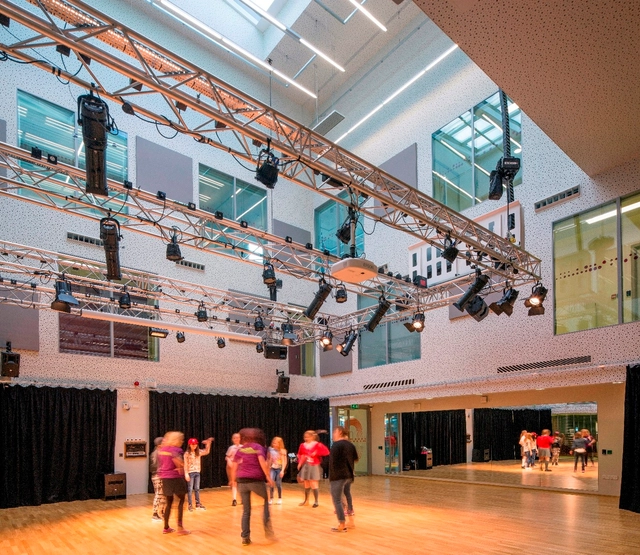
British practice Astudio have recently completed a large youth space in Poplar, East London, featuring a gym, recording studios and performance hall alongside multiple social and learning spaces. Designed with the input from other 1600 young people and stakeholders, the four year project has been part of a wider initiative to address the inadequate provision of existing youth facilities in the London borough of Tower Hamlets. As the team's second youth space completed in the last year, Spotlight has recently been shortlisted for a World Architecture Festival Award.


In an article for the New York Times Rachel Donadio examines Masterworks vs. the Masses. From the Louvre in Paris to London's British Museum, Florence's Uffizi to the Vatican Museums, the increasing surge of visitors to these international cultural nodes "has turned many museums into crowded, sauna-like spaces." Balancing everyone's right to be "nourished" by cultural experiences with protecting and preserving the works of art in question is a very real problem. According to Donadio, "even when the art is secure, the experience can become irksome." With some museums seeing annual visitors of up to 6.7 million visitors (British Museum), addressing the issues faced by institutions that are a victim of their own success is becoming more and more pressing. Read the article in full here.

As part of the 2014 London Festival of Architecture, teams of architects from the four of the most recent Stirling Prize winning British practices were challenged with creating the most imaginative piece of a city - out of LEGO. Each team began with a carefully laid out square on the floor of the largest gallery of the Royal Academy Summer Exhibition, at which point they were given just one hour and 45 minutes to create an urban masterpiece out of blocks. Each group of architects worked alongside students from the Royal Academy’s attRAct programme, which offers A-level art students the chance to engage with art and architecture. An esteemed panel of judges ultimately selected the team from Zaha Hadid Architects as victorious, who "considered London on a huge scale and used curving buildings of different typologies which echoed the shape of the Thames."
Read more about the brief and the other participating entries after the break.

Recently winning first place in a Skyscapers and SuperSkyscapers Competition, SURE Architecture has put forth a daring new proposition for a London skyscraper design. Their proposal, titled "The Endless City in Height," does away with the traditional notion of stacking floors on top of each other. Rather, this innovative design incorporates two street-sized ramps that wind their way up the exterior of the tower, creating extensions of the city streetscape that rise and coil vertically into the London skyline.

In an article for London's Royal Academy of Arts Magazine entitled Plane Sailing, Zaha Hadid discusses the influence of Russian Suprematist painter Kazimir Malevich on her own design work. In Hadid's early work, such as The Peak Blue Slabs (1982/83), the visual connections to Malevich's strict, regular shapes and lines are evident.


Following the recent announcement of Aedas' demerger into two separate companies - one retaining the Aedas name and the other now known as AHR - we spoke to Keith Griffiths, Chairman of Aedas' global board and a practicing architect for close to three decades. The company, which was recently ranked by the Architects' Journal as the 5th largest and most influential practice in the world, have now moved their head office to London's Chandos Place and are championing a new approach to urban regeneration in the UK's capital. Alongside discussing how an international practice of Aedas' scale successfully operates, Griffiths offered his insight into how the future looks for European cities based on a tried and tested Asian model of densification.
To find out how Aedas approach sustainability in flourishing Asian markets, as well as the significance of the 'urban hub' typology for London's metropolitan future, read the interview in full after the break.
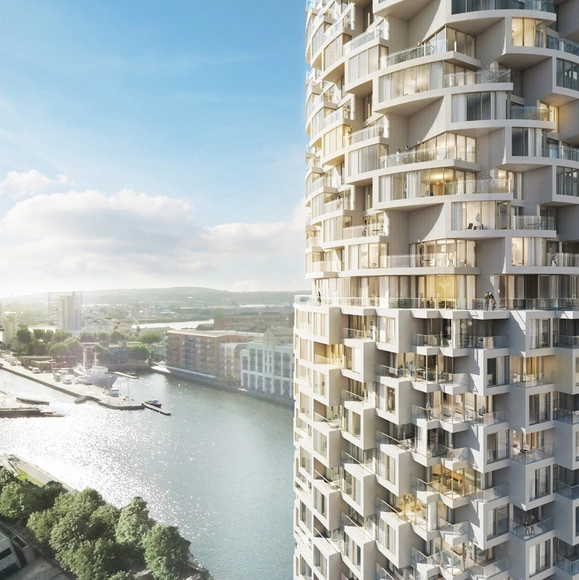
A significant development at Canary Wharf has been approved by planners in London. The scheme, dubbed 'Wood Wharf' and consisting of 30 new buildings, was masterplanned by Allies and Morrison and includes a cylindrical residential tower by Herzog & de Meuron, and will provide 3,100 homes, 240,000 square metres of office space, a primary school, a medical centre, a community centre, a hotel, and around 100 retail outlets. Connecting the space will be a 3.6 hectare network of public spaces.
Read on for more on the development
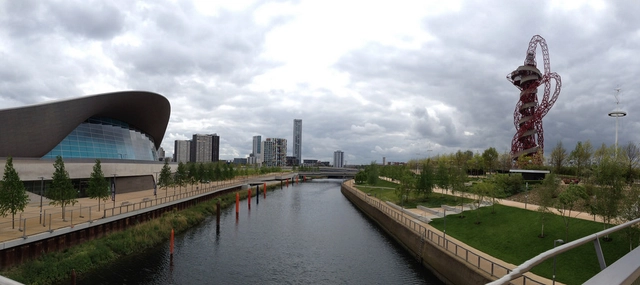
The Mayor of London Boris Johnson has announced a new competition for the designs of a cultural quarter next to the 2012 Olympic park. The site has been dubbed 'Olympicopolis', and so far has expressions of interest from University College London, University of the Arts London, the V&A, Sadler's Wells Theatre and now possibly - according to the Guardian - Washington DC's Smithsonian.
Read on after the break for more details of the competition

The Mayor of London Boris Johnson has unveiled three proposals to redevelop Heathrow Airport into 'Heathrow City,' a new town occupying the site that according to one study "could provide 90,000 jobs and 80,000 homes" in West London. Developed in parallel with Foster + Partners' proposal to create a new airport in the Thames Estuary, the three possible designs are part of a plan that Johnson believes will not only improve the capital's aviation capacity, but also the quality of living in the area around the existing Heathrow Airport.
The three proposals, by Rick Mather Architects, Hawkins\Brown and Maccreanor Lavington, all take very different approaches to the brief, which was to create a mixed use residential and commuter town, with a focus on education and technology industries. Find out more about the three different proposals after the break.
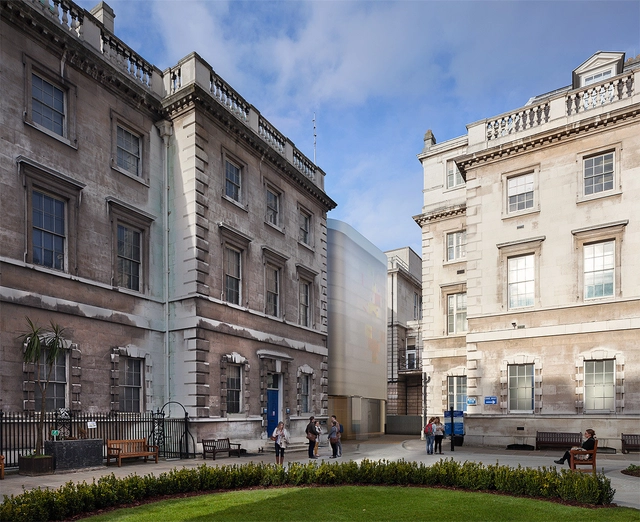
Steven Holl's designs for a Maggie's Centre at St Bart's Hospital in London have finally been approved, after a tense debate among the City of London Planning Committee which culminated in a vote of 11 to 10 in favour of the design. The approval puts an end to a year of controversy, after Holl's first attempt failed to gain planning (the first time a Maggie's Centre has ever been declined permission) and a protest group commissioned a rival scheme by Hopkins Architects which gained planning permission in April.
More on the decision after the break

The shortlisted projects in the competition to design a new art gallery for Goldsmiths College at the University of London have been revealed. The project will see a new 400 square metre gallery created in the back of what was formerly a Victorian bath-house, and is now the college's Grade-II listed art studios. Six shortlisted practices were given six weeks to design a gallery which works with the existing industrial structures - including the building's old water tanks.
The designs will now be judged by Goldsmiths' competition jury, a panel which includes David Chipperfield and sculptor Antony Gormley.
Read on after the break for details of all six proposals

ECOWEEK in a non-governmental NGO with the mission to raise awareness on environmental issues and Climate Change and to promote the principles of sustainability. ECOWEEK has been organizing conferences and workshops across Europe that inspire and empower young architects to be active designers for the benefit of their communities.
Since 2005 ECOWEEK has hosted keynote lectures by leading professionals and thinkers including award-winning architects, such as Shigeru Ban, Ken Yeang, Bjarke Ingels, Francis Kere, Francoise-Helene Jourda, Michael Sorkin and landscape architect Julie Bargmann.
The ECOWEEK International Conference & Sustainable Design Workshops is scheduled to take place in London in September 14-21, 2014. The event is expected to attract young architects, landscape architects, designers and architectural students from the UK and abroad.

Jason Lamb, a recent graduate from London's Bartlett School of Architecture, has developed a project which centres around the legacy of hydraulic fracturing in the British coastal city of Blackpool. The theoretical thesis, which employs the possibility of Chinese investment prompting the transitory integration of hydraulic fracturing within the city for the exploitation of shale gas, features a number of interesting explanatory illustrations.