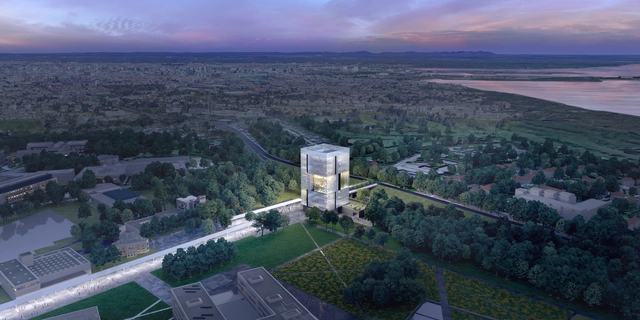
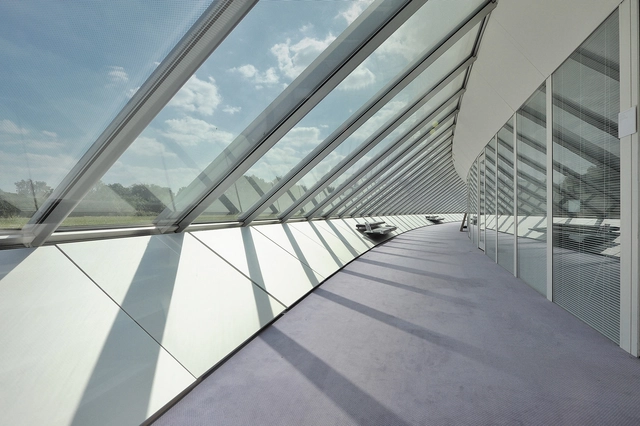
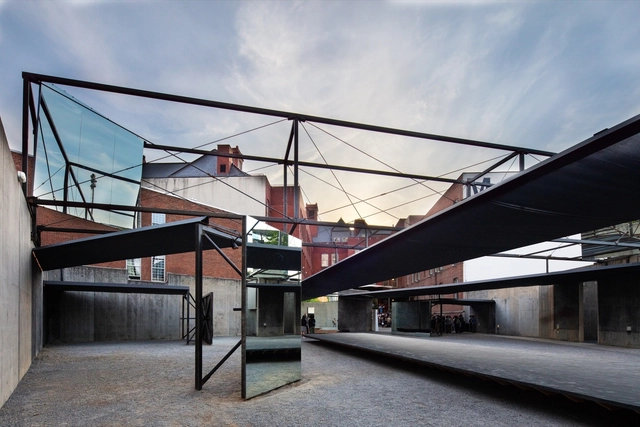
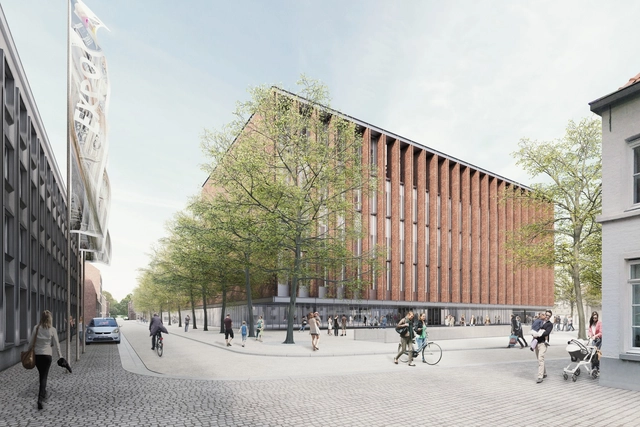
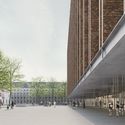
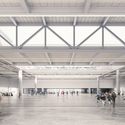
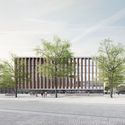
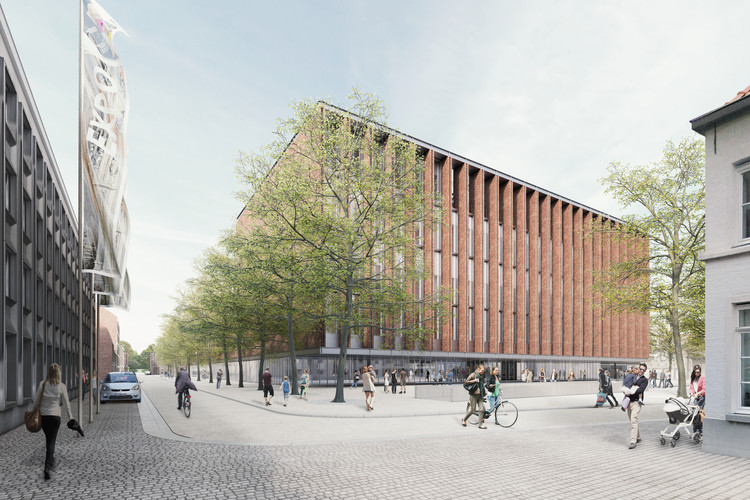
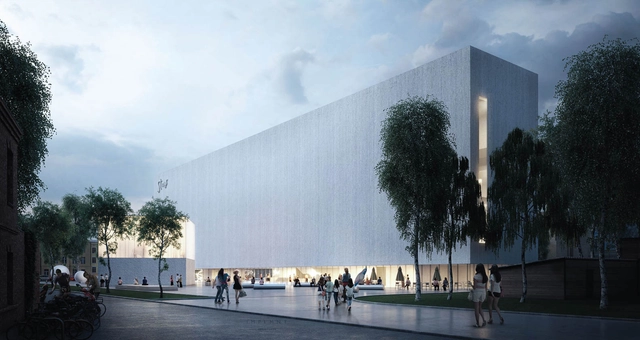
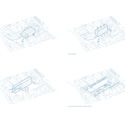
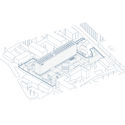
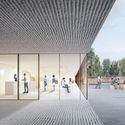
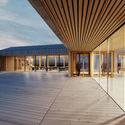
Eduardo Souto de Moura, in collaboration with META architectuurbureau, has released images of a proposed urban renewal project in the Belgian city of Bruges. The Beursplein & Congresgebouw consists of a new exhibition hall and covered public square on the site of a recently demolished trade fair complex.
The $46million (€40million) scheme seeks to act as a catalyst for urban renewal at the center of Bruges, with a dual role of exhibition hall and conference center capable of receiving business delegates on weekdays, and tourists on weekends.
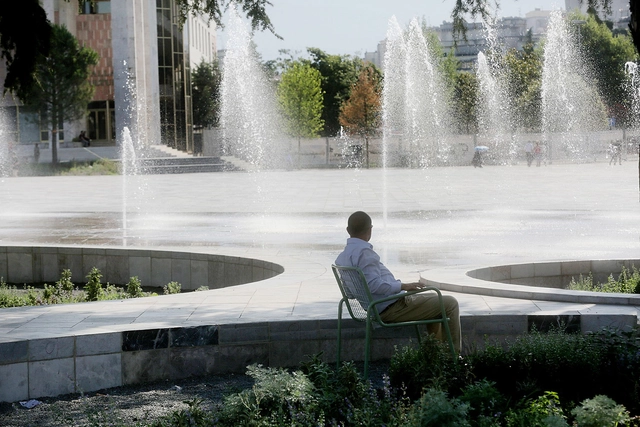
Brussels-based architecture firm 51N4E have won first prize for their Skanderbeg Square project in Tirana, Albania. The European Prize for Urban Public Space is a biennale competition that promotes creating, restoring, and improving public spaces within European cities, and have chosen this year’s winners for their impressive transformation of the city’s central square.
51N4E’s restructuring and renovation of the Skanderbeg Square is a result of winning an international architecture competition back in 2008. After the project was paused in 2010 for administrative changes, and resumed in 2015, the end result is a series of urban interventions, “inviting public and semi-public neighboring functions to spread into the exterior space”.
Instagram and social media are fundamentally changing the way we design in the 21st century. There is an inspirational component to the content we see and cite on the internet, but beyond the pretty pictures lies an opportunity for growth and learning. Zean Macfarlane (@zeanmacfarlane) has found his niche on Instagram somewhere in the middle. The "daily architecture" posts feature process sketches, articulated elevations, and graphic design; but the fun doesn't stop there.
Macfarlane's account also includes a link to tutorial ebooks where you can learn his unique graphic style and begin to apply the effects and techniques into your own drawings. The entire grid of posts acts as a digital artboard, rich with playful forms and careful composition. See for yourself why he has amassed a following of nearly 50k people.
The College of Architects of Madrid (COAM) has made the initial digitization process of their Architecture Journal public, making one of the most important and influential Spanish architectural publications of the twentieth century available to everyone. COAM is a publication known as a platform for debate, thought, and a vital resource for architects, urban planners, and professionals from other closely related sectors.
Founded in 1918 as the official publication of the Central Society of Architects, the journal ARQUITECTURA, became the first publication of the Spanish architectural press. However, the Spanish Civil War would halt its normal development, transforming the magazine, as was required by the new times, into the National Journal of Architecture. It was edited until 1946 by the Directorate General of Architecture, then eventually placed in the hands of the Ministry of the Interior.
https://www.archdaily.com/897336/download-all-of-coam-architecture-journals-issues-from-the-last-100-years-for-freeJavier García Librero
Brazilian contemporary artist Ernesto Neto recently realized a colorful sculpture made of hand-knotted cotton strips in the atrium of Zurich's Central Station. Titled Gaia Mother Tree, the installation resembles a giant tree and extends from the station's roof to its floor.
Exhibited by the Fondation Beyeler, Neto's sculpture is an immersive work of art, a space that one can enter into and walk around or remain and meditate. The Gaia Mother Tree will be on display until July 29th. A series of activities for adults and children, including musical concerts, workshops and debates, is scheduled to take place under the net of cotton.
Bjarke Ingels and Jakob Lange have launched an Indiegogo fundraiser for an 80-foot-diameter ORB to be constructed for the 2018 Burning Man festival at Black Rock City, Nevada. Scaled at 1/500,000th of the earth’s surface, the reflective sphere sits “at the axis of art & utility, capturing the entire Black Rock City in an airborne temporal monument that mirrors the Burning Man experience to the Burners as single beings in the midst of an intentional community."
As well as acting as a wayfinder for navigating The Playa, the ORB sits as a tribute to mother earth and human expression, designed to blend with its surroundings during the night, and leave no trace following its deflation.
Apple Store, Sands Cotai Central, Macau - exterior at night with the cube illuminated and bamboo planting framing the entrance with people. Image Courtesy of Nigel Young, Foster + Partners
Foster + Partners has published photographs of their recently-opened Apple Store in Macau, intended as a “new oasis of calm” against the city’s buzz and excitement. The store, opened on June 29th, was designed in response to a brief calling for “an inviting, contemplative space, where technology, entertainment, and arts come together to make a positive contribution to the city.”
In spite of their apparent simplicity, small cabins have always been a welcome design challenge in which scale, materiality and habitability must be resolved in order to take maximum advantage of minimal spaces. Perhaps the most famous exercise in cabin design, the Le Corbusier-designed 16m2 cabanon was a container of ideas in which the Swiss architect explored the "modulor"-- an understanding of the fundamentality of human scale. In the ensuing half-century, many prominent architects have ventured into cabin design both experimentally and at a primitive level, especially as a small refuge in harmony within a natural context.
We have selected 40 small cabin designs from around the world that explore different types of solutions according to context and programmatic needs.
Lithuanian city Panevezys will have a new cultural hub thanks to the winning design of architecture firm, IMPLMNT. The proposed design of the Stasys Eidrigevicius Arts Centre, which will be built in the northern part of the city center, won the competition due to its function, location, architecture, and the social/economic value it will be adding to the city.
The center will take the place of an existing movie theater, a historic landmark in the Lithuanian city. After performing structural analysis on the existing theater, a study of the conditions indicated that it can no longer be preserved or saved. Keeping in mind the importance of the movie theater to the city, the architects at IMPLMNT decided to draw inspiration from the existing building, as well as use its proportions to create the newly-designed structure.
Courtesy of Ekberg Lous Architects / Visualizations by AZR Studio
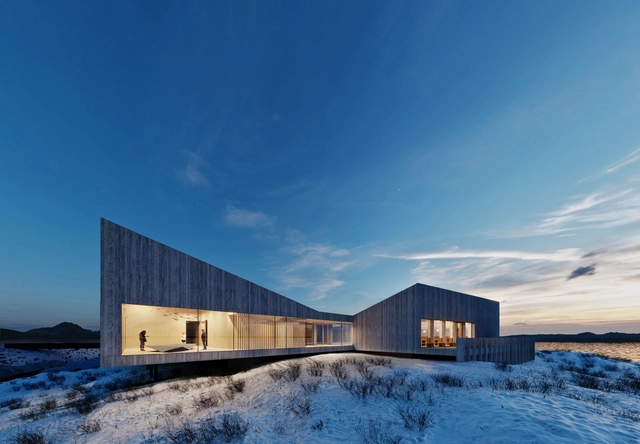
Oslo-based architecture firm Ekberg Lous Arkitekter have designed Norway’s first World Heritage Visitor Center, after having won the open international architectural competition in 2008. Following the competition, the project was halted for seven years due to a lack of funding, but has been given the green light in 2015 with revised plans and a new site. The center, which will be built on the tip of the northern shore of Vega Island, is expected to be a gathering point for both locals and foreigners. It will provide visitors with knowledge about the natural and cultural values of the Vega Archipelago and world heritage sites in general. The center is set to be open in spring 2019.
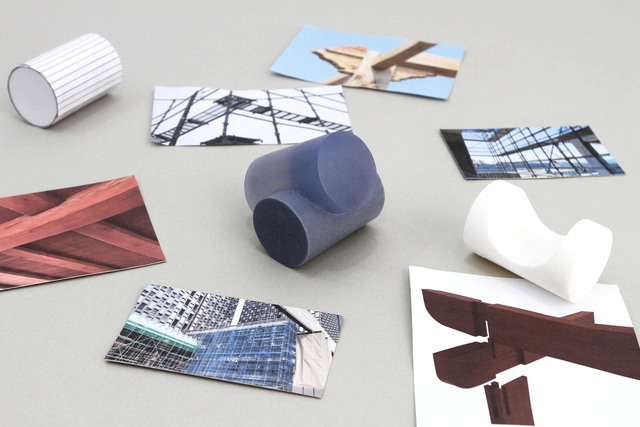
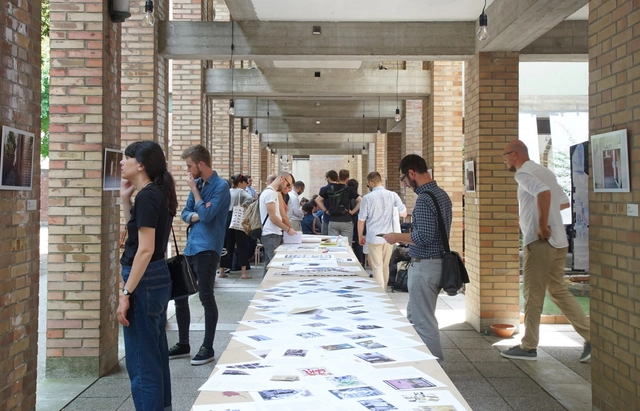
The ‘Unfolding Pavilion’ is an exhibition and editorial project that pops up at major architecture events in previously inaccessible but architecturally significant buildings.
On each occasion the ‘Unfolding Pavilion’ features a different theme inspired by the space it occupies, by means of commissioned original works that react to it and to its wider cultural-historic background. The ‘Unfolding Pavilion’ doesn’t necessarily care about the hosting event’s theme. It lets its occupied space inspire its own theme. Without a good exhibition space (of the finest architectural making), the 'Unfolding Pavilion’ doesn’t have any reason to exist.
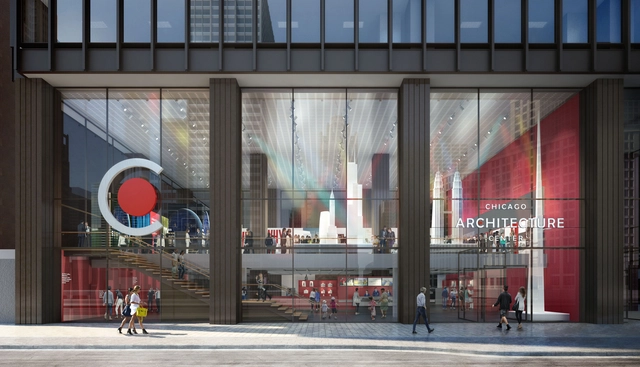
The Chicago Architecture Foundation (CAF) has announced the opening date for their new home, the Chicago Architecture Center (CAC). Set to open August 31 of this year, the CAC will be the "home to everything architecture in Chicago." The 20,000-square-foot structure is located at 111 East Wacker Drive, just above the dock for the River Cruise offered by the CAF.
Lynn Osmond, the CAF's president and CEO, said of the new Center, "We can't wait for people to visit and experience how Chicago architects have influenced the world through their innovation and vision. We've engineered a stimulating and immersive space where visitors can have fun discovering Chicago's groundbreaking architecture and appreciate its profound impact on the world."
Designed by Chicago-based firm Adrian Smith + Gordon Gill Architecture (AS+GG), the CAC will feature custom spaces designed for education, tour orientation, and other public programs, as well as a store and interactive exhibits.
Read on for more about the Chicago Architecture Center and its unique design experience.
The project will include two major changes to UCD’s Belfield campus, located about 5 km from Dublin’s city center: a major update to the campus’ entry precinct along Stillorgan Road, as well as a new 8,000 square meter Centre for Creative Design, which will house UCD’s design studios.
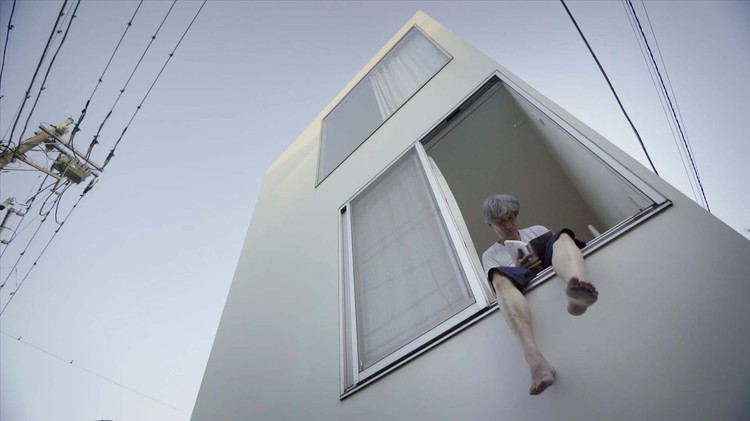
"Moriyama-San" - a film by Bêka & Lemoine - has been awarded the 2018 Best Prize at the Arquiteturas Film Festival in Lisbon. Centered around the famous Moriyama House by Pritzker Prize LaureateRyue Nishizawa, it becomes part of a developing series called “Living Architectures,” in which the filmmakers aim to “put into question the fascination with the picture, which covers up the buildings with preconceived ideas of perfection, virtuosity, and infallibility.” In its unique approach, the film “masterfully combines image, sound, and narrative in a compelling story about a unique character and its relation to his house and music.”
From a historical perspective, visiting a significant work of architecture only amounts to a fractional part of what it takes to understand its importance. Context is crucial; every project responds to the society around it as much as it does the site that it inhabits, and it represents a synthesis of precedents and a point of inspiration for works that follow. As recently featured in Metropolis Magazine, these dynamics take center stage in a new exhibition staged in Norman Foster’s seminal Sainsbury Centre for Visual Arts, a contemporary landmark built in 1978 on the campus of the University in East Anglia in Norwich, England. Entitled Superstructures: The New Architecture: 1960–1990, the exhibit explores the central trends in post-war 20th-century building design, highlighting the historical context of the Sainsbury Center itself on the occasion of the museum building’s 40th anniversary.
In Dnipro, Ukraine, sits a unique multi-purpose pavilion rich with historical roots and design influence. Stage is a collaborative project between architects from Ukraine, Poland, Denmark and Italy, crowdsourced and crowdfunded by the citizens of Dnipro. The site for the pavilion has been centered around community involvement throughout the complex history of Dnipro, but it has laid unused for over 70 years.
Stage is an emanation of the rich and vibrant culture and was built to accommodate the needs of dozens of artists, poets, painters and musicians, who previously relied on various spaces scattered around the city. Their "collective creative energy" was used to reactivate the lost community space. Stage was recently awarded Special Mention in the 2018 European Prize for Urban Public Space.
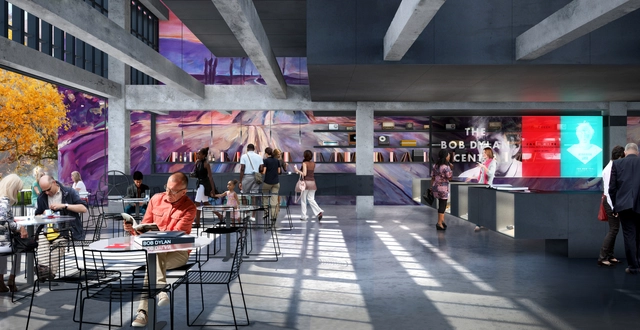
With construction underway on their renovation of the Space Needle, Olson Kundig will shift their focus to a different American icon. The Seattle firm has unveiled their proposal as lead architect and exhibit designer for The Bob Dylan Center—a new museum that will also house the Bob Dylan Archive in Tulsa, Oklahoma. Sponsored by the George Kaiser Family Foundation and the University of Tulsa, the center is expected to open in 2021, with groundbreaking planned for 2019 in the Tulsa Arts District.
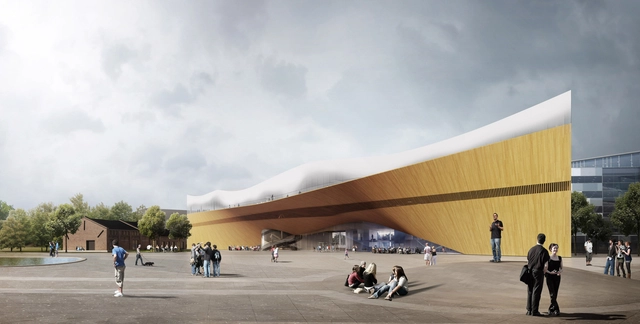
The Helsinki Central Library Oodi. Image Courtesy of ALA Architects
The Helsinki Central Library Oodi, designed by ALA Architects, is nearing completion in Finland. Due to open its doors on December 3rd 2018, the library is situated in the cultural district of Töölönlahti, where it will sit as a ”powerful and iconic temporary design” among other architectural landmarks.
Situated across from the Finnish Parliament House, the scheme represents an interaction between the state and its citizens, “a new avenue to promote freedom of speech and democracy.”
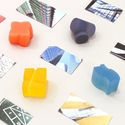
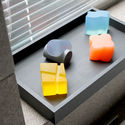
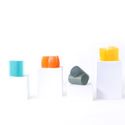
Designers Studio Ohk have released details of their architecturally-inspired “Urban Soaps” range, reflecting built fragments of the South Korean capital Seoul. The four designs reference traditional and modern architectural elements in Seoul through their shapes and colors, “curated and blended by the team to highlight the city’s personality.”
The products began with an idea of “delivering regional stories, images, and experiences through an accessible medium” with soap chosen ultimately for its flexibility, and its appeal to multiple senses, such as sight, scent, and touch.
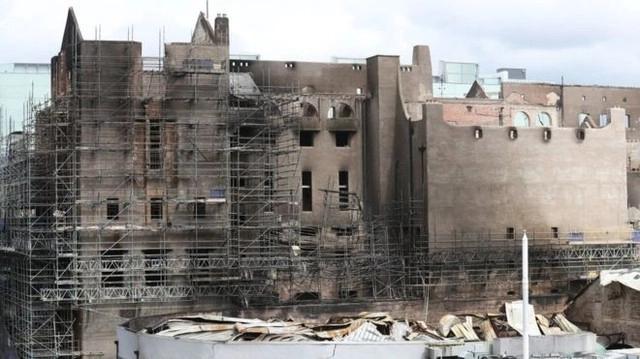
It has been confirmed that parts of the Glasgow School of Art’s Mackintosh building are to be dismantled. A statement by Glasgow City Council, reported by the BBC, revealed that substantial movement in the building’s walls had been detected from surveys following the June 15th fire, indicating the sudden partial collapse of the structure was likely.
Hide & Seek by Dream The Combine for The Museum of Modern Art and MoMA PS1’s Young Architects Program 2018, on view at MoMA PS1 from June 28 to September 3, 2018. Image courtesy MoMA PS1. Photo by Pablo Enriquez.
The Museum of Modern Art (MoMA) has opened its exhibition of the Young Architects Program 2018 at its MoMA PS1 location in Long Island City, New York. Now in its 19th edition, the Young Architects Program offers emerging talent in the architectural world the opportunity to “design and present innovative projects, challenging each year’s winners to develop creative designs for a temporary, outdoor installation that provides shade, seating, and water.”
Last month Harvard University’s School of Public Health re-launched their Center for Climate, Health, and the Global Environment, introducing new partnerships and a new director for the institutional home of Dr. Joseph Allen’s Healthy Buildings initiative. With the stated mission of “improving the lives of all people, in all buildings, everywhere, every day,” the Healthy Buildings Team is leading research on how today’s built environments impact the health, productivity, and well-being of the people who inhabit them; as well as how future buildings can help us live healthier lives.
In the interest of defining their terms and presenting their research in a way that audiences outside academia can understand and incorporate into their work, the Healthy Buildings team have released an exhaustive list that details the simple foundations of making a building healthy.
The 9 foundations for healthy buildings are as follows:
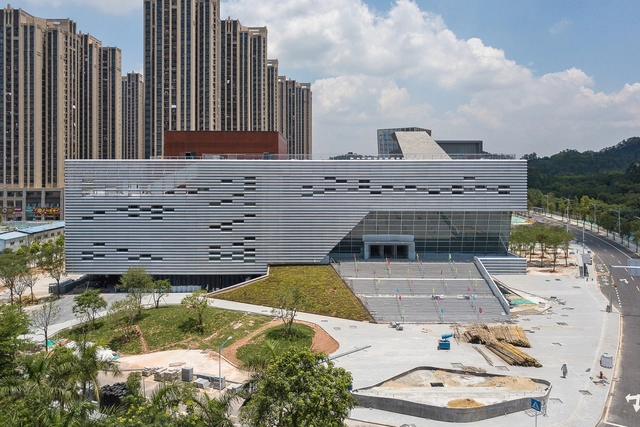
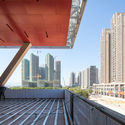
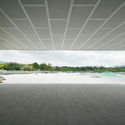
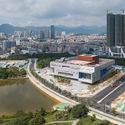
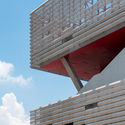
OPEN Architecture has released a new set of photos that documents the construction milestones of Pingshan Performing Arts Center in Shenzhen, China. The project was initially announced in 2015 as the first theatre planned for the newly-developed Pingshan area. With its building envelope now fully formed and cladded in precision-engineered aluminium panels, the Performing Arts Center is set to open by the end of this year as one of the city’s most anticipated cultural venues.


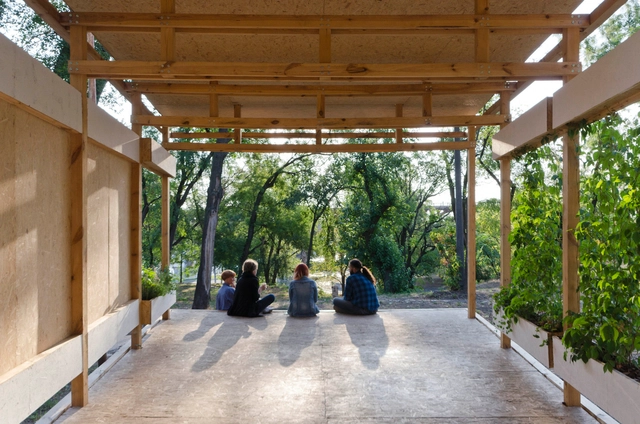
.jpg?1530628241 "© infunctievan")





















.jpg?1529424893 "© atelier XYZ")







_at_111_E._Wacker_above_dock_for_CAF_River_Cruise_aboard_Chicago's_First_Lady_Cruises.jpg?1529636740 "Courtesy of Chicago Architecture Foundation")