1. ArchDaily

  2. Sustainable Architecture

Sustainable Architecture: The Latest Architecture and News

New Life for Old Spaces: Buildner Announces Results of Its First Annual Re-Form Competition

 | Sponsored Content

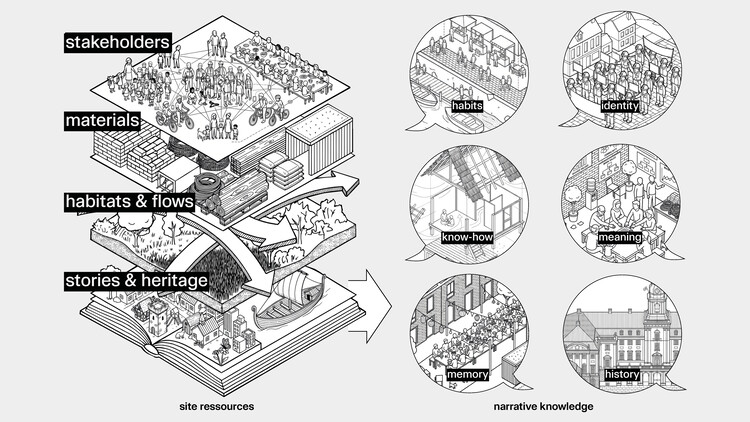
Buildner has announced the results of its Re-Form: New Life for Old Spaces, an international ideas competition examining the adaptive reuse of small-scale existing buildings. The competition invited architects and designers to propose transformations of used, abandoned, or overlooked structures with an approximate footprint of 250 square meters, located anywhere in the world. With no fixed site or program, participants were encouraged to explore alternatives to demolition and new construction through reuse strategies grounded in contemporary social and environmental concerns.

As an open-format competition, Re-Form foregrounded sustainability, feasibility, and community impact over formal or typological constraints. Submissions ranged from precise urban insertions to more speculative rural interventions, reflecting a broad range of approaches to working with existing fabric. Many projects focused on how limited, often marginal spaces could be reactivated to support new forms of collective use while responding to material, climatic, and ecological conditions.

How Architects Are Responding to Technology That Turns Buildings into Carbon Sinks

 | Sponsored Content

During the Time Space Existence exhibition, organized by the European Cultural Centre in Venice, the building-solutions company Holcim and Pritzker Prize-winning architect Alejandro Aravena, with his firm ELEMENTAL, unveiled a full-scale prototype that introduces a new approach in incremental housing solutions.

The housing prototype—The Basic Services Unit—was built with Hoclim's recently launched biochar technology, which transforms buildings into carbon sinks by permanently trapping carbon in a bio-based material called biochar. This material is used as a component of low-carbon concrete, cement, and mortars.

Faveker’s Tailor-Made Tiled Facade Brings Personality and Efficiency to the New Muskiz Secondary School

 | Sponsored Content

The new Muskiz Secondary School building (Vizcaya), designed by BAT Architecture studio, has become a leading symbol of sustainable architecture for educational centers. Designed in accordance with Passivhaus criteria and built using cross-laminated timber (CLT), the project combines innovation and comfort with environmental care.

In this equation, Faveker's tiled ventilated facade, tailor-designed using its GA16 system as a basis, plays a key role. This precise, luminous tiled skin enhances the building's energy efficiency and infuses it with a unique architectural personality that harmonizes with the surrounding natural setting.

Faveker’s Tailor-Made Tiled Facade Brings Personality and Efficiency to the New Muskiz Secondary School - Image 2 of 4
© Aitor Estévez
Faveker’s Tailor-Made Tiled Facade Brings Personality and Efficiency to the New Muskiz Secondary School - Image 3 of 4
© Aitor Estévez

Barangaroo South Masterplan by RSHP and Lendlease Completes a 15-Year Transformation of Sydney’s Western Waterfront

RSHP has announced the completion of the Barangaroo South Masterplan in Sydney, marking the realization of a 15-year redevelopment that has reconnected the city's north-western harbour edge to its urban core. Once a disused container port, the 22-hectare site has been transformed into a mixed-use, carbon-neutral precinct, integrating commercial, residential, and public spaces along the waterfront. Developed in collaboration with Lendlease following an international design competition, the masterplan is organized into three zones: Barangaroo South, a high-density extension of the Central Business District; Barangaroo Reserve, a reconstructed natural headland that reintroduces native landscapes to the harbour; and Barangaroo Central, a low-density residential area linking the northern and southern ends of the development.

Barangaroo South Masterplan by RSHP and Lendlease Completes a 15-Year Transformation of Sydney’s Western Waterfront - Imagem 1 de 4Barangaroo South Masterplan by RSHP and Lendlease Completes a 15-Year Transformation of Sydney’s Western Waterfront - Imagem 2 de 4Barangaroo South Masterplan by RSHP and Lendlease Completes a 15-Year Transformation of Sydney’s Western Waterfront - Imagem 3 de 4Barangaroo South Masterplan by RSHP and Lendlease Completes a 15-Year Transformation of Sydney’s Western Waterfront - Imagem 4 de 4Barangaroo South Masterplan by RSHP and Lendlease Completes a 15-Year Transformation of Sydney’s Western Waterfront - More Images+ 10

Unlocking the Untapped Potential of Our Existing Buildings for a Healthier Future

 | Sponsored Content

The VELUX Group is launching the next step in its Action Leadership agenda as an experiment to explore how existing buildings can better serve both people and planet. The experiment builds on decades of demonstration projects and research into healthy buildings, including Living Places, which achieved an ultra-low carbon footprint and first-class indoor climate in an affordable and accessible way. The next step shifts focus towards existing buildings, from new build to renovation—named Re:Living.

Re:Living is a forward-thinking experiment to reimagine renovation to be more than a technical upgrade, and instead as a holistic opportunity to improve human well-being, support biodiversity, and reduce environmental impact. It's part of VELUX's long-term commitment to lead the building industry toward healthier, more sustainable practices, driven by a belief that simply reducing harm is no longer enough.

Transforming Row Houses: Heritage and Modernity in Montreal’s Historical Neighborhoods

Subscriber Access | 

Montreal, the second largest city in Canada is home to a wide array of heritage residential architecture, most of it dating to the 19th and early 20th-century. These are particularly abundant in some of its central neighborhoods like the Plateau Mont-Royal. Interestingly, their preservation is not accidental; it is the result of decades of advocacy by influential figures who recognized the value of the city's built environment, such as Phyllis Lambert and Blanche Lemco Van Ginkel. Efforts like theirs were instrumental in landmark preservation battles that helped to ensure current municipal support. Today, the city has implemented a set of comprehensive heritage protection laws designed to safeguard the integrity of the city's historic neighborhoods.

Transforming Row Houses: Heritage and Modernity in Montreal’s Historical Neighborhoods - Imagen 1 de 4Transforming Row Houses: Heritage and Modernity in Montreal’s Historical Neighborhoods - Imagen 2 de 4Transforming Row Houses: Heritage and Modernity in Montreal’s Historical Neighborhoods - Imagen 3 de 4Transforming Row Houses: Heritage and Modernity in Montreal’s Historical Neighborhoods - Imagen 4 de 4Transforming Row Houses: Heritage and Modernity in Montreal’s Historical Neighborhoods - More Images+ 8