I first met WikiHouse cofounder Alastair Parvin—not in the flesh, of course, much less in print—courtesy of YouTube. You can do the same by watching his lecture, “Architecture for the People by the People.” In the video, Parvin explains the WikiHouse concept to the 2013 annual TED conference in Long Beach, California. Looking young and trim in a white shirt and blue jeans, Parvin’s voice is chipper and confident as he delivers his provocative idea to the world.
Given that the 1,600 TED lectures that are currently available online have been viewed more than a billion times, you may have already heard a little about the WikiHouse by now. In case you haven’t, it’s “an open- source construction set,” according to the WikiHouse online collaborative. “The aim is to allow anyone to design, download, and ‘print’ CNC-milled houses and components, which can be assembled with minimal skill or training.”
A recent topic that has been receiving attention among architects is the issue of designing prisons. The increased awareness of the problem has been spearheaded by Raphael Sperry, founder of Architects/Designers/Planners for Social Responsibility, who has been campaigning to have the AIA forbid members from designing execution chambers or solitary confinement units. At the other end of the scale, Deanna VanBuren, a principle of FOURM Design Studio and a member of ADPSR herself, has championed 'restorative justice', an approach to the justice system which emphasizes rehabilitation and reconciliation in order to prevent people from re-offending.
Now Glen Santayana, a student at Harvard's Graduate School of Design, has used his thesis project to add to this debate, designing PriSchool - a prison which both integrates with a school of criminology and is embedded within the community. Could this radical approach to prison design really be an answer to the stretched prison system in the US (and elsewhere)? Read on after the break to find out more.
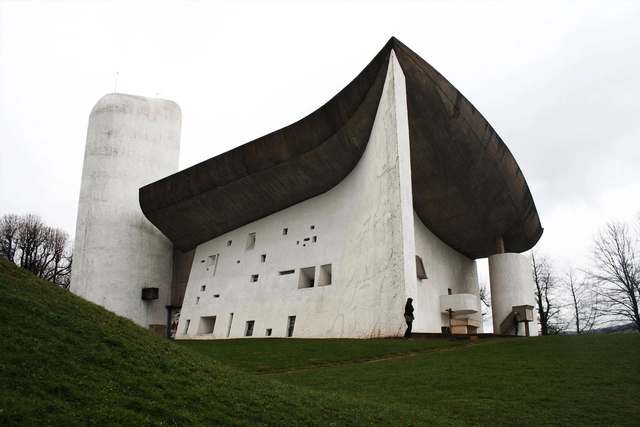
Le Corbusier was commissioned by the president of the Mill Owners’ Association to design the organization’s headquarters in Ahmedabad, a city historically active in India’s textile trade. The building is a physical manifesto representing Le Corbusier’s proposal for a modern Indian architecture. Constructed in 1954, the Mill Owners’ Association Building is considered the first of four completed commissions in Ahmedabad.
https://www.archdaily.com/464142/ad-classics-mill-owners-association-building-le-corbusierRennie Jones
About 40% of the area of Hamburg, the second largest city in Germany, is made up of green areas, cemeteries, sports facilities, gardens, parks and squares. For the first time ever, the city has decided to unite them together via pedestrian and cycle routes. It's all part of the "Green Network Plan," which aims to eliminate the need for vehicles in Hamburg over the next 20 years.
According to city spokeswoman Angelika Fritsch, the project will help to turn the city into a one-of-a-kind, integrated system: "Other cities, including London, have green rings, but the green network will be unique in covering an area from the outskirts to the city centre. In 15 to 20 years you'll be able to explore the city exclusively on bike and foot."
2013 was a year of stories that were intriguing, exciting, disappointing and - sometimes - downright hilarious.As is traditional at this time of year, many critics are rounding up their highlights of the past 12 months.Perhaps the most entertaining of the roundups is Olly Wainwright's of the Guardian; Wainwright took 10 big stories from this year and twisted them into new year's resolutions - offering up helpful advice such as "don't be afraid of copying", "be nice to skateboarders", and the Walkie-Scorchie inspired "don't melt things". Other critics, though, had more sensible suggestions for what went right and wrong in 2013 - read on after the break to find out more.
Things at Architecture for Humanity were shaken up with the departure of co-foundersCameron Sinclair and Kate Stohr. Resiliency became the new sustainability. China suddenly became defined less for its adventurous architecture and urbanism and more for its darker, smoggier flipside. My hometown, Los Angeles got a few more bike lanes, some big plans for its concrete river, plus a new Bloomberg-esque mayor with attendant sustainability tsar. There were people complaining about architecture and telling us why they left the profession. Kanye got attacked for daring to tell us why he likes architecture, and then architecture loved talking about Kanye for weeks on end until we just wanted architecture to shut up about Kanye. Poor Kanye. There are so many things we could say were key in 2013. It’s been a great year. And there were also a lot of fantastic buildings.
In this article, originally posted on Grasp as "We Are All Ethical Hackers!", Kasper Worm-Petersen demonstrates how design has the ability to make the abstract tangible and create desirable activities. When that ability is used to promote sustainability and improve the state of the world great things happen and we all get a chance to become ethical hackers.
There are enough big issues to tackle in the world today. The financial crisis and the climate crisis seem almost insurmountable. And as our old habits are keeping us from adapting to the new circumstances there is a need for viable alternatives to our current way of living. At the Design for Smart Growth event held by the Global Agenda Council on Design and Innovation some interesting and promising solutions were presented. And they all had design as a key component.
The Danish Minister of the Environment Ida Auken set the scene when she discussed her engagement in environmental policies, “I was so frustrated with the image of environmental policies. That green was someone who hated life... I really want to flip it around and see how we can get people to actually want to live in a sustainable way. How can we make them desire it? And that is where designers come in. It is as easy as that.”
Read on to find out how we can be "ethical hackers" after the break.
Gautam Bhatia is an architect based in New Delhi and one of the most well-known architectural writers in India, having written for The New York Times, Outlook magazine and Indian Express.
We live today the way we do because we know no other. Our lives fit the defined patterns of homes, streets, neighborhoods, cities. As an architect I try to understand and explore - through drawing - different possibilities of building and landscape. More and more, drawing has taken me away from the conventions of architecture, into more abstract realms. Drawing has helped define space as it doesn’t exist, and perhaps as it should. Not in a utopian way, but one that tries merely to describe a different way we may live.
Francesco Veenstra, one of six partners at the Dutch practice Mecanoo and Lead Architect on a number of major projects in the United Kingdom, recently spoke to Mies. UK about the practice's approach to design and their unique take on sustainability. Having recently completed a major public building in Birmingham (which was put to the vote and won the AJ's 2013 Building of the Year), and with more in the pipeline, the practice's international outlook is growing. How has the practice's design methodology and core ideas influenced this success? Read more after the break.
Foster + Partners has unveiled a scheme that aims to transform London’s railways into cycling freeways. The seemingly plausible proposal, which was designed with the help of landscape firm Exterior Architectureand transportation consultant Space Syntax, would connect more than six million residents to an elevated network of car-free bicycle paths built above London’s existing railway lines if approved.
"SkyCycle is a lateral approach to finding space in a congested city," said Norman Foster, who is both a regular cyclist and the president of Britain's National Byway Trust. "By using the corridors above the suburban railways, we could create a world-class network of safe, car free cycle routes that are ideally located for commuters."
ArchDaily recently spoke to Ben van Berkel, co-founder and principal architect at UNStudio, an international network of specialists in architecture, urban development and infrastructure based in the Netherlands. The office, which was founded in 1988, has completed projects around the world ranging from Rotterdam’s Erasmus Bridge to the Mercedes-Benz Museum in Stuttgart. With over 81 built projects, and 54 currently in progress (including Raffles City in Hangzhou and Scotts Tower in Singapore), London’s Canaletto Tower (which is due to be completed in 2015) marks the practice’s first major project in the UK.
Our mission is to provide inspiration, knowledge and tools to the architects who will have the challenge to face the urban growth of the next 40 years.
We understand that each of the thousand of projects that we feature every year can transfer knowledge from the firms to other architects around the world, through the photos, details, diagrams and their own descriptions.
But we feel that there is a very important structural layer in these projects that can only be understood by actually knowing the architects behind them. And that’s why we started our interview program when we launched ArchDaily in 2008.
The following 20 articles are what we at ArchDaily consider the Best of 2013. They may not have received the most traffic, but they posed fascinating theories about the state of architecture and urbanism today, they gave us insight into the creative processes of innovative architects (from Bjarke Ingels to Peter Zumthor) and, most of all, they provoked us to question: What does architecture mean? For us architects, and for the world?
It's that time of year again! The time when we round-up what you, our dear readers, most enjoyed this year. The following ten articles - from fun lists (30 Architecture Docs to Watch in 2013) to thought-provoking looks into the state of the architecture profession (Are Renderings Bad for Architecture?) - caught your attentions and provoked some great comments. See them all - including our record-breaking #1 article - after the break.
Mies. UK recently spoke to Roger Stephenson OBE, Managing Partner at Manchester based stephenson:ISA Studio, about his award winning practice's approach to "using craft in a contemporary way". The office most recently completed an addition to Chetham's School of Music, winning the 2013 RIBA Regional Building of the Year Award, RIBA National Award, and the RIBA Regional Award. This project is the latest in a long list of innovative buildings that are part of a "rigorously coherent, contextually progressive architecture" that has made the practice one of best known regionalist design offices in the UK.
Read the interview in full, and watch a three minute tour of Chetham's School of Music, after the break.
ArchDaily is in need of an architecture-obsessed, history buff to delve into the world of ArchDaily Classics for Spring 2013 (January 15th – May 15th)! If you want to spend your days researching/writing about the best architecture around the globe – and work for the world’s most visited architecture website – then read on after the break…