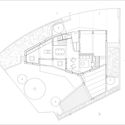
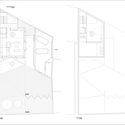
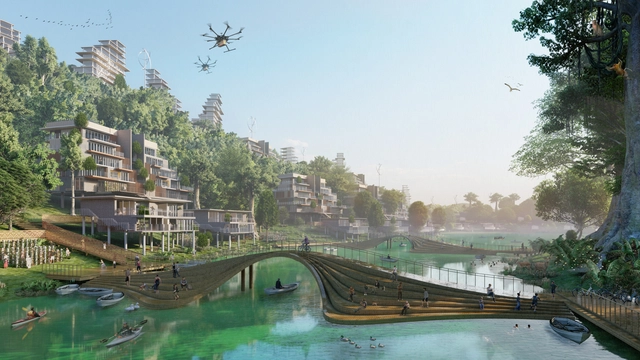
“The Infinite City” smart city design for Indonesia New Capital. Image Courtesy of AntiStatics Architecture
Presented part of international competitions, this week’s best-unbuilt architecture gathers award-winning projects submitted by our readers. Highlighting as usual diverse approaches from across the globe, ArchDaily is rounding up in this article, a curated selection of cultural, civic, and urban proposals.
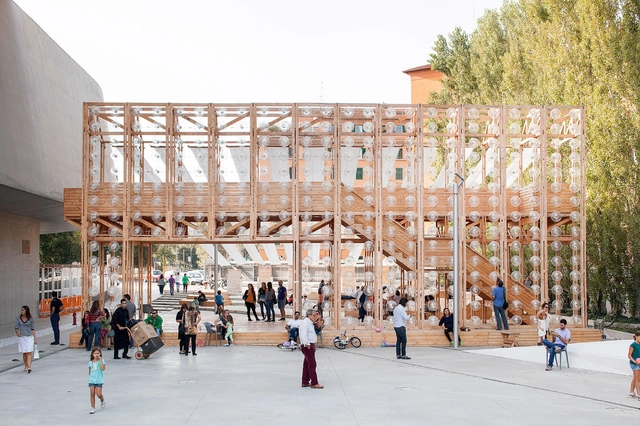
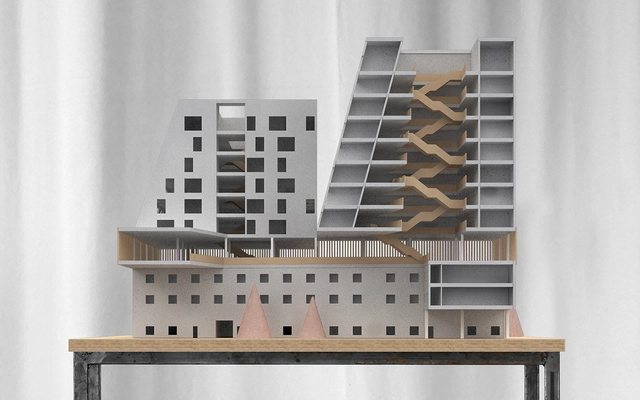
In Singapore, an adaptive reuse project transforms a power station into a creative industrial hub, while in Indonesia, a smart city design for the new capital generates an ecologically responsible environment. Moreover, Kjellander Sjöberg designs and develops an original city block in Stockholm, and TheeAe imagines a city hall for China. Other proposals include an entire reflective surface for a public square in Italy, a new city district in Tampere Finland, a University building in Warsaw, and a school for contemporary art in Vienna.
Cities used to be hailed for cultural diversity, with thriving and resonating dynamism. But today, scenes of desperation reigns, as stores are closed, streets rendered lifelessly and -from our homes, we no longer enjoy urban economic vibrancy. As numerous businesses are facing bankruptcy, others realise that -with technology, working 100km or 5km away makes no difference. The coronavirus brought our urban economy to a standstill. The functioning of cities is being re-questioned. How we react to this crisis will shape the city for decades to come.
https://www.archdaily.com/938782/coronavirus-as-an-opportunity-to-address-urban-inequalityZaheer Allam, Gaetan Siew and Felix Fokoua
Throughout human history, the movement of populations–in search of food, shelter, or better economic opportunities–has been the norm rather than the exception. Today, however, the world is witnessing unprecedented levels of displacement. The United Nations reports that 68.5 million people are currently displaced from their homes; this includes nearly 25.4 million refugees, over half of whom are under the age of eighteen. With conflicts raging on in countries like Syria and Myanmar, and climate change set to lead to increased sea levels and crop failures, the crisis is increasingly being recognised as one of the foundational challenges of the twenty-first century.
While emergency housing has dominated the discourse surrounding displacement in the architecture industry, it is critical for architects and planners to study and respond to the socio-cultural ramifications of population movements. How do we build cities that are adaptive to the holistic needs of fluid populations? How do we ensure that our communities absorb refugees and migrants into their local social fabric?
This World Refugee Day, let’s take a look at 5 shining examples of social infrastructure from around the world–schools, hospitals, and community spaces–that are specifically directed at serving displaced populations.
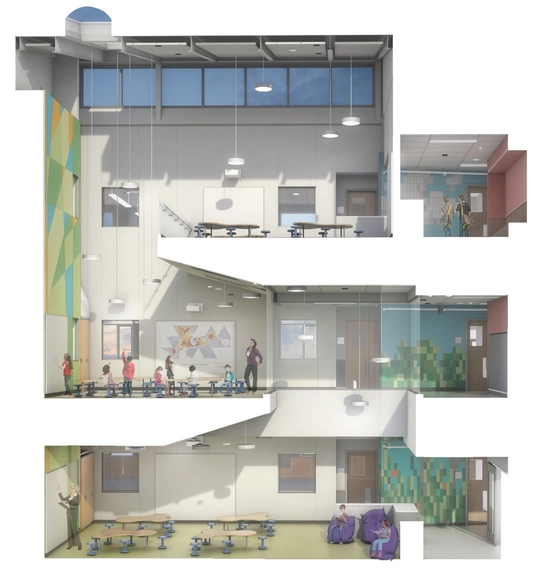
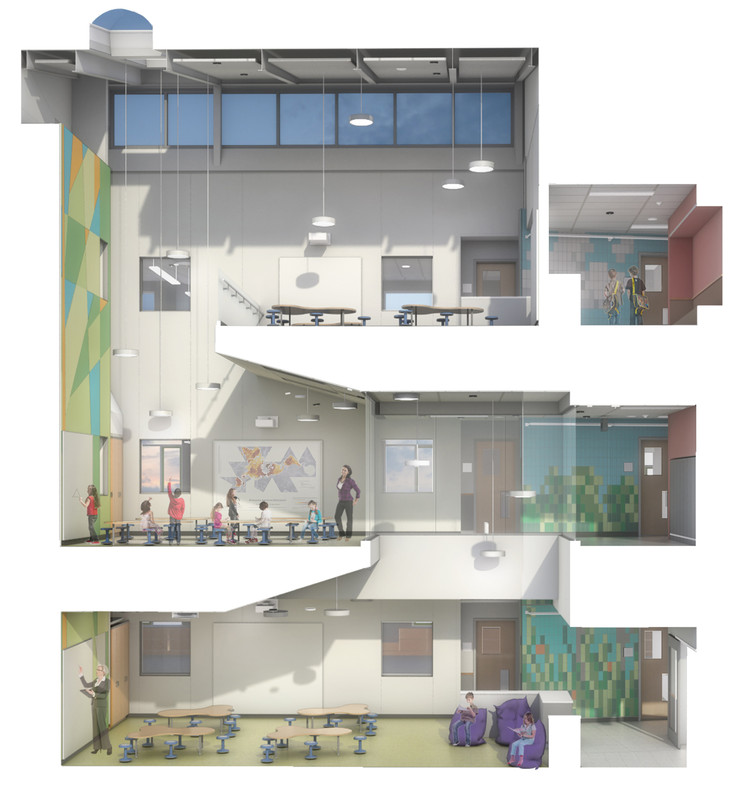
Woodland Elementary School / HMFH Architects. Image Cortesia de HMFH Architects
It is a student's right to be educated in a safe, healthy, and even aesthetically appealing environment, especially young students for whom these factors are even more important. For example, it has been shown that when the ergonomics of chairs are inadequate, they can greatly affect levels of concentration and the development of skills such as calligraphy. At the same time, the effectiveness of traditional teaching methods is increasingly being questioned and the quality of alternative methodologies increasingly being considered. In other articles, we discussed in more detail the design of Montessori schools and the atmosphere of Waldorf interiors.
Today, we will cover the importance of choosing furniture and address some aspects to consider when organizing them in classroom design for the schools of the future.
New Generations is a European platform that analyses the most innovative emerging practices at the European level, providing a new space for the exchange of knowledge and confrontation, theory, and production. Since 2013, New Generations has involved more than 300 practices in a diverse program of cultural activities, such as festivals, exhibitions, open calls, video-interviews, workshops, and experimental formats.
New Generations has launched a fresh new media platform, offering a unique space where emerging architects can meet, exchange ideas, get inspired, and collaborate. Recent projects, job opportunities, insights, news, and profiles will be published every day. The section ‘profiles’ provides a space to those who would like to join the network of emerging practices, and present themselves to the wide community of studios involved in the cultural agenda developed by New Generations.
ArchDaily and New Generations join forces! Every month ArchDaily will publish a selection of studio profiles chosen from the platform of New Generations.
The digitization of production and technological resources linked to the development of increasingly sophisticated tools has a direct impact on the contemporary practice of architecture and urbanism. Thinking about cities and buildings based on the digital assumption provides great possibilities for innovation in terms of design, optimization of resources and processes, improvement in performance and monitoring the maintenance of work, among other aspects. Many tools are already available, ranging from artificial intelligence to 3D printing, through various devices that change the paradigms of the profession and demand a new attitude when designing.
In a predominately urban world that constantly has to deal with complex problems such as waste generation, water scarcity, natural disasters, air pollution, and even the spread of disease, it is impossible to ignore the impact of human activity on the environment. Climate change is one of the greatest challenges of our time and it is urgent that we find ways to slow down the process, at the very least. Toward this end, our production, consumption, and construction habits will have to change, or climate change and environmental degradation will continue to diminish the quality and duration of our lives and that of future generations.
Although they seem intangible and distant, these various energy inefficiencies and waste issues are much closer than we can imagine, present in the buildings we use on a daily basis. As architects, this problem is further amplified as we deal daily with design decisions and material specifications. In other words, our decisions really do have a global impact. How can we use design to create a healthier future for our world?
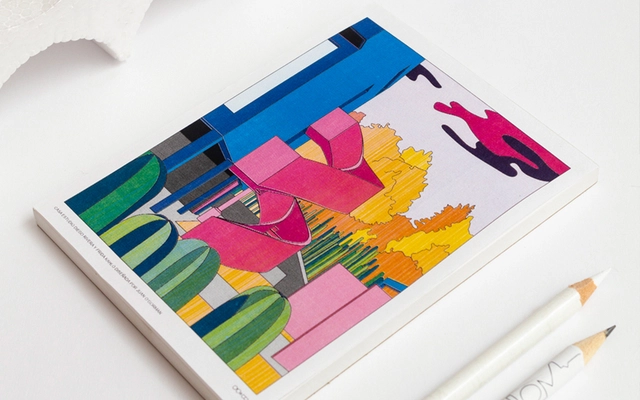
Carmelina&Aurelio Architecture Studio based in Tuxtla Gutiérrez, Chiapas in Mexico, released a book with architectural illustrations to color. The book in PDF format is available on their website for free and consists of eight letter-size pages. Read on for the featured projects as well as examples of color palettes for further inspiration.
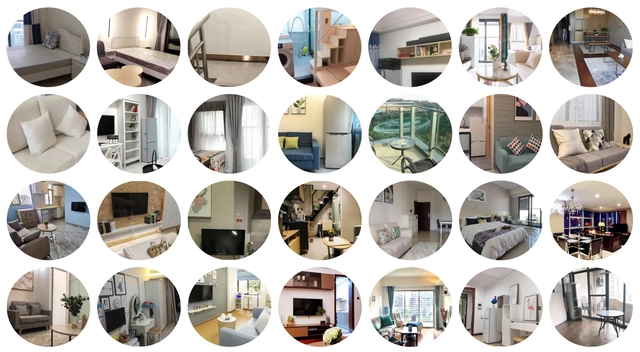
Your Real Estate Interior: Noourbanographical Sample of the single bedroom/studio apartment. Source: www.flatchina.com
Can a collective agency, or mind, be traced across the urban condition? And how should we map its effects on the physical matter of our cities? A specific representation of a specific type of ‘home’ is employed as an exercise in defining the impact of a “logic of thinking that is both embodied and distributed, singular and collective.” Hélène Frichot’s proposal for “Noourbanographies” was written as a response to the call for papers of the “Eyes of the City,” well before our domestic interiors became the new public. Looking at the distance between hegemonic collectives and ecologies of subjectivities as space for action, the essay opens up to an articulate range of issues that involve matters of care, diagrammatic thinking and spaces of control.
For the 2019 Shenzhen Biennale of Urbanism\Architecture (UABB), titled "Urban Interactions," (21 December 2019-8 March 2020) ArchDaily is working with the curators of the "Eyes of the City" section to stimulate a discussion on how new technologies might impact architecture and urban life. The contribution below is part of a series of scientific essays selected through the “Eyes of the City” call for papers, launched in preparation of the exhibitions: international scholars were asked to send their reflection in reaction to the statement by the curators Carlo Ratti Associati, Politecnico di Torino and SCUT, which you can read here.
This spring semester 2020, architect Wonne Ickx from PRODUCTORA was invited to teach a studio at RICE University in Houston, Texas as the Cullinan Visiting professor. The studio was called 'Pyramid Schemes' and combined an interest in the early XXth Century housing projects by Henri Sauvage, with a project site in Mexico City and an analysis of the related local conditions. The studio started out with quite some travelling forth and back between Houston and Mexico City, including a week-long study trip of the RICE students to Mexico's capital.
A global pandemic can change the way you look at things. In Greenwich, Connecticut, as with most places, restaurants and bars are shuttered now, schools are closed, and traffic is sparse as people stay home and maintain social distancing.
But each weekday, as the sun comes up over the eerily tranquil streets of the historic downtown business district, First Selectman Fred Camillo is still heading to the office. Camillo works in the Town Hall, a public building that’s been off-limits to the public—and to most employees—since mid-March, when all of Connecticut entered a constantly evolving state of lockdown following an executive order by Governor Ned Lamont in response to the COVID-19 outbreak.
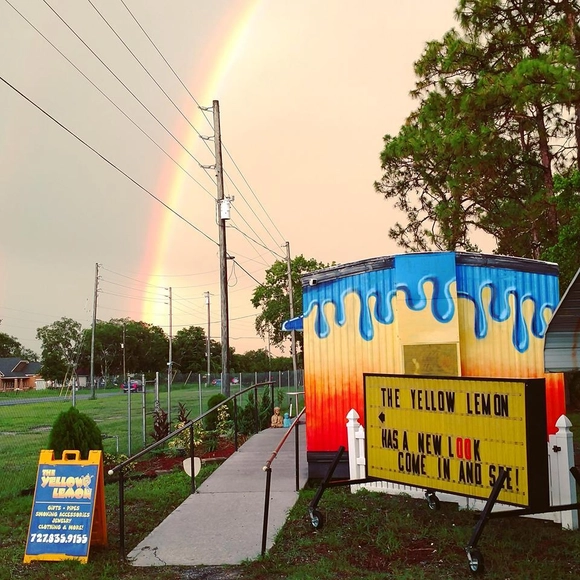
Head shops, born during the counterculture movement of the 1960s, were legally mandated to only sell products for use with legal substances. This influenced a tradition of delightfully surreptitious shop names and bright, far-out signage welcoming potential customers to a safe space, while staying within the law. From the cartoon apple with marijuana leaves as stems gracing the sign at Adam’s Apple in Chicago, to the simple block-lettered neon sign at The Fitter in Boulder, the tradition of odd, cool, freeform, blocky, colorful lettering spelling out fun and hardly clandestine shop names has offered sanctuary for those searching for the sub- and counterculture for half a century.
https://www.archdaily.com/938394/clog-x-cannabis-the-future-of-head-shops-in-the-usMarshall Ford and CLOG
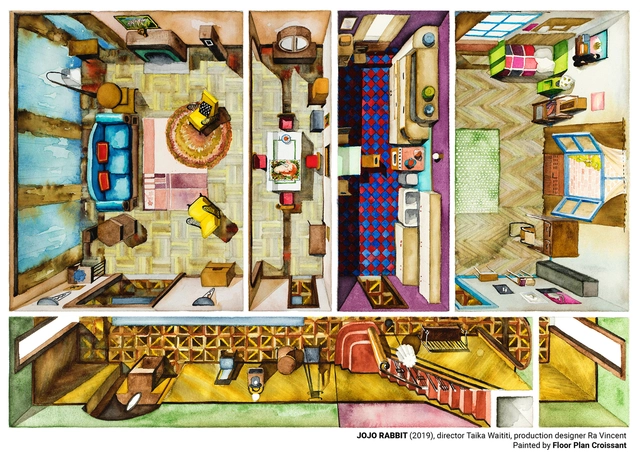
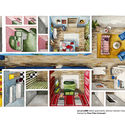
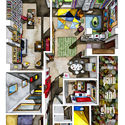
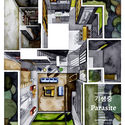
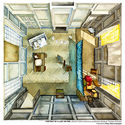
Floor Plan Croissant is a project directed by Boryana Ilieva founded to examine cinematographic spaces and bring the spatial language of the director to her own architectural understanding. However, later these translations took a social turn: as an architect and cinema lover, Boryana perceives a general gap between cinema and architecture, or in other words, a space that allows architects to explore beyond the screen. With this in mind, her work is based on extracting the plans from the main protagonist places in outstanding films, since she believes that a movie theater plan forms a phantom matrix around which the directors not only construct arguments, but rather they also place hidden messages.
The use of artificial intelligence (AI) is based on the idea of optimizing, streamlining and expanding the reach of the most diverse operations. Their systems are programmed to identify patterns and carry out predictions, decisions, and ultimately perform and actions with speed and accuracy. The efficiency of the models depends on the quantity and quality of the data, which can be obtained by applications, cameras, and sensors. In the urban context, technology based on the use of artificial intelligence has been seen as a way to improve the management of cities, especially those that are denser and have larger footprints.
Foster + Partners first built project in Russia is set to be completed later this year, as construction work for the RMK headquarters in Yekaterinburg nears finalization. The 15-storey building designed for the leading copper producer rethinks the conventional office space, bringing about a domestic scale to the interior layout.
Until the recent outbreak of the COVID-19 pandemic, the climate crisis was perhaps the fundamental design problem of our Anthropocene era. The threat of climate change has forced us as designers to reevaluate how we realize designs at all scales. Eco-friendly interior finishes, net-zero energy skyscrapers, and strategies to prevent the rising sea levels from pushing residents in coastal cities more inland are just some of the innovative solutions that have come from the increased urgency to mitigate the effects of the climate on our world.
Realistic images and walk-throughs have become an integral part of project presentations. Designers are using cutting-edge softwares and constructing precise 3D models to showcase their work as authentically as possible. As for the world of video games, it is not just about the quality of the graphics or how accurate these graphics are, but rather the immersive experience of visual designs and how the players are communicating with the virtually-built environment.
In an exclusive interview with ArchDaily, Philip Klevestav, principle artist at Blizzard Entertainment, the gaming development company known for Warcraft, Overwatch, and Diablo, shares his insights on video game designs and the influence of architecture on the designing process.
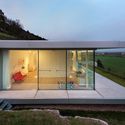
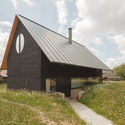
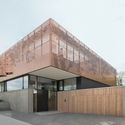
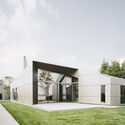
German design has become synonymous with accuracy, efficiency and precision. While the stereotype has roots in geography and local culture, the country's built environment reflects an affinity for structure, privacy and order. Combined with influences across Europe, Germany's contemporary architecture showcases refined forms and an emphasis on craft.
Fifty percent of landfill waste in New Zealand is construction and demolition waste. The demand for homes in the coming years and decades is rapidly outstripping any possible supply we could provide with our current construction methods. PhD student Ged Finch discusses the problems with the home building industry and practices in New Zealand and proposes an alternative to what he terms the "disposable model" of building. Today's homes are not built to last, and can make us sick in the time they are here. Finch's research focuses instead on a completely reimagined, zero waste model for construction. Utilizing today's digital fabrication technologies, we can create a set of building parts that are optimized and reusable from naturally durable materials. But the technical solution is only one part, states Finch. The real key is human ambition.
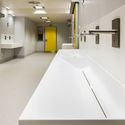
Although any architectural project must ensure the safety and well-being of its occupants, this goal is especially pertinent for healthcare spaces, whose primary occupants are those prone to getting sick or worsening their initial condition. For this reason, its design must not only support medical procedures in their optimal conditions, but also ensure that the environment is kept sterile and clean at all times.
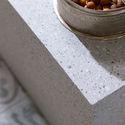
How do materials that fight the growth of pathogenic bacteria work? Is it possible to improve the hygiene and healthiness of an environment without neglecting the aesthetics of the space? We address this question by reviewing the case of Krion® solid surfaces, widely used in the healthcare sector but also in residential, commercial and office projects.
It's no secret that concrete has one of the highest CO2 emissions of all building materials, making it a focal point for architects looking to innovate and experiment with it as a way to optimize its production and application in construction while decreasing its environmental impact. This exploration of elements such as concrete's thermal inertia, which could serve to make buildings more energy efficient, as well as its durability, which guarantees a long-lasting, zero- maintenance structure even in the most extreme of climates. The ultimate goal is to create luminous living spaces with natural ventilation while simultaneously exploring the possibility of reusing frameworks as a way of cutting costs and streamlining the building process.
Almost two months have passed since the quarantine regime started in several countries as a strategy to reduce the transmission rate of the coronavirus. Since then, a considerable part of the architecture professionals has started to adopt telework or home office, keeping up with the projects that have already started, supported by a number of new online meeting tools, document storage in the cloud and BIM models.
https://www.archdaily.com/938534/what-can-we-do-to-overcome-or-avoid-the-next-crisis-in-architecture-and-constructionEquipe ArchDaily Brasil
Memory is unique to the individual. Physical places are often strong triggers for memories, or else can be the focus of the memory itself. In AXOR's personal new campaign, "AXOR Places", design partners of the brand share their "Place of Memory". Complemented by aerial landscape photography by Tom Hegen, the designers' stories showcase their individual experiences of place. The photography connects the personal "Places of Memory" with the individualization possibilities offered by the AXOR MyEdition faucet collection.
While opting for still images seems to be the most utilized means of presenting a project, some architects choose to invite viewers into the architecture itself, allowing them to experience the building and its surroundings immersively. Since 2006, architecture filmography studio Spirit of Space has engaged viewers with over 200 short films of projects built by world-renowned architects such as Peter Zumthor, Steven Holl, Daniel Libeskind, and Jeanne Gang. The studio’s multidisciplinary team has combined visuals with customized soundtracks, elevating the journey and turning it into a multi-sensory experience.


.jpg?1588588896&format=webp&width=640&height=580)
.jpg?1561029678&format=webp&width=640&height=580)
.jpg?1561029668 "© Y. Meiri")
_(1).jpg?1561029646 "Courtesy of CatalyticAction")

.jpg?1561029689 "© Shidhulai Swanirvar Sangstha")
.jpg?1561029678)




.jpg?1587757409 "© Carmelina&Aurelio")

.jpg?1587757443 "© Carmelina&Aurelio")





_Paolo_Rosselli__DSC2950.jpg?1588226670&format=webp&width=640&height=580)






.jpg?1587656580)
.jpg?1587656568 "HU – Strasbourg / S&AA. Image Cortesía de Porcelanosa Grupo")

.jpg?1587656568)