With every fraction of a degree of global warming, the impacts of climate change become more intense. In the Sixth Assessment Report of the Intergovernmental Panel on Climate Change (IPCC), 278 scientists from 65 countries demonstrate that to keep the 1.5°C limit established by the Paris Agreement within reach, global greenhouse gas (GHG) emissions must peak within the next three years.
https://www.archdaily.com/1132298/6-key-takeaways-from-the-2022-ipcc-report-on-climate-change-mitigationClea Schumer, Sophie Boehm, Taryn Fransen, Karl Hausker e Carrie Dellesky
Municipalities, much like people, are dynamic entities, constantly evolving to keep pace with and adapt to the social, economic, and environmental shifts of their time. By the same token, the vision of how the ideal city should be planned has continually been shaped by the reality and prevailing thought of each era.
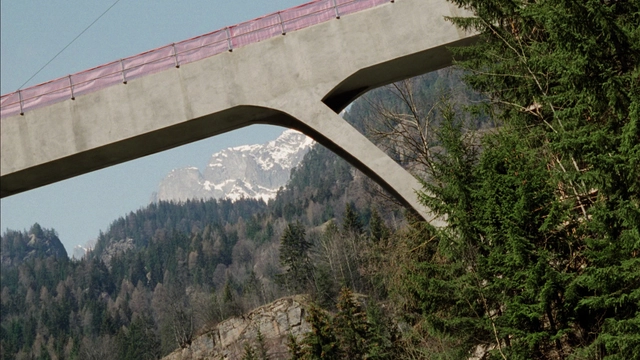
Still from Maillarts Brücken (2001), by Heinz Emigholz.
Photography has historically been used to document architecture. Indeed, in the very first photograph, the subject captured was the estate of its inventor, Joseph Nicéphore Niépce. While commonly viewed as a mere recording of the actual work of art (the captured building), architectural photography is more than just a tool at the service of these structures; it is an art form in its own right, possessing its own language and aesthetic concerns.
Cities play a fundamental role in the search for solutions and policies to mitigate the problems driving global climate change. Today, urban areas account for more than 70% of carbon dioxide (CO₂) emissions—one of the main causes of the greenhouse effect and its consequences for the environment and human life.
In his most recent book, Survival of the City, economist Edward Glaeser diagnoses the conflicts of interest that permeate the urban debate. According to him, there is a fundamental opposition between insiders—longtime residents interested in maintaining the status quo and increasing their property values—and outsiders—new residents looking for affordable housing and new opportunities for work, consumption, and urban space.
https://www.archdaily.com/1132011/nimby-and-yimby-two-visions-of-the-cityAndrey Barbosa, Gabriel Nunes, Guilherme Pereira e Pedro Portes
Just like much of popular culture, for most of the twentieth century, architectural media relied on magazines sold at newsstands and supermarkets. Through them, readers discovered what was being built, tracked technological innovations, and, to some extent, popularized architectural discourse, taking it beyond the academic and elitist confines of universities and conferences. With the rise of the internet, the format of this information shifted, finding new ways to reach the public. Social media and specialized websites became crucial channels for sharing information and services, expanding public access to architectural issues. Today, every major social network hosts profiles dedicated exclusively to architecture, tailoring their content to each specific platform.
Two thousand five hundred reais is the average price of a good virtual reality headset. If you opt for the full experience, shell out another four thousand reais to add sensors and controllers. These models must be connected to a high-performance computer to process information and transform spaces into 3D models, costing at least five thousand reais. In addition to the headset, sensors, and computer, software is also required, with annual licenses that likewise run into the thousands. In short, keeping up with technology nowadays is quite a costly endeavor.
The world's population is aging, and one of the major questions raised by this demographic shift—with more older adults than young children—is whether municipalities are equipped for these citizens to use urban spaces safely and accessibly, and to feel included in the social and civic life of their communities.
A United Nations (UN) report estimates that the number of individuals aged 65 or older is expected to double by 2050, growing from 727 million in 2020 to approximately 1.5 billion—representing 16% of the global population.
https://www.archdaily.com/1132240/how-to-make-a-city-age-friendlySomos Cidade
Summer, carnival, and transit fare hikes: the beginning of the year in Brazil is typically when municipal and state governments announce increases in public transportation fares. While these fares were frozen in 2021 due to the coronavirus pandemic, many cities have faced hikes once again in 2022. Understanding the impact of rising public transportation fares on our society is crucial.
Bringing lighting to those in need using solar energy and affordable materials. This is the mission of the NGO Litro de Luz, which, during a three-day campaign, positively impacted the quality of life of 173 families from riverside communities living along the banks of the Rio Negro in the Amazon.
One of the great theorists of architecture, the city, and nature recently passed away on March 17, 2022, at the age of 85. Born in Vienna on October 4, 1936, Christopher Alexander lived a long life of singular contributions, offering visionary ideas about cities that challenged the mainstream of architectural practice.
https://www.archdaily.com/1132139/christopher-alexander-the-legacy-of-a-visionary-urbanistVinicius M. Netto
Alternating between housewife and architect, Lina Bo Bardi appeared in the pages of O Cruzeiro magazine—featured in women's columns for her risotto alla milanese, and in cultural sections as the architect of MASP (Museum of Modern Art of São Paulo). Published weekly by Assis Chateaubriand's Diários Associados, O Cruzeiro enjoyed nationwide notoriety and circulation. Although targeted at upper-class housewives, its content was broad, covering fashion, culture, cinema, politics, and "women's advice sections" (sic).
Lacking a clear definition, the term smart cities has become increasingly common with each passing year. Many theorists point out that this conceptual ambiguity is linked to its rapid adoption and expansion by large corporations and institutions, thus turning it into a buzzword. Despite the “innovative” rhetoric, the model chosen to implement a smart city can lead to segregation and privilege specific groups if it is not designed around local specificities and does not involve local leadership (MENDES, 2020). This essay adopts the understanding that innovation and intelligence are not necessarily tied to digital technologies or high-cost resources. Rather, they stem from a fresh perspective on urban problems and the development of non-traditional solutions in decision-making and execution.
Videos
Opening frame. Source: Oliver Latta/Apple TV+.
One of the most highly acclaimed television productions of recent years, “Severance” (released as “Ruptura” in Brazil), the Apple TV+ sci-fi series released in 2022, establishes an intriguing premise: employees of the mysterious Lumon Industries volunteer to undergo a procedure that surgically separates their personal and professional memories, ensuring that their work and private lives never overlap. The procedure thus creates an intermittent alter ego, mutually unaware of the other self and hyper-focused on its respective domain. The deft direction of Ben Stiller and Aoife McArdle, coupled with stellar performances from the cast, does justice to Dan Erickson's brilliant plot. Here, however, we focus on how the show's primary setting—the corporate headquarters in the fictional town of Kier—heightens the distress of the small team of employees through the architecture that houses and alienates them during the workday.
Gentrification is the process by which real estate becomes more desirable and, consequently, more expensive. Rising prices displace long-time residents, replacing them with higher-income newcomers. This should not be confused with the forced removal of citizens through eminent domain or forced evictions. Evicting residents by official decree is a different issue altogether.
https://www.archdaily.com/1132196/filtering-gentrification-in-reverseAnthony Ling e Jeff Andrade-Fong
On May 5, the first edition of the Model. Barcelona Architectures Festival officially opened. Jointly organized by the Barcelona City Council and the Association of Architects of Catalonia (COAC), the event is led by artistic directors Eva Franch i Gilabert and Beth Galí, along with cultural researcher José Luis de Vicente. It brings us closer to experimental architecture, helping us rethink how we want to live together through new urban models and new imaginaries.
Through five temporary architecture installations located along a circuit in Ciutat Vella—starting at Plaza de Catalunya, the Sant Antoni slab, Plaza de Idrissa Diallo, Paseo de Lluís Companys, and Plaza Reial—the festival explores its five major themes under the central concept of "Regrow": Between-Classes, Between-Cultures, Between-Species, Between-Generations, and Between-Materials.
In this context, we present the installation "Reversing the Pyramid" by OJO estudio.
We must slow down traffic in Brazilian cities—and fast. This is a public health issue, as traffic crashes are among the leading causes of death worldwide. It is also a matter of quality of life and equity, as cities that effectively reduce vehicle speeds become safer, more welcoming, and more vibrant for everyone.
https://www.archdaily.com/1131994/8-approaches-and-trends-to-promote-safe-traffic-and-quality-public-spacesPaula Manoela dos Santos, Bruno Rizzon e Adriana Jakovcevic
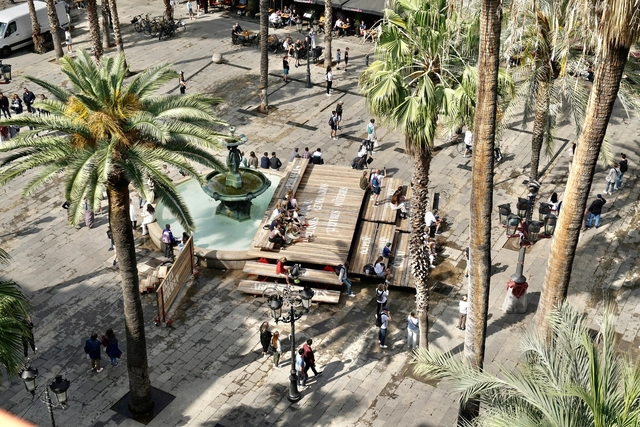
From May 5 to 15, Barcelona's Plaza Real was transformed into one of the hubs for debates on architecture and the city during the MODEL Festival. The ephemeral installation "Occupy the Center with the Word"—led by the ELISAVA Barcelona School of Design and Engineering under the direction of Roger Paez, in collaboration with Manuela Valtchanova, Albert Fuster, and Toni Montes—sought to "create optimal conditions for both encounters and disagreements to take place, always through the spoken word."
Architects and designers, as well as psychologists and sociologists, recognize that aesthetics and its underlying philosophy have the power to change how we perceive the world around us. Consequently, a deeper understanding of what is beautiful has the power to reshape how people respond to their environment.
Exploring the different meanings of aesthetics in architecture—from "form follows function" to the aesthetics of the metaverse—can help us understand the potential of our physical and virtual environments on the path toward a better world.
Much has already been written on the subject, but we now want to open the debate to you, our readers. Share your thoughts on what makes a building or a city beautiful.
Leave your comments in the form below. These will be selected and published in an upcoming article.
At the dawn of the automobile era, suppose Henry Ford and John D. Rockefeller had asked how urban planners could increase the demand for cars and gasoline. Consider three options. First, divide the city into separate zones (housing here, jobs there, shopping over there) to generate trips between them. Second, limit density to spread everything out and increase those trips even further. Third, require ample off-street parking everywhere, making cars the easiest and cheapest way to travel.
On a warm, hazy Sunday afternoon, Nairobi's concrete tenements tower over the city's shanties (or “slums”). Men and women hang laundry from roofs and balconies — making the buildings look like a patchwork quilt, a mosaic of fabric.
According to Victor Carvalho Pinto, an attorney specializing in Urban Law and a legislative advisor to the Brazilian Federal Senate, supporting the modernization of city and state administrations—so-called "institutional development"—is more critical than funding municipal public works. In an exclusive interview with Geocracia, Carvalho Pinto, coordinator of the Cities and Regulation Hub at Insper's Arq.Futuro Cities Lab, stated he is not concerned about the dissolution of the Ministry of Cities, as the federal budget, Caixa Econômica Federal, and BNDES already allocate non-repayable grants for many municipal projects.
https://www.archdaily.com/1132416/before-municipal-works-come-information-mapping-and-property-registrationCarlos Vieira e Victor Carvalho Pinto
The new report from the Intergovernmental Panel on Climate Change highlights nature's immense potential to reduce climate change risks and build resilience. The political landscape has become increasingly supportive of this approach. In 2021, for instance, 137 countries collectively committed to halting forest loss and land degradation by 2030 as part of the Glasgow Leaders' Declaration on Forests and Land Use. Signatories reaffirmed the importance of all forests in adapting to the impacts of climate change and maintaining healthy ecosystem services. Funding pledges quickly followed, including $19.2 billion to protect and restore forests globally.
From early 20th-century hygienism to the macro-planning of urbanization in the 1970s, the urban model aimed at carving out wide avenues to connect neighborhoods (the center and its extensions) via motorized transport: the city on wheels. This North American urbanization model, adopted by Brazilian cities, privileges high-rise development and private vehicles over public transit.