1. ArchDaily
  2. Pavilion

Pavilion: The Latest Architecture and News

Greek Pavilion Takes Center Stage at the 2018 London Design Biennale

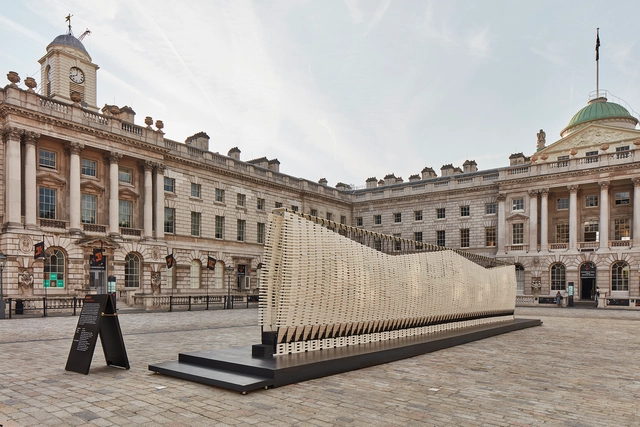
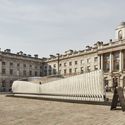
Experimental design practice Studio INI's has designed a kinetic installation to represent this year's Greek Pavilion for the 2018 London Design Biennale. Entitled ΑΝΥΠΑΚΟΗ (Disobedience), the installation responds to the Biennale theme of Emotional States. Selected for the central courtyard exhibit, the design is comprised of a 17 meter-long wall constructed from a steel spring skeleton built up with recycled plastic which flexes, morphs and breathes around the human body.

Greek Pavilion Takes Center Stage at the 2018 London Design Biennale - Image 1 of 4Greek Pavilion Takes Center Stage at the 2018 London Design Biennale - Image 2 of 4Greek Pavilion Takes Center Stage at the 2018 London Design Biennale - Image 3 of 4Greek Pavilion Takes Center Stage at the 2018 London Design Biennale - Image 4 of 4Greek Pavilion Takes Center Stage at the 2018 London Design Biennale - More Images+ 4

Snøhetta Designs Rotating Book Pavilion for the 2018 London Design Festival

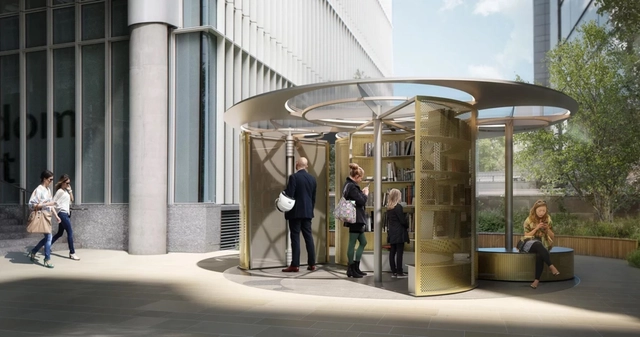
Celebrating Paddington Central’s first year as a Design Route at the London Design Festival, the design practice Snøhetta created a rotating book pavilion for British Land. Snøhetta wanted to create a project that would reimagine the traditional principles of a library through a mechanized pavilion that generates varied spatial types. Designed for visitors to immerse themselves into a world of books, the pavilion encourages exploration, interaction and reflection.
Snøhetta Designs Rotating Book Pavilion for the 2018 London Design Festival - Image 1 of 4Snøhetta Designs Rotating Book Pavilion for the 2018 London Design Festival - Image 2 of 4Snøhetta Designs Rotating Book Pavilion for the 2018 London Design Festival - Image 3 of 4Snøhetta Designs Rotating Book Pavilion for the 2018 London Design Festival - Image 4 of 4Snøhetta Designs Rotating Book Pavilion for the 2018 London Design Festival - More Images+ 4

LOLA, L+CC, and Taller Architects Design "Romantic" Forest Trail for Forgotten Sports in Shenzhen

LOLA Landscape Architects, Taller Architects, and L+CC have released images of their competition-winning design for a 600-hectare forest and sports park in Guang Ming, Shenzhen, China. Commissioned in response to the exploding technology industry in the Shenzhen metropolitan area, the park will place an emphasis on health, sports, and nature to offer an ecological counterpoint to dense urban surroundings.

The winning collaboration saw off competition from JCFO, SWA, and TCL, with the competition jury praising the scheme for its “fresh approach and [for] being highly attentive to local ecology [while] meanwhile incorporating romantic techniques and realistic urban visions.”

LOLA, L+CC, and Taller Architects Design "Romantic" Forest Trail for Forgotten Sports in Shenzhen - Image 1 of 4LOLA, L+CC, and Taller Architects Design "Romantic" Forest Trail for Forgotten Sports in Shenzhen - Image 2 of 4LOLA, L+CC, and Taller Architects Design "Romantic" Forest Trail for Forgotten Sports in Shenzhen - Image 3 of 4LOLA, L+CC, and Taller Architects Design "Romantic" Forest Trail for Forgotten Sports in Shenzhen - Image 4 of 4LOLA, L+CC, and Taller Architects Design Romantic Forest Trail for Forgotten Sports in Shenzhen - More Images+ 16

Open Call: The Best Student Design-Build Projects

When learning about architecture, there is no replacement for practical experience: seeing how materials can be joined together, how structural elements respond to the stresses placed upon them, or how construction techniques can alter the finished project. For this reason, it is a good idea to give students a chance for some hands-on experience building real structures—something that, due to budgetary constraints and the academic culture of many architecture schools, has sadly been uncommon in the past.

However, in recent years, this culture has started to shift, with increasing numbers of architecture schools finding ways for students to be involved in construction projects, from small, temporary interventions and pavilions, to larger permanent buildings. In order to show the excellent work that can be done in an educational context, for the fourth time ArchDaily is calling on students and professors to submit the design-build projects they have completed in the past year. As always, we're teaming up with all of ArchDaily en Español, ArchDaily Brasil, and ArchDaily China, in the hope that we can present the best work from students worldwide to a worldwide audience. Read on to find out how you can take part.

New Pavilion in Rotterdam's Leuvehaven Port Brings High-Tech Design to a Historical Context

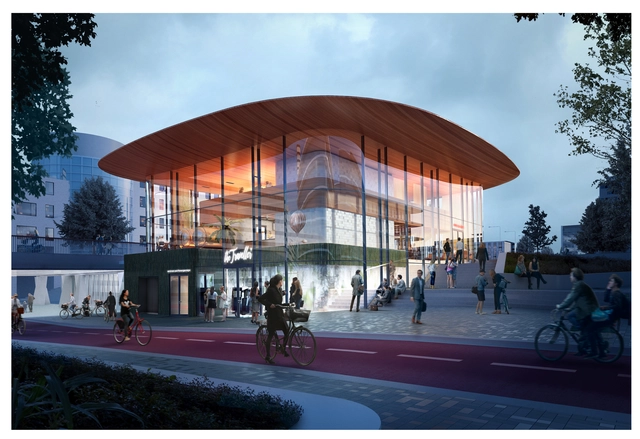
A new public pavilion from MoedersheimMoonen Architects is set to be built in the old 'Leuvehaven' port in Rotterdam. Located near the Erasmus Bridge, the pavilion intends to bring new life to the historic port of Rotterdam. The municipality of Rotterdam is also set to invest in a bustling residential climate, with this new pavilion housing multiple programs that will contribute to a "lively" and "greener" Maritime District.

The building will replace three existing pavilions, providing a new perspective for visitors to the Leuvehaven. Much of the structure and foundation from the existing buildings are reused in the new design, promoting sustainability, honoring the present conditions of the site, and bringing high-tech design elements to the historical context.

The various programs for the Pavilion will include "the Port Information Point of the Port of Rotterdam, two publicly accessible workshops from the Maritime Museum Rotterdam and two catering establishments with terraces by the water," with the surrounding exteriors space also to be renewed in phases.

New Pavilion in Rotterdam's Leuvehaven Port Brings High-Tech Design to a Historical Context - Community , FacadeNew Pavilion in Rotterdam's Leuvehaven Port Brings High-Tech Design to a Historical Context - Community , Garden, FacadeNew Pavilion in Rotterdam's Leuvehaven Port Brings High-Tech Design to a Historical Context - Community New Pavilion in Rotterdam's Leuvehaven Port Brings High-Tech Design to a Historical Context - Community , Facade, CityscapeNew Pavilion in Rotterdam's Leuvehaven Port Brings High-Tech Design to a Historical Context - More Images+ 6

New Details Released of Estudio Carme Pinós' 2018 MPavilion in Melbourne

The Naomi Milgrom Foundation has released images of the MPavilion 2018, designed by Barcelona-based architect Carme Pinós of Estudio Carme Pinós, and situated in Melbourne, Australia. The fifth MPavilion in an ongoing series, the Estudio Carme Pinós design seeks to invite interaction at an intersection between people, design, nature, and the city.

The first Spanish architect to design an MPavilion, Carme Pinós follows on from past MPavilion designers such as OMA in 2017, Studio Mumbai in 2016, and AL_A in 2015.

New Details Released of Estudio Carme Pinós' 2018 MPavilion in Melbourne - Image 1 of 4New Details Released of Estudio Carme Pinós' 2018 MPavilion in Melbourne - Image 2 of 4New Details Released of Estudio Carme Pinós' 2018 MPavilion in Melbourne - Image 3 of 4New Details Released of Estudio Carme Pinós' 2018 MPavilion in Melbourne - Image 4 of 4New Details Released of Estudio Carme Pinós' 2018 MPavilion in Melbourne - More Images

"Unfolding Pavilion / Little Italy" at the 2018 Venice Biennale

As part of our 2018 Venice Architecture Biennale coverage, we present the Unfolding Pavilion. Below, curators Daniel Tudor Munteanu, Davide Tommaso Ferrando, Sara Favargiotti describe the exhibition in their own words.

The ‘Unfolding Pavilion’ is an exhibition and editorial project that pops up at major architecture events in previously inaccessible but architecturally significant buildings.

On each occasion the ‘Unfolding Pavilion’ features a different theme inspired by the space it occupies, by means of commissioned original works that react to it and to its wider cultural-historic background. The ‘Unfolding Pavilion’ doesnt necessarily care about the hosting events theme. It lets its occupied space inspire its own theme. Without a good exhibition space (of the finest architectural making), the 'Unfolding Pavilion’ doesn’t have any reason to exist.

"Unfolding Pavilion / Little Italy" at the 2018 Venice Biennale - Image 1 of 4"Unfolding Pavilion / Little Italy" at the 2018 Venice Biennale - Image 2 of 4"Unfolding Pavilion / Little Italy" at the 2018 Venice Biennale - Image 3 of 4"Unfolding Pavilion / Little Italy" at the 2018 Venice Biennale - Image 4 of 4Unfolding Pavilion / Little Italy at the 2018 Venice Biennale - More Images+ 37

This Crowdsourced and Crowdfunded Pavilion in Ukraine Embodies the Collaborative Spirit

In Dnipro, Ukraine, sits a unique multi-purpose pavilion rich with historical roots and design influence. Stage is a collaborative project between architects from Ukraine, Poland, Denmark and Italy, crowdsourced and crowdfunded by the citizens of Dnipro. The site for the pavilion has been centered around community involvement throughout the complex history of Dnipro, but it has laid unused for over 70 years.

Stage is an emanation of the rich and vibrant culture and was built to accommodate the needs of dozens of artists, poets, painters and musicians, who previously relied on various spaces scattered around the city. Their "collective creative energy" was used to reactivate the lost community space. Stage was recently awarded Special Mention in the 2018 European Prize for Urban Public Space.

This Crowdsourced and Crowdfunded Pavilion in Ukraine Embodies the Collaborative Spirit - Image 1 of 4
© Alexandr Burlaka

Read on for more about Stage and the collaborative effort that made this initiative possible.

Seduction Pavilion: Call for Entries

YAC – Young Architects Competitions – and the Foundation Fashion Research Italy – in cooperation with the Cineteca di Bologna - launch “Seduction Pavilion”, an architectural competition to design and realize an installation that will became a real landmark of an exhibition that the Foundation is going to dedicate to the endless beauty of aspiring female celebrities and pin-ups. A cash prize of € 10,000 + realization of the 1st prize project will be awarded to winners selected by a well-renowned jury made of, among the others, Patricia Urquiola (Studio Urquiola), Fabio Novembre (Studio Fabio Novembre), Ippolito Pestellini Laparelli (OMA), Claudio Silvestrin (Claudio Silvestrin Architects)

Seduction Pavilion: Call for Entries  - Featured ImageSeduction Pavilion: Call for Entries  - Image 1 of 4Seduction Pavilion: Call for Entries  - Image 2 of 4Seduction Pavilion: Call for Entries  - Image 3 of 4Seduction Pavilion: Call for Entries  - More Images+ 1

Boutique Pavilion by Zaha Hadid Architects For Cosmetics Label Il Makiage Opens in New York City

Zaha Hadid Architects, in collaboration with photographer Paul Warchol, has released images of their boutique pavilion for the make-up brand Il Makiage, located in the label’s store in SoHo, New York City.

The pavilion coincides with the launching of Il Makiage’s new 800-piece makeup collection, and was designed to convey the label’s “characteristically bold graphic identity.”

Boutique Pavilion by Zaha Hadid Architects For Cosmetics Label Il Makiage Opens in New York City - Image 1 of 4Boutique Pavilion by Zaha Hadid Architects For Cosmetics Label Il Makiage Opens in New York City - Image 2 of 4Boutique Pavilion by Zaha Hadid Architects For Cosmetics Label Il Makiage Opens in New York City - Image 3 of 4Boutique Pavilion by Zaha Hadid Architects For Cosmetics Label Il Makiage Opens in New York City - Image 4 of 4Boutique Pavilion by Zaha Hadid Architects For Cosmetics Label Il Makiage Opens in New York City - More Images+ 11

Photographs Capture Frida Escobedo's 2018 Serpentine Pavilion Nearing Completion

Photographer Francesco Russo has captured the construction of Frida Escobedo’s 2018 Serpentine Pavilion, as the structure nears completion in London’s Hyde Park. The images showcase the dark cement roof tiles used to construct the pavilion, which comprises an enclosed courtyard created by two rectangular volumes.

With an interplay of light and water, the pavilion seeks to evoke the sensation of the domestic architecture of Mexico, from where Escobedo hails. The stacked cement tiled visible in the photographs form a "celosia," a type of permeable wall common in Mexico.

Photographs Capture Frida Escobedo's 2018 Serpentine Pavilion Nearing Completion - Image 1 of 4Photographs Capture Frida Escobedo's 2018 Serpentine Pavilion Nearing Completion - Image 2 of 4Photographs Capture Frida Escobedo's 2018 Serpentine Pavilion Nearing Completion - Image 3 of 4Photographs Capture Frida Escobedo's 2018 Serpentine Pavilion Nearing Completion - Image 4 of 4Photographs Capture Frida Escobedo's 2018 Serpentine Pavilion Nearing Completion - More Images+ 3

Shortlist Revealed for 2019 Dulwich Pavilion in London

Following deliberation from a judging panel of industry experts, six emerging architecture firms have been shortlisted for the design of the Dulwich Pavilion 2019 in London, chosen from over 150. In collaboration with the London Festival of Architecture, the six schemes will be displayed at the Dulwich Picture Gallery throughout June and July of 2018.

The initiative follows on from the success of the gallery’s first pavilion in 2017, designed by IF_DO and exhibited at the London Festival of Architecture in 2017. Following the exhibition of the six shortlisted schemes for 2019, a public vote will be combined with a panel vote to select the winning pavilion.

Shortlist Revealed for 2019 Dulwich Pavilion in London - Image 1 of 4Shortlist Revealed for 2019 Dulwich Pavilion in London - Image 2 of 4Shortlist Revealed for 2019 Dulwich Pavilion in London - Image 3 of 4Shortlist Revealed for 2019 Dulwich Pavilion in London - Image 4 of 4Shortlist Revealed for 2019 Dulwich Pavilion in London - More Images+ 50

First Serpentine Pavilion Outside UK Opens with Design by JIAKUN Architects

A new Serpentine Pavilion has opened in Beijing, China, marking the first time the prestigious program has been implemented away from its usual home at the Serpentine Gallery in Hyde Park, London. Designed by JIAKUN Architects, the pavilion was commissioned by The Serpentine Galleries working in partnership with WF CENTRAL, and is located just 600 meters away from Beijing's Forbidden City.
UNStudio’s Ben van Berkel Weaves an Immersive Pavilion for Revolution Precrafted Series

Continuing towards its goal of creating design-forward structures that are available to the public and installable anywhere, Revolution Precrafted's series has unveiled its latest pavilion design by Ben van Berkel, founder and principal architect of UNStudio. The limited edition Ellipsicoon (a portmanteau of Ellipse and Cocoon) is available now through Revolution Precrafted’s website, joining the selection of prefabricated pavilions and single-family home designs by the likes of Zaha Hadid, Jean Nouvel, and Daniel Libeskind.

UNStudio’s Ben van Berkel Weaves an Immersive Pavilion for Revolution Precrafted Series - Image 1 of 4UNStudio’s Ben van Berkel Weaves an Immersive Pavilion for Revolution Precrafted Series - Image 2 of 4UNStudio’s Ben van Berkel Weaves an Immersive Pavilion for Revolution Precrafted Series - Image 3 of 4UNStudio’s Ben van Berkel Weaves an Immersive Pavilion for Revolution Precrafted Series - Image 4 of 4UNStudio’s Ben van Berkel Weaves an Immersive Pavilion for Revolution Precrafted Series - More Images+ 3

Chinese Pavilion Opens With Robot-Printed 'Cloud Village' at 2018 Venice Biennale

The Chinese Pavilion at the 2018 Venice Architecture Biennale, themed "Building a Future Countryside", is endeavored to explore new technology and ideas to make better of China's rural areas. A digitally-fabricated outdoor pavilion "Cloud Village" has been set up in addition to the national exhibition at the Venetian Arsenale. The Cloud Village has a twisting form which creates a sequence of open and semi-enclosed spaces under its roof. It seeks to convey an abstraction of the everyday life in Chinese countryside where boundaries of private and public realms are not always defined.

The Cloud Village is structurally made possible by the robotic printing technology developed by Philip F. Yuan and his team. Read below for a detailed account of the project from the architects.

Chinese Pavilion Opens With Robot-Printed 'Cloud Village' at 2018 Venice Biennale - Image 1 of 4Chinese Pavilion Opens With Robot-Printed 'Cloud Village' at 2018 Venice Biennale - Image 2 of 4Chinese Pavilion Opens With Robot-Printed 'Cloud Village' at 2018 Venice Biennale - Image 3 of 4Chinese Pavilion Opens With Robot-Printed 'Cloud Village' at 2018 Venice Biennale - Image 4 of 4Chinese Pavilion Opens With Robot-Printed 'Cloud Village' at 2018 Venice Biennale - More Images+ 16

Pine Park Pavilion / DnA

Pine Park Pavilion / DnA - Landscape, Deck, Beam, Facade, ForestPine Park Pavilion / DnA - Landscape, Deck, Beam, Facade, DoorPine Park Pavilion / DnA - Landscape, Beam, Facade, Column, LightingPine Park Pavilion / DnA - Landscape, ForestPine Park Pavilion / DnA - More Images+ 20

  • Architects: DnA
  • Area Area of this architecture project Area:  197
  • Year Completion year of this architecture project Year:  2017

Francis Kéré to Design New Pine Log Pavilion for Tippet Rise Art Center

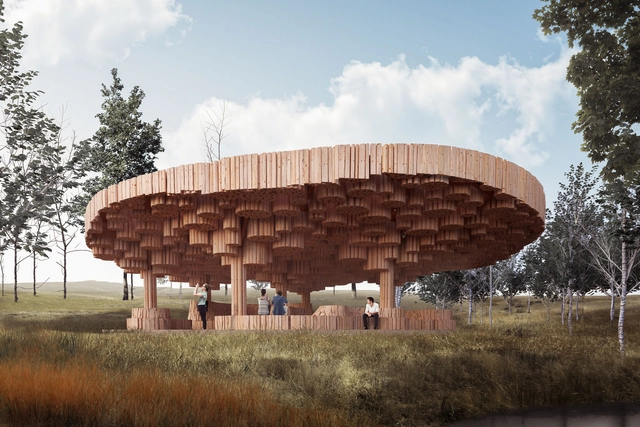
Tippet Rise Art Center has announced the commissioning of architect Francis Kéré to design a 1,900-square-foot pavilion for the center’s 10,000-acre grounds in Montana, USA. Envisioned as a “communal gathering space nestled among a cluster of aspen and cottonwood trees,” new renderings by Kéré Architecture depict the scheme featuring a locally-sourced log canopy.

The scheme can be read as an evolution of Kéré’s canopy structures designed for the Louisiana Museum of Modern Art near Copenhagen, and his 2017 Serpentine Pavilion in London.

Francis Kéré to Design New Pine Log Pavilion for Tippet Rise Art Center - Image 1 of 4Francis Kéré to Design New Pine Log Pavilion for Tippet Rise Art Center - Image 2 of 4Francis Kéré to Design New Pine Log Pavilion for Tippet Rise Art Center - Image 3 of 4Francis Kéré to Design New Pine Log Pavilion for Tippet Rise Art Center - Image 4 of 4Francis Kéré to Design New Pine Log Pavilion for Tippet Rise Art Center - More Images+ 2

Can Architecture Save China’s Rural Villages? DnA’s Xu Tiantian Thinks So

Subscriber Access | 
Can Architecture Save China’s Rural Villages? DnA’s Xu Tiantian Thinks So - Arch Daily Interviews
Bamboo Pavilion. Image © Zhou Ruogo

Travel seven hours by car in a Southwest direction from Shanghai and you will arrive in Songyang County. The name is unfamiliar to many Chinese people, and even more foreign to those living abroad. The county consists of about 400 villages, from Shicang to Damushan.

Here, undulating lush green terraces hug the sides of Songyin river valley, itself the one serpentine movement uniting the lands. Follow the river and you will see: here, a Brown Sugar Factory; there, a Bamboo Theatre; and on the other side, a stone Hakka Museum built recently but laid by methods so old, even the town masons had to learn these ways for the first time, as if they were modern methods, as if they were revolutionary.

And maybe they are. Songyang County, otherwise known as the “Last Hidden Land in Jiangnan,” may look like a traditional Chinese painting with craggy rock faces, rice fields and tea plantations, but it has also become a model example of rural renaissance. Beijing architect Xu Tiantian, of the firm DnA_Design and Architecture, has spent years surveying the villages of Songyang, talking to local County officials and residents, and coming up with what she calls “architectural acupunctures.”

Can Architecture Save China’s Rural Villages? DnA’s Xu Tiantian Thinks So - Arch Daily InterviewsCan Architecture Save China’s Rural Villages? DnA’s Xu Tiantian Thinks So - Arch Daily InterviewsCan Architecture Save China’s Rural Villages? DnA’s Xu Tiantian Thinks So - Arch Daily InterviewsCan Architecture Save China’s Rural Villages? DnA’s Xu Tiantian Thinks So - Arch Daily InterviewsCan Architecture Save China’s Rural Villages? DnA’s Xu Tiantian Thinks So - Arch Daily InterviewsCan Architecture Save China’s Rural Villages? DnA’s Xu Tiantian Thinks So - Arch Daily InterviewsCan Architecture Save China’s Rural Villages? DnA’s Xu Tiantian Thinks So - Arch Daily InterviewsCan Architecture Save China’s Rural Villages? DnA’s Xu Tiantian Thinks So - Arch Daily InterviewsCan Architecture Save China’s Rural Villages? DnA’s Xu Tiantian Thinks So - Arch Daily InterviewsCan Architecture Save China’s Rural Villages? DnA’s Xu Tiantian Thinks So - More Images+ 65