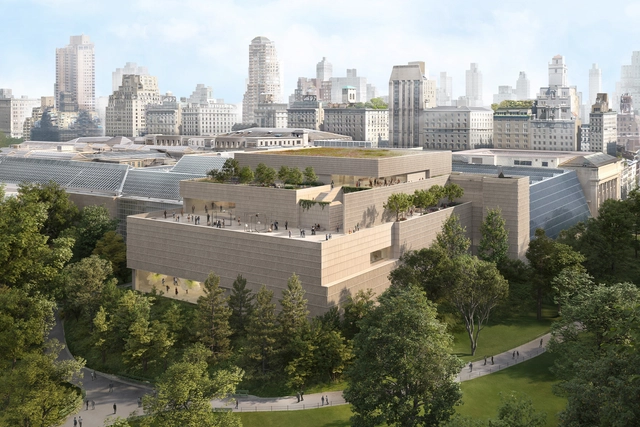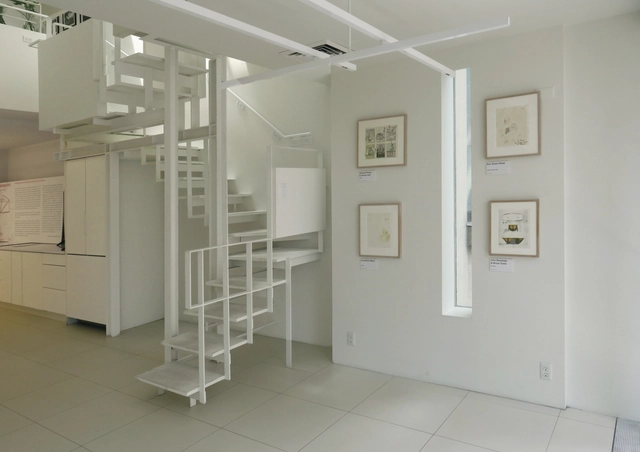
The Metropolitan Museum of Art in New York has unveiled the design for a new wing dedicated to its 20th- and 21st-century art collection. Architect Frida Escobedo, the first woman to design a Met wing, is leading the project. The Oscar L. Tang and H.M. Agnes Hsu-Tang Wing will increase gallery space by almost 50 percent, adding over 70,000 square feet. This expansion will address accessibility issues, improve infrastructure, and enhance the sustainability of the building. The opening of the new wing is anticipated in 2030.
Air rights transactions have become essential in urban development, allowing cities to grow vertically while preserving limited land resources. Typically defined as the right to use or sell the space above a property, air rights enable property owners to transfer unused floor area ratio (FAR) to neighboring parcels, creating increased density and financial gain opportunities. However, the definition can vary based on locality and region, as each country interprets air rights and the ability to build or transfer them differently. As urban centers face mounting pressures from limited land supply and population growth, air rights continue to offer a creative solution that fosters architectural innovation and economic efficiency.
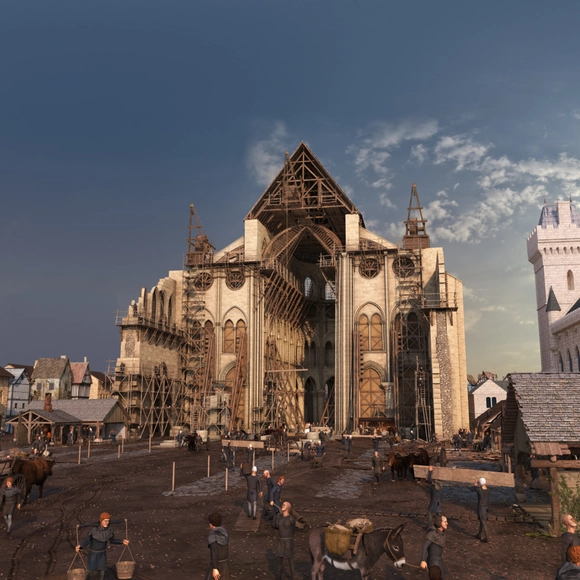
1180 - The Gothic Choir. Image Courtesy of Histovery
Ahead of the official reopening of Notre Dame de Paris, scheduled for December 8, a series of exhibitions are happening worldwide, aiming to use immersive technologies and augmented reality to bring to a wider audience both the restoration efforts and the wider story of the beloved monument. The event aims to present significant chapters of the history of the iconic structure, from its medieval origins to its witnessing of historical events such as the coronation of Napoleon or the marriage of Henri IV, the 19th-century restoration which added the spire designed by French architect Viollet-le-Duc, and the devastating 2019 fire.
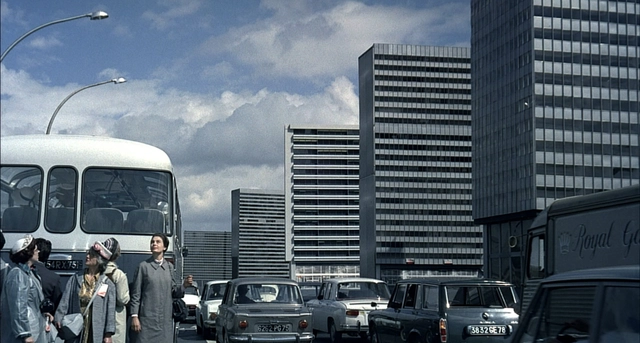
Playtime movie (Jaques Tati 1967) . Image via screenshot
Architecture criticism and journalism are often expected to announce "the good, the bad, and the ugly" in architecture and the built environment. Its purposes go however further than that. As Michael Sorkin put it, "seeing beyond the glittering novelty of form, it is criticism's role to assess and promote the positive effects architecture can bring to society and the wider world". In other words, by telling us what they are seeing, critics are also showing us where to look in order to identify and address the issues plaguing our built environment.
The field of architecture journalism has been led by female writers even in times when the pursuit of a career in architecture was discouraged and inaccessible for women. Ada Louise Huxtable established the profession of architecture journalism by holding the first full-time position of architecture critic at a general-interest American newspaper. In 1970, she also received the first-ever Pulitzer Prize for criticism. Esther McCoy started her career as a draughtswoman at an architecture office, yet, because of her gender, she was discouraged from training as a professional architect despite her ambitions to study the field. Through her writings, she managed to bring attention to the overlooked architectural scene of the American West Coast and advocate for the values of regional Modernism.
Carl Pruscha, an Austrian architect who mainly dedicated his professional career to investigating and working closely in the field of regional architecture in the Eastern world, a territory that was being overlooked at a time when the modern movement in architecture and in the rest of the world was booming. Through an overview of his life, we will highlight some of his most relevant works in Nepal and Sri Lanka and understand how Pruscha managed to stamp his unique visions of architecture and cities into his built projects.
The relationship between art and humanity dates back to the origins of civilization. Museums have become spaces where vast collections of art and artifacts narrate the history of time, humankind, cities, and countless stories about cultures and societies. Over the years, the museum's role has evolved, taking on different forms and scales, including the modern-day art gallery. The importance of art and culture in contemporary cities and neighborhoods is undeniable. However, galleries serve multiple roles in integrating art and culture into daily life. Why are these spaces valuable to communities? How do they support emerging artists? How can galleries revitalize neighborhoods?
The mayor of New York City, Eric Adams, along with the Future of Fifth Partnership, announced plans to transform Fifth Avenue, between Bryant Park and Central Park, into a pedestrian-centered boulevard. The project includes expanding sidewalks by 46%, reducing traffic lanes, improving pedestrian safety with shorter crosswalks, and adding greenery and lighting. The initiative begun with the Future of Fifth public-private partnership, which selected Arcadis, Sam Schwartz Engineering, and Field Operations to lead the design and study, and schematic design, scheduled to be completed by summer 2025.

For centuries, models have been central to architectural design, providing architects with a tangible way to explore ideas, test concepts, and communicate their vision. From the Renaissance to Modernism, models have been instrumental in the construction and reflection processes, offering insights into form, proportion, and spatial relationships. However, in today's digital age, where 3D modelsand Virtual Reality(VR) have become powerful and efficient tools, the question arises: Are physical models still relevant in contemporary architecture?

On the morning of September 11, 2001, two hijacked commercial jetliners struck the Twin Towers in Lower Manhattan, a third plane struck the Pentagon, and a fourth crashed in rural Pennsylvania. A total of 2.977 people were killed in the terrorist attacks. In the face of this unprecedented loss, the city of New York promised to rebuild Lower Manhattan as a lively neighborhood while honoring and maintaining the memory of this day. Thus began one of the largest reconstruction projects in New York City, a process that is still ongoing now, 23 years after the tragedy.
How have architecture and building design adapted to unforeseen future uses? As cities evolve, their needs for buildings inevitably change. Buildings may transition between cultural, commercial, industrial, and office functions depending on a city's identity and economic activity. In a world that is becoming increasingly dynamic and fast-paced, it's essential to consider the challenges static structures face when required to meet new demands. Cities have repurposed these static structures in ways not anticipated during their original design, with many successes in repurposing industrial buildings. Unlike structures designed with flexibility in mind, most manufacturing facilities were not initially intended for multiple uses. Yet, how have cities, communities, and occupants used these spaces, and what are the challenges of transforming a building’s existing uses?
The continuation of remote work practices has altered cities' bustling downtown areas along with the traditional office landscape, leaving behind many vacant spaces whose future purpose is a matter of speculation. Four years after the onset of hybrid working policies, office occupancy rates in urban centers remain lower than pre-pandemic levels, signaling a long-term shift in the work environment. Some developers have aimed to reposition these buildings while other are seeking alternative uses of vacant buildings in central location. While both approaches prove beneficial in their own ways, the potential for repurposing office buildings is vast and exciting. From residential living to cutting-edge research facilities, architects and developers explore diverse possibilities and challenges of transforming these underutilized structures into thriving new spaces.
The office building typology emerged from the need to unite thousands of people within a relatively strict working environment. In major cities, these structures clustered into Central Business Districts (CBDs), which became dedicated neighborhoods accommodating commerce and businesses. However, the COVID-19 pandemic disrupted this model, leading to the rise of remote and hybrid work. Now, nearly four years later, occupancy rates in these urban centers remain lower than pre-pandemic levels, signaling a long-term shift in the work environment. To address this challenge, developers have been increasingly looking into “repositioning” their projects, seeking to redefine their image by adapting them to contemporary demands. This typology considers the surrounding urban fabric, aiming to expand the building’s use beyond its original purpose and attract people back to the CBDs.
New York City’s skyline tells the tale of the region’s dated relationship with architectural innovation and style. Among the many materials that cloak the city’s built environment, terracotta has a distinct significance. The clay-based material was a prominent feature in buildings from the late 1800s to the 1920s and, after a brief pause, is experiencing a resurgence with contemporary design. The revival pays homage to The Big Apple’s architectural heritage while leading a movement for sustainable materials in the city.
A holistic approach to design and architecture becomes apparent when we delve into the work of NO ARCHITECTURE, an architectural practice based in New York, founded by Andrew Heid in 2014. The firm's portfolio and research showcase an integrative way of building, with projects demonstrating a close connection between the built environment and their immediate surroundings, whether in natural landscapes or urban contexts. Their programs emphasize flexibility, possibilities, and inclusion, prioritizing human well-being above all.
The U.S. has a long tradition of republicanism and laissez-faire capitalism that has not favored strong federal housing policy or intervention in the housing market. Policymakers have believed that private enterprise could best provide sufficient housing and that, as with healthcare and education,[1] government involvement would bring in “socialism” and undesirable control of the free market. There are two major exceptions to this tradition: the 1937 National Housing Act, a result of the devastation of the Great Depression, and the “war on poverty,” initiated by the Johnson administration in the mid-1960s.[2] Successful as these programs were, subsequent federal housing policy has mostly been aimed at undermining them, through either malice or neglect. Instead, federal policy has mainly sought to promote home ownership, the American dream, but that approach was eviscerated by the collapse of financing due to the subprime loan crisis and its aftermath. The result is that there is currently virtually no cogent federal housing policy. Thirty-five million Americans live in substandard housing; a much larger number devote 50% of their income to a roof over their heads. Housing construction is at a historic low, and construction costs have risen so high that they are well beyond the means of the average citizen.
On April 10, 2024, the New York Landmarks Conservancy bestowed the Preservation Leadership Award to author and urbanist Roberta Brandes Gratz. A longtime preservation activist, Gratz served on the City’s Landmarks Preservation Commission. She also led the successful effort to restore the Eldridge Street Synagogue, now the Museum at Eldridge Street. The following is a slightly edited version of the speech Gratz delivered at the 34th annual Lucy C. Moses Preservation Awards.
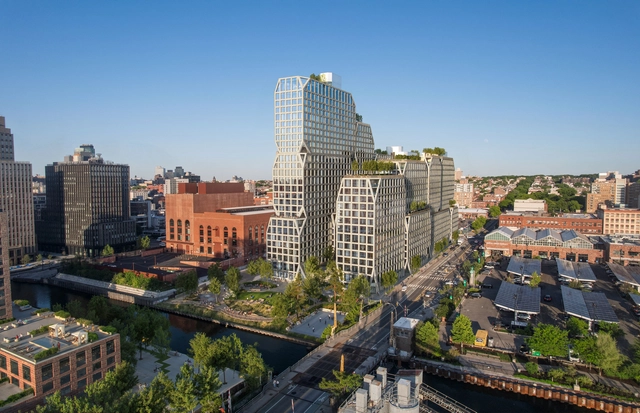
New York-based architecture office ODA has unveiled its design for Lorimer House and Copper Lofts, a development comprised of two residential buildings located in East Williamsburg in New York City. The design takes advantage of the triangular shape of the plot, employing rounded corners throughout the building to soften its image and create contextual references to its urban surroundings. Containing a total of 336 residential units, in addition to various amenities, the construction is slated for completion in 2024.