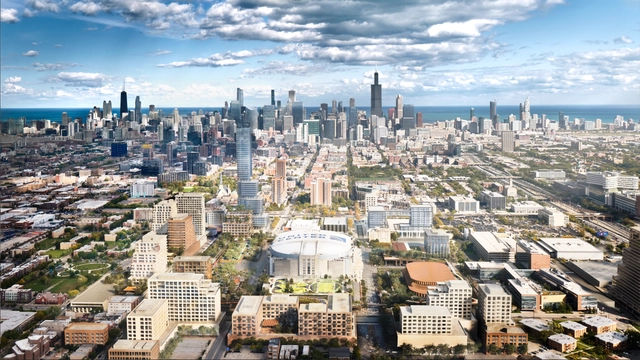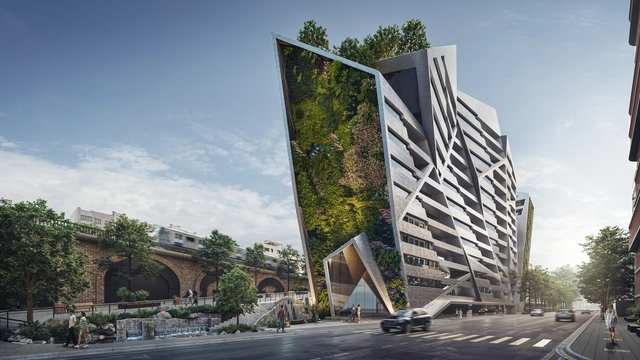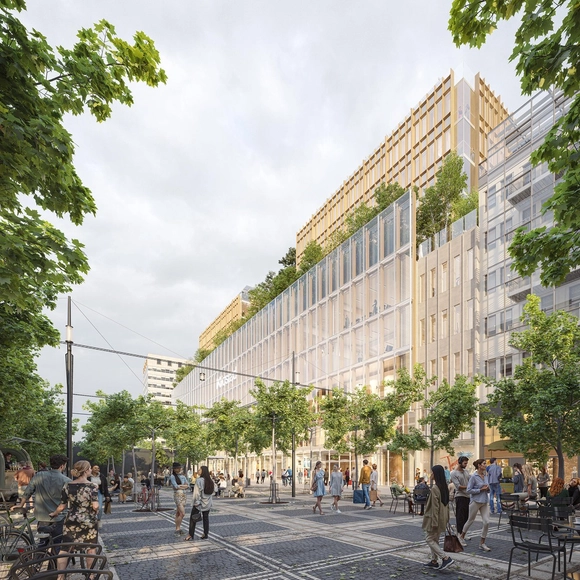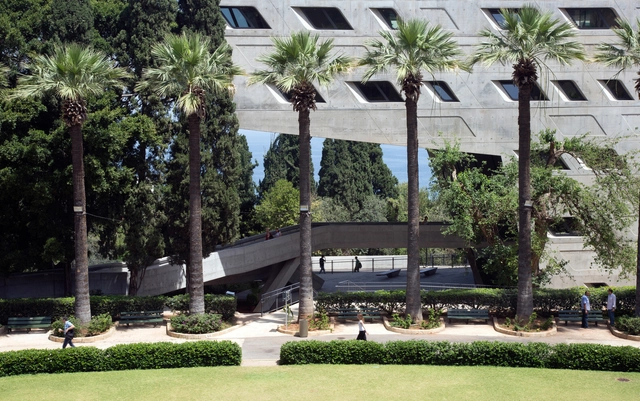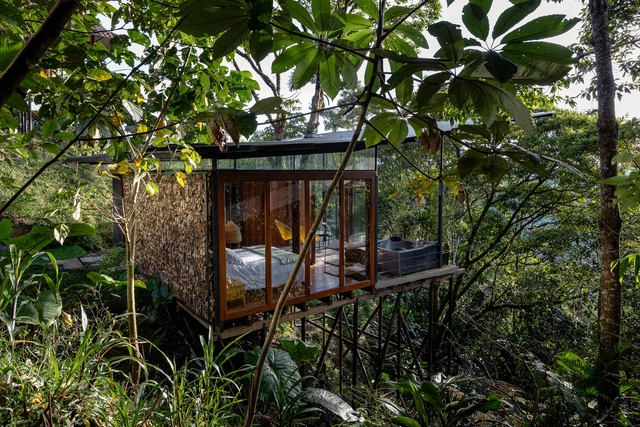
As part of a series of articles developed by Nikos A. Salingaros, David Brain, Andrés M. Duany, Michael W. Mehaffy, and Ernesto Philibert-Petit on the study of social housing in Latin America, this installment reviews examples of design strategies for its construction. Read all previous publications and the new article below.
https://www.archdaily.com/1121071/design-strategies-for-social-housing-in-latin-americaNikos A. Salingaros, David Brain, Andrés M. Duany, Michael W. Mehaffy & Ernesto Philibert-Petit
In an official statement issued on May 8, 2019, the Board of Directors of Real Madrid C.F. decided to award the contract for the remodeling of the Santiago Bernabéu stadium to FCC Construcción. The company is owned by one of the world's most prominent business magnates: Mexican billionaire Carlos Slim, who has been involved in major international projects such as the controversial New International Airport of Mexico.
The iconic ESSO building (now the CAR Building), designed by New Yorker Douglas Lathrop alongside Martínez Cárdenas, and the Pan American building (now the Teusacá building) by Colombian architect Germán Samper—both located across from Bogotá's National Park—are included in the "CAR- Universidad Libre" Partial Urban Renewal Plan, which proposes their demolition.
Design of the elevated park on Minhocão. Image: Prefeitura de São Paulo
The long-standing debate over the future of the João Goulart Overpass—the famous Minhocão, which cuts through downtown São Paulo toward the city's West Zone—has finally come to an end. Current mayor Bruno Covas has decided to transform the massive structure into an elevated park, modeled after several others around the world that followed the example of the High Line in New York City.
Photo: Chaval Brasil on Visual hunt / CC BY-NC-ND. Collage: ArchDaily
The terminology cultural property has several definitions. Found across various spheres and historical periods, the term has been gradually reshaped, with its application and meaning expanding and becoming more clearly defined over time.
Berlin subway station. Image: Tuomo Lindfors on Visual Hunt / CC BY-NC-SA
Berlin is a global leader in urban mobility, according to the Mobility Futures study by data and consulting firm Kantar, which evaluated major world cities. The German capital topped the mobility ranking due to several factors, most notably more cost-effective travel and easy access to a broad public transit infrastructure network and shared mobility services.
Índia painting a graffiti piece about the bond of motherhood (Personal Archive) / Credit: Personal archive
Anyone walking through São Paulo is already accustomed to the colorful walls scattered across the capital. Generally, the graffiti that colors the city's streets is signed by men, and rarely by women. However, this scenario is changing in the city's outskirts. More and more women are bringing art to the streets, balancing motherhood with graffiti.
https://www.archdaily.com/1121418/women-graffiti-artists-occupy-the-walls-of-sao-pauloDanielle Lobato, Erica Pacheko, Ira Romão e Priscila Gomes
Venice is undoubtedly one of the most sought-after destinations in Europe for travelers from around the world. The city boasts attractions in many areas, from gastronomy to art, and naturally, architecture—an art form deeply woven into the city's fabric, most prominently showcased at the Architecture Biennales, held since 1980. Beyond the Biennale, the island has much to offer those interested in exploring places that epitomize the relationship between past and present, the preservation of historical memory, and new technologies serving buildings in constant relation with the water.
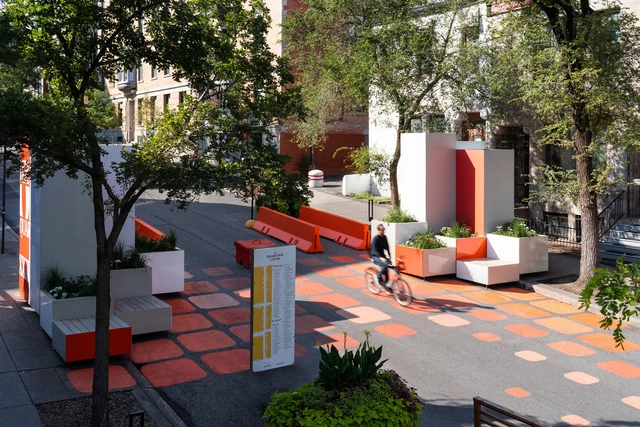
Among the various strategies for urban design and the occupation of public spaces, complete streets are perhaps currently the most prominent. They stem from a very simple idea: making street space truly public, in the broadest sense of the word. In other words, their goal is to provide transportation options and access to as many modes of transit as possible—walking, cycling, wheelchairs, public transportation, and private cars.
The environment affects behavior, just as behavior affects the environment. This is one of the core propositions of environmental psychology, a field that studies the interrelationship between human behavior and the surrounding environment, whether built or natural. If the environment has the power to influence our choices and habits, then it is possible to design it to encourage more sustainable choices. And complete streets offer a way to do just that.
To expand the Technical Assistance Network for Housing Improvements initiated in São Paulo during the Hands-on Program in Technical Assistance for Social Interest Housing (ATHIS), the non-governmental organization Soluções Urbanas is promoting the Technical Assistance for Housing Improvements Workshop across several Brazilian states. The workshop will be led by Architect and Urban Planner Mariana Estevão.
The City of São Paulo is launching a public consultation today, May 17, regarding the project for the park to be built over the Presidente João Goulart elevated highway—popularly known as the Minhocão—which was announced in February of this year. The new public space will span a section of approximately 900 meters between Praça Roosevelt and Largo do Arouche.
It is well known that our cities are increasingly saturated by automobile use; mobility has therefore become a key element in any discussion on urban living, particularly in large Brazilian cities. This premise prompts us to examine and better understand which aspects of urban commuting we can prioritize for intervention, moving toward approaches where car use is less necessary. An important step in this dialogue is understanding just how time-efficient cars actually are. Mapping Lab conducted a visual analysis of 27 Brazilian capital cities using data from the here.com platform.
Facade of the Justos Family Residence, in Downtown Ponta Grossa, built in 1950 by Miguel Juliano. Photo: Google Maps/Reproduction
The Municipal Council of Cultural Heritage of Ponta Grossa has denied the heritage-listing request for two of the last preserved modernist houses in the city. The properties are the 1948 Correia de Sá Family Residence, designed by João Vilanova Artigas, and the 1950 Justus Family Residence, designed by Miguel Juliano, an architect from Goiás who gained national prominence for his public works.
LED bulbs have become ubiquitous due to their low energy consumption, durability, and increasingly affordable prices. However, our need for illumination can work against us if we do not understand the effects of this type of light on the body.
While we have previously addressed light temperatures, warm and cool lighting, and the dangers of blue light regarding sleep cycles and eye strain, we must now also consider the phototoxicity of blue light.
Among the various programs within architectural and urban planning practice, projects for public spaces are perhaps those that most encourage professionals to build a rich narrative, drawing upon the multidisciplinarity inherent to the craft. Designing spaces destined for everyday public use and appropriation reflects how architects envision urban life, opening up a platform for collective dialogue on the subject.
São João Cemetery, Porto Alegre-RS. Image: Lívia Stumpf/Flickr. Via Caos Planejado
“The following day, no one died.” Thus begins the novel Death with Interruptions, by Nobel laureate José Saramago. In it, death suspends its services and, for a time, everyone remains alive in an imaginary country. This masterly metaphor conceived by the Portuguese author, already in his final pairs of shoes, serves as the foundation for discussing the dilemmas and conflicts of the end of life.
A house, likely from the 1950s, featuring a clothesline near a three-basin laundry sink, a bathroom with large tiles covered in rugs, and a kitchen filled with food. A middle-class family home in Barretos, in the interior of the state of São Paulo. This house stands as the protagonist in the narrative proposed by the series "Maria, José e menino" by São Paulo-based photographer Marina Schiesari.
Based on the 2010 Census, Nexo Jornal developed a series of maps of Brazil that reveal densely occupied and urbanized portions of the territory alongside others that are virtually uninhabited. For the study, the Brazilian Institute of Geography and Statistics (IBGE) divided the country into about 13 million squares of approximately 40,000 m² and counted the number of inhabitants in each.
The Lisbon Architecture Triennale has announced the Catalan practice Bonell+Dòriga, founded by the young architect duo Laura Bonell and Daniel López-Dòriga, as the winner of the third edition of the Début Award. The firm gained recognition for the work compiled on the platform A Series of Rooms, which presents an extensive, multidisciplinary study of domestic spaces and the archetypes of habitation.
Cortesia de Luiza de Souza Santos, Marcus Barbosa e Gabriel Thomé de Oliveira
The Brazilian student team, comprising Luiza de Souza Santos, Marcus Barbosa, and Gabriel Thomé de Oliveira from UFMG, was awarded an honorable mention in the SkyCity Challenge 2019 international competition, which aimed to "explore sustainable ways of living, working collectively, and having fun." Learn more about their proposal below.
Brazil currently has 167,060 active, registered architects and urban planners with the Council of Architecture and Urbanism. The majority, 63.10% (105,420), are women, while 36.90% (61,640) are men (61,400). In 2018, these percentages were 62% and 38%, respectively. This predominance is expected to grow in the coming years, as the share of female students is significantly higher: 67%.
Carolina Maria de Jesus, 1960. Documentary collection: Correio da Manhã. Image via Wikipedia
In this doctoral dissertation, architect and urban planner Gabriela Leandro Pereira explores the accounts and contested urban narratives of the writer Carolina Maria de Jesus, from Minas Gerais, Brazil. Carolina is one of the country's pioneering and most prominent Black female writers; her best-known work is the book Quarto de Despejo: Diário de Uma Favelada—the raw account of the harsh daily reality experienced by a Black woman, waste picker, and resident of the Canindé favela in São Paulo. Defended in 2015 at the Federal University of Bahia under the advisement of Professor Ana Maria Fernandes, PhD, the dissertation received the Rodrigo Simões Doctoral Dissertation Award from the National Association of Postgraduate Studies and Research in Urban and Regional Planning (ANPUR) in 2017. Read the abstract provided by the author below.
https://www.archdaily.com/1121419/body-discourse-and-territory-the-contested-city-in-the-folds-of-carolina-maria-de-jesuss-narrativePedro Vada
Featuring varied and flexible programs, cultural centers are public buildings that play a key role in promoting, as their name suggests, local culture. Designed to encourage daily and ongoing use by residents of a specific area, their architectural programs can be highly diverse, accommodating a library, cinema, auditorium, exhibition spaces, workshop rooms, and communal areas, among other facilities.