Nobody doubts that, in large measures, 20th century modernity has been brought to one’s living room by the media. Sure, toasters and mass-produced carpets have offered a sense of domestic modernity fostered by ever-more accessible technologies. But newspapers, the radio, and TV sets have delivered the sense that one was immersed in the long revolution happening outside. Drawing from popular media, Martha Rosler’s “House Beautiful: Bringing the War Home” series (1967-1972) gave this idea a poignant visual expression. If newspapers carried home modernity’s many conflicts and tensions, life-style magazines completed the picture with alluring visions of how to make yourself and your environment become “modern.”
When it comes to public space, many assume that while truly public space is always good, "privately owned public space" is always bad. However, in this article originally published by Metropolis Magazine as "A Plaza is No Guarantee of Democracy," NBBJ's Carl Yost argues that the distinction is not so binary. As architects, it's our job to smooth over the difference between the two, while we're at work - but most importantly while we're not.
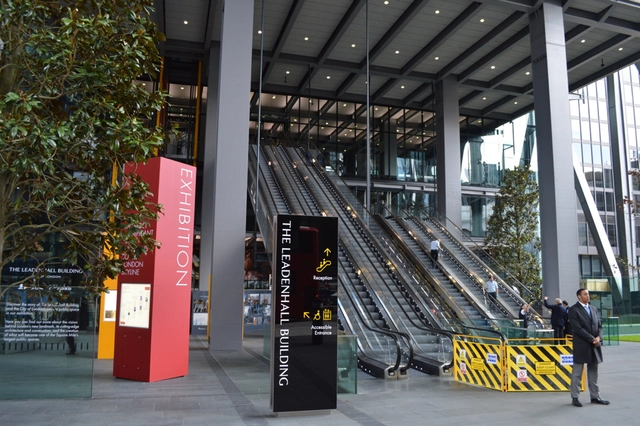
The past few months have seen the opening of high-profile projects with contested public space. The Leadenhall Building, London’s “Cheesegrater,” rises above a public plaza that the Financial Times called “problematic,” with “an astonishing array of defensive measures to make it clear that while it may be open to the public, it is still ours” (that is, the landlord’s). In New York, the World Trade Center plaza has taken fire from critics, both domestic and international, who chafe at restrictions on visitors’ behavior.
It evokes the debate over “privately owned public space,” or POPS, that arose during Occupy Wall Street, when protesters camped out in Zuccotti Park, a Lower Manhattan plaza that is privately owned by Brookfield Office Properties yet must remain open to the public. Many rightly pointed out the restrictions that POPS pose to free speech and assembly, when owners can evict people they consider unwelcome.
Every two years Audi hosts the Audi Urban Future Award (AUFA), which challenges cities from different parts of the world to investigate future mobility trends and come up with innovative solutions. This year AUFA selected Mexico City, Boston, Berlin and Seoul to participate in the challenge and respond to the question: how will data shape mobility in the megacities of the future? These four groups were asked to create a vision for how their city could use data in a strategic way, taking into consideration innovative energy solutions, sustainability, feasibility and the potential for their ideas to be implemented in other cities.
Mexico City’s team took home first place with their “operative system for urban mobility,” which centered around a data platform that cities can use to structure their urban traffic planning. Their system was also based around the idea that citizens themselves can become “data donors” and use the system to make informed decisions on how they move about the city. The team was comprised of architect and urbanist José Castillo, researcher Carlos Gershenson and the city government’s experimental lab “Laboratorio para la Ciudad.”
Learn more about the winning project after the break.
What does it take for a 22-year-old art school drop-out to start a lifelong professional relationship with "the greatest American architect of all time"? Originally published by Curbed as "How a 22-Year-Old Became Wright's Trusted Photographer," this article reveals that for Pedro E. Guerrero, it took some guts and a lot of luck - but once they were working together this unlikely pairing was a perfect match.
When Frank Lloyd Wright hired Pedro E. Guerrero to photograph Taliesin West in 1939, neither knew it would lead to one of the most important relationships in architectural history. Wright was 72 and had already been on the cover of Time for Fallingwater. Guerrero was a 22-year-old art school drop-out. Their first meeting was prompted by Guerrero's father, a sign painter who vaguely knew Wright from the neighborhood and hoped the architect would offer his son a job. Any job.
Young Guerrero had the chutzpah to introduce himself to the famous architect as a "photographer." In truth, he hadn't earned a nickel. "I had the world's worst portfolio, including a shot of a dead pelican," Guerrero said later. "But I also had nudes taken on the beach in Malibu. This seemed to capture Wright's interest."
In Brisbane, the largest research institute for medicine south of the equator, the Translational Research Institute (TRI), is transforming the world of medical research in part thanks to its new building by Wilson Architects and BVN Donovan Hill. Opened last year, the building has found success in the way it encourages chance encounters, offers a shaded breakout space for the neighboring hospital, and simply makes researchers feel like they "must be doing something important." In this article originally published by Metropolis Magazine as "In Brisbane, An Innovative Laboratory Complex Is Home to Pioneering Medical Research," Mikki Brammer explores how such a building can have such a powerful effect on the world of medicine.
It’s not often that the aspect of chance is considered a positive thing in the world of medicine, where the smallest error can determine life or death. But at the Translational Research Institute (TRI) in Brisbane, Australia, chance encounters are leading to lifesaving discoveries.
With the number of officially “tall” buildings — at least 656 feet (200 meters) — doubling over the next ten years, and the number of “megatall” buildings — at least 1,969 feet (600 meters) — expected to jump from two to 10 by 2020, building construction around the world is literally reaching new heights.
Indeed, next year alone 10 new skyscrapers of at least 1,110 feet (338 meters) will be completed. They are 2015's tallest buildings…
ArchDaily is continuing our partnership with The Architectural Review, bringing you short introductions to the themes of the magazine’s monthly editions. In this editorial from AR’s November 2014 issue, AR Editor Catherine Slessor uses the opening of Frank Gehry's Fondation Louis Vuitton as occasion to examine the split that has developed within the architectural profession, musing "On how architecture can be either manifestation of vanity or source of social transformation."
One of the most depressing illustrations of how far architecture has lost its grip on reality is Frank Gehry’s new handbag. Along with other selected ‘iconoclasts’ from the world of fashion, art and design, Gehry was tasked by French luxury goods purveyor Louis Vuitton to design a bespoke limited edition ‘piece’. Gehry’s new Fondation Louis Vuitton has just opened in Paris and he is the man of the hour, so it seems obvious that after designing a monumental repository for contemporary art, he should turn his hand to the trifling matter of a fashion accessory. The handbag is yours for £2490. The art museum is yours for around £100 million, though some speculate that it cost much, much more.
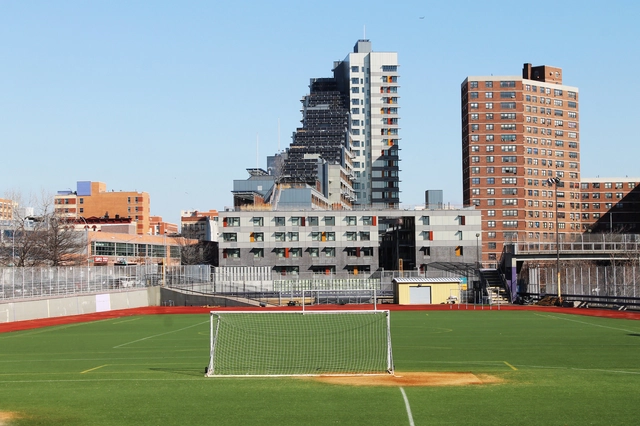
Two years after the completion of Grimshaw and Dattner's acclaimed Via Verde ("Green Way"), no successors have even been proposed for this supposed model for the design and construction of new affordable housing. In this article, David Bench returns to the site, finding that the sustainable project's lack of impact is caused by a completely different type of "green."
Affordable housing is the quest of every New Yorker. The routes to finding it are mysterious and widely misunderstood, as they are made up of a myriad of buildings, programmes, and rules that have failed to keep pace with the production of luxury housing and gentrification of middle class neighbourhoods in the city. This apartment anxiety has led to such amusing and fateful reactions as the creation of the Rent is Too Damn High political party – whose name speaks for itself – and an economic narrative that propelled Bill de Blasio from a long-shot mayoral candidacy to an overwhelming majority on election day in 2013. Soon after taking office, de Blasio unveiled the most ambitious affordable housing program in generations, which aims to build or preserve 200,000 units in the next decade.
It's not often that a major design project by a bevy of superstar architects is forgotten to history. But this seems to be what happened in the 1980s, when Italian designer Cleto Munari commissioned a stable of world-famous architects to design a new jewelry collection. The (unashamedly PoMo) results were documented in a now almost forgotten book by Barbara Radice called simply "Jewelry By Architects," which included interviews with each designer. Originally published by Monica Khemsurov of Sight Unseen, this article shows off just some of the contents of this fascinating work.
Until about six months ago, there was only one Munari we idolized: Bruno, one of our favorite 20th-century designers and design theorists. (If you haven’t read Design As Art, we suggest you hop to it!) But then, one fateful day this past spring, we were wandering aimlessly around the internet when we stumbled upon the biggest editorial coup we've scored in years, and thus began our love affair with Cleto Munari. The Italian designer—who, as far as we can tell, is unrelated to Bruno—commissioned a dream-team of architects like Ettore Sottsass and Peter Eisenman in the early ’80s to create a jewelry collection for his eponymous company, and the project had almost no coverage anywhere on the web. After immediately snapping up a copy of the incredible out-of-print book that documented it, which we’re excerpting a small portion of here, we set about doing more research on Munari himself. Turns out he’s a bit of a Sight Unseen patron saint, who dreamed up all kinds of cross-disciplinary projects for the precious metals–focused design brand he founded in the ’70s with Carlo Scarpa. “It is most interesting to me to have a poet design a table, a painter design a credenza, and an architect design a spoon,” Munari told the Huffington Post in an interview two years ago.
ArchDaily is continuing our partnership with The Architectural Review, bringing you short introductions to the themes of the magazine’s monthly editions. In this post, we take a look at AR’s October 2014 issue which, inspired by URBED's Wolfson Prize-winning design, features a look at Garden Cities. Here, AR Editor Catherine Slessor questions whether Garden Cities could be the solution for what is fast becoming one of Britain's most potent political problems, asking “Could Howard’s Garden City and Rudlin’s winning proposal for the Wolfson Prize give crucial hints to come out of the housing crisis?
Every town-planning module for architecture students begins (and possibly ends) with the Garden City. Yet though Ebenezer Howard’s famous ‘Three Magnets’ diagram is now 116 years old, the notion of combining the better attributes of town and country in a socially reformed, neatly zoned, quasi Utopian city-on-the-hill still has a pervasive appeal. In Howard’s original vision there was room for all, even an insane asylum and ‘home for inebriates’ strategically corralled in a green belt between the city centre and an outer rim of allotments.
The Urban Implications of Living With Water, a recent report by the Urban Land Institute (ULI) Boston, opens with the clear assertion: "We are beginning to feel the effects of climate change." The result of a conversation amongst over seventy experts from the fields of architecture, engineering, public policy, real estate and more, the report covers the proposed integrated solutions for a future of living in a city that proactively meets the challenges accompanying rising water levels.
"We accept that the seas are rising, the weather is changing, and our communities are at risk; and we recognize that no solution can be all-encompassing. It is our hope that this report will spark conversation, shift our understanding of what is possible, and aid us in reframing challenges into opportunities as we move toward this new era of development."
Become part of the discussion and read more about the collective ideas, after the break.
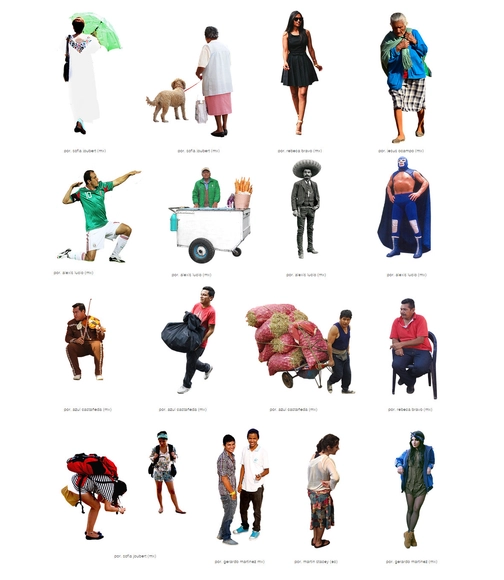
Tired of seeing Nordic families in representations of Colombian markets and New York hipsters drinking coffee in Mexican cultural centers, a group of self-described “young latinos” have created Escalalatina, a collection of high-resolution images of “people on the road to development” to be used for renderings.
Inspired by Teodor Javanaud Emdén's SKALGUBBAR - a virtual library of people for renders - Escalatina aims to provide a way for Latin American architects to fill their renders with images of local people.
All of the images are available in .png format and users can also submit their own images for the site as well.
Check out some of the Escalalatina images after the break.
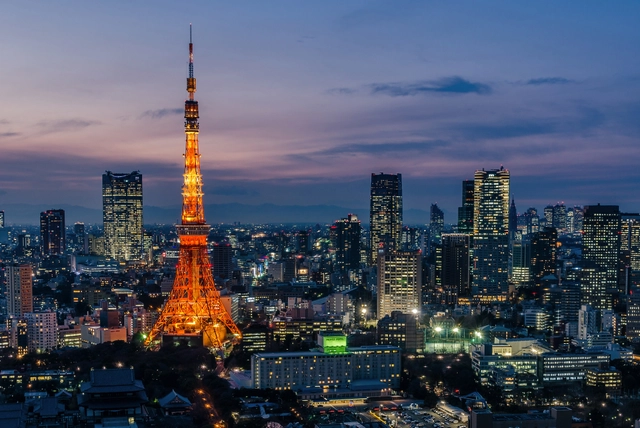
If you read a lot of articles about cities and urbanism, you're probably familiar with the words "half of the world's population now lives in cities." For a number of years, these words have been frequently used in the opening sentences of articles, hoping to convince readers in just a few seconds of the importance of the subject at hand. In fact, according to the World Health Organization these words are no longer even true: in 2014 the urban portion of the world's population has already reached 54%. In other words, every nine months the world adds enough new urbanites to fill a city the size of Tokyo, with an increase of nearly 300 million new urban dwellers since we reached the tipping-point in 2008.
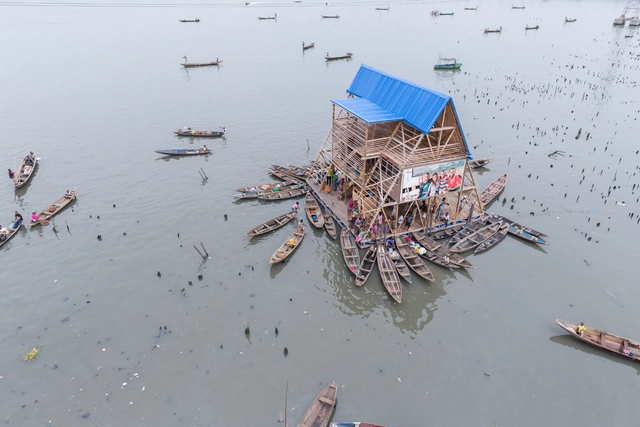
Kunlé Adeyemi, the 38 year-old former disciple of Rem Koolhaas, made headlines last year with his Makoko Floating School, which enabled better access to education a slum community in Lagos. In this profile of Adeyemi and his Practice NLÉ Architects, originally published by Metropolis Magazine, Avinash Rajagopal explores what drives the young architect, explaining why he was selected as one of 10 designers in Metropolis Magazine's 2014 New Talent list.
When the Makoko Floating School was completed in March 2013, it received wildly enthusiastic critical acclaim from the international news media. The simple A-frame structure, buoyed by recycled plastic barrels in a lagoon in Lagos, Nigeria, was designed by NLÉ, a Lagos- and Amsterdam-based studio founded by the architect Kunlé Adeyemi. The project, intended as a model for how Lagos’s floating community could build simple, sustainable structures for themselves, subsequently faced a few challenges. One of the biggest was winning over local officials, who simply did not know what to make of such a building.
Few of the architectural principles developed in the 20th century have been as widely accepted as the curtain wall, with the technology going from an implied feature of Le Corbusier's Five Points of Architecture to the go-to facade treatment of architects worldwide. In this article, originally published on Australian Design Review as "Invisible Cities - The Last Remnant of Modernism," Annabel Koeck argues that the curtain wall, initially prized for its glassy transparency, is now making buildings and even entire cities invisible thanks to its sheer ubiquity - at the expense of architectural expression.
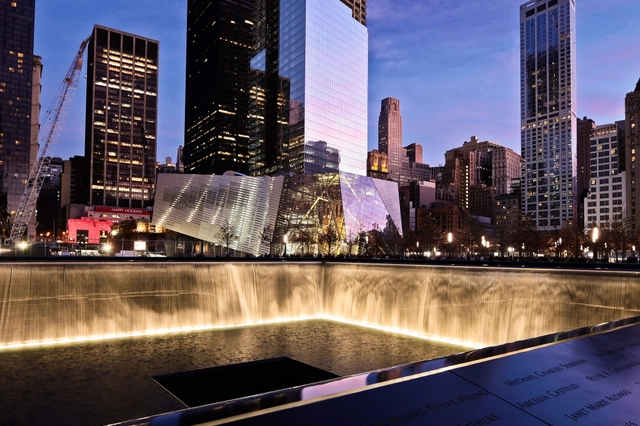
Norwegian architects Snøhetta, based between Oslo and New York, designed the glass structure for the The National September 11 Memorial entry pavilion, which appears camouflaged against the backdrop of neighbouring glass curtain walls that define the New York skyline. Admittedly, Snøhetta’s pavilion was conceived by a very different brief, one defined by timidity and subtlety; yet paradoxically it was the curtain wall that facilitated this. Looking over the South Pool towards an array of glazed elevations that dominate the skyline it is ironic that a Modernist technique – the curtain wall – could now spell the end for architectural diversity in cities.
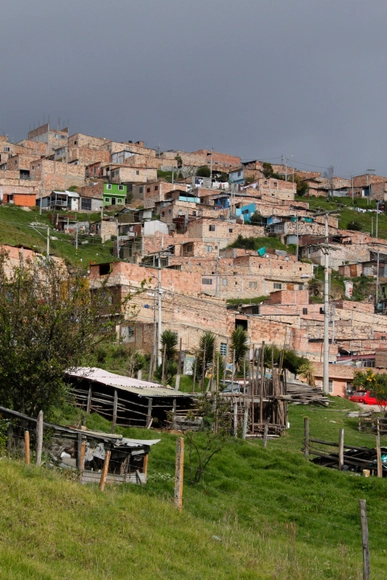
Perched behind the fog that conceals Bogotá’s mountains is William Oquendo’s house. It is a labyrinth of doors and windows, wherein a bedroom opens into the kitchen and a bathroom vents out into the living room.
Five thousand 5,000 kilometers away in Rio de Janeiro, Gilson Fumaça lives on the terrace level of a three-story house built by his grandfather, his father, and now himself. It’s sturdy; made out of brick and mortar on the ground floor, concrete on the second, and a haphazard combination of zinc roof tiles and loose bricks on the third. The last is Gilson’s contribution, which he will improve as his income level rises.
On the other side of the world in Bombay (Mumbai since 1995), houses encroach on the railway tracks, built and rebuilt after innumerable demolition efforts. “The physical landscape of the city is in perpetual motion,” Suketu Mehta observes in ‘Maximum City.’ Shacks are built out of bamboo sticks and plastic bags; families live on sidewalks and under flyovers in precarious homes constructed with their hands. And while Dharavi—reportedly the largest slum in Asia—has better quality housing, running water, electricity and secure land tenure, this is not the case for most of the new migrants into the city.
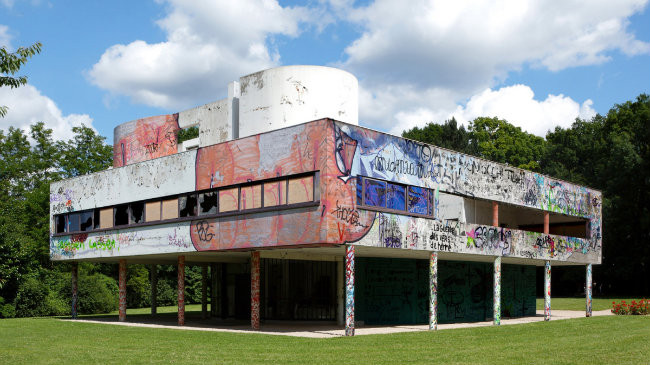
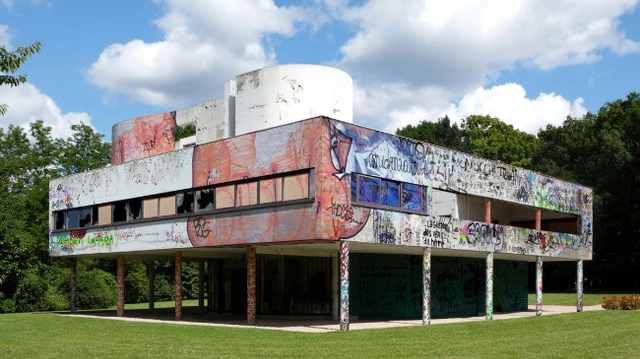
These images from artist Xavier Delory show Le Corbusier's celebrated Villa Sovoye in a shocking state of disrepair. With stones and spray paint, vandals have tragically defaced its pristine walls and windows. Don't panic: the images shown here are photoshopped. But what if they weren't? In this article originally published by Metropolis Magazine as "Modernism in Ruins: Artist "Vandalizes" a Le Corbusier Masterpiece," AJ Artemel explores how our shock and dismay at such images exposes an underlying hypocrisy in our reverence for famous modernist works, and proposes that perhaps Modernism and vandalism are more closely related than we thought.
















.jpg?1413464890 "© Xavier Delory")