Videos
Courtesy of TRANSFER Architecture Video Award 2023
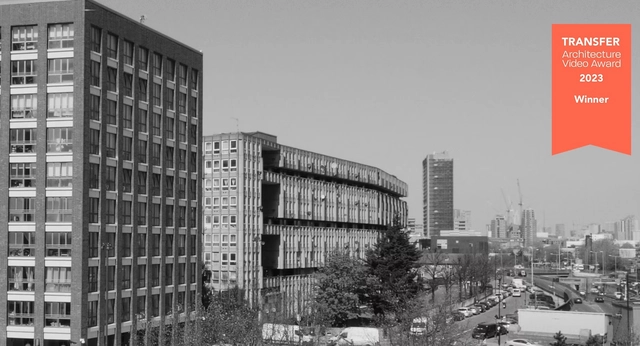
TRANSFER Architecture Video Award 2023 has just announced the winners of this year's edition of the innovative architecture short film competition. Due to the high quality and the diversity of the entries, the jury has decided to award 4 winners ex aequo and 2 honorable mentions.
The TRANSFER Architecture Video Award 2023 ceremony took place on February 22 in Lausanne, as part of the film festival Écrans Urbains. You can discover thewinning, finalist, and shortlisted videosinTRANSFER.
As the final segment of the One World Trade Center was hoisted into position – topping the structure out at a patriotic 1,776 feet – Curbed NY captured its journey via a small Go-Pro camera to reveal its fascinating, and somewhat nauseating, view of Manhattan.
While the US rejoices this monumental feat, a debate amongst architects, engineers and city officials lingers on whether or not the 408-foot spire will count towards the One WTC’s overall height and allow it to officially claim its title as the tallest building in the Western Hemisphere. Although the Port Authority argues that the spire doubled as a radio antenna is considered as non-essential telecom equipment and therefore should not be considered as part of the “architectural top”, the Council on Tall Buildings and Urban Habitat will make the final call in October.
modeLab‘s videos from both Introduction to Processing and Algorithmic Design in Grasshopper webinars are now posted online. The Introduction to Processing webinar covered the basics of writing programs in Processing’s Java-based syntax as well as developing user influenced behaviors. The Algorithmic Design in Grasshopper webinar focused on creating algorithms using lists and transformations in Grasshopper. To view these videos, and all 10 courses they launched last year, which is comprised of 125 videos, please visit here.
New York’s Garment District, consisting of 18 blocks in the west side of midtown, was the city’s most well known industries in the boom of the 1920s through the early 50s. The influx of immigrants and the geography of New York City made it a natural hub for manufacturing and trading activity. The work began in small workshops and at home in crowded tenements and eventually grew out of these crammed space into factories and warehouses. The industry inadvertently transformed Seventh Avenue into rows of skyscraper factories that faithfully abided to New York City’s zoning regulations. The 125 loft buildings all shared the pyramidal forms due to step-back laws governing design.
Now, The Skyscraper Museum in New York City is celebrating this neighborhood and its influential development of business, industry and architecture and the mark that it left on the city with an exhibition called URBAN FABRIC. It is curated by Andrew S Dolkart, the Director of the Historic Preservation Program, and will be running through February 17th.
Learn more and watch the curator’s lecture after the break.
A small group of students and architect Tobias Holler of sLAB Costa Rica at the New York Institute of Technology, have teamed up to design and build a communal recycling center for Nosara, Costa Rica – a city that is facing grave problems with sanitation and illegal dumping of garbage on beaches and in wildlife areas. Construction started last summer after a Kickstarter campaign that raised $15,000 helped provide expenses and costs associated with housing the students that assisted with the construction. A relaunch of the Kickstarter campaign will provide the project with additional funds to bring the students back to accelerate the pace of construction. The funds also support the documentary by Ayana de Vos, whose film follows the progress of the project and features waste management and sustainability in Costa Rica.
Join us after the break for more.
The motivation behind building a Communal Recycling Center is based in the severe problems that Nosara specifically, and Costa Rica in general, has in municipal waste management. Without appropriate infrastructure and policies, over 1400 tons of waste is deposited into unregulated dumps daily. A lot of the garbage makes its way into rivers and forests, pollutes ground water, threatens the health of local communities and destroys wildlife.
Chika Kijima Architect’s Office + O.F.D.A. transformed a cluster of three existing homes into this work/live haven for a pair of musicians. The naturally lit interiors of the single-story Overlapped House features a studio, kitchen, hall, ample amounts of storage and a well-buffered sleeping quarters.
This interview with professor and author Tom Fisher, Dean of University of Minnesota, is part of a documentary series called “Things May Happen”, in which he describes the dangers of Fracture-Critical Design. This topic is also the subject of his recent book, Designing to Avoid Disaster: The Nature of Fracture-Critical Design. Fisher discusses examples in which our systems, whether they be architectural, structural or even social and financial, fail with disastrous consequences. In a TEDxUMN talk at the University of Minnesota, Fisher spoke about the 1-35W bridge collapse in Minneapolis in 2007, the failure of New Orleans’ levees during Hurricane Katrina, the BP Oil Spill on the Gulf Coast, the Wall Street investment bank failures, the housing foreclosure crisis and now the destruction wrought by Hurricane Sandy. Covering a whole spectrum of “when things go wrong” scenarios, Fisher illuminates the failed foresight in designing systems that are resilient to disaster.
Sunny & Mild Media presents Part 2 of its Googie Architecture Series, presenting design work at the cusp of technological innovations of the 1950s. Emerging out of an obsession with the fast new world of cars, planes and rockets, Googie Architecture became an ultramodern style that sought to encapsulate the spirit of the 21st century. The new forms – sweeping, cantilevered roofs, starbursts, and flowing forms – became a form of advertisement that caught the attention of motorists, for its vibrance along the stretches of highways and for its distinctive style.
This installment features a closer look at the diners and restaurants that thrived in the ’50s and were designed with the Googie style. Even the one of the first McDonald’s restaurants adapted the style to work with its logo. Many of these buildings stand in ruin now, but the style was used in all kinds of building typologies – most of which emphasized the car: drive-thru’s, drive-in’s, car washes, diners, and gas stations. Even Las Vegas, and our associations with the its architecture today, are a reflection of that style.
Who will run the world for the next 100 years? Envision Solar President and CEO Desmond Wheatley argues that it will be whoever has abundant sources of power. That is constructive power, rather than destructive power, which is essential to run the information and technology industries that our world is entirely dependent on. Additionally, Wheatley states that energy equals water. And, with less than 1% of the world’s fresh water available for use, desalination is becoming an increasingly plausible solution. The only problem now is that energy is expensive. But, once cities have the will to switch over to renewables, that will no longer be an issue. Could you imagine San Diego as an net exporter of water? Desmond Wheatley can.
Biology student turn architect, Doris Kim Sung has dedicated her studies to the infinite possibilities of thermobimetals, smart materials that respond dynamically to temperature change. As tested with DO|SU Studio Architecture’s recent installation “Bloom”, whose surface is completely fabricated with thermobimetal, these smart materials are capable of relieving our dependence on energy-inefficient mechanical systems with their self-shading and self-ventilating properties.
Imagine a building skin capable of maintaining thermal comfort in an environmentally responsible and cost effective way by responsively mimicking the characteristics of human skin.