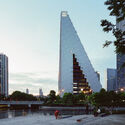
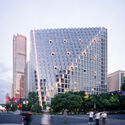
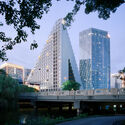
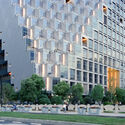
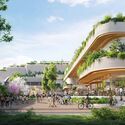
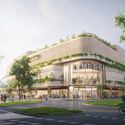
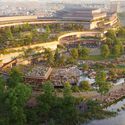
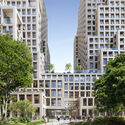
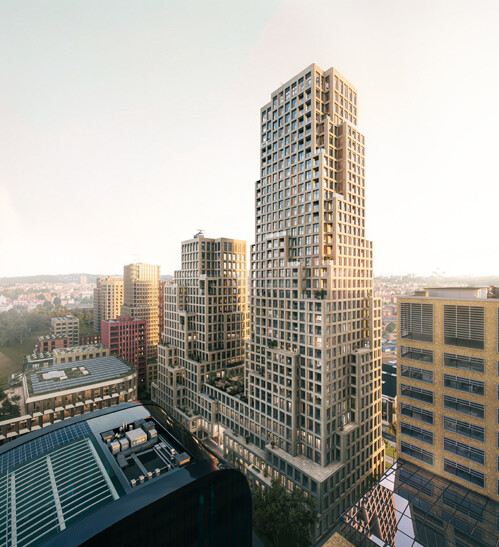
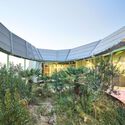
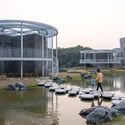
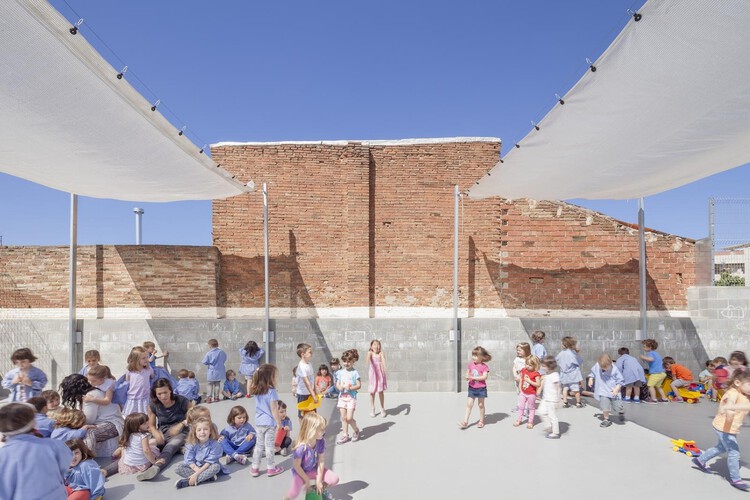
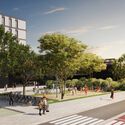
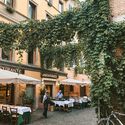
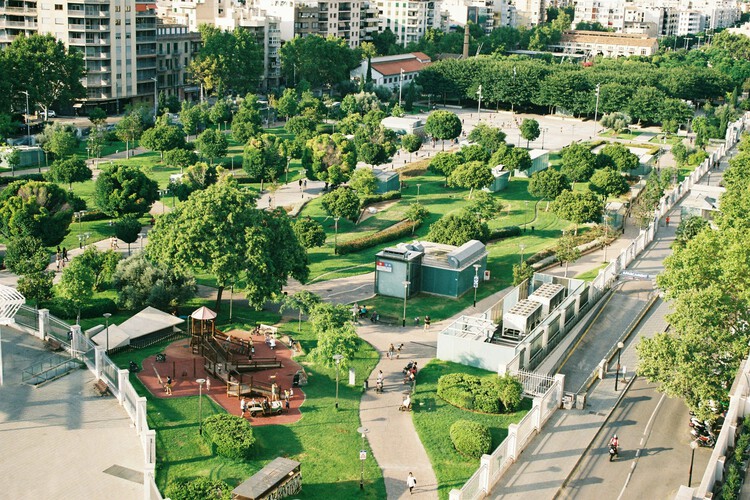
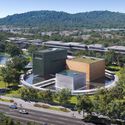
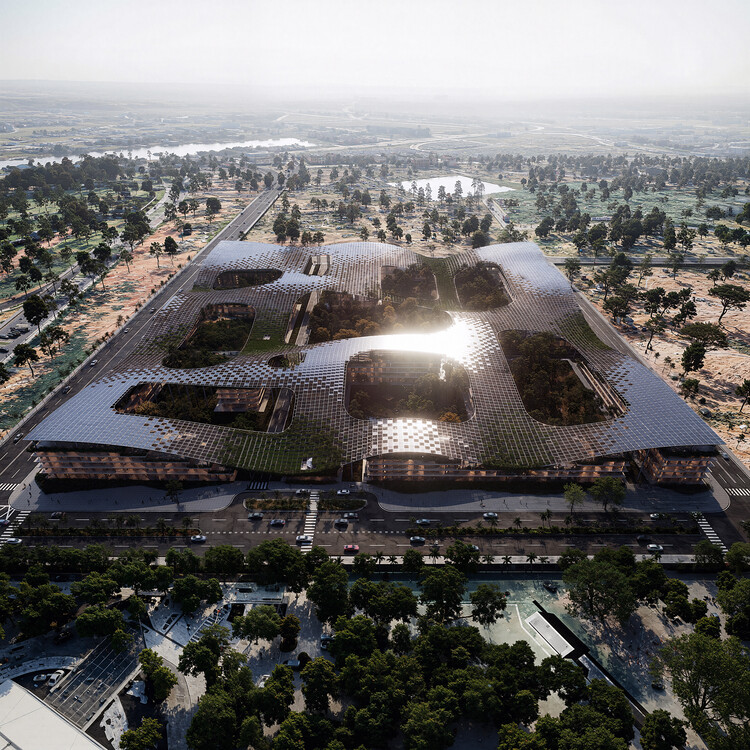
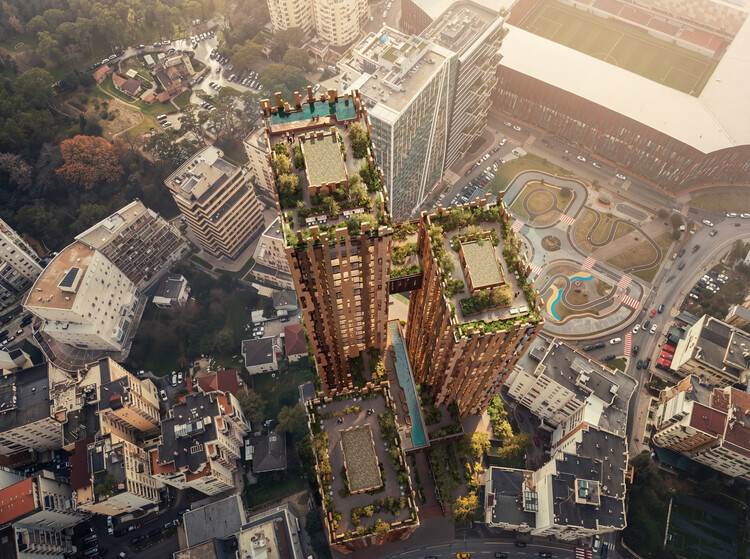
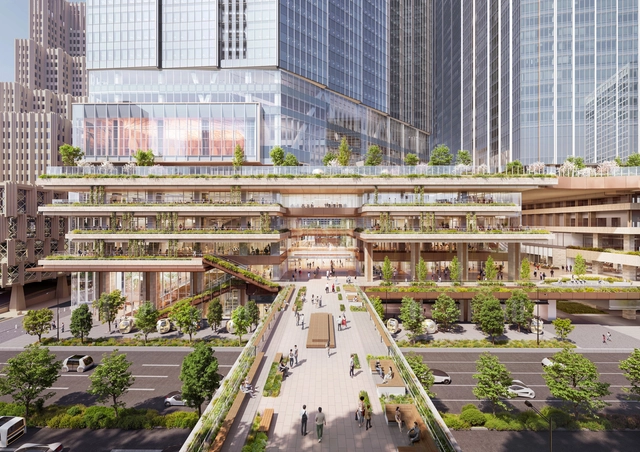
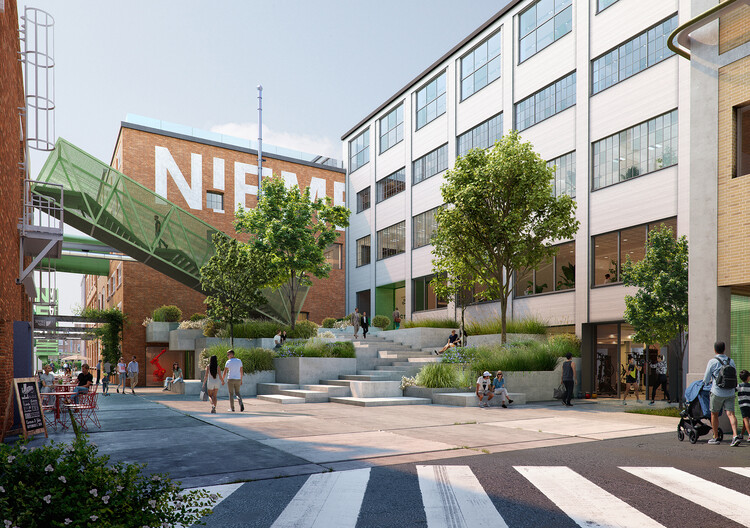
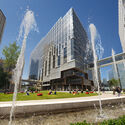
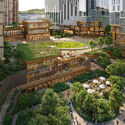
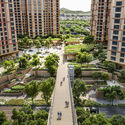
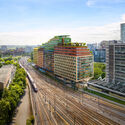
UNS has revealed images of SeoulOne, a master plan designed for Hyundai Development Company (HDC) in Seoul, South Korea, intended as a new model for multigenerational living. The project, already under construction on a brownfield site in the northeast of the city, reimagines an existing industrial site and railway area as a 405,000 m² car-free neighborhood for a multigenerational community. A never-sleeping, green master plan for Seoul, SeoulOne is envisioned as a mixed-use mini-city where all essential services for people of all ages are available within a 10-minute walk. The design includes 24/7 residential towers, retail spaces, offices, a hotel, sports facilities, daycare centers, senior living facilities, and a medical center, offering permanent services within walking distance. More than 30% of the site is dedicated to vegetation, including pocket parks, roof gardens, water gardens, and a forest walk, creating a year-round green village.
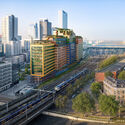
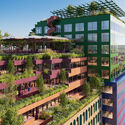
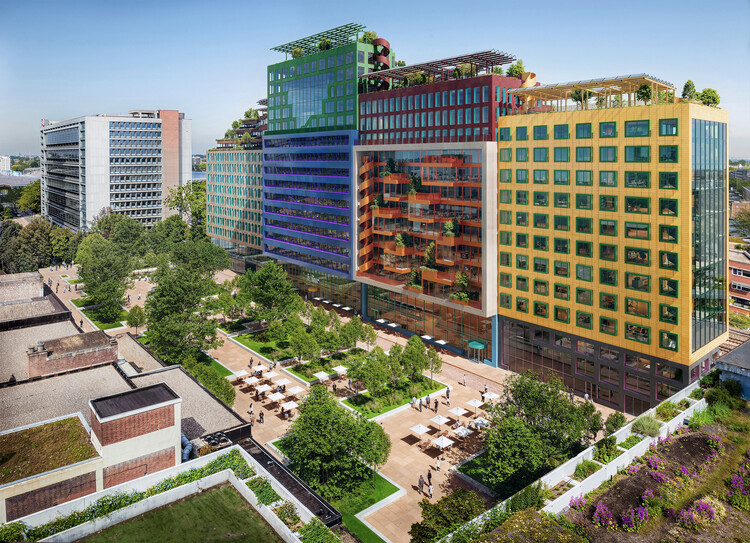
MVRDV and SYNRG have received approval to construct Schieblocks, a 47,000-square-metre office building in Rotterdam, the Netherlands. Designed for developer LSI, who markets the project as The Bluezone Offices, the building will occupy a narrow site along the railway line, reaching 61 metres in height and extending almost 150 metres in length. The programme includes commercial spaces at ground level, offices throughout, and a restaurant and event venue on the upper floors. Conceived as a "3D neighbourhood," the design breaks the large volume into a series of colourful, distinct blocks that incorporate numerous references to Rotterdam's architectural character.

Founded in Winnipeg, Manitoba, in 2007 by Johanna Hurme and Sasa Radulovic, and shortly afterward joined by its third partner, Colin Neufeld, 5468796 Architecture was established as an architecture firm whose early work explored the current state of housing in North America. The Canadian studio operates as a collaborative group of approximately 20 designers, where they prioritize the collective value of ideas over individual authorship.
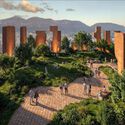
Ciudad Cayalá, a privately developed, mixed-use community on the outskirts of Guatemala City, is often described as a "theme park" of white lime-washed walls, red tiles, and cobbled plazas. A closer examination, however, reveals a more complex urban narrative. Its significance, however, lies in its capacity to create a safe and well-managed public space, proposing a modern reinterpretation of historic urban principles that mark the region's architectural and urban heritage. Behind the Antigua-style façades lies an urban experiment: a modern re-engagement with architectural elements like arcades, courtyards, and open plazas, which propose a privately-managed public space as a solution to urban challenges in the region.
Hudson's Detroit mixed-used development. Aerial view. Image Courtesy of Bedrock
Detroit-based Bedrock development group has announced the completion of the first phase of its Hudson's Detroit mixed-use project in the city center. The project was first unveiled in 2017, when the company presented plans for a 1.2-million-square-foot development designed by SHoP Architects to be built on one of downtown Detroit's long-abandoned sites, formerly occupied by the J.L. Hudson's Department Store. Once the tallest department store in the world and a central gathering place for the city throughout much of the 20th century, the site has now been reimagined as a contemporary urban destination. After nearly a decade of planning and construction, Hudson's Detroit aims to bring new activity and public space to a location emblematic of the city's commercial and cultural past.
Areal am Kronenrain / MONO Architekten. Image Courtesy of Gregor Schmidt
Marginalized in architectural discourse and often dismissed as purely functional, parking garages remain among the most ubiquitous structures in the urban landscape. Designed to accommodate the needs of private vehicles, they occupy central locations, shape skylines, and consume considerable resources, yet rarely receive the same attention — or architectural care — as cultural institutions, schools, or housing. Despite their prevalence, these buildings tend to fade into the background of daily life, treated as infrastructural necessities rather than as design opportunities.
This is beginning to change. As urban mobility undergoes profound transformations — from the decline of car ownership to the rise of electric vehicles and shared transport systems — the role of parking infrastructure is being redefined. Architects and planners are reimagining garages as adaptable frameworks that integrate public space, ecological functions, and mixed-use programs. These new approaches challenge the perception of parking as a residual typology and instead position it as a civic structure with the potential to support more inclusive, flexible, and sustainable urban models.
IOTA Seoul I mixed-use development. Render. Image Courtesy of Foster + Partners
Foster + Partners has released images of the proposed design for IOTA Seoul I, a mixed-use development in Seoul, South Korea. The project would be located between Seoul Station and Namsan, a 270-meter-high peak in the Jung-gu district in the south-central part of the city. The site has been described by the architects as a landmark location due to its historical significance as one of Seoul's gateways for travelers arriving by train.
In December 2016, BIG unveiled the first images of a concrete superstructure for Los Angeles' Arts District. The project, a mixed-use complex called 670 Mesquit, was originally projected to cover 2.6 million square feet (242,000 square meters) and include office space, residential units, and two hotels, marking BIG's first project in Los Angeles. In July 2025, nearly nine years after the original proposal, the Los Angeles City Council approved the project to be eventually built in multiple phases.
Foster + Partners has completed the modernization of Manchester United's men's first team building at the Carrington Training Complex. The project rethinks the 1999 structure to create a high-performance, collaborative environment for players and staff, integrating new facilities while retaining much of the original building's structure. The refurbishment introduces large windows and rooflights to bring natural light deep into the floor plate, complemented by timber panelling that adds warmth and a sense of permanence. Integrated MEP systems improve the building's operational performance, energy efficiency, and overall user experience.
Foster + Partners' Central Crossing, Hong Kong. Image Courtesy of Foster + Partner
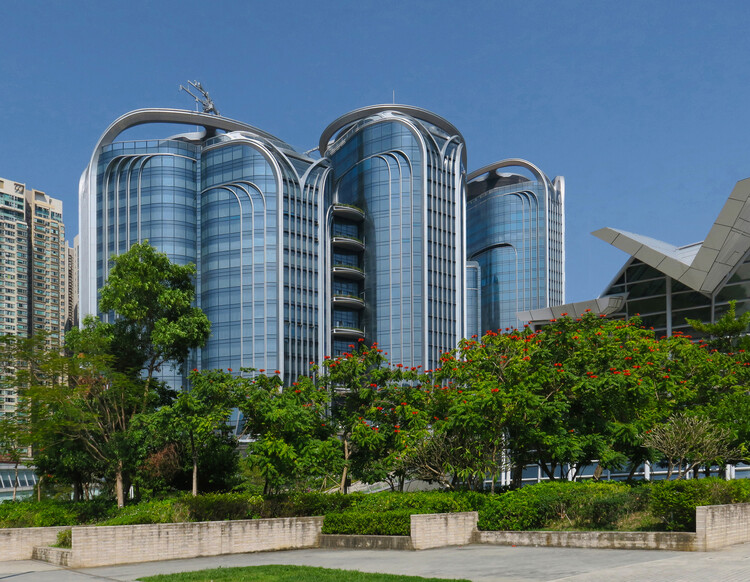
Foster + Partners has unveiled designs for Central Crossing, a new mixed-use development in the heart of Hong Kong's Central district. Located at 118 Wellington Street and bordered by Graham, Gage, and Cochrane Streets, the project is a joint venture between Wing Tai Properties Limited and CSI Properties Limited. Positioned within a triangle formed by the historiclandmarks Tai Kwun, PMQ, and Central Market, the site offers a rare opportunity to build within one of the city's most vibrant and historically layered neighborhoods. Central Crossing continues Foster + Partners' ongoing engagement with historical contexts, following earlier interventions such as the Carré d'Art in Nîmes and the extension to the Royal Academy in London. The project seeks to balance sensitivity to its urban fabric with an architectural presence, contributing to the evolving identity of Central.
District 11 in Sharjah, UAE. Exterior render. Image Courtesy of HWKN
Architecture firm HWKN has been commissioned by Al Marwan Real Estate Development to design eleven distinct buildings for a new commercial neighborhood in central Sharjah, the third most populous city in the United Arab Emirates. The district, featuring offices, retail spaces, cafés, childcare and healthcare facilities, specialized institutes, and a mosque, has been fully researched, conceptualized, and planned using Artificial Intelligence (AI).
Lincoln Center for the Performing Arts, Inc. has revealed the design for the Amsterdam Avenue side of its campus, developed by Hood Design Studio, Weiss/Manfredi Architecture/Landscape/Urbanism, and Moody Nolan. Recently released renderings illustrate a transformation that includes a new outdoor performance venue, expanded community park spaces, and the removal of the existing wall along Amsterdam Avenue. In response to long-standing calls from both Lincoln Center and local communities, the construction is expected to begin in spring 2026 and be completed by spring 2028.
Foster + Partners is developing a comprehensive masterplan for Maratué, a 1,045-hectare site located along the Puchuncaví coast in Chile. Developed for Inmobiliaria Maratué, the project seeks to reconnect the existing town of Puchuncaví with its coastal edge, while conserving and enhancing the region's diverse natural landscapes. The masterplan aims to create a sustainable framework for long-term development, balancing residential growth with environmental protection.
Overall Framework Render. Image Courtesy of Sasaki
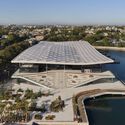
Salalah is Oman's largest logistics port and its second-largest city. Located within a two-hour flight from Dubai and a 90-minute flight from Muscat, the city attracted over one million tourists in 2024. As part of the Oman Vision 2040 investment plan, Oman's Ministry of Housing and Urban Planning has commissioned Sasaki to develop a master plan for redesigning the city's waterfront. The plan includes renovating the city's coastal public spaces and constructing new housing and infrastructure to accommodate projected growth. The project is part of a broader initiative to double tourism's contribution to the nation's GDP by 2030, with on-site construction set to begin later this year, in 2025.
The United Center arena in Chicago, designed by HOK Sport (now Populous), Marmon Mok, and W.E. Simpson Company, was built between 1992 and 1994. With a capacity of over 20,000 seats for sports and general events, it includes more than 6,000 parking spaces in lots surrounding the arena. These parking lots span approximately 55 acres (over 22 hectares) in Chicago's West Side (1901 W. Madison Street). A new master plan, named the 1901 Project, aims to transform this space into a mixed-use neighborhood. Led by design collective RIOS, with contributions from landscape architecture studio Field Operations, this long-term, multi-phase project aims to connect neighborhoods by creating new public spaces and infrastructure on a metropolitan scale. The proposal recently received approval from the Chicago Plan Commission.
Renzo Piano Building Workshop (RPBW), in collaboration with Holger Meyer Architekten, has won the competition for the new Midstad project in Frankfurt. Led by Joost Moolhuijzen and Erik Volz, the design reimagines the future of European city centers as resourceful and multifunctional. The project involves a 35,000 m² rehabilitation of an existing department store on the Zeil in Frankfurt's city center, integrating a six-story mass timber extension and a mixed-use, community-driven program. The project involves reconstruction during ongoing operation, partial demolition, and the expansion of the existing department store.
Transit-Oriented Development (TOD) is a comprehensive urban planning strategy aimed at creating dense, walkable, and vibrant neighborhoods centered around public transportation hubs. By seamlessly integrating residential, commercial, and recreational facilities within close proximity to transit nodes, TODs seek to reduce automobile dependency, increase public transit ridership, and stimulate local economic development. Government agencies play a pivotal role in supporting these developments through zoning reforms, easing floor area ratios (FARs), selling air rights, and facilitating public-private partnerships to secure capital for public infrastructure. While TODs have gained global traction, East Asia boasts some of the most successful examples. Conversely, efforts to replicate these models in different contexts—such as New York City—highlight the importance of adapting TOD principles to local conditions, geographical characteristics, and community needs.