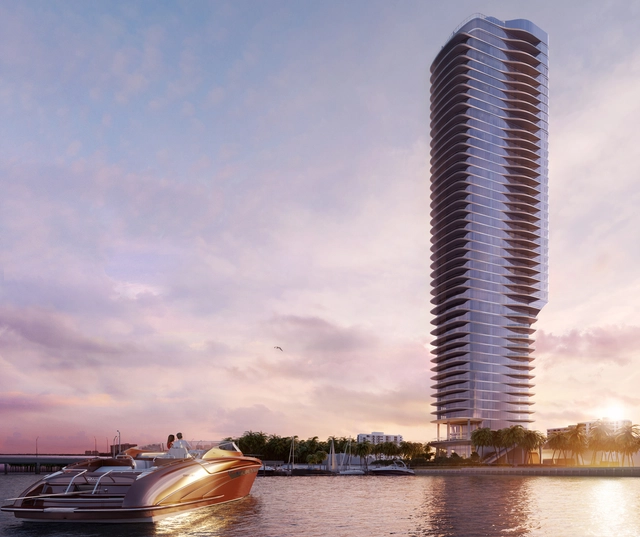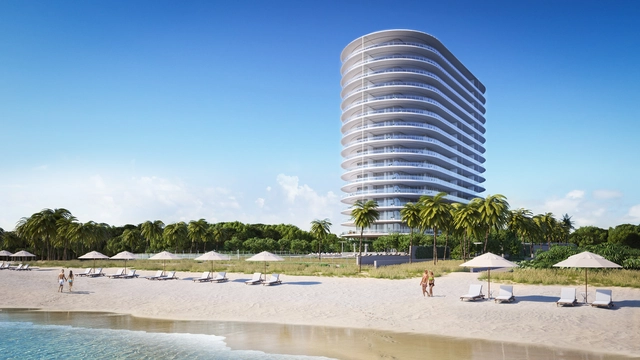
New details have been released of Renzo Piano Building Workshop’sfirst residential building in the United States; a landmark luxury condominium scheme on Miami’s North Beach. Designed in collaboration with interior architects Rena Dumas Architecture Intérieure (RDAI) and landscape firm West 8, the 66-unit scheme seeks to embrace both the ocean and adjacent 35-acre park, with a fluid design to “blur the line between imagination and craftsmanship.”
The architectural concept behind the scheme, titled “Eighty Seven Park,” was to create a “coastal sanctuary” floating above the lush landscape of North Shore Park. Though simple in form and motif, Piano’s design prioritizes an intricate attention to detail; “the belief in perfecting every element of its design and construction.”
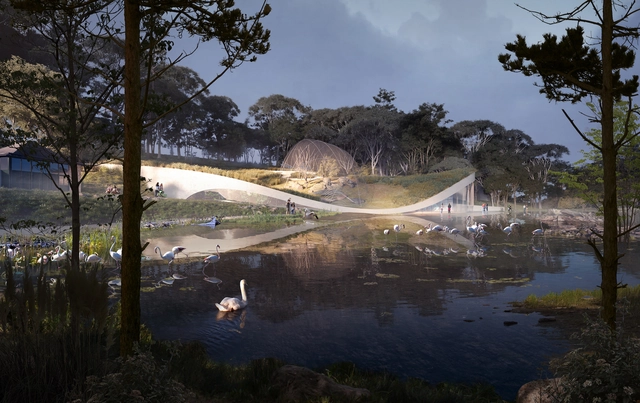
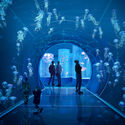
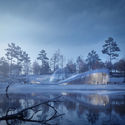
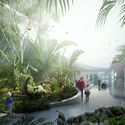
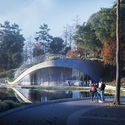
3XN and GERNER GERNER PLUS have released details of their competition entry for the design of a new aquarium in Schönbrunn Zoo, Vienna. Developed in collaboration with aquarium specialists ATT, “Poseidon’s Realm” was designed to be “elegant, simple and mysterious, lying across the landscape like a great veil.” The scheme was awarded second place in an international competition for the aquarium’s design, with the winner yet to be announced.
The “Poseidon’s Realm” scheme is defined by a spacious green roof landscape embedded in the zoo’s path network. The aquarium covers a total area of 65,000 square feet (6,000 square meters), divided across four levels, with a large, glazed, wave-shaped entrance enticing visitors to transition between outdoor greenery and a “softly undulating waterworld.”
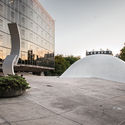
In March 1972, an article in The Architectural Review proclaimed that this structure was “probably the best building in Paris since Le Corbusier’s Cité de Refuge for the Salvation Army.”[1] The article was, of course, referring to Brazilian architect Oscar Niemeyer’s first project in Europe: the FrenchCommunist Party Headquarters in Paris, France, built between 1967 and 1980. Having worked with Le Corbusier on the 1952 United Nations Building in New York and recently finished the National Congress as well as additional iconic government buildings in Brasilia, Niemeyer was no stranger to the intimate relationship between architecture and political power.[2]
Studio Gang has released details of their first project in Los Angeles, a 26-story mixed-usetower designed in collaboration with local development partner Creative Space and European lifestyle brand MOB. The scheme places an emphasis on community spaces, with a curved form creating dynamic public plazas at street level, forming a link between Chinatown, the recently-opened LA State Historic Park, Union Station, and El Pueblo.
Located on 643 North Spring Street, the scheme will provide 300 apartments ranging from studios to three-bedroom units, and a 149-room hotel operated by MOB. Emphasizing the importance of community space and interaction, the residents and hotel guests will share a rooftop amenity deck with landscaped terraces on the second and third floor, as well as a gym, coworking spaces, rentable offices, pop-up stores, a rooftop swimming pool and bar, and space for outdoor cooking.
https://www.archdaily.com/893019/studio-gangs-curved-mixed-use-tower-to-be-their-first-project-in-los-angelesNiall Patrick Walsh
Studio Gang’s 10-story commercial “Solar Carve Tower” has topped out in New York’s Meatpacking District. Officially named “40 Tenth Avenue,” the scheme responds to a perceived lack of site-specific design in New York, with Studio Gang prioritizing “intentionality and contextuality” as their guiding principles. The scheme is therefore defined by a dramatic curtain wall, chiseled shape, and a dynamic relationship with its surrounding environment.
Sand is the most-consumed natural resource in the world after water and air. Modern cities are built out of it. In the construction industry alone, it is estimated that 25 billion tons of sand and gravel are used every year. That may sound a lot, but it’s not a surprising figure when you consider how everything you’re surrounded with is probably made of the stuff.
But it’s running out.
This is a scary fact to think about once you realize that sand is required to make both concrete and asphalt, not to mention every single window on this planet. The United Nations Environment Programme found out that from 2011 to 2013, China alone used more cement than the United States had used in the entire 20th century and in 2012, the world used enough concrete to build a wall around the equator that would be 89 feet high and 89 feet thick (27 by 27 meters).
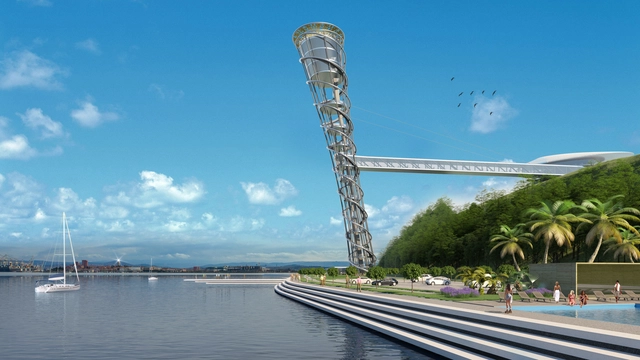
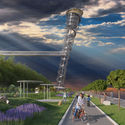
Massimiliano and Doriana Fuksas have released images of their competition-winning “Capo Grande Tower,” a tower and bridge situated on the Slovenian coastline linking Giusterna Beach to Monte San Marco. Designed in collaboration with Slovenian architect Sandi Pirš, the scheme consists of a 365-foot-high (111-meter-high) double-ellipse structure inclined slightly towards the sea, seeking to “immediately become a new symbolic element of the city.”
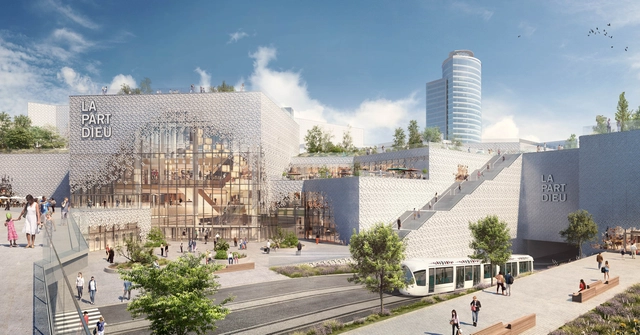
In the 3rd Arrondissement of the French city of Lyon, construction has begun on Lyon Part-Dieu, an MVRDV-designed scheme seeking to transform the city’s main shopping center. Featuring partly-transparent glass and a public green roof, the MVRDV scheme will revitalize and integrate what was formerly an introverted complex built for an era dominated by the car.
At 166,000 square meters, Lyon Part-Dieu is the largest downtown shopping center in Europe, built in 1975. In order to improve the existing outdated complex, MVRDV worked with co-architects SUD to produce a design that offers a contemporary update to the existing façade and a re-organization of the interior program.
https://www.archdaily.com/890665/construction-begins-on-mvrdvs-redesign-for-europes-biggest-urban-shopping-centerNiall Patrick Walsh
Now in its sixth year, CONNECT highlights innovative design programs at universities throughout the country. Students, under the supervision of university faculty, have the opportunity to design environments that incorporate seating and lighting installations, with the intention of offering an intimate area on the show floor where attendees can sit, relax and "connect." Exhibits will be located throughout the show floor, providing SOFA CHICAGO's international audience an opportunity to experience the innovation and creativity of future designers.
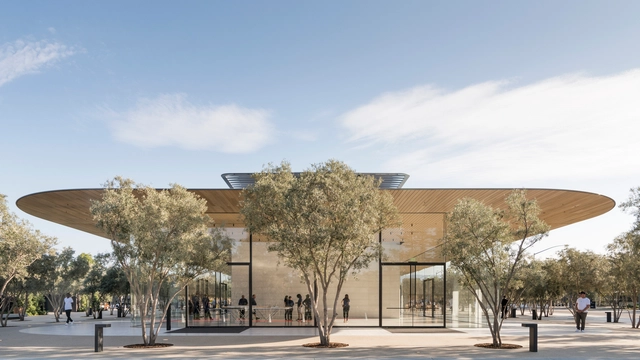
A shot of the Apple Park Visitor Center. Image Courtesy of Foster + Partners
Apple’s unwavering love for glass and seamless edges is one of the reasons designers flock in masses to purchase their products. But that aesthetic has caused a bit of a snafu at the company’s new Foster+Partners-designed headquarters in Cupertino, where employees are running into the highly transparent glass walls at an alarming rate.
The Union of Architects of Russia calls for submissions to the Sixth "Glass in architecture" awards for 2018. It will be held on April, 18-19, 2018 within the framework of the Forum of the architectural glass industry, "ArchGlass 2018," in Moscow at the Central House of Architects.
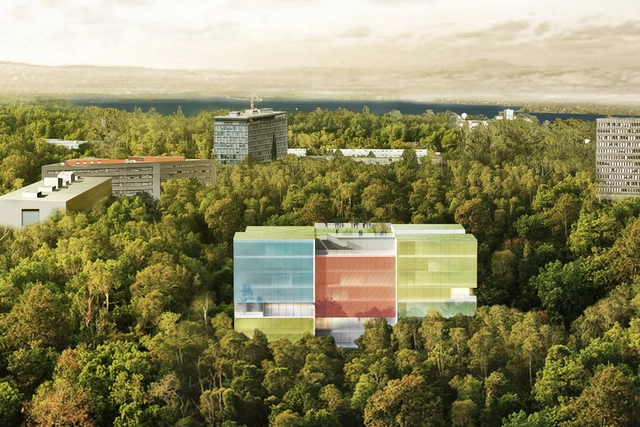
Clad in an innovative colored photovoltaic glass facade system, the energy-efficient building will provide flexible work and social spaces for more than 250 employees.
This essay by Space Popular references an installation currently on display at Sto Werkstatt, in London. You can experience it in virtual reality, here.
The Glass House has no purpose other than to be beautiful. It is intended purely as a structure for exhibition and should be a beautiful source of ideas for “lasting” architecture but is not intended as such. According to the poet Paul Scheerbart, to whom it is dedicated, the Glass House should inspire the disillusion of current architecture’s far-too-restricted understanding of space and should introduce the effects and possibilities of glass into the world of architecture.
Bruno Taut [above] described his Glashaus for the 1914 Werkbund Exhibition in Cologne, Germany, as a "little temple of beauty"; as "reflections of light whose colors began at the base with a dark blue and rose up through moss green and golden yellow to culminate at the top in a luminous pale yellow.”[1] The Glass Pavilion, designed based on its potential effects on those who perceived it, was supposed to create vivid experiences. The site was the human mind.