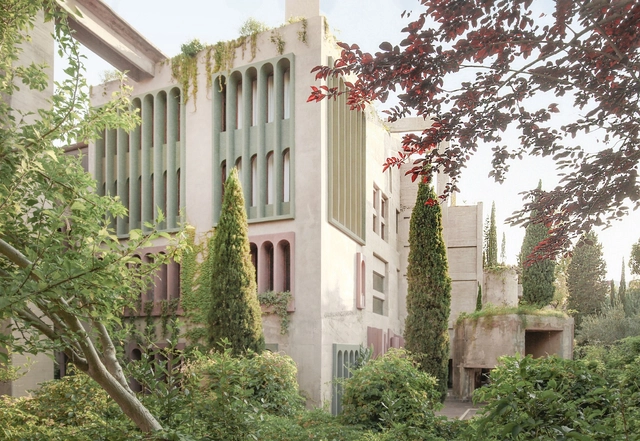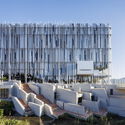
The Villa Cavrois stands as a powerful testament to early modernist architecture and the vision of architect Robert Mallet-Stevens. Built between 1929 and 1932 in Croix, France, this landmark residence was commissioned by Paul Cavrois, a prominent textile industrialist, to embody modern values and house his growing family. Mallet-Stevens' design merges Modernist ideals with a luxurious, functional aesthetic that breaks sharply from traditional styles, creating a space defined by clean lines, balanced proportions, and innovative materials.
More than just a family home, Villa Cavrois was designed as an architectural manifesto, presenting bold new ideas in residential design that would inspire generations. Its meticulously crafted layout, advanced technological features, and harmonious connection to the surrounding landscape positioned it as a symbol of modern living.
Adjacent to Toronto's Pearson International Airport, the Bombardier Aircraft Assembly Center represents a landmark project in Canadian aerospace design. Located next to Canada's largest airport, it blends 70,000 m2 (750,000 ft2) of technical precision with a focus on people. ArchDaily's editor Moises Carrasco had the opportunity to speak with Lilia Koleva, partner at NEUF architect(e)s and founder of the firm's Toronto office, which led this project. Koleva shared insights into her professional journey and reflected on the challenges of building and growing NEUF's Toronto-based office. She also discusses the Bombardier Campus, describing it as a defining project in her career, and how it showcases NEUF's ability to tackle large-scale, technically demanding projects while maintaining a focus on the people who use the space. This project builds on the office's prior expertise in industrial design and expands its portfolio of human-centered architectural solutions. Koleva also reflects on the importance of fostering collaboration, adaptability, and a clear understanding of client needs; qualities that have defined her approach to architecture and leadership at NEUF.

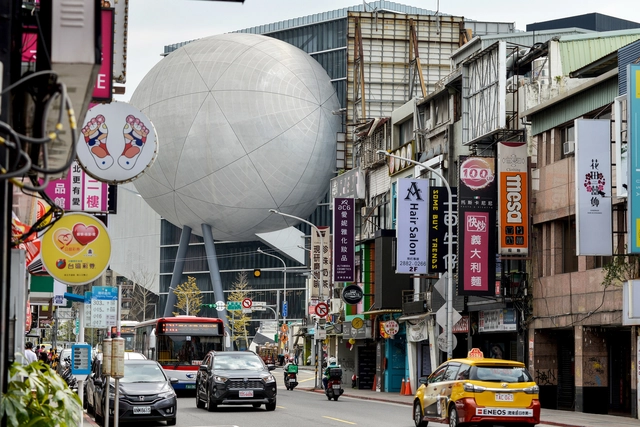
Playtime movie (Jaques Tati 1967) . Image via screenshot
Architecture criticism and journalism are often expected to announce "the good, the bad, and the ugly" in architecture and the built environment. Its purposes go however further than that. As Michael Sorkin put it, "seeing beyond the glittering novelty of form, it is criticism's role to assess and promote the positive effects architecture can bring to society and the wider world". In other words, by telling us what they are seeing, critics are also showing us where to look in order to identify and address the issues plaguing our built environment.
The field of architecture journalism has been led by female writers even in times when the pursuit of a career in architecture was discouraged and inaccessible for women. Ada Louise Huxtable established the profession of architecture journalism by holding the first full-time position of architecture critic at a general-interest American newspaper. In 1970, she also received the first-ever Pulitzer Prize for criticism. Esther McCoy started her career as a draughtswoman at an architecture office, yet, because of her gender, she was discouraged from training as a professional architect despite her ambitions to study the field. Through her writings, she managed to bring attention to the overlooked architectural scene of the American West Coast and advocate for the values of regional Modernism.
KCAP has been chosen to design two new skyscrapers in Bratislava, Slovakia. Respectively standing at 260 meters and 180 meters tall, these towers will become key additions to the city's skyline and contribute significantly to its urban landscape by providing over 1,100 residential units with extensive city and landscape views. This district, once an industrial zone, has undergone substantial redevelopment, transforming into a mixed-use urban hub that combines residential, commercial, and leisure spaces. The new towers support this ongoing urban renewal, offering easy access to public transport and nearby cultural landmarks.
Two museums in Africa built in the mid-twentieth century carry the name 'National Museum.' They reflect the story of their respective nation's history and are tied to notions of national identity. Both are also examples of fine architecture built on the principles of Modernism, a movement associated with nation-building in Africa. However, their inception and purpose followed very different paths. This article explores the under-reported architecture of the National Museum of Ghana in Accra and the Sudan National Museum in Khartoum.
Student housing has undergone a remarkable transformation over the last century. Once seen as a utilitarian necessity, providing shelter and basic amenities for students, this architectural typology has evolved to address increasingly complex societal, cultural, and urban demands. Starting with Le Corbusier's modernist approach at the Cité Universitaire in Paris, student housing has reflected broader trends in architecture, urbanism, and social change.
Today, these buildings must cater to a highly diverse and transient population, navigating the pressures of affordability, density, and the evolving living standards of young adults. With rapid urbanization and increasing student mobility, universities now face the challenge of designing housing that is not only functional but also adaptable to different cultural and social contexts. This has led to more flexible, innovative solutions that promote both privacy and community living.
OODA has just revealed its design for a new mixed-use urban development in central Tirana, Albania. Located in the central district of Tirana on Myslym Street, the Ndarja building, represents a new approach to mixed-use urban development, incorporating residential, hospitality, office, and commercial functions within a single structure. The building comprises two distinct sections positioned along their narrow sides, creating a central square that serves as a gathering spot, contrasting the busy surroundings.
In the heart of Tallinn, where history weaves through cobblestone streets and ancient towers, stands the Ungern-Sternberg Palace — a monument that bridges the opulent past of Estonia's aristocracy with the vibrant world of contemporary academia. Now home to the Estonian Academy of Sciences, this historic building embodies Estonia's enduring dedication to knowledge and cultural preservation. Through Open House Tallinn, which highlights the city's architectural heritage, the palace's significant history, and remarkable architectural details are brought to a wider audience, offering unique insight into Estonia's cultural resilience.
Constructed in the 19th century as a symbol of aristocratic power, the palace has transformed from a private residence into a national hub of intellectual life. Its grand halls, once the scene of lavish gatherings, now foster scientific and academic pursuits, illustrating how heritage architecture can evolve alongside societal change.
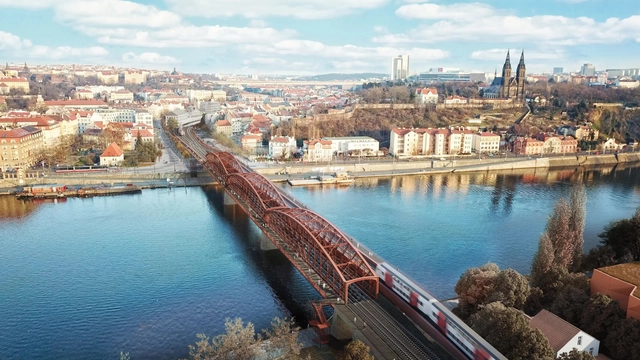
Liverpool Waterfront, location of the Maritime Museum & International Slavery Museum, Liverpool by Feilden Clegg Bradley Studios, drone image 2024. Image Courtesy of National Museums Liverpool
The redevelopment of the International Slavery Museum (ISM) and Maritime Museum in Liverpool, UK, achieved planning approval in Autumn 2024. On this occasion, ArchDaily's editor Mohieldin Gamal had the opportunity to engage in a conversation with Kossy Nnachetta, partner at Feilden Clegg Bradley Studios, the office in charge of the redevelopment. She discusses her architectural journey, key considerations of her practice, and the challenges and opportunities of designing the Maritime and International Slavery Museum, a joint project that had to address several sensitive and historically important issues. Kossy draws on her human-centered and community-driven design approach, describing how this development builds upon Feilden Clegg Bradley Studios' extensive portfolio of cultural projects, adaptive reuse, and historical restorations.
The 29th Conference of the Parties to the UN Framework Convention on Climate Change (COP29) takes place between the 11th and 22nd of November in Baku, Azerbaijan. The event proposes a global gathering of business leaders, governments, and civil society with the aim of taking effective measures to limit global warming to 1.5°C above pre-industrial levels. As the construction industry is responsible for approximately 37% of global emissions, the conference is of particular interest to architects, urban planners, and researchers in this field.
Women have played a pivotal role in the evolution of landscape architecture, overcoming the constraints of a male-dominated profession to introduce groundbreaking ideas and fresh perspectives. From early pioneers to contemporary leaders, their work has reshaped how we interact with public and private spaces, intertwining aesthetics, functionality, and sustainability in innovative ways.
In the late 19th and early 20th centuries, female landscape architects carved out their place in the profession, emphasizing harmony between built structures and natural landscapes. Their projects showcased a deep commitment to community and ecological balance, setting the stage for an inclusive and thoughtful approach to design that continues to inspire the field today.
Selected as one of ArchDaily's Best New Practices for 2024, Mix Architecture bases in Nanjing, China, took their approaches honed from rural China to the city, dealing with projects across different scales that stay true to the identity of the communities they work in, but with a contemporary character that is dealing with projects across different scales that stay true to the identity of the communities they work in, but with a contemporary character that is setting the bar for Chinese architecture. They responded sincerely to the site, to the construction, to the functional needs, and to the expression of sociality. From the name of their studio, one can observe that they are an inclusive design studio.
In an interview with ArchDaily, they summarise their design practice as 'the evolution of scenery', each time drawing design information from the site, not just responding to nature or culture, but becoming part of the landscape. This allows even the casual viewer without a professional background in architecture to perceive the atmosphere created by the design. Treating architecture as a social event, each design maximizes the use of local resources under limited conditions to bring about a relatively good result, responding to the environment, the cultural heritage, the materials, the craftsmanship of the workers, the type of function of the space and the real needs of the owner.
Recognized for completing 36 distinct yet cohesive public projects across Mexico in just 36 months, Colectivo C733 showcases the impact of collaborative design on public spaces and communities. The 36 projects were part of a national effort to revitalize vulnerable urban and rural areas in Mexico, earning them the 2024 Obel Award focused on the theme of "Architectures With". The team behind the designs, Colectivo C733, is a collaborative group formed by the joint offices of architects Gabriela Carrillo (Taller Gabriela Carrillo), Carlos Facio, and José Amozurrutia (TO), along with Eric Valdez (Labg), and Israel Espin. In a recent conversation with ArchDaily's Editor-in-Chief, Christele Harrouk, the collective discussed their approach to public architecture, the process of integrating diverse voices, and remaining flexible to the challenges of local conditions.
The Chicago Architecture Biennial (CAB) has announced its sixth edition, marking the tenth anniversary of the renowned event, to take place from September 12, 2025, to February 28, 2026. The event will be titled CAB 6: Shift: Architecture in Times of Radical Change and will be directed by Florencia Rodriguez, an esteemed architect, writer, and educator. As the first female Latin American Director to lead CAB, Rodriguez brings a fresh perspective to the Biennial, which is set to continue its tradition as North America's largest exhibition of contemporary architecture, held biennially in Chicago.
Global conferences, events, and exhibitions have profoundly influenced the evolution of architecture and design, serving as catalysts for innovation, new ideas, and pivotal debates. Some gatherings, like the historic Congrès International d'Architecture Moderne, have impacted the field. In contrast, others, such as the Venice Biennale and the World Design Capital (WDC), continue shaping the architectural landscape through periodic editions. Initiated in Turin, Italy, the WDC celebrates a different city every two years as a hub of design reflection and creativity. In the latest edition, the binational region of Tijuana-San Diego made history as the first cross-border WDC, emerging as a creative epicenter with a rich, innovative program that warrants special attention.
https://www.archdaily.com/1023090/tijuana-san-diego-as-a-creative-beacon-exploring-the-world-design-capitals-growing-influenceEnrique Tovar
India is often recognized for its thriving technology industry, with a reputation for producing a substantial number of skilled tech professionals each year. This has attracted a dynamic technology ecosystem that increasingly draws global companies to establish operations in the country. The rise of tech parks has become a key strategy for harnessing this talent and resources, cultivating an environment conducive to innovation. What impact do these tech parks have on the urban landscape of Indian cities?