
Ukrainian Architecture

  1. ArchDaily
  2. Countries
  3. Ukraine

Latest projects in Ukraine

Latest news in Ukraine

Lina Bo Bardi's First Exhibition in China and GXN's Reclaimed-Material Community Space: This Week's Review

Audio available

This week's stories explore how architecture engages with questions of culture, access, and collective life, from new cultural institutions and exhibitions to public spaces and housing. This week, the 2026 NCARB by the Numbers report provided a broader perspective on the profession itself, showing that people of color accounted for 49% of licensure candidates in 2025 and women for 47%, compared with 21% and 28% among the overall architect population. The report offers one perspective on access within the profession, while projects and cultural initiatives further examine how architecture responds to different forms of public and collective life.

The Ukrainian Pavilion Examines Displacement and Shared Space Through "Pool of Questions" at the 2027 Venice Architecture Biennale

Audio available

The Ukrainian pavilion at the 20th International Architecture Exhibition – La Biennale di Venezia is being designed by the team from CO-HATY, a local volunteer initiative restoring abandoned buildings in the country to transform them into stable homes for internally displaced people. The team is formed by METALAB and relocated members of the Ukrainian Urban Curators agency, who have been developing CO-HATY since 2022. Titled "Pool of Questions," the project poses a question the organization argues is rarely voiced in the context of survival: not simply where displaced people should live, but when they can begin to live. For Venice, the imagined installation extends the restoration and adaptive reuse work into a discourse on affordable housing, dignity and rest during an ongoing war.

Imagining Ukraine's Future: 6 Unbuilt Projects from the ArchDaily Community

Subscriber Access | 
Audio available

The context of the ongoing war marks Ukraine's place in the international consciousness. Architecture, however, most often transcends the span of a human life and can therefore be a tool for imagining the future. The practice of architectural design, whether speculative, conceptual, or practical, serves as a means of bringing to life ways of living and interacting beyond our current realities. In this selection of conceptual projects submitted by ArchDaily readers, we see material, spatial, and symbolic strategies that seek to address contemporary contexts in the residential, educational, and commercial sectors.

The Productive Clash: Heritage Interiors, Contemporary Projects, and the Value of Imperfection

Audio available

Heritage, in interiors, is increasingly rarer to be only a matter of preservation alone. More often it arrives as friction: the encounter between what a building already is—its plan logic, its scars, its structural inconsistencies—and what contemporary life demands of it.

Cultural Heritage Sites in the Middle East Damaged as War Strikes Historic Urban Areas

Audio available

On February 28th, 2026, the news of the loss of human lives, the operational pattern of military strikes, damage to infrastructure, communication disruptions, and international responses following US-Israeli military attacks on Iran confirmed to the world that there was a new focus of war in Southwest Asian territory. This military conflict has also had a human and infrastructural impact on Lebanon, Syria, Iraq, and Jordan, with active combat zones in their territories, and the Gulf States, where damage particularly affected US military bases and energy infrastructure. This adds a new site of armed conflict in the area, following over two years of systematic destruction of life, habitat, and essential facilities in the Gaza Strip, reaching a near total of 81% destroyed structures by the end of 2025. These territories are currently involved in the deliberate destruction of their normality, including essential, everyday, and cultural infrastructure of global value. Although information is currently scattered and partial, it is possible to assess some of the damage to cultural heritage caused by this new outbreak of armed conflict.

Druzhba Sanatorium: A Soviet Monument Suspended Between Earth and Sea

Subscriber Access | 
Audio available

Perched above the cliffs of Crimea, the Druzhba Thermal Sanatorium appears less as a building than as a landed spacecraft. Its circular forms, suspended decks, and spiraling ramps evoke a scene from Andrei Tarkovsky's Solaris (1972), where architecture and psychology merge into a single landscape. Built between 1978 and 1985 by Igor Vasilevsky, the complex was conceived as a thermal resort for workers of the oil industry, part of the Soviet Union's extensive network of sanatoria dedicated to health and recreation.

Cultural Venues, Fresh Perspectives on Public Space and One Month until the Winter Olympics: This Week’s Review

Audio available

This week's news compilation brings together current discussions around public and collective space, cultural infrastructure, and long-term urban transformation across diverse geographic contexts. From shared management models redefining public space ownership in cities such as Paris and New York, to large-scale event-driven initiatives linked to Milano Cortina 2026 and the World Urban Forum in Baku, the selected projects and initiatives highlight how governance, culture, and infrastructure intersect in contemporary practice. These themes are further developed through a mix of strategic planning processes, including international test planning efforts in Northern Lviv, and built projects spanning education, culture, and temporary architecture, from a new dental teaching facility in Blantyre, Malawi, to restored and newly opened cultural venues in the United States and Taiwan, and adaptive reuse interventions showcased at the Chicago Architecture Biennial. The international examples outline an architectural landscape shaped by reuse, public engagement, and the evolving role of design in responding to social, cultural, and institutional frameworks.

From Munich to Mumbai: 7 Unbuilt Office Towers Redefining the Future of Vertical Workspaces

Subscriber Access | 

As cities continue to expand upward, the office tower remains one of the most visible symbols of architectural ambition and urban evolution. No longer defined solely by efficiency or corporate image, contemporary workplace architecture is being reimagined as a hybrid ecosystem, one that balances density with daylight, productivity with well-being, and technology with material and spatial integrity. The following unbuilt projects, submitted by the ArchDaily community, reveal how architects across continents are rethinking the typology of the tower, turning verticality into an opportunity for connection, adaptability, and sustainability.

From Vancouver to Kyiv: Architecture Now Showcases Global Projects Shaping Sacred, Civic, and Cultural Spaces

Subscriber Access | 

As cities and communities adapt to new cultural, environmental, and social realities, architecture is taking on an expanded role in shaping spaces of resilience, gathering, and imagination. This edition of Architecture Now highlights six recent projects that span continents and typologies, from the redevelopment of post-industrial landscapes to sacred architecture, cultural pavilions, and civic hubs. Whether through mass timber innovation in Vancouver and Jülich, adaptive reuse in Ostrava, a children's pavilion in London, a spiritual centre in India, or a parametric church in Kyiv, each project demonstrates how design can bridge heritage and innovation while fostering connection, care, and community.

The Ukrainian Pavilion at the Venice Biennale Presents a Parallel Between Vernacular and Emergency Architecture

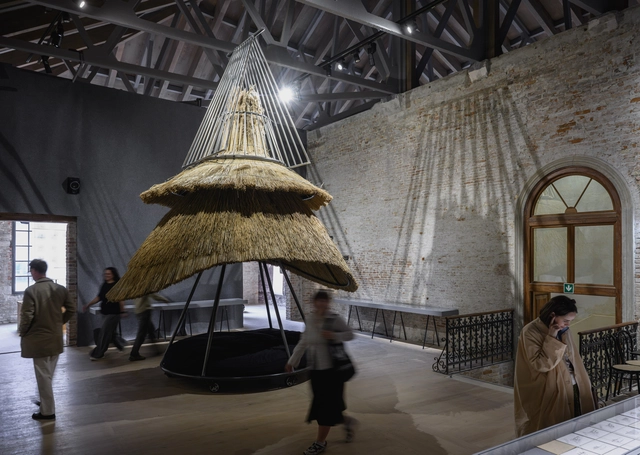
The Ukrainian pavilion at the 19th International Architecture Exhibition – La Biennale di Venezia explores the intersection of traditional building methods and improvised construction during wartime crises. Under the title "DAKH (ДАХ): Vernacular Hardcore", the exhibition refers to the concept of the roof ("dakh" in Ukrainian) as a primary shelter in architecture, examining the roofs of an "architecture without architects" both in the country's constructive tradition and in the contemporary reality of aerial vigilance over its national territory. Curated by Bögdana Kosmina, Michał Murawski, and Kateryna Rusetska, the Ukrainian display consists of a six-element exhibition at the Arsenale's Sale d'Armi and an accompanying nomadic program titled Planetary Hardcore.