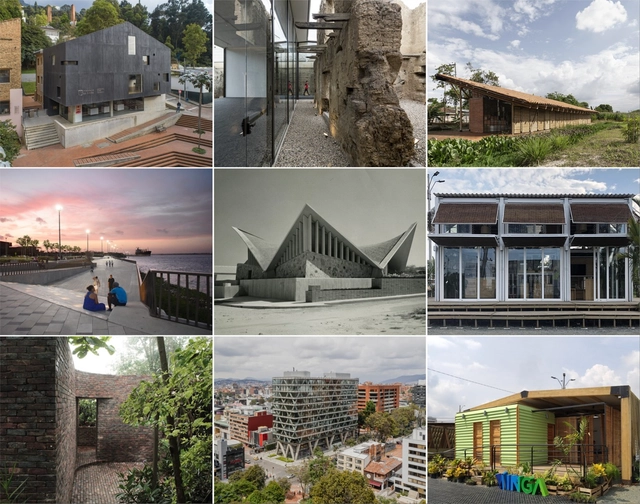
Colombian Architecture

  1. ArchDaily
  2. Countries
  3. Colombia

Latest projects in Colombia

Latest news in Colombia

Community-Centered Architecture: Redefining the Role of Architects in South America

Subscriber Access | 

Across South America, architecture is increasingly being understood as a collective act. Rather than imposing external views, many studios and designers are building with and for communities, learning from their local practices, materials, and ways of inhabiting. These projects are repositioning the architect's role from an author to a facilitator, transforming design into a participatory process that centers collaboration, care, and mutual respect.

Highlights from BAL 2025: Latin American Architecture Biennial

Subscriber Access | 

Held in Pamplona from the 23rd to the 26th of September, the 2025 Latin American Architecture Biennial (BAL) brought together emerging studios and established voices from across the continent. This year’s edition stood out for the diversity and depth of its participants: projects of striking formal and conceptual richness, developed by young yet remarkably mature offices. Together, they reflected the vitality of today’s Latin American architecture — thoughtful, inventive, and deeply aware of its context.

Childhood and Ancestry: What South American Indigenous Communities Can Teach Us About Environments for Children

In South American Indigenous communities, a child’s place is wherever they choose to be. Babies crawl on the earthen floor, approach the fire, investigate anthills, and experience the world with their whole bodies. They learn by feeling: discovering limits, recognizing dangers, and gathering lessons no manual could ever teach. In urban contexts, by contrast, children are often confined to spaces designed for adults, filled with rules that—though well-intentioned—tend to distance them from essential experiences. Rather than judging which model is “better,” what matters is recognizing that when cultures observe one another, there is always room for learning.

Colombia Pavilion at Expo Osaka 2025 Presents a Dynamic "Ice Cube" Playing With Form and Light

The Colombia Pavilion at the Expo Osaka 2025 adopts the theme "ICE CUBE," inspired by the scene in Gabriel García Márquez's One Hundred Years of Solitude where a young boy encounters ice for the first time. Translating this literary reference into built form, the pavilion presents a facade of translucent cubes set at varying angles, creating a sense of movement and articulation. Designed by MORF Inc., with Karim Chahal as Project Director and Ko Oono as Principal Architect, the exterior is composed of semi-transparent polycarbonate panels integrated with color-controlled lighting, allowing the facade to transform in appearance throughout the day and night.

Architecture for Contemplating the Landscape: 4 Scenic Viewpoints in Latin America

Subscriber Access | 

When designing spaces for viewing, architecture enters into a dialogue with the territory in an effort to understand the landscape and the enjoyment of reality, whether natural or built. Through an invitation to contemplate our surroundings, several architecture professionals in Latin America embark on the challenge of constructing structures that interact with nature, reinterpret certain building typologies, or become part of the learning and teaching of architecture for future generations. The wide variety of landscapes and cultures present in the Latin American context reflects the endless opportunities where architecture holds the potential to foster dialogue between the observer and the observed while drawing from the region’s deep connection with local flora, fauna, and other species.

An Architecture of Mixed Ancestry: The Work of Taller Síntesis and Its Dialogue with Colombia's Diverse Territory

Subscriber Access | 

A change in the way architecture was practiced in Colombia was necessary, and Taller Síntesis emerged to materialize this transformation. The studio combines a deep understanding of the territory and its context with architectural solutions that translate into materiality and built spaces. Their works stand out for their strong local cultural identity, achieving a precise balance between the preexisting, the new, and harmony with the landscape.

Revitalizing Territories in Colombia: Comprehensive Acupunctures for Urban and Social Transformation

Subscriber Access | 

What urban and social transformations do our cities require today? How can urban planning and design contribute to improving the experience of their inhabitants in urban spaces? As Andreea Cutieru explains, urban acupuncture refers to the improvement of social and urban issues through precise interventions capable of revitalizing specific areas of cities and consolidating urban planning strategies. The +VIDA program represents a comprehensive strategy for urban and social transformation in territories, strategically focused on vulnerable populations in the Colombian Caribbean. It encourages the collective construction of cities through the exchange of knowledge, intelligence, and expertise, with the aim of transforming the habitat in an integrated manner.

Refuges in the Latin American Jungle: 7 Lodges to Connect With Nature

Subscriber Access | 

Many people living in large urban centers have, at some point, wished to trade the chaos of city life for the calm and tranquility of nature. As the desire for such experiences grows, Latin American countries' tourism and hospitality sectors have been investing in resorts nestled within forests. Inspired by eco-tourism, these retreats are designed to blend seamlessly into their surroundings, using local materials and traditional techniques that respect the ecosystem and promote sustainability.

The 50 Best Latin American Houses of 2024

Annually, ArchDaily's curatorial team undertakes a rigorous selection process to identify exemplary projects in Latin American residential architecture. The goal is to share these works of architecture with our audience and highlight and promote good practices within contemporary architecture. This meticulous effort focuses on identifying projects that stand out for their design and their positive impact on the environment, innovative use of materials and techniques, and ability to address current needs.

Small Bars and Restaurants: 14 Projects Less than 50 m2 in Latin America

Subscriber Access | 

When designing spaces with reduced dimensions, adopting an efficient configuration and distribution is crucial for the user experience and the smooth development of activities and tasks to be carried out. In the case of bars and restaurants, numerous architecture and interior design professionals strive daily to meet the needs of clients, employees, and employers, considering everything from necessary installations and technologies to services, atmospheres, and furniture suitable for the type of gastronomy to be consumed.