

This guide explains how to structure multi-image prompts in the RunDifussion platform. Explore RunDifussion's product catalog.
Articles
How to Prompt and Annotate Multiple Images with AI
| Sponsored Content
https://www.archdaily.comhttps://www.archdaily.com/catalog/us/products/38860/how-to-prompt-and-annotate-multiple-images-with-ai-rundiffusion
Getting the Data You Need to Run a Successful Firm
| Sponsored Content

When your firm adopts project accounting—the practice of accounting on a project-by-project basis—you’ll get insights that’ll change the way you do business. You’ll understand your projects, employees, clients, and firm on a deeper level, and you’ll be able to make changes that will dramatically increase efficiency and profits.
Before this happens, though, you need to lay the groundwork. With the right tools, logging and making sense of the data you need is convenient and easy. You just have to be consistent.
https://www.archdaily.com/888091/getting-the-data-you-need-to-run-a-successful-firmRene Submissions
How To Be a Tech-Savvy Architect

Architecture is a collaborative discipline, where a day’s work often involves sharing files, emails, and information in the process of completing a project. Whether you are entering competitions, applying for jobs or getting your work published, being tech-savvy when sharing files is a crucial skill to have—while failing to be tech-savvy can lead to frustrated colleagues, wasted time, and even missed career opportunities.
To help you ensure you're not making any mistakes, we’ve put together a few pointers you can use to share work online more efficiently and effectively.
https://www.archdaily.com/888004/how-to-be-a-tech-savvy-architectYiling Shen
Show Us Your Best Architectural Model Photos!
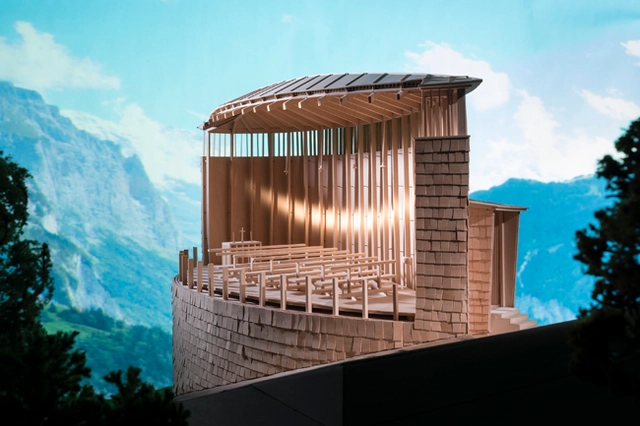
For a lot of architects, models hold a special place in our hearts. Whereas a building can take years to construct and usually can't be drastically altered as it nears completion, a model provides architects with the immediacy and flexibility we crave as designers while also allowing us to feel like we're really making something—a feeling that digital modeling software can rarely provide.
Models have even played decisive roles in the careers of many world-famous architects. Peter Zumthor, for example, is known to prefer the tactility of models over other forms of representation, while early in his career Steven Holl gained recognition for his visionary "Bridge of Houses" proposal for the Highline in New York, presented through a series of provocative models. And, physical models have even been key in some of the great advancements of the profession: In the 1990s, Frank Gehry's pioneering work in digital design involved tracing the forms of his digital models into CATIA software, whereas Frei Otto's models using soap films from the 1960s were key in his research into tensile structures.
https://www.archdaily.com/888340/show-us-your-best-architectural-model-photosAD Editorial Team
11 Houses With Gorgeous Double-Height Spaces
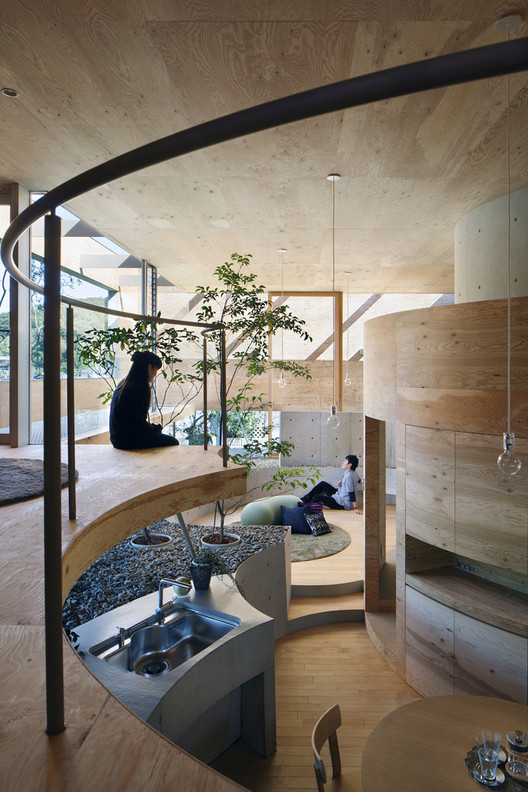


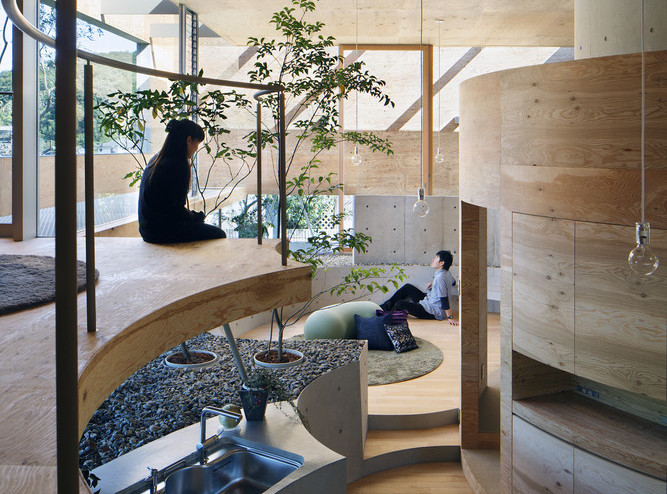
The private dwelling is a particularly favorable place in which to enjoy double-height spaces. This design strategy not only allows vertical spaces to be connected, but also enriches the functional and aesthetic possibilities of a building; often used in living rooms and kitchens, these spaces are designed to generate encounters between occupants. In this Photos of the Week selection, we present images by renowned photographers such as Kim Zwarts, Rena Lorenz, and Shigeo Ogawa.
https://www.archdaily.com/888220/11-houses-with-gorgeous-double-height-spacesMaría Francisca González
The Minimalist 3D Wooden Maps Currently Crushing It on Kickstarter

There is something incredibly satisfying about 3D maps that make you want to follow the streets and rivers with your fingers, navigating your way through the urban landscape. Almost like contours, the CityWood’s minimalist maps are built up through plywood layers, laser cut with precision to one-hundredth of a millimeter and hand assembled for high-quality craftsmanship.


https://www.archdaily.com/888324/the-minimalist-3d-wooden-maps-currently-crushing-it-on-kickstarterElla Thorns
Architectural Education: Is It Actually Preparing Our Students for the Future?
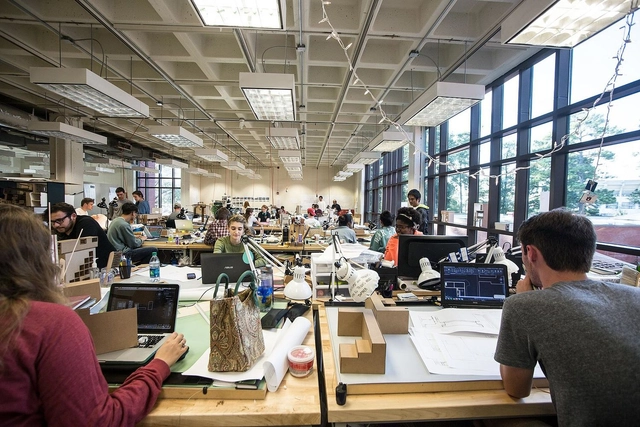
The issue of how we educate our architects of the future is a divisive one. With the capabilities of our technology advancing rapidly, new mediums of Virtual Reality, robotics, and artificial intelligence are all changing the architectural profession at a fundamental level. This creates the question of whether architectural pedagogy is keeping up with the times and educating students to be ready for both professional practice and an uncertain future.
In his opinion piece for Common Edge, ‘Architectural Education is Changing: Let’s Hope the Profession Can Keep Up’, Phil Bernstein articulates his belief that architectural education today is indeed teaching students the necessary skills, but rather than focusing on simply teaching them to become competent workers, it is teaching them skills to design for the future.

https://www.archdaily.com/888190/architectural-education-is-it-actually-preparing-our-students-for-the-futureYiling Shen
What Does it Take to Design a Super Bowl Stadium?

On the 4th of February, Minneapolis will host the New England Patriots and the Philadelphia Eagles for the 52nd Super Bowl. With over 100 million people expected to watch the game this Sunday, all eyes will be on the city of Minneapolis—a city known for not allowing the harsh climate get in the way of their celebrations—and the brand new US Bank Stadium, where a huge permanent roof will ensure that, come rain, shine, or snow, Minneapolitans will have a space to gather and enjoy themselves.
HKS Architects took on the challenge of designing the stadium to replace the Minnesota Viking’s previous home, the Metrodome, which was known as "Minneapolis’s living room" for the strong relationship it had with the population as both a civic hub and a stadium. Unlike past stadiums the Dallas-based architects have designed, the US Bank Stadium required a different outlook, with a focus on designing a catalyst for public infrastructure and a communal space that provokes interaction with the community. So how did they achieve a structure that can both host the Super Bowl yet remain a prominent part of the city for years to come? We spoke to the lead architect on the US Bank Stadium, Lance Evans, about how to design and construct the centerpiece for one of the biggest sports events of the year.


https://www.archdaily.com/887950/what-does-it-take-to-design-a-super-bowl-stadiumElla Thorns
Reebok Teams Up With Gensler to Turn Gas Stations Into Fitness Hubs
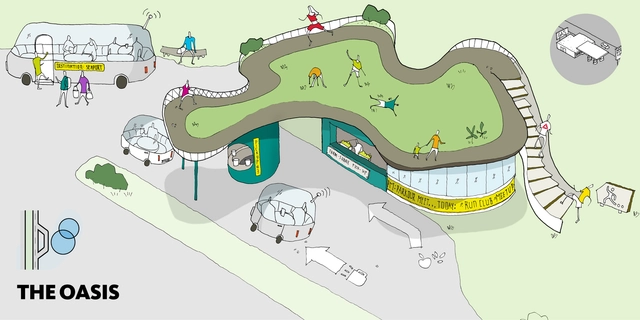
The gas station does not usually catch one’s fancy. It is a ubiquitous building, one built primarily for function instead of for pleasure or community. We see them all the time but barely give them a second glance unless the need arises – and then, we get our fuel, and we are out of the station in minutes.
With the smell of gasoline and the usual convenience store spread, these service stations do not exude any particular sense of wellness. Neither have their flat, perennial structures captured the imagination of architects – until now.
Reebok and Gensler are the first to catch on to the enormous potential of the common gas station. These buildings sit on prime real-estate all over the country, from highways to local streets. In their new collaborative project, “Get Pumped,” the global architecture firm and the fitness brand are coming up with a plan to re-do the gas station as we know it.
https://www.archdaily.com/888009/reebok-teams-up-with-gensler-to-turn-gas-stations-into-fitness-hubsKeshia Badalge
Architecture On Screen: Illustrated Plans From 6 Award-Winning Films of 2017

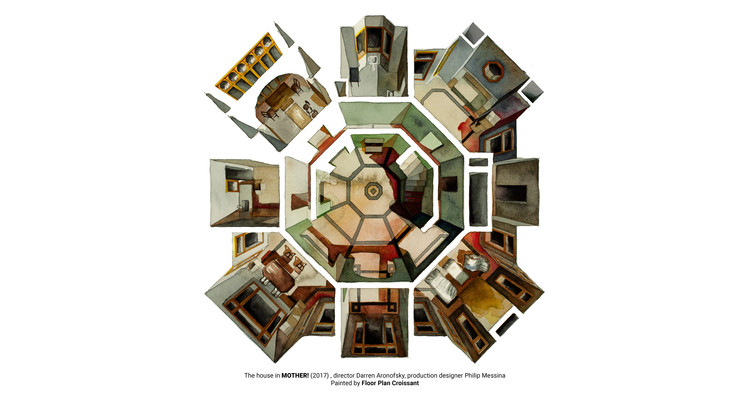
Why does a film garner critical acclaim? Is it captivating performances from its actors? Stunning tableaus and cinematic moments? Or, could it be the intricate sets where tales of drama, laughter, love, and loss play out?
Following her stunning watercolor prints of last year’s Oscar nominees and the Netflix sensation Stranger Things, architect and illustrator Boryana Ilieva provides a glimpse into the elaborate sets of 6 stand-out films from 2017. With the Golden Globes broadcasted earlier this month and the Academy Awards only a few weeks away, the homes in these award-winning motion pictures deserve as many accolades as the Hollywood stars who inhabit them.


https://www.archdaily.com/887807/architecture-on-screen-illustrated-plans-from-6-award-winning-films-of-2017Evan Pavka
Deepen Your Understanding of Construction and Materials With These Online Courses
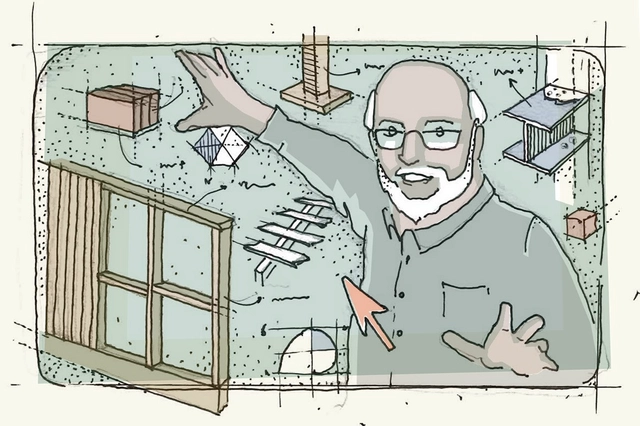
How much do you wish you knew about carpentry, solar energy or masonry? Leonardo Da Vinci said, "the noblest pleasure is the joy of understanding." Those who are open to learning and expanding their horizons are more likely improve their approach to design. If you've always wanted to understand more about construction processes, structures or materials, this list of online courses is for you.
We scoured MOOC platforms and databases to highlight a series of online courses related to construction and building materials. Many of the courses are permanently available and can be taken immediately; we've also provided information so that you may contact the universities or instructors to inquire about start dates, certificates, costs, course language and other relevant details.
https://www.archdaily.com/888068/deepen-your-understanding-of-construction-and-materials-with-these-online-coursesJosé Tomás Franco
9 Principles of Ethical Redevelopment to Consider in Order to Improve Communities, Not Gentrify Them
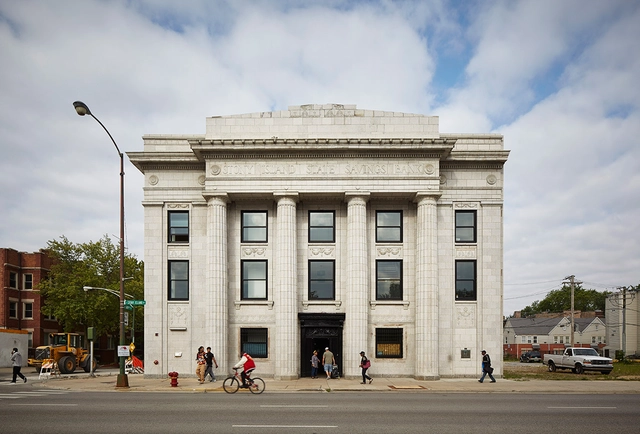
A version of this article was originally published by Common Edge as "The Principles of Ethical Redevelopment."
Where does creativity live? Can the highest level of cultural production come from down the street? What does it mean to be a good neighbor, a good steward? How does that look when there are so many forces at work keeping people isolated? How do you see value in what others discard? Can we learn to talk about moments of success in our struggling neighborhoods, not as random and magical, but as sophisticated flexibility? What is civic empathy?
These are some of the questions Place Lab, a University of Chicago partnership between Arts + Public Life and the Harris School for Public Policy, explored in an exercise last year conducted with the support of the John S. and James L. Knight Foundation: it’s the articulation of a set of nine principles collectively called Ethical Redevelopment.
https://www.archdaily.com/888047/9-principles-of-ethical-redevelopment-to-consider-in-order-to-improve-communities-not-gentrify-themIsis Ferguson
How Did You Finance Your Model-Making and Printing Costs During Architecture School?

Architecture is well-known as one of the more expensive professions to study given the high costs for supplies. The fast-paced rhythm of traditional studio courses requires students to present their design ideas using drawings, diagrams, renderings, and collages—usually plotted onto paper—adding to the already high cost of creating physical models. The price tag for studying and practicing architecture is a cost that the entire profession has assumed, for better or worse.
If you aren't one of the lucky few residing in a country or state in which education is free, or in which there are significant financial aid support systems, the constant extra cost of building models and printing presentation materials has a big impact. In the best case (and only in cases in which the family is in the fortunate position to do so) parents supplement the extra money need; but in many cases, students must work while studying. What else can you do when you're expected to produce a final project or thesis that can total hundreds or even thousands of dollars to produce?
https://www.archdaily.com/887986/how-did-you-finance-your-model-making-and-printing-costs-during-architecture-schoolJosé Tomás Franco
The 13 Types of Student You Encounter During an All-Nighter

Days (or rather, nights) before the deadline, the studio becomes a haven for all those students madly rendering, photoshopping, and printing the last pieces of their presentation, using the adrenaline of the deadline for motivation. While it's common for people to disagree even on the true definition of an all-nighter—is it classed as working until the sun rises, being awake for a period of over 24 hours, or even working right through to bedtime the following evening?—students often unhealthily boast about how many they have survived.
People’s true personalities begin to blossom in the early hours of the morning, and you get to experience the person they truly are. Although many of us have probably experienced such nights, it is luckily a culture that we grow out of throughout architecture school, or at least something we get wise to and begin to reassess our priorities. But the memories of those who suffered through with us will never be forgotten.
https://www.archdaily.com/887709/the-13-types-of-student-you-encounter-during-an-all-nighterElla Thorns
15 Fantastic Photos of Stunning Staircases




The staircase is a fundamental element for the connection of architectural spaces. But beyond its functional use, in many projects the staircase serves as a sculptural object, offering an opportunity for architects to generate creative spatial forms that animate the built space. In this installment of our Photos of the Week, we present 15 incredible staircases captured by photographers such as Patricia Parinejad, José Campos, and Brigida González.
https://www.archdaily.com/887779/15-fantastic-photos-of-stunning-staircasesMaría Francisca González
Why Do Cities Exist, and What Makes Them Grow? Here’s A Detailed Explanation
In this video, Wendover Productions asks some simple (if rarely asked) questions about cities: Why do they exist? What causes them to grow exponentially over time in the way they do? In answering these questions, the video suggests that, somewhat paradoxically, the creation and growth of cities is a natural phenomenon, bringing up some interesting implications regarding city planning in the future.
https://www.archdaily.com/887831/why-do-cities-exist-and-what-makes-them-grow-heres-a-detailed-explanationYiling Shen
Laser-Cut Mini Architecture Masterworks As Wall Hooks

Indian design and fabrication studio, MuseLAB creates customized furniture and products. Their 2017 creations include to-scale miniature architectural wall hooks. These functional household items were inspired by the works of Oscar Niemeyer, Le Corbusier, Charles Correa, Michael Graves, and others.
https://www.archdaily.com/887817/laser-cut-mini-architecture-masterworks-as-wall-hooksLindsey Leardi
These Delicate Illustrations Turn Images of Urban Density into Art

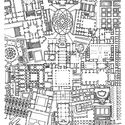
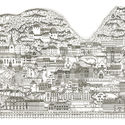
Trained in Architecture, Urban Design, and Theory, Alina Sonea illustrates the complex and often paradoxical nature of the cities we inhabit. The Feldkirch-based artist and architect has, since 2013, completed a series of detailed illustrations that employ graphic yet delicate black lines to render dense images of fantastical metropolises.



https://www.archdaily.com/887615/these-delicate-illustrations-turn-images-of-urban-density-into-artEvan Pavka
8 Architects Whose Names Became Architectural Styles
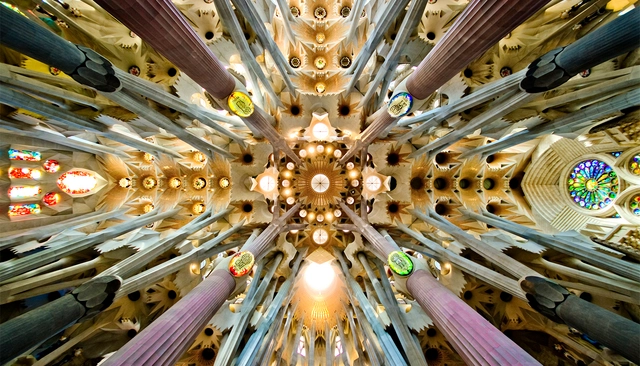
Throughout history, there have been certain architects whose unique ideas and innovative styles have influenced generations to come. Some of these pioneers introduced ideas so revolutionary that entirely new words had to be invented to truly encapsulate them. Whether they became a style embraced by an entire era, or captured the imagination of millions for decades to come, we know a Gaudiesque or Corbusian building when we see one.
Here are eight adjectives derived from the works of architects whose names are now in the dictionary:




https://www.archdaily.com/887670/8-architects-whose-names-became-architectural-stylesYiling Shen
What Is the Best Camera (and Camera Equipment) for Architectural Photography?
A great photograph is often as important as a great building—sometimes even more. From the pages of glossy magazines to the galleries of digital publications and online portfolios, high-quality photography is crucial for contemporary architects. Yet the array of camera options, equipment, accessories, and technical jargon (aperture, ISO, shutter-speed, etc.) can be dizzying, if not intimidating. So what happens when the camera in your iPhone is no longer enough?
To ensure emerging practitioners and professionals alike take the perfect shot, Eric Reinholdt summarizes at length the photography equipment used in his own practice in this two-part video from 2016. The first instalment on the architect, writer, and photographer's channel 30X40 Workshop makes it clear that his preference is a digital SLR camera. The 20+ megapixel image quality as well as range of larger aperture lenses with added versatility are crucial features for large format printing and digital publishing. Canon and Nikon are among the suggested brands as they are established with a large offering of products. And, are expected to provide additional upgrade paths as new equipment is released.
https://www.archdaily.com/887699/what-is-the-best-camera-and-camera-equipment-for-architectural-photographyEvan Pavka
Frank Gehry’s Online Masterclass: A Review By Architecture Students

You’ve probably seen the ads. Popping out from your Facebook newsfeed, the Masterclass sales pitch immediately attracts the eye: beautifully backlit wooden models and silky hand sketching emphasized by orchestral swells are accompanied by an adorable pirouette by the one and only Frank Gehry. The combination of Gehry’s status and slick production has managed to amass over 1.6 million views for the trailer on Youtube. Even in the company of courses taught by Martin Scorsese, Deadmau5, and Samuel L Jackson, the lone architect impressively lays claim to the eighth most popular teaser in the Masterclass series. The production value alone is almost a convincing argument for the $90 USD price, a detail that is quietly left out of the trailer.
The course has been reviewed by a critic, a practicing architect, and a curator—but what of its ostensible target audience, the architecture student? Has Masterclass managed to crack the online class conundrum with cinematography and celebrity?
https://www.archdaily.com/885220/frank-gehrys-online-masterclass-a-review-by-architecture-studentsAndy Chen & Thomas Musca
Dear Employers: Do You Want an Architect or a Revit Monkey?

We are seeking someone with a Bachelor of Architecture with two years of experience. Knowledge of Revit, Vray, Adobe and Microsoft. Knowledge of RNE and Municipal documentation. Immediate availability - Typical Architecture Job Listing.
Are newly graduated Architects "employable" people according to the requirements of the current market? And are these the right requirements?
https://www.archdaily.com/887408/dear-employers-do-you-want-an-architect-or-a-revit-monkeyAlhelí Zanella Giurfa
Living Architecture 'Astrocyte' Questions Whether Buildings Can Think and Care
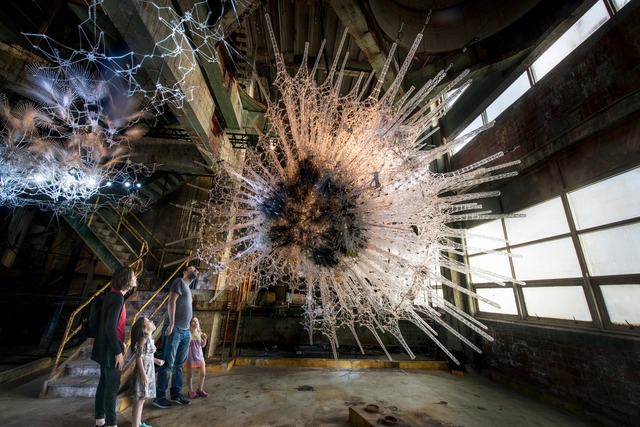
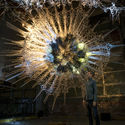
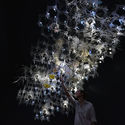
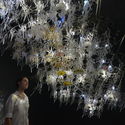
'Astrocyte' is a living piece of architecture that could easily be mistaken for a piece of science fiction. Engaging with the senses for an immersive experience, artist and architect Philip Beesley’s aerial structure combines chemistry, artificial intelligence, and a responsive soundscape. ‘Astrocyte’, translates from Greek to the literal meaning of star and cell, appropriate for such a complex structure that can react with the viewers' movements with patterns of light, vibrations and surround sound.


https://www.archdaily.com/886314/living-architecture-astrocyte-questions-whether-buildings-can-think-and-careElla Thorns
Architecture and the Bare Body: 15 Spaces for Healing, Relaxing and Bathing

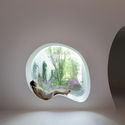




Spas, swimming pools, and saunas are spaces to which we turn in search of positive experiences, especially healing and sanitation. What characterizes all of these spaces is a requirement to wear little clothing--or even none at all--meaning that these spaces have very different expectations regarding nudity, privacy, and the human body when compared to other forms of architecture. From the point of view of design, nudity requires specific spatial conditions, forcing architects to think carefully about details such as the opacity of materials and the dimensions of space. With this in mind, this week we present a selection of the 15 best images of healing spaces, captured by renowned photographers such as Kevin Scott, Clément Guillaume, and Marcello Mariana.
https://www.archdaily.com/887350/architecture-and-the-bare-body-15-spaces-for-healing-relaxing-and-bathingMaría Francisca González
Photos Show the Light and the Dark in Zaha Hadid Architects' Vienna Library
.jpg?1516392347)
In Zaha Hadid Architects' description of their Library and Learning Centre at the University of Economics Vienna, they describe the exterior of the building as "characterized by two elements of contrasting colors separated by a glass joint: shell and shadow." For that reason, the building was a perfect subject for architect and photographer Edwin Seda, who says he is fascinated by the effect light has on buildings. "Design is created to work with natural light but is never really in control of this aspect," says Seda. "This set of images therefore explores light as a medium for architectural transformation, a sort of fourth dimension, that only materializes once the building is complete and the seasons begin to change."
Seda's photoset captures the Library and Learning Centre throughout the course of a day: from the daytime when the building's light and dark elements are clearly distinguished; to sunset when one side of the building is closer to orange than the white or black planned by the architects; then to the evening, when the building's internal lights bring an entirely different dynamic to the building's composition. Read on to see the full set of images.
.jpg?1516392338 "© Edwin Seda")
.jpg?1516392360 "© Edwin Seda")
.jpg?1516392312 "© Edwin Seda")
.jpg?1516392330 "© Edwin Seda")
.jpg?1516392301)
https://www.archdaily.com/887422/photos-show-the-light-and-the-dark-in-zaha-hadid-architects-vienna-libraryRory Stott