The world’s longest sea bridge has officially opened to traffic, connecting Hong Kong and Macau to the Chinese mainland. The 34-mile (55-kilometer) “Hong Kong-Zhuhai-Macau Bridge” features a range of unusual features, with The Guardian reporting “cameras to detect yawning, drivers forced to wear heart monitors and access restricted to the political elite and charity donors.”
Opened by Chinese president Xi Jinping, the $20billion bridge was constructed of 400,000 tonnes of steel, the equivalent of 60 Eiffel Towers. The bridge has been designed to withstand earthquakes and typhoons of up to 340 kilometers per hour.
https://www.archdaily.com/904728/the-worlds-longest-sea-bridge-opens-in-chinaNiall Patrick Walsh
In response to calls for a larger space, the Santiago Apostle Cathedral is the proposed home for the Queretaro Diocese. The proposed building lies on a 20,000 square meter plot of land on the city's south central side. The project aims to turn the building into not only a new religious and community space, but also an architectural icon for the city.
The project's design is based on a guiding axis that points towards the rising sun. The nave's geometry begins in the circle and then spreads throughout the structure from the principal entrance all the way towards the altar. The cathedral's roof is made up of a grand staircase that also houses a reflection pool.
To activate the historical and cultural significance of music in the city of Yekaterinburg, a design competition to create a new concert hall was announced earlier in April. From the 47 proposals that were submitted, the top three architectural concepts were recently selected by the jury committee, awarding first place to Zaha Hadid Architects, and the two runner-up positions to Alvisi Kirimoto + Partners and Robert Gutowski Architects respectively.
Despite selecting ZHA's proposal as the project laureate, all three projects are still in contention as the feasibility studies are ongoing. For the snowy climate of this Russian city, the buildability of the design continues to be under debate.
In a permanent state of architectural transience, New York City continues to be adorned with new skyscrapers with every passing day. Historically fueled by financial prosperity coupled with the demand for commercial space, the only way to continue to build was up. Blue Crow Media’s latest map, “Art Deco New York Map” showcases over sixty buildings from the era, celebrating the eclectic nature of Art Deco architecture that is so deeply inherent to the identity of the city.
Airport Metro Connector. Image Courtesy of GRIMSHAW
Grimshaw Architects and Gruen Associates have released updated renderings of the Metro station connecting Los Angeles International Airport to light rail. Expected to open in 2023, the $500-million transit hub will span across a 9.5 acre site adjacent to the Crenshaw/LAX Line’s maintenance yard. The design was made to create a fully inter-modal facility that will become a new point of arrival into the city.
Dutch robotics company MX3D have unveiled the world's first 3D printed stainless steel bridge at Dutch Design Week. Set to be installed across one of the oldest and most famous canals in the center of Amsterdam, the bridge was created with designer Joris Laarman. Now both the span and deck are complete. Equipping industrial robots with purpose-built tools, the project showcases the potential applications of multi-axis 3D printing technology.
The Oscar Niemeyer Award for Latin American Architecture is a renowned initiative by the Latin American Architecture Biennial Network (REDBAAL). This award recognizes the best architectural production, unquestionable empowerment, and presence of Latin American architecture in the international context.
The Mayor of Boston and SCAPE Landscape Architecture have collaborated on a vision to protect the city’s 47 miles of shoreline against climate change. The scheme lays out strategies which will “increase access and open space along the waterfront while better protecting the city during a major flooding event.”
The vision forms part of the Imagine Boston 2030 initiative while using the city’s Climate Ready Boston 2070 flood maps, targeting infrastructure along Boston’s most vulnerable flood pathways.
https://www.archdaily.com/904610/boston-publishes-radical-scape-plans-to-combat-climate-changeNiall Patrick Walsh
Los Angeles-based KTGY Architecture + Planning’s Research and Development studio has unveiled an idea to reuse millions of square feet of empty retail stores as housing for the homeless. The “Re-Habit” concept calls for the installation of bathrooms, dining, sleeping, gardening, and job training facilities, transforming obsolete big-box stores into agents of social change.
The concept comes at a time when vast big box stores such as Macy’s, JC Penney, and Sears are closing in record numbers, leaving large vacant footprints throughout the urban landscape.
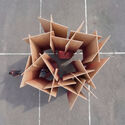
Architecture firm SOM has designed Kinematic Sculpture, an origami-like pavilion installation for Chicago Design Week. Exploring kinematics as the science of motion, the sculpture was formed as one of the firm's ongoing interdisciplinary research projects. As a test in integrated design, the structure aims to establish ideas that foster new architectural and structural solutions for pressing challenges in the built environment.
Amsterdam-based architect Angelo Renna has designed a 90 meter high artificial 'sponge mountain' made to absorb CO2 in Turin, Italy. Formed from soil excavated from the construction site of the railway tunnel connecting Turin to Lyon, the mountain aims to improve air pollution through engineered soil. Mixing sand and concrete, the man-made mountain is designed as a green landmark for the city.
No 1 Poultry, the iconic Grade II* listed landmark in London designed by James Stirling, has opened its doors as WeWork’s 28th London location. The Postmodern masterpiece now serves as a WeWork space for 2300 members, as well as shops, a roof garden, and a restaurant.
Gasklockan tower. Image Courtesy of Herzog & de Meuron
Herzog & de Meuron have released more images of their Gasklockan tower project in Stockholm. First announced late last year, the design will replace a 1930s gasholder with a 90 meter tower. As the firm's first project in Sweden, Gasklockan tower is being created with developer Oscar Properties. The latest images showcase the interior of the project and details of the facade. Designed with over 300 apartments, the circular tower was inspired by the original gasholder on site.
The trustees of Barcelona's historic Sagrada Família have reached an agreement with the city council to pay off $41 million in debt for not having the appropriate building permits. As the New York Times reports, the saga has continued for more than a century, as an original building permit issued in 1885 by Sant Martí de Provençals was no longer valid when the town was absorbed into the city of Barcelona. Designed by Catalan architect Antoni Gaudí in 1882, the Sagrada Família is still under construction 136 years later.
Snøhetta has been announced as the winner of a design competition for the renovation of the avant-gardist Théâtre Nanterre-Amandiers in Nanterre, France. The renovation seeks to breathe new life into the 1960s theater, known for its high-quality performances and global collaborations.
The renovations will include the addition of a 200-seat theater, and the reconfiguration of the building’s restaurant, bookshop, and atrium space, with an emphasis on flexibility and natural light.

https://www.archdaily.com/904425/snohetta-to-renovate-avant-garde-theater-in-nanterre-france-with-dynamic-extensionNiall Patrick Walsh
The “Bosco” design schematic utilizes timber construction and ecological design practices to create a multi-sided residential city block. Not only are the private domestic spaces important, but the definition of ‘living space’ is expanded to include private outdoor and shared spaces.
In this way, the wood exterior becomes an extension of the interior. The use of timber, throughout, and the simple language of Bosco’s underlying geometric forms create a well-articulated and homogeneous ensemble of housing components.
Cristopher Cichocki's Root Cycle combines installation art with existing architecture in an effort to spark a discussion regarding the relationship between design, both contemporary and historical, and environmental sustainability.
Cichocki partnered with Geoplast, a local Italian designer and manufacturer dedicated to producing innovative sustainable design products. The artist uses a particular Geoplast elevator product and Aloe Vera plants as the main components for the artwork.