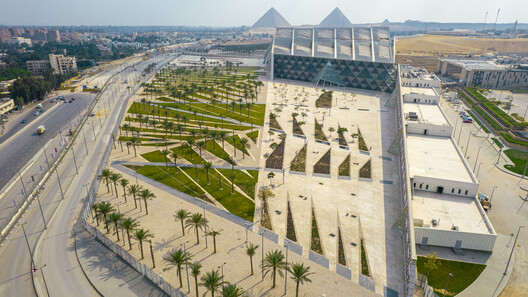
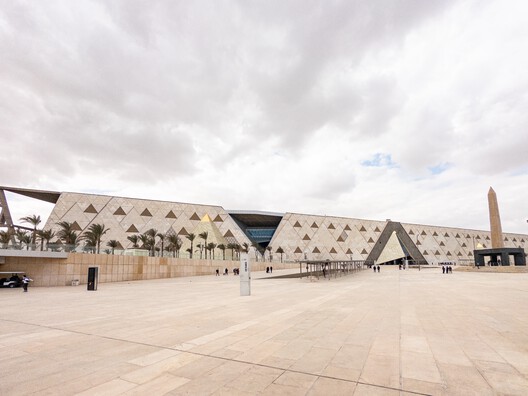
The Grand Egyptian Museum (GEM) in Cairo will open to the public on November 1, 2025, completing a project that has been in development for more than two decades. Designed by Heneghan Peng Architects, the museum is located on the Giza Plateau, approximately two kilometers from the Pyramids of Giza, and occupies a 500,000-square-meter site positioned between the edge of Cairo and the desert. Conceived as a new cultural and research center, the museum aims to present the legacy of ancient Egyptian civilization within a contemporary architectural framework.
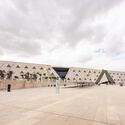
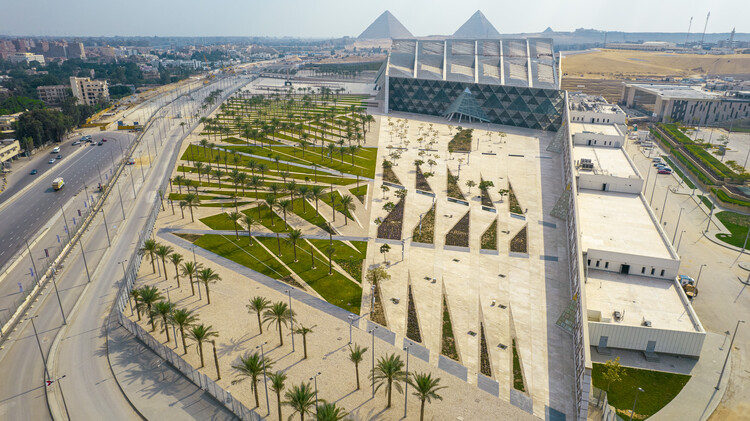
The project originated in the 1990s, with an international design competition launched in 2002 that received over 1,500 entries from 82 countries. Construction began in 2005, followed by a series of delays due to political changes, funding challenges, and the global pandemic. Throughout the design and construction process, Heneghan Peng Architects worked in joint venture with Arup and Buro Happold, with Cultural Innovations and Metaphor supporting the museum's museological development. The landscape design, led by West 8, introduces the Thematic Gardens, Welcome Plaza, and key exterior transitions that mediate between the desert plateau and the Nile Valley. With its completion, the Grand Egyptian Museum establishes a new cultural landmark on the Giza Plateau, connecting modern Cairo to its archaeological heritage and reshaping the visitor experience of one of the world's most historically significant landscapes.
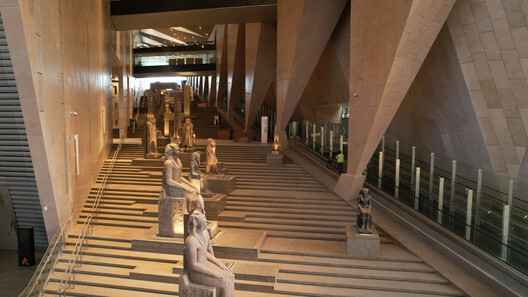
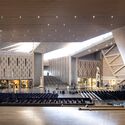
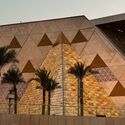
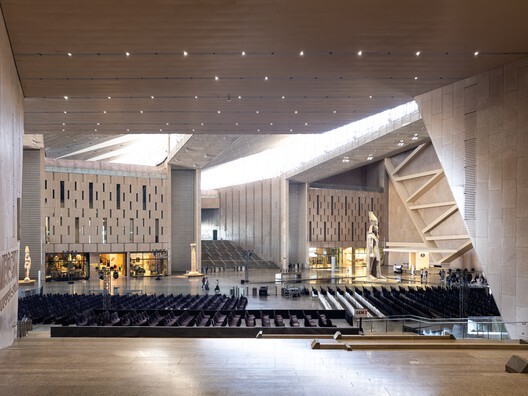
The design organizes the museum through a series of visual and spatial axes aligned with the three pyramids. A translucent stone facade composed of locally sourced alabaster defines the building's desert-facing elevation, creating a porous threshold that filters daylight and responds to the site's natural topography. Inside, a six-story Grand Hall contains the 3,200-year-old statue of Ramesses II beneath a roof that admits diffused sunlight. From this atrium, visitors move along a central staircase that connects the entrance with the main exhibition level, offering framed views toward the Giza monuments through a full-height glass wall.
Related Article
Exploring the Grand Egyptian Museum Through Photography: Bridging Past and Present in Cairo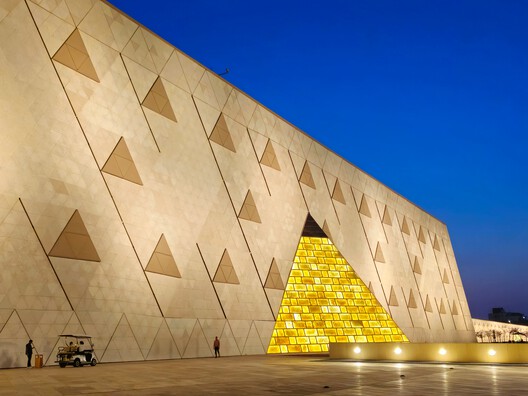
The museum encompasses approximately 81,000 square meters of exhibition space and features over 100,000 artifacts, making it the world's largest institution dedicated to a single civilization. At its core, the 7,500-square-meter Tutankhamun Gallery presents the complete burial treasures of the pharaoh for the first time since the discovery of his tomb in 1922. Designed by Atelier Brückner, the gallery unfolds as an immersive spatial narrative that guides visitors through the life, death, and afterlife of the young ruler. More than 5,600 artifacts, including over 3,000 objects never previously exhibited, are arranged within two parallel wings extending 180 meters in length. The scenography integrates architecture, lighting, and media to balance monumentality with intimacy, highlighting both the craftsmanship and historical significance of the collection. Atelier Brückner also contributed to other major interior spaces, including the atrium housing the statue of Ramesses II, the Grand Stairs, the Piazza, and the Children's Museum, while additional highlights across the museum include the restored Khufu solar boat, monumental sculptures of ancient rulers, and objects transferred from archaeological sites and regional institutions across Egypt.
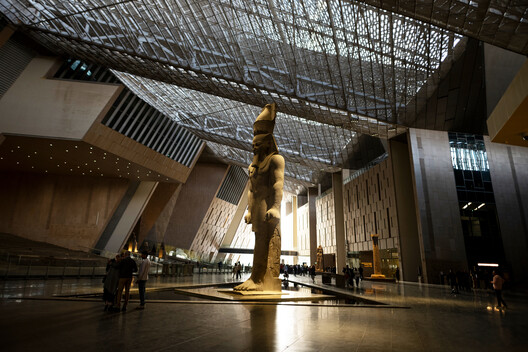
The architectural composition emphasizes horizontal continuity with the plateau and maintains visual alignment with the surrounding landscape. The building's massing follows the desert's contours, ensuring that it remains subordinate to the pyramids on the horizon. Natural light is modulated through folded ceilings and slanted translucent walls, producing a consistent ambient quality suitable for conservation and display. The spatial arrangement allows large-scale artifacts to be exhibited within open galleries that support flexible curation.
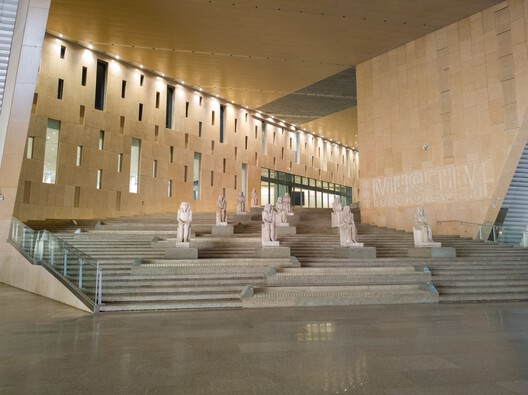
Beyond its exhibition functions, the Grand Egyptian Museum integrates research, education, and conservation facilities, including restoration laboratories, archives, and a children's museum. Sustainable design strategies were incorporated throughout construction, including solar installations, rainwater collection, natural ventilation, and the use of local materials such as granite and marble. These measures have earned the project multiple environmental certifications, including EDGE Advance, recognizing it as the first green museum in Africa and the Middle East.
In other recent developments, seven finalist proposals have been unveiled for the Museum of Jesus' Baptism in Jordan, featuring designs by international teams including heneghan peng architects. In Germany, construction has begun on the Museum Ehrhardt in Plüschow, the first cultural project in the country by Francis Kéré and his practice Kéré Architecture, as well as their first museum building in Europe. Also in Germany, MVRDV has broken ground on the Innovation Park Artificial Intelligence Campus in Heilbronn, continuing the firm's focus on architecture that fosters collaboration between research, technology, and urban life.
Editor's Note: This article was originally published on October 31, 2025, and updated on November 3, 2025, to include new photographs of the space and updated information.