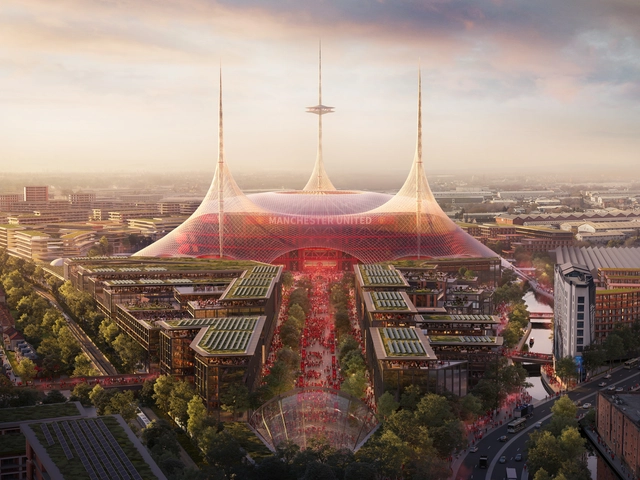
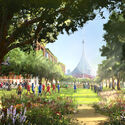
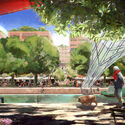
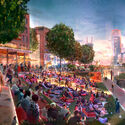
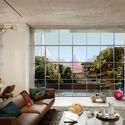
Aerial render. Image Courtesy of Foster + Partners
In September 2024, Foster + Partners announced its appointment by Manchester United for the development of a master plan for the Old Trafford Stadium District. The centerpiece of the master plan is a new stadium, set to become the largest football venue in the United Kingdom with a capacity of 100,000 seats. This week, the firm unveiled images of the stadium design along with surrounding public spaces, including parks, mixed-use developments, an open-air cinema, and a renovated train station. These images contain the illustrative concepts that will become the basis for more detailed feasibility, consultation, and planning work as the project enters new stages.
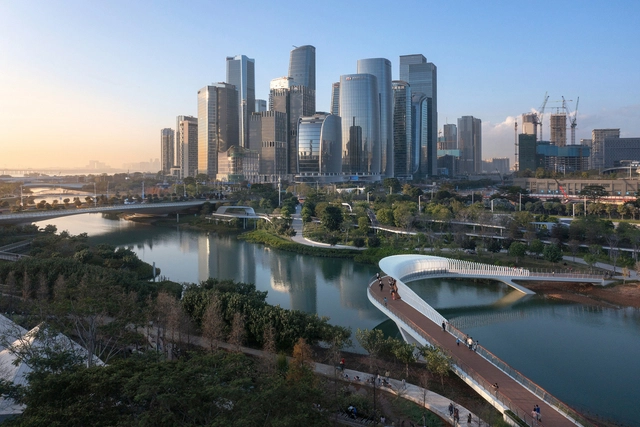
The concept of "sponge cities" has gained prominence since it was introduced by Chinese landscape architect Kongjian Yu, founder of Turenscape, and was officially adopted as a national policy in China in 2013 to combat urban flooding. This approach prioritizes nature-based infrastructure such as wetlands, rain gardens, and permeable pavements, creating landscapes with porous soil where native plants can thrive with minimal maintenance. When it rains, these systems absorb and slow down water flow, reducing flood risks. In contrast, traditional concrete- and pipe-based drainage solutions, though widely used, are costly, rigid, and require frequent maintenance, sometimes even making cities more vulnerable to flooding due to blockages and overflows.
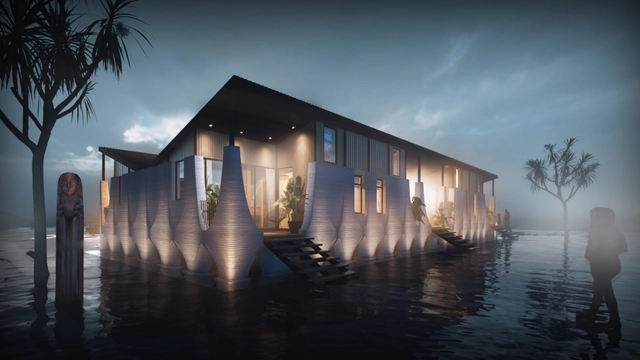
In an open competition, ICON’s Initiative 99 requested participants to design a home using ICON’s 3D printing technologies while keeping the construction budget under $99,000. Among the three selected winners for the Open Category, New Zealand-based office MTspace Studio proposes a robust flood-resistant design, in response to the housing crisis in New Zealand’s flood zones. Titled “Wai Home” after the Māori word for water, the concept revolves around the idea of working with this essential natural element. The design features innovative rainwater collection and storage systems, along with elements to increase the resilience of the construction in the face of increasing threats.
Water scarcity is one of the most stressful situations that one could ever endure. And yet, in India, a country that holds 18% of the total world population with only 4% of its water resources, this is a recurring struggle with notable numbers of Indian households having to manage water scarcity on a daily basis.
The yearly water cycle is a tough one, ranging from one extreme to another. Harsh monsoons and flood seasons turn into insufferable droughts, making it increasingly difficult to control and retain water resources. While most large-scale actions focus on consequences to agricultural and production sectors, the result is also recognizable at an individual household level. Therefore cumulative small-scale actions are relevant gateways for citizens (? people, designers) to mitigate the issue.
An arid environment refers to specific regions characterized by a severe lack of available water and extremely dry weather conditions. More specifically, arid regions by definition, receive less than 25 centimeters of rain per year. In the immense vastness of arid environments, where extreme climates present significant challenges, the role of water in architecture takes on a new dimension.
For centuries, architects and designers dealing with harsh desert landscapes and the vital necessity of water have invented techniques, technologies, and new structures. Moreover, many creative approaches have been created to harness, collect, and cool water in arid environments.
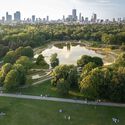
The climate crisis has accentuated changes in the amount of rainfall, causing droughts or storms with large volumes of water, which result in floods that can cause great damage to urban infrastructure. To combat this, the sponge city is a solution that has a green infrastructure to operate the infiltration, absorption, storage and even purification of these surface waters.
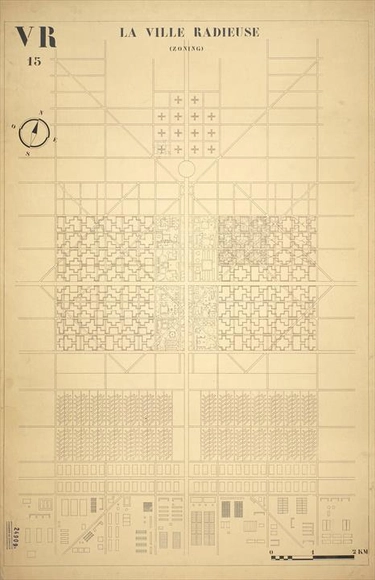
The Master Plan of the Radiant City. Image Courtesy of LE CORBUSIER FOUNDATION
Throughout history, religious reformers and visionary starchitects have attempted to envision the future of our cities: from the Venetian model city of Palmanova to the multi-story housing complex for 5,000 people drafted by Italian architect Paolo Soleri, from Frank Lloyd Wright’s Broadacre City to Le Corbusier’s Radiant City, numerous masterplans have been crafted to illustrate some of the most unprecedented ambitions.
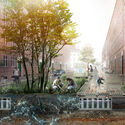
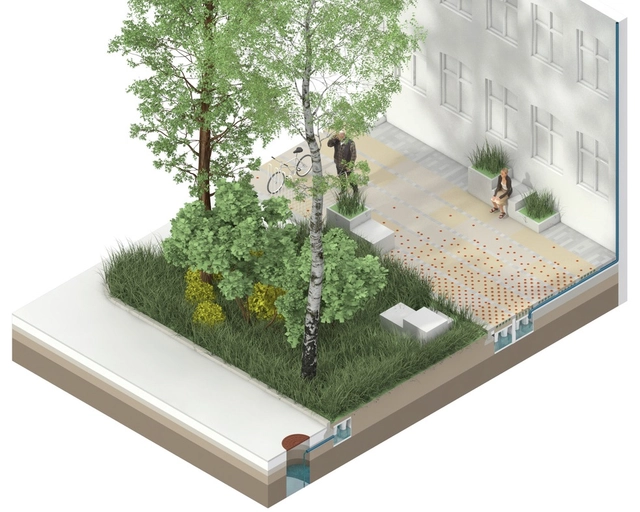
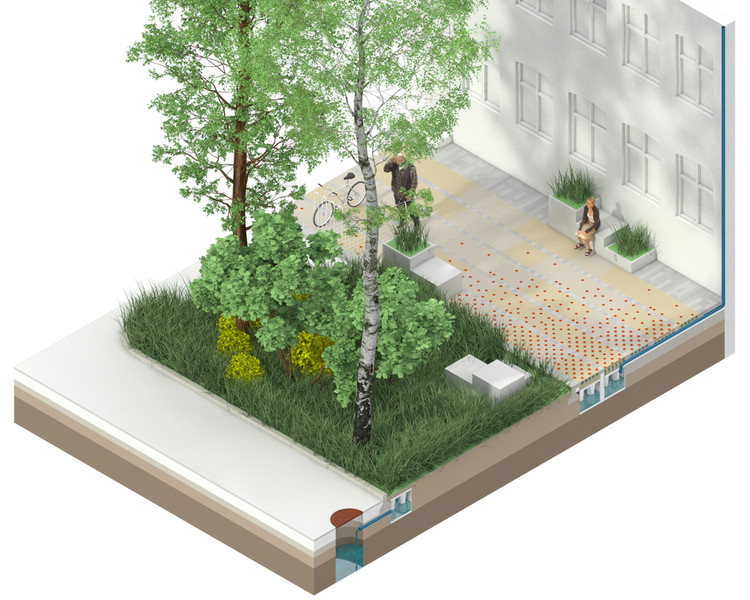
The Climate Tile is a pilot project designed to catch and redirect 30% of the projected extra rainwater coming due to climate change. Created by THIRD NATURE with IBF and ACO Nordic, the project will be inaugurated on a 50m pavement stretch at Nørrebro in Copenhagen. The first sidewalk was created as an innovative climate project that utilizes the Climate Tile to create a beautiful and adaptable cityscape. Aimed at densely populated cities, the tile handles water through a technical system that treats water as a valuable resource.


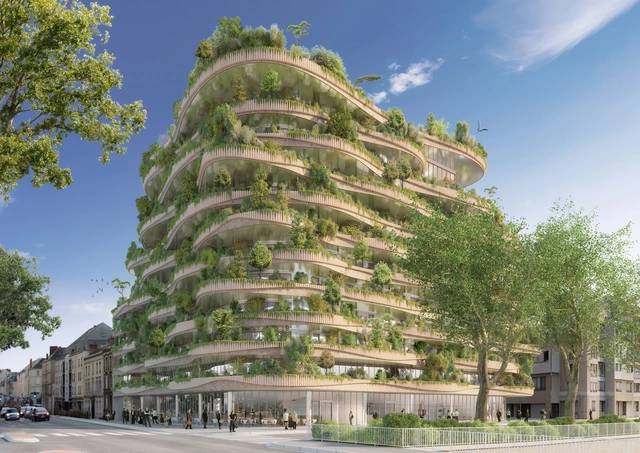
For the "Imagine Angers"international design competition, Vincent Callebaut Architectures worked in collaboration with Bouygues Immobilier group to submit a proposal for the French city at the intersection of social and technological innovation, with a focus on ecology and hospitality. Named Arboricole, meaning “tree” and “cultivation,” this live-work-play environment gives back as much to the environment as it does its users. Although WY-TO prevailed in the competition, the Callebaut scheme succeeded in winning the public vote.
Videos
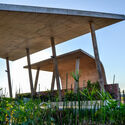
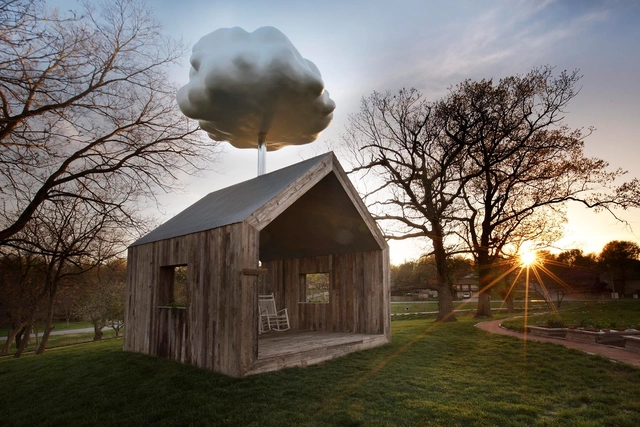
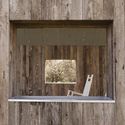
The barn has been constructed of timber and metal salvaged from an abandoned farm. Image Courtesy of Matthew Mazzotta
Few sounds in this world are quite as satisfying as that of fresh rainwater falling on a tin roof. However, this soothing sensation is just one element of the Cloud House, a unique, interactive rainwater-harvesting system created by designer Matthew Mazzotta in Springfield, Missouri. From the comfort of a wooden rocking chair, the user is immersed in a rural farm experience, offering passers-by a moment to slow down, enjoy fresh edible plants and, as promised, bask in the sound of rain striking a tin roof.
KAMJZ have unveiled their proposal for the UIA’s MOLEWA (Mount Lu Estate of World Architecture) competition, which tasked participants with designing several cultural and commercial complexes near one of the world’s largest flower theme parks in Ruichang, China. Titled Ruichang Flower Market, KAMJZ's design contemplates a series of shopping streets with high-end, as well as more vernacular shopping spaces, in particular a specialty area carrying flowers grown in the neighboring Flower Theme Park, traditional crafts, and souvenirs.
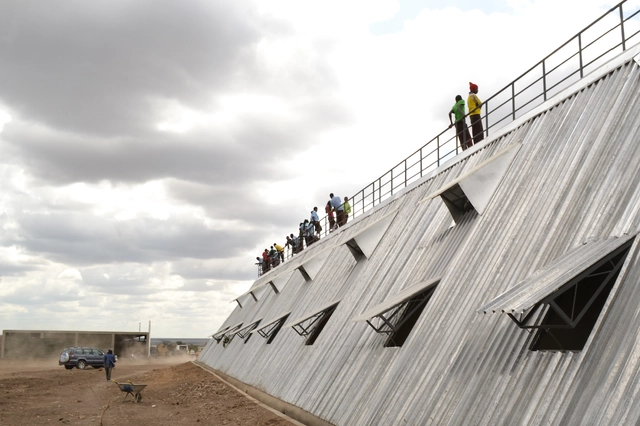
Waterbank Stadium under construction, photo credit: A.Maganga. Image Courtesy of PITCHAfrica
In many African countries, clean water is still a luxury. Wars are fought over it, families are uprooted for it, and entire communities perish without it. The scarcity of freshwater has plagued nations in Africa and around the world for centuries. Now, non-profit group PITCHAfrica is fixing the problem with a novel combination of sport and design. Part of a 10-acre Waterbank Campus comprised of 7 water-harvesting buildings, the soccer (or “futsal”) stadium is capable of hosting up to 1500 people, helping to save, educate and unite communities that are most in need.
Material Minds, presented by ArchDaily Materials, is our new series of short interviews with architects, designers, scientists, and others who use architectural materials in innovative ways. Enjoy!
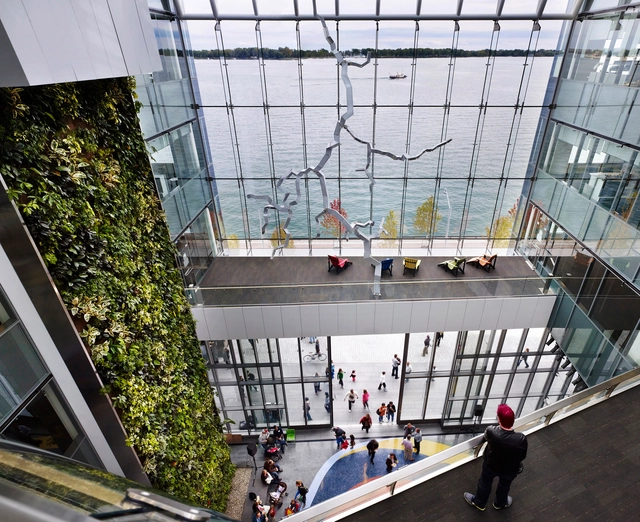
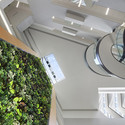
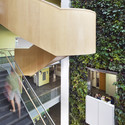
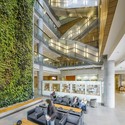
Green, or living, walls have begun popping up and growing across commercial interiors everywhere over the last decade. To understand how a living wall functions, and how to design one, we went straight to a pioneer in the profession: Ms. Birgit Siber of Diamond Schmitt Architects in Toronto. The synthesis of natural systems and building systems had been in her mind since her days as a student, but the major break came in 2000, when her team constructed a massive living wall for The University of Guelph-Humbar. To understand how architects are closing the gap between interior and exterior via the living wall, read the full interview after the break.