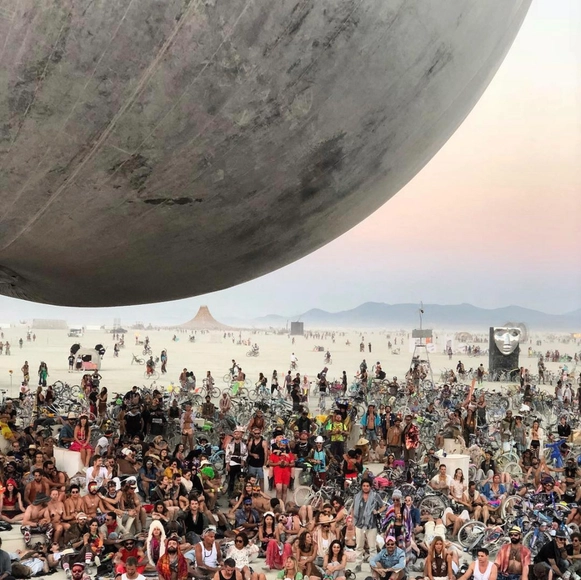
As Burning Man 2018 comes to a close, snapshots and glimpses of the event have begun to emerge in the mediasphere. The most recognizable among these is, perhaps, BIG's Orb, a hovering sphere representing a scaled version of the earth itself.


As Burning Man 2018 comes to a close, snapshots and glimpses of the event have begun to emerge in the mediasphere. The most recognizable among these is, perhaps, BIG's Orb, a hovering sphere representing a scaled version of the earth itself.
Since moving to New York in 2010, BIG founder Bjarke Ingels has built an impressive portfolio, from developed projects such as VIA 57 West and The Eleventh to propositions such as West 29th Street and The Spiral.
In a new interview with Louisiana Channel, Ingels steps back from the pragmatism of individual projects, and instead reflects on his view of New York, from multiculturalism and inequality to regeneration and skyscrapers.

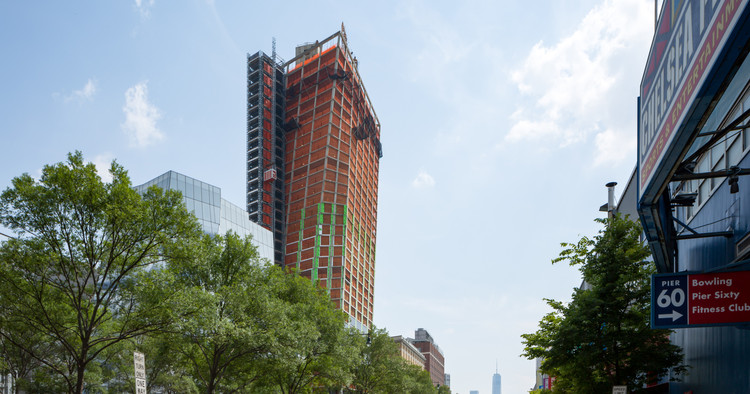
Bjarke Ingels Group’s “The Eleventh” has marked a major milestone, with the first of the scheme’s two twisting High Line towers topping out in Chelsea, Manhattan. New images show construction moving quickly along, with the taller 35-story tower now topped out, and work on the cladding steadily progressing.
The 400-foot-tall structure will twist alongside a second 300-foot-tall sister tower, standing out even amongst notable neighbors including Frank Gehry’s IAC Building, Jean Nouvel’s 100 11th Avenue and Foster + Partners’ 551 West 21st Street.

Bjarke Ingels and Jakob Lange have launched an Indiegogo fundraiser for an 80-foot-diameter ORB to be constructed for the 2018 Burning Man festival at Black Rock City, Nevada. Scaled at 1/500,000th of the earth’s surface, the reflective sphere sits “at the axis of art & utility, capturing the entire Black Rock City in an airborne temporal monument that mirrors the Burning Man experience to the Burners as single beings in the midst of an intentional community."
As well as acting as a wayfinder for navigating The Playa, the ORB sits as a tribute to mother earth and human expression, designed to blend with its surroundings during the night, and leave no trace following its deflation.
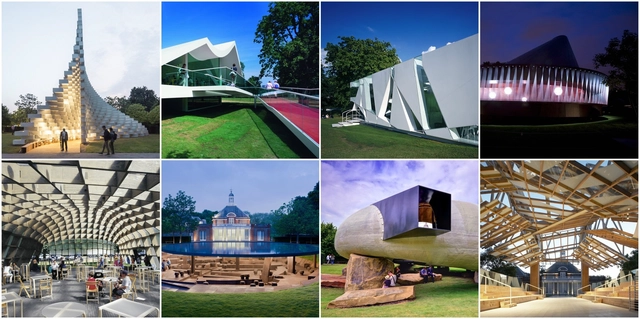
Lasting for close to two decades now, the annual Serpentine Gallery Pavilion Exhibition has become one of the most anticipated architectural events in London and for the global architecture community. Each of the previous eighteen pavilions have been thought-provoking, leaving an indelible mark and strong message to the architectural community. And even though each of the past pavilions are removed from the site after their short summer stints to occupy far-flung private estates, they continue to be shared through photographs, and in architectural lectures. With the launch of the 18th Pavilion, we take a look back at all the previous pavilions and their significance to the architecturally-minded public.

Bjarke Ingels Group (BIG) has a knack for combatting a variety of complex issues via its step-by-step approach, yielding a design that seems almost inevitable. Ingels has labeled his design strategy as a form of “architectural alchemy." This combines multiple programs or “ingredients” that on their own, would simply be seen as “normal." But in aggregate, you get more out of the mix than you would keeping them separate. The result of this looks something like a waste-to-energy plant topped by a ski-slope, or a parabolic skyscraper with a Copenhagen-style courtyard.
Inspired by BIG’s “will to find new solutions for environmental, social, economic and technological problems”, artist Giuseppe Gallo has designed these 9 posters that evaluate BIG’s unique use of syntax.
More on syntax in architecture and how you can get your own copies of the posters after the break.
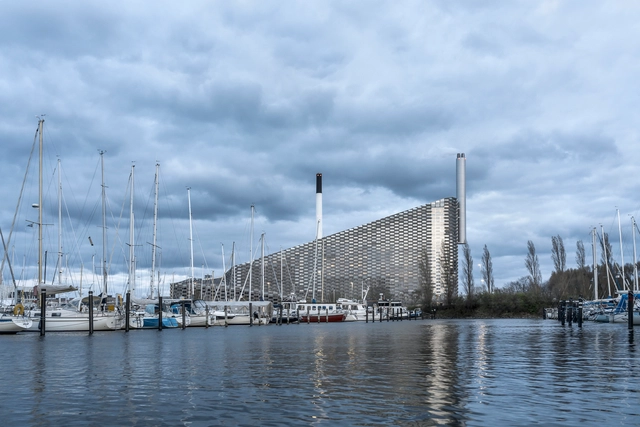
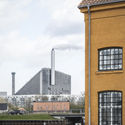
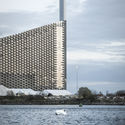
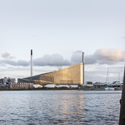
Photographer Aldo Amoretti has captured new images of one of 2018’s most awaited projects, as the BIG designed Amager Bakke Waste-to-Energy Plant takes shape in Copenhagen, complete with an SLA-designed park and ski slope. The images show to the completed power plant, which opened in March 2017, while work progresses on the 170,000-square-foot (16,000-square-meter) park and ski slope that will cap the scheme.
Initially master planned by BIG, the unique design seeks to reclaim a typically unused element of a building for the public through the introduction of the nature-filled program. During summer months, the SLA-designed rooftop activity park will provide visitors with hiking trails, playgrounds, fitness structures, trail running, climbing walls, and of course, incredible views. In the winter, the park will be joined by over 1,640 feet (500 meters) of ski slopes designed by BIG.

WeWork has announced that Bjarke Ingels will be its new Chief Architect. Ingels, who has taken the architecture world by storm since founding BIG in 2005, will continue in his role as Founding Partner and Creative Director of his firm, however in his new role at WeWork he also "will offer his insights and ideas to extend and help us push the boundaries of architecture, real estate, technology, and design," explained WeWork today in a press statement.
In recent years, it seems like Bjarke Ingels has been everywhere you look; he has been profiled by The New Yorker, was named one of TIME Magazine's 100 most influential people in 2016, has given TED Talks, and featured in countless other documentaries, videos, and articles (yes, including many on ArchDaily). But there is one place he hasn't yet appeared: on the cover of Surface Magazine. Today, with the launch of Surface's May/June issue, that changes.
"When The New Yorker published Ian Parker’s 11,000-word story on BIG’s rise in 2012, I knew Surface should put a pause on any major coverage, at least for several years, just to see how the firm’s story would evolve," says Surface editor-in-chief Spencer Bailey to explain the magazine's apparent omission. "I think that inkling was right: BIG has grown to five hundred employees, twelve partners, and three offices, with twenty projects under construction and fifty in development. His clients include Google, WeWork, and Audemars Piguet. There’s so much to unpack now."

It was an early morning in Chelsea, and men in suits were standing around the street, ushering in guests into a dark, 12,000 square-foot exhibition space at the XI gallery. Inside, the room was lit by a centerpiece installation of the New York City skyline, sprawling upwards towards the ceiling with its reflection. Bjarke Ingels was going to unveil new plans for The XI (‘The Eleventh’), a pair of twisting towers set between 17th and 18th Streets and 10th and 11th Avenue. Es Devlin, a British artist who has stage-designed for Beyoncé and Katy Perry, was tapped by HFZ Capital Group to create three installations to present the project.
In the gallery, Bjarke Ingels's work is seen through a sculptural map of Manhattan constructed within a 30-foot wide concave hemisphere (Egg); a pair of illuminated towers gently rotating upon shimmering water (Dance); and a 360-degree film strip of Ingels and his sketches scrolling across a horseshoe-shaped room (Paper, Stone, Glass, Water).
“Evolution in constant motion,” Es Devlin told reporters as she gestured towards the curves of the dancing towers.
Bjarke laughed. “I’ll bring it down to pragmatism.”
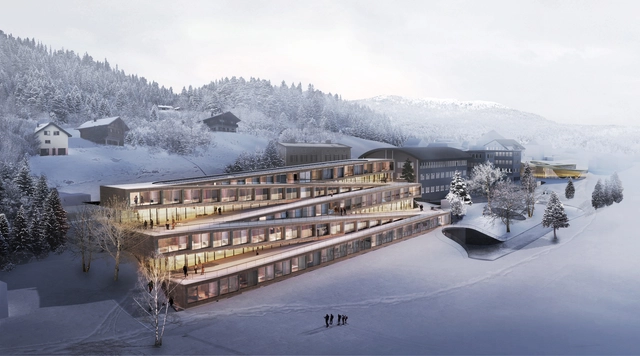
BIG-Bjarke Ingels Group has unveiled images of their proposed Audemars Piguet Hotel des Horlogers, a ski hotel set in the scenic Vallée de Joux, Switzerland. The compact scheme, designed in collaboration with Cche Architecture, is defined by a zig-zag form seamlessly integrated into the smooth topography of the surrounding valley, forming a connection with the nearly Musée Atelier.

Today marks what would have been the 100th birthday of the leading Danish architect, Jørn Utzon. Notably responsible for what could be argued to be the most prominent building in the world, the Sydney Opera House, Utzon accomplished what many architects can only dream of: a global icon. To celebrate this special occasion, Louisiana Channel has collaborated with the Utzon Center in Aalborg, Denmark to put together a video series to hear prominent architects and designers talk, including Bjarke Ingels and Renzo Piano, about their experiences with Utzon and his work—from his unrivalled visual awareness of the world, to his uncompromising attitude that led him to create such strong architectural statements.
Unlike many architects around at the time of Jørn Utzon, who as modernists rejected tradition in favour of new technologies and orthogonal plans, Utzon combined these usually contradictory qualities in an exceptional manner. As the architects recount, he was a globalist with a Nordic base, that has inspired the next generation to travel the world and challenge their concepts. Many of them compare his work to Alvar Aalto’s, as both shared an organic approach to architecture, looking at growth patterns in nature for inspiration. Utzon even coined this approach "Additive Architecture," whereby both natural and cultural forms are united to form buildings that are designed more freely.
.jpg?1521233754&format=webp&width=640&height=580)
The Shenzhen International Energy Mansion is the main headquarters of the Shenzhen Energy Company in China. In designing the building, Bjarke Ingels Group (BIG) paid special attention to one feature: the building's facade. The firm knew that in such a tropical climate, using a traditional curtain wall glass envelope would overheat the buildings and make people crank up their air conditioners. What BIG came up with in their winning design, and what is now the building's most defining feature, is a folded, origami-like facade. This facade provides high insulation and diffuses incoming sunlight, while reflecting the strongest rays onto solar panels.
Laurian Ghinitoiu points his lens towards this uncommon facade design and places the skyscraper within the lively metropolitan context of Shenzhen, China.

What if the one thing that makes BIG "BIG" was suddenly stripped away right at the apex of its potential? That's the question posed by the trailer for Kaspar Astrup Schrøder’s documentary BIG TIME, which ominously illustrated a possible problem with Bjarke Ingels’ health.
Schrøder's documentary highlights the intense journey of Bjarke Ingels, the founder of Bjarke Ingels Group, through the past few years of his life. This unique insight into what exactly it's like to be an architect on top of the world ultimately poses a question that needs to be answered by anyone seeking to reshape the world through design. How do you handle the responsibility of forming the future you want to live in?
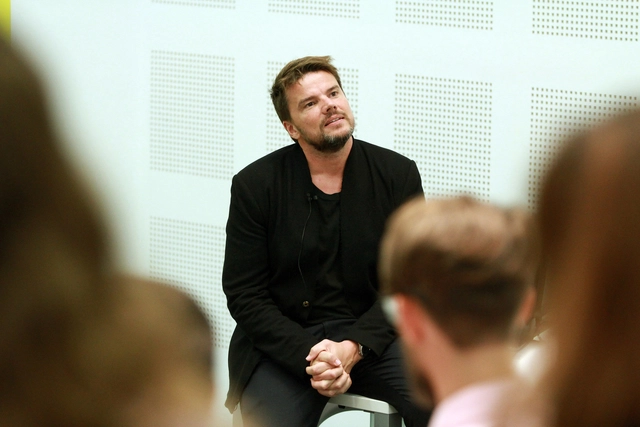
In just 13 years since its inception, Danish firm BIG has earned world renown for its inventive architecture and its founder, Bjarke Ingels, has become one of the most popular names in the architectural world. However, with success comes criticism; BIG has been called out by some critics for what they believe is the "infantilization of architecture," referring to their designs as isolated, self-admiring and solely photogenic.
On her most recent visit to Spain, Spanish journalist Anatxu Zabalbeascoa spoke with Ingels about the impact of the Danish office on architecture and how their work wavers on a tightrope between "breakthrough projects for the world of the powerful" and "a face for people who are not happy with existing architectural models."

Despite 3 years of community input and redesign, BIG’s plans for the new Smithsonian Institution Campus Master Plan in Washington, D.C., has been met with skepticism from the Commission of Fine Arts, one of the two federal agencies charged with approving the plan.

BIG has unveiled an updated vision for the new Campus Master Plan for the Smithsonian Institution in Washington, D.C., after taking into account over 3 years of community input and collaboration with the storied museum and research institution. The revised proposal pays particular attention to the preservation of unique character of the Enid A. Haupt Garden while still addressing the existing and future needs of the Smithsonian at one of the nation’s most historically significant sites.
Great buildings blatantly express their true essence to the world
In this interview from the Louisiana Channel, Bjarke Ingels shares the personal moments of his life that have influenced the graphic, playful and humanistic architectural style for which he is now world renowned.
















.jpg?1525269583 "© Laurian Ghinitoiu")







.jpg?1521233888 "© Laurian Ghinitoiu")
.jpg?1521233745 "© Laurian Ghinitoiu")
.jpg?1521233769 "© Laurian Ghinitoiu")
.jpg?1521233903 "© Laurian Ghinitoiu")
.jpg?1521233754)

.jpg?1516393483 "Courtesy of BIG. Rendering by Brick Visual")
.jpg?1516393475 "Courtesy of BIG. Rendering by Brick Visual")