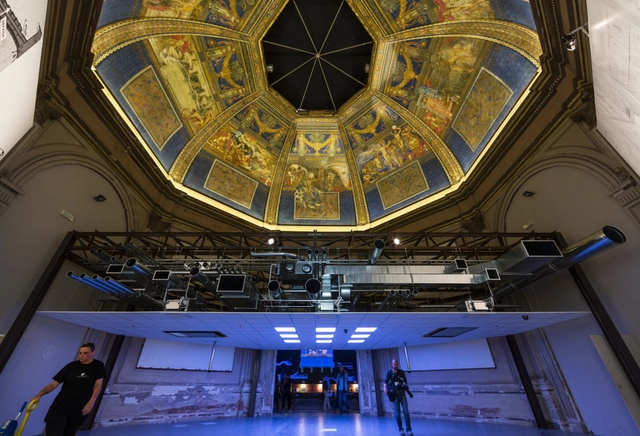
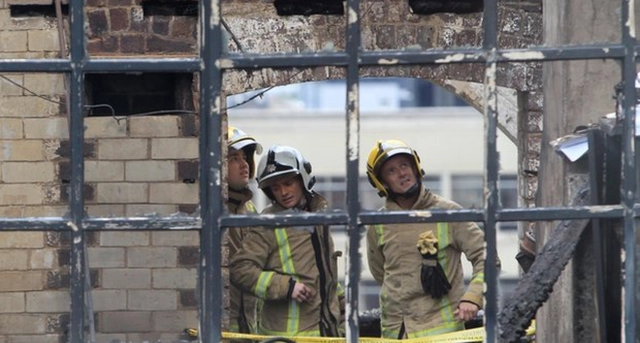
The Glasgow School of Art (GSA) have revealed the unfortunate series of events that led to the school's iconic Mackintosh library, alongside a large collection of student work and archives, devastated in a fire in May of this year. According to BDOnline, who have spoken with Tom Inns (Director of the GSA), "final-year students were setting up their degree show projects in the basement and holes in some pre-built foam panels were being filled with the spray foam."
The flammable gas used as a propellant in the canister was sucked into [a nearby] projector’s cooling fan, setting it alight. A foam panel directly behind the projector then quickly also caught light. "The flames quickly spread to timber panelling and through voids around the basement studio and then into the library two floors above and up through the rest of Mackintosh’s 1909 masterpiece." To add insult to injury, the Scottish Fire and Rescue Service (SFRS) reported that "a fire suppression system was in the latter stages of installation at the time of the fire but was not operational."
Videos
Eco Ruburb, a community hybrid of the rural and the urban (with Hawkins\Brown). Image Courtesy of Sam Jacob Studio
In an interview with Core77Sam Jacob, formerly of FAT and now principal at Sam Jacob Studio, has "always pursued an idea of design practice as a combination of criticism, research and speculation that all feed directly into the design studio." This approach has allowed his ideas to "cross-fertilize, find connections and directions that make the practice stronger, more agile and able to respond intelligently to the problem at hand." Jacob, who is also a Visiting Professor at Yale and the University of Illinois at Chicago whilst simultaneously director of the Night School at London's Architectural Association, recently saw the end of FAT's final project: the curation of the British Pavilion (alongside Dutch architect and academic Wouter Vanstiphout). In the UK, former partner Charles Holland is bringing a collaborative project with artist Grayson Perry to completion in Essex.
Read more and see some of Jacob's drawings after the break.
As part of their quest to synchronise our digital and analogue worlds, sketchbook designer Moleskine have joined forces with the Adobe Creative Cloud platform to "simplify workflows" for illustrators, designers and architects. Suggesting that the initial stages of the creative process often occur offline, out of the studio or in transit, the team behind the collaboration note that as a portable, uncomplicated object, the Moleskine notebook "can be used anytime, anywhere and especially on the move. Sketching on paper is immediate, and can even be done on a crowded train."
Now users with a Creative Cloud subscription, combined with a special Moleskine sketchbook, can capture images of their drawings with the associated app (iOS only). These are then converted into smooth vector files which are automatically synchronised to desktop programs such as Photoshop (as a .jpeg) or Illustrator (as a .svg).
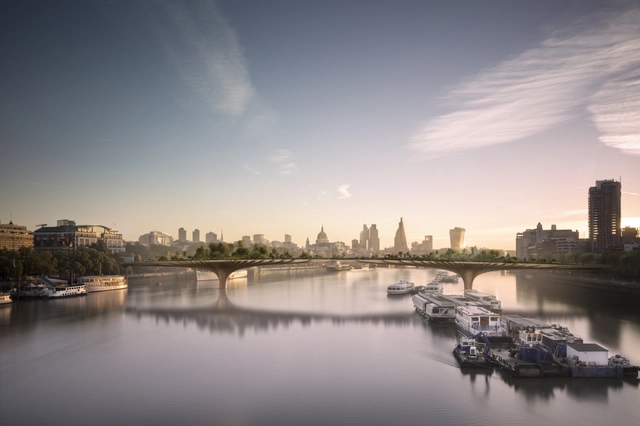
After a fortnight of highs and lows for Thomas Heatherwick and British celebrity Joanna Lumley's campaign for a garden bridge stretching across London's River Thames, Rowan Moore of The Observer has meticulously described the project as "nothing but a wasteful blight." Although he acknowledges that support for the bridge "has been overwhelming," he argues that Heatherwick - though an "inventive and talented product designer" - has a past record in large scale design which "raises reasonable doubts about whether his bridge will be everything now promised."
The Royal Institute of British Architects (RIBA)’s Future Trends Survey for October showed that confidence is very high among UK architects, with the workload index up rising substantially to +37 from +29 in September - the second highest ever workload forecast balance figure. This positive figure was spread right across the country with the most optimistic reports coming from Scotland, with a workload index figures of +80, and Wales, which reported a figure of +28. In addition, the percentage of respondents reporting that they had personally been under-employed was down "considerably" to 12% - the lowest since the survey began in January 2009.
The question of whether the traditional museum survive in the digital age has been bounced around since the dawn of digital art and archiving. In an article for The Independent, Christopher Beanland examines the issue of a global "museum boom" (especially in China where a new one opens every day), and how this is having an undoubtedly positive impact on people's quality of life. For Beanland, it's curious that "we don't splash out on council houses or universities or hospitals any more – but we do build museums and galleries." Perhaps it's because they are "a reliquary for our collective memories" and "a triumph of our collective will" or, in most cases, because they employ excellent PR and branding strategies. He notes that "despite being swamped by possessions, we've changed our views towards those things. In the second half of the 20th century, people defined themselves by what they had. But today people increasingly define themselves by what they do."
The Pazzi Chapel is a landmark of architecture in the city that was once the cradle of the Italian Renaissance: Florence. Located in the Santa Croce church complex (the largest Franciscan church in the world), the chapel was designed by Filippo Brunelleschi - the goldsmith-turned-architect who dedicated his life to engineering the dome of Florence's Santa Maria del Fiore. It is "a prime example of 15th-century architectural decoration in grey pietra serena sandstone, colourful maiolica, and terracotta."
550 years have taken their toll on this structure and its decoration. Concern for the state of the loggia of the chapel is now so great that the non-profit institution in charge of the church’s administration - the Opera di Santa Croce - have raised 50% of the funds needed to carry out a restoration, set to begin in early 2015. They are now looking to crowdfunding to source the remaining half ($95,000) and, in so doing, are inviting people from around the world to become part of the 720-year-long history of Santa Croce.
Fundamentals, the title of the 2014 Venice Biennale, will close its doors in a matter of days (on the 23rd November). From the moment Rem Koolhaasrevealed the title for this year’s Biennale in January 2013, asking national curators to respond directly to the theme of ‘Absorbing Modernity 1914-2014’, there was an inkling that this Biennale would be in some way special. Having rejected offers to direct the Biennale in the past, the fact that Koolhaas chose to act not only as curator but also thematic co-ordinator of the complete international effort, was significant. This announcement led Peter Eisenman (one of Koolhaas' earliest tutors and advocates) to state in one interview that “[Rem is] stating his end: the end of [his] career, the end of [his] hegemony, the end of [his] mythology, the end of everything, the end of architecture.”
Renzo Piano Bulding Workshop / OMA / UNStudio / Siza / Mecanoo. Image
The Dutch city of Rotterdam, often referred to as a hotbed of architectural activity, has been named as the best city in Europe by The Academy of Urbanism at the 2015 Urbanism Awards. Pitted against two other finalists - Aarhus in Denmark and Turin in Italy - the city has been praised for its "predominantly young, open, tolerant community that is embracing innovative architecture and urban design and new business models."
Despite being a very closely fought battle, the Academy said that Rotterdam was a vote winner for its "unique approach to governance. Appointed for six years by central government, the role of mayor sits outside of political structures and with no portfolio, allowing greater engagement with citizens and businesses." Steven Bee, Chairman of the Academy, said that "a long-term perspective, a high level of autonomy, strong leadership by the mayor and municipality, and strong partnerships between public and private sector, are all helping Rotterdam grow positively."
What is Architecture? (WIA), a small collection of interviews with influential architects from around Europe, seeks to "provide clear and concise information about architecture", thereby "forming a panoramic view of today's architectural thinking." Set up by three students of architecture residing in Innsbruck, the WIA team have interviewed the likes of Patrik Schumacher (Zaha Hadid Architects), Sir Peter Cook (CRAB Studio), Jacob and Nathalie van Rijs (MVRDV), and Ben van Berkel (UNStudio). Their collection, though small, is continually expanding.
See a selection of WIA's interviews after the break (or see the entire collection here).
Videos
Vision of the masterplan (commissioned in 2007). Image Courtesy of Bristol Temple Quarter
Five practices have been shortlisted to put forward designs for the Bristol Arena, a cultural and sporting hub which is set to have a 12,000 seating capacity and is due to open towards the end of 2017. The city's Mayor, George Ferguson (who is himself an architect-turned-politician), has said that "we now have five very capable and talented design teams with a wealth of experience between them drawing up proposals" that will contribute to the regeneration of the city's Temple Quarter Enterprise Zone (a site close to Temple Meads Station). The five shortlisted multi-disciplinary design teams are consortiums experienced in delivering major cultural venues in the UK or overseas. A team led by Populous, who completed the London 2012 Olympic Stadium, are running in collaboration with Feilden Clegg Bradley, who were shortlisted for the 2014 RIBA Stirling Prize. They are competing against teams led by Grimshaw and Wilkinson Eyre, who recently installed a cable-car across London's Millennium Dome.
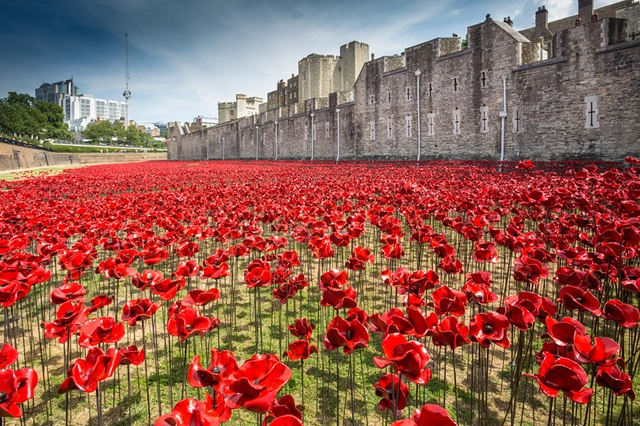
The Observer'sRowan Moore "accidentally got swept into a tide of humanity at the weekend, or to put it another way, couldn’t move for crowds." In memorial of the start of the centenary of World War One, of which today marks the anniversary of the armistice (11.11.1918), the Tower of London have installed a sea of 888,246 ceramic poppies in the former moat. The artwork, created by Paul Cummins and Tom Piper, and entitled Blood Swept Lands and Seas of Red, "has caught the national imagination." For Moore, however, "it is deeply disturbing that a hundred years on from 1914, [the UK] can only mark this terrible war as a national tragedy." He argues that "the spectacle of all these red poppies is emptier than that. [...] It is a deeply aestheticised, prettified and toothless war memorial." Read the article in full here.
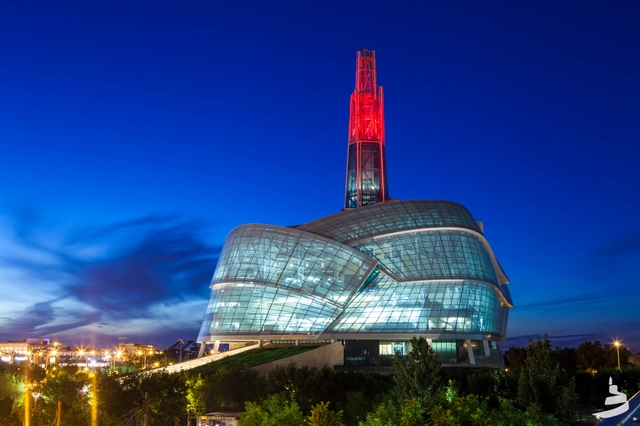
In an article for The Walrus, Adele Weder examines Antoine Predock's (who was recently made a National Academy Academician) Canadian Museum for Human Rights: a "colossal, twelve-storey mountain of concrete and stone, 120,000 square feet of tempered glass, and 260,000 square feet of floor space." Early advocates of the museum "felt that Winnipeg was ripe for such a statement piece," just as Bilbao had been for the Guggenheim. Welder's explorations are clear and concise, finding all sorts "of paradoxes swirling around the Museum for Human Rights." Noting that "it’s definitely a kick-ass building, with its aggressive outer form, jagged paths inside, big black slabs of basalt, thick sheets of glass, and the huge metal girders that hold it all together," Weder argues that it's position as a "failed memorial and white elephant" may be it's eventual undoing.
Tom Bridgen: 'The Protected Vista' - Commendation - RIBA President’s Award for the Outstanding PhD Thesis. Image Courtesy of RIBA
The RIBA President's Awards for Research, established to "promote and champion high-quality research and encourage its dissemination to the profession," have announced the 2014 laureates. Spanning four categories - Master's, PhD, University, and Practice-Located Research - the winning theses and projects highlight the need for research across the profession to nurture innovation and strategic thinking. Ruth Morrow, chair of the jury and Professor at Queen's University Belfast, commented on the judging panel's "disappointment" at the lack of entries submitted from outside London.
The disparity between the six London based schools and those in the rest of the UK (of which there are more than forty high-calibre institutions) continually makes itself manifest in RIBA student awards. In spite of this, half of the awards and commendations given this year are for students studying at schools outside the capital; the remaining half were awarded to students of The Bartlett (UCL). Morrow hopes that "next year, in the 10th anniversary year of the awards, that more universities and practices from across the nations and regions will submit entries."
See this year's winning and commended projects after the break.
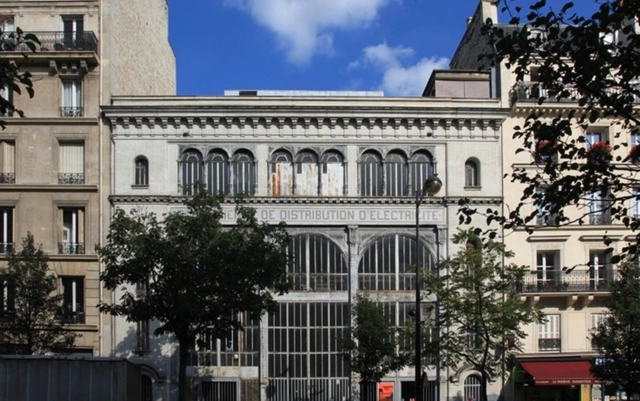
Site: Sous-station Voltaire (11e). Image Courtesy of Reinventer Paris
The City of Paris has called upon the architects of the world to propose "innovative urban projects" to reimagine the city's urban future. As the first competition of its kind in the world, Mayor Anne Hidalgo and her Deputy, Jean-Louis Missika, will "select and implement the new forms of buildings that will shape the future of Paris," putting innovation at the top of the criteria. Offering 23 sites, located in the centre of Paris and on the peripheries, the City is convinced that "the challenges faced by the world can be addressed through local answers." According to the Mayor, "from today, world creators are given carte blanche to reinvent the ways of living, working and trading in Paris." "Surprise us!"
The British city of Manchester, often seen as the UK's second city alongside Birmingham, will become the first metropolis outside of London to be given greater local autonomy over budgets and city planning. The devolution deal, which will also see the city receive the right to directly elect a Mayor (in line with large cities in the US, for example), will furnish the city with "a new housing investment fund worth up to £300million." As it is understood that the first Mayor of Greater Manchester will be elected in 2017, there's time to discuss how this new political environment in the UK might help boost building in what has described as a "Northern Powerhouse."
In the third and final installment of their micro documentary series on architecture and water, Ellis Woodman and a team at the Architectural Review (AR) have collaborated with architects, developers, urbanists and thinkers to examine the latent connections between water infrastructure and our built environment. Taking a journey by narrowboat through London, the film explores the radical ideas which may offer the keys to unlocking the potential of the urban waterway. Through recreation, interaction and radical ideas such as floating parks, amphibious houses and new public wetlands can the river become a living part of the city?
The relationship between immortality and architecture is ancient one. Writing in The New Yorker, Alexandra Lange discusses the past and future of cemetery design in relation to a new exhibition on display in New York. Featuring a selection of 1300 individual mausoleum designs stored in Columbia University's archives, Lange notes how "patrons weren’t picky about originality. In the late nineteenth century, memorial companies might just bring back a shipment of angels from Carrara to be distributed among future clients." These "rural estates in miniature" eventually gave way to more contemporary designs which dabbled in Realism and Cubism. What will the people of today house their remains in? For Lange, "the design we take personal pleasure from everyday is now less likely to be architecture and more likely to be an interface." Read the article in full here.





.jpg?1416853943&format=webp&width=640&height=580)