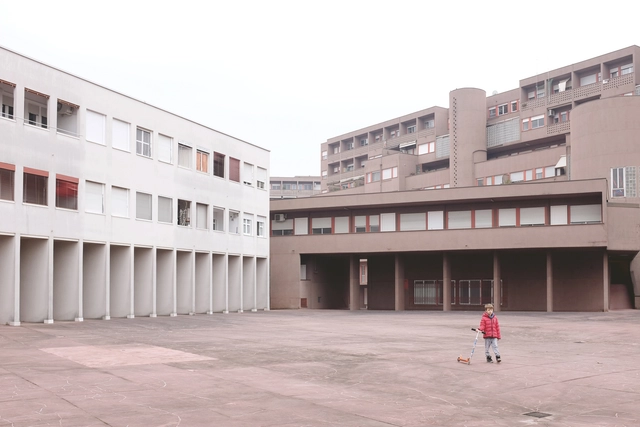
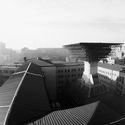
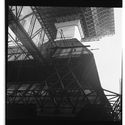
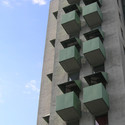
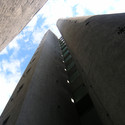
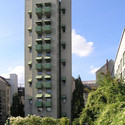
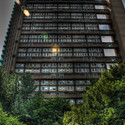
As the dust settled following the Second World War much of Europe was left with a crippling shortage of housing. In Milan, a series of plans were drafted in response to the crisis, laying out satellite communities for the northern Italian city which would each house between 50,000 to 130,000 people. Construction the first of these communities began in 1946, one year after the end of the conflict; ten years later in 1956, the adoption of Il Piano Regolatore Generale—a new master plan—set the stage for the development of the second, known as 'Gallaratese'. The site of the new community was split into parts 1 and 2, the latter of which was owned by the Monte Amiata Società Mineraria per Azioni. When the plan allowed for private development of Gallaratese 2 in late 1967, the commission for the project was given to Studio Ayde and, in particular, its partner Carlo Aymonino. Two months later Aymonino would invite Aldo Rossi to design a building for the complex and the two Italians set about realizing their respective visions for the ideal microcosmic community.[1]
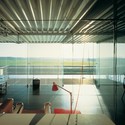
The Police Center Operative Headquarters by Spasoje Krunic is a building that technologically is way ahead of its time. It is an extravagant vision based on futuristic concepts and a sophisticated morphological and constructive technology, which combined, form a unity with distinctive aesthetical features. Owing to its construction and well-formed dynamics, the Operative Headquarters finds its place somewhere on the borderline between architecture and free design. The building is associated with new constructivism, a movement that has never been established in Serbian architecture, nor is it a current trend. Rather, it developed out of a specific set of structural requests imposed on the architect.
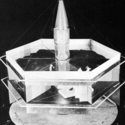
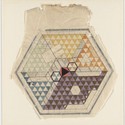
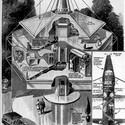
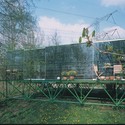
The Dymaxion House was a futuristic dwelling invented by the architect and practical philosopher R. Buckminister Fuller - who would have turned 124 today. The word “Dymaxion,” which combines the words dynamic, maximum and tension, was coined (among many others) by Fuller himself.
In 1920 Fuller wished to build a sustainable autonomous single family dwelling, the living machine of the future. Although never built, the Dymaxion's design displayed forward-thinking and influential innovations in prefabrication and sustainability. Not only would the house have been exemplary in its self-sufficiency, but it also could have been mass-produced, flat-packaged and shipped throughout the world.
More on this revolutionary design after the break...
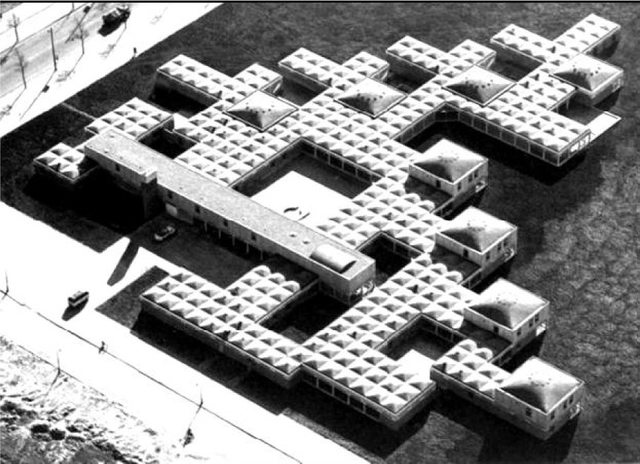
Dutch Architect Aldo van Eyck built the Amsterdam Orphanage in 1960. His design focused on a balance of forces to create both a home and small city on the outskirts of Amsterdam.
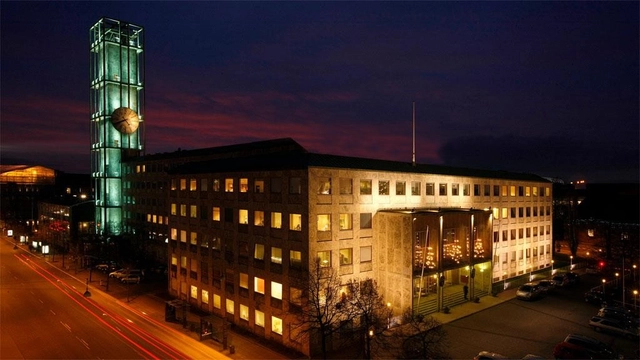
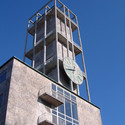
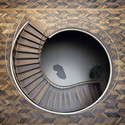
In 1941, at the height of World War II in Western Europe, the city of Aarhus, Denmark achieved an unusual architectural feat. It finished construction on a brand new city hall that was to be a beacon of democratic governance while the city lay under direct Nazi occupation. Designed four years earlier by the heralded duo of Arne Jacobsen and Erik Møller, the Rådhus survived the war and became an internationally recognized classic of Danish modernism.
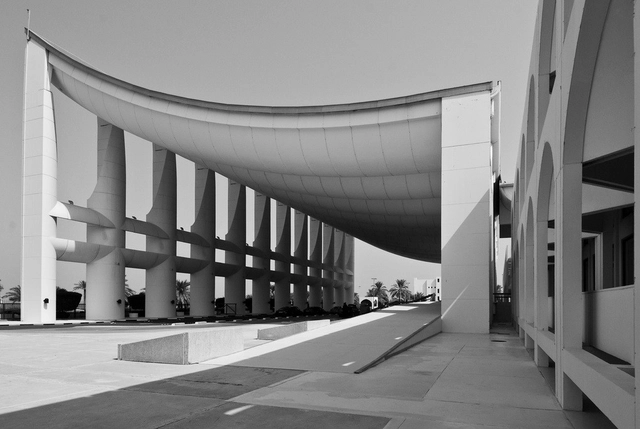
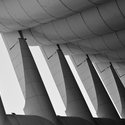
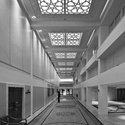
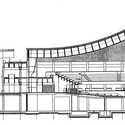
No single building typology reveals as much about a nation’s political culture as the seat of its government. Parliamentary or palatial structures can tell stories of bureaucratic sprawl, autocratic excess, democratic openness, and anything in between. Kuwait’s National Assembly Building, the home of its popularly elected legislature, is no exception. Much like the nominally-democratic, effectively-oligarchic government it hosts, the building projects conflicting messages of accessibility and regionalist modernity, referencing traditions that don’t necessarily exist in the country and sometimes ending up in direct contradiction with itself. As an emblem of political culture, the building is thus perhaps too accurate in its reading of the Kuwaiti story, yielding a revealing insight into the complex political fabric of the country through its own eclectic bricolage of ideas.
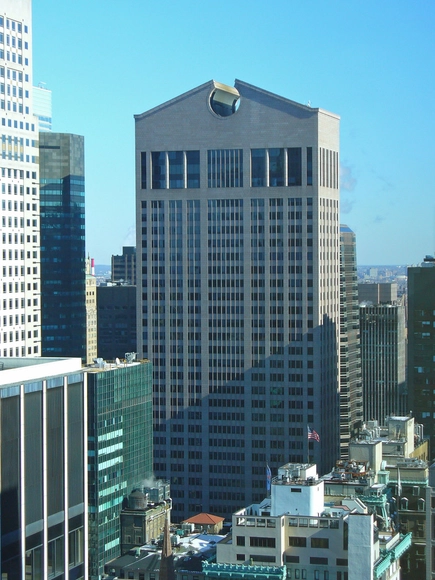
It may be the single most important architectural detail of the last fifty years. Emerging bravely from the glassy sea of Madison Avenue skyscrapers in midtown Manhattan, the open pediment atop Philip Johnson and John Burgee’s 1984 AT&T Building (now the Sony Tower) singlehandedly turned the architectural world on its head. This playful deployment of historical quotation explicitly contradicted modernist imperatives and heralded the mainstream arrival of an approach to design defined instead by a search for architectural meaning. The AT&T Building wasn’t the first of its type, but it was certainly the most high-profile, proudly announcing that architecture was experiencing the maturation of a new evolutionary phase: Postmodernism had officially arrived to the world scene.
This article was originally published on August 27, 2017. To read the stories behind other celebrated architecture projects, visit our AD Classics section.
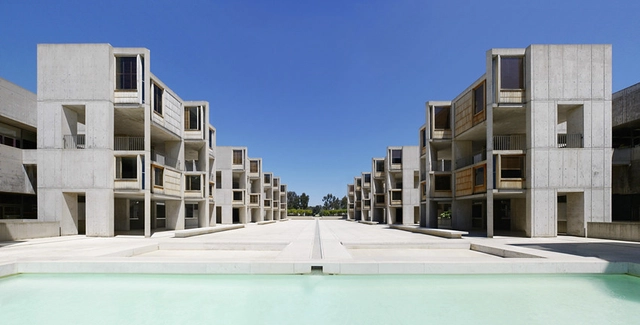
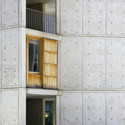
In 1959, Jonas Salk, the man who had discovered the vaccine for polio, approached Louis I. Kahn with a project. The city of San Diego, California had gifted him with a picturesque site in La Jolla along the Pacific coast, where Salk intended to found and build a biological research center. Salk, whose vaccine had already had a profound impact on the prevention of the disease, was adamant that the design for this new facility should explore the implications of the sciences for humanity. He also had a broader, if no less profound, directive for his chosen architect: to “create a facility worthy of a visit by Picasso.” The result was the Salk Institute, a facility lauded for both its functionality and its striking aesthetics – and the manner in which each supports the other.[1,2]
This article was originally published on October 19, 2015. To read the stories behind other celebrated architecture projects, visit our AD Classics section.
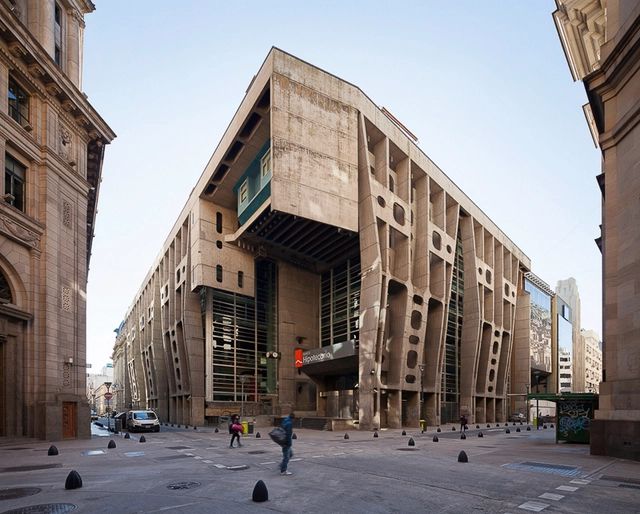
The Bank of London and South America (Banco de Londres y América del Sud, or BLAS) in Buenos Aires defies convention and categorization, much like the architect primarily credited with its design, Clorindo Testa. A unique client relationship, guided by the bank’s staff architect Gerald Wakeham, and a supportive collaboration with the firm Sánchez Elía, Peralta Ramos and Agostini (SEPRA) resulted in a building that continues to evoke surprise and fascination.
This article was originally published on April 14, 2014. To read the stories behind other celebrated architecture projects, visit our AD Classics section.
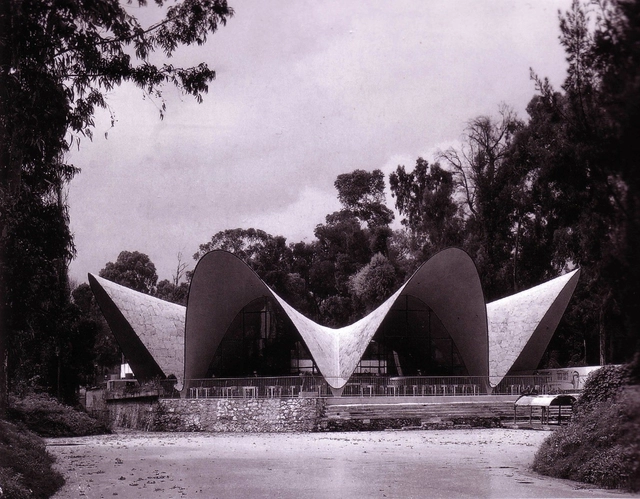
With the design for Los Manantiales, Felix Candela’s experimental form finding gave rise to an efficient, elegant, and enduring work of structural art. Comprised of four intersecting hypars, a strikingly thin roof surface creates a dramatic dining space. Built as Candela was establishing an international reputation as the foremost shell building, he demonstrated to the world his masterful combination of artistry and technical virtuoso.
https://www.archdaily.com/496202/ad-classics-los-manantiales-felix-candelaMichelle Miller
This article was originally published on August 2, 2014. To read the stories behind other celebrated architecture projects, visit our AD Classics section.
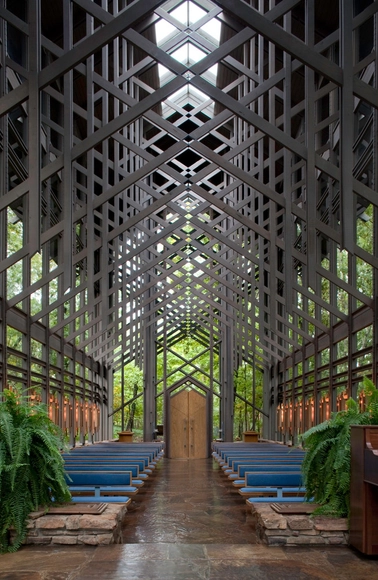
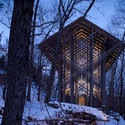
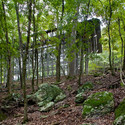
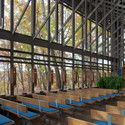
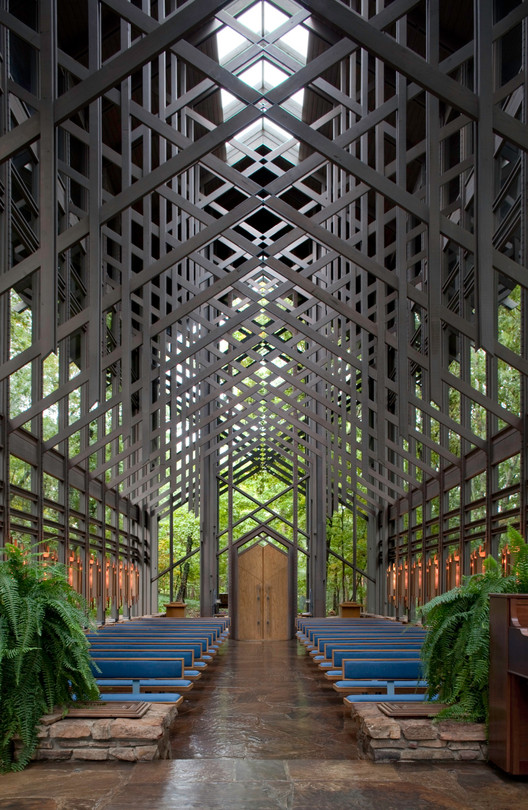
Hidden in the middle of the forests surrounding Arkansas’ Ozark Mountains, Thorncrown Chapel rests amongst the oaks, pines and maples. The humble chapel, designed by Euine Fay Jones, is less than 35 years old – yet it’s on the U.S. Historic register, has been named one of the AIA’s top ten buildings of the 20th century, and has even been called the best American building since 1980.
This article was originally published on November 5, 2014. To read the stories behind other celebrated architecture projects, visit our AD Classics section.
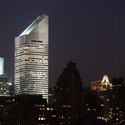
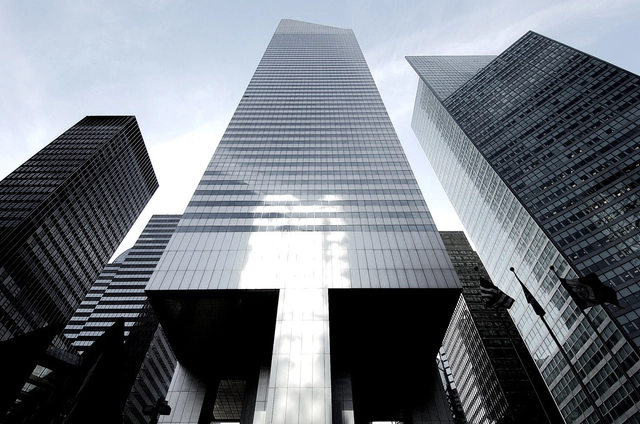
In a city of skyscrapers of nearly every shape and size, the Citigroup Center on Lexington Avenue is one of New York’s most unique. Resting on four stilts perfectly centered on each side, it cantilevers seventy-two feet over the sidewalk and features a trademark 45-degree sloping crown at its summit. The original structure responsible for these striking features also contained a grave oversight that nearly resulted in structural catastrophe, giving the tower the moniker of “the greatest disaster never told” when the story finally was told in 1995. The incredible tale—now legendary among structural engineers—adds a fascinating back-story to one of the most iconic fixtures of the Manhattan skyline.




.jpg?1578401675&format=webp&width=640&height=580)





.jpg?1417704295&format=webp&width=640&height=580)

.jpg?1417704295)











.jpg?1397104743 "via wikiarquitectura")

.jpg?1397104702 "via wikiarquitectura")


.jpg?1413872412 "© Flickr user Steven Severing-Haus")