

This week's review focuses on concrete responses to shared urban challenges, including housing affordability, long-term resilience, and the role of cultural and material innovation in shaping cities. The selection spans regulatory measures affecting housing markets in European cities, high-density residential and mixed-income proposals in New York, and major renewal and planning efforts in London, Barcelona, Ulaanbaatar, and Drammen. It also highlights research-driven and built projects in Chicago, Buenos Aires, Las Vegas, and Riyadh that explore circular construction, adaptive reuse, and new models for cultural and public infrastructure. Together, these worldwide projects offer a snapshot of how architecture and urban planning are addressing immediate pressures while laying the groundwork for more resilient and inclusive urban futures across diverse geographic and cultural contexts.


New Approaches to Addressing Housing Challenges in Global Cities
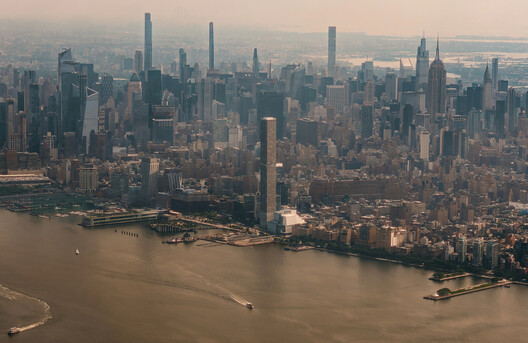
This week's news selection highlights emerging approaches to addressing housing challenges across different urban contexts, from regulatory frameworks to architectural and institutional interventions. Several European cities are introducing new limits on short-term rentals in response to housing affordability pressures, signaling a shift toward policy-driven strategies aimed at protecting long-term residential stock. In New York City, new residential towers illustrate contrasting yet complementary responses, including the near completion of Meganom's 262 Fifth Avenue residential skyscraper and Powerhouse Company's proposal for a mixed-income supertall development that seeks to integrate affordability and social equity within high-density construction. Meanwhile, in London, the advancement of the Barbican Centre Renewal Programme underscores the role of long-term stewardship and reinvestment in existing housing and cultural infrastructure as a means of securing livability and resilience.
Related Article
Housing Affordability Drives New Limits on Short-Term Rentals Across European CitiesVisions for Long-Term Urban Resilience and Cultural Infrastructure
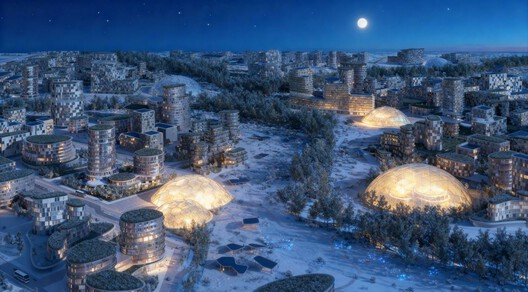
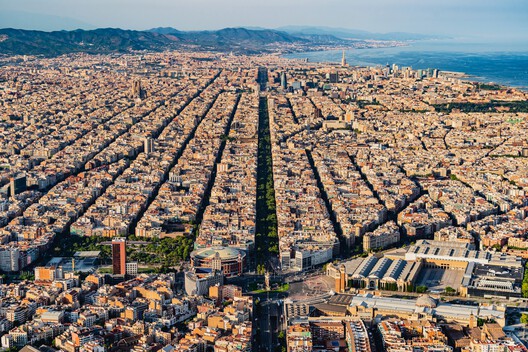
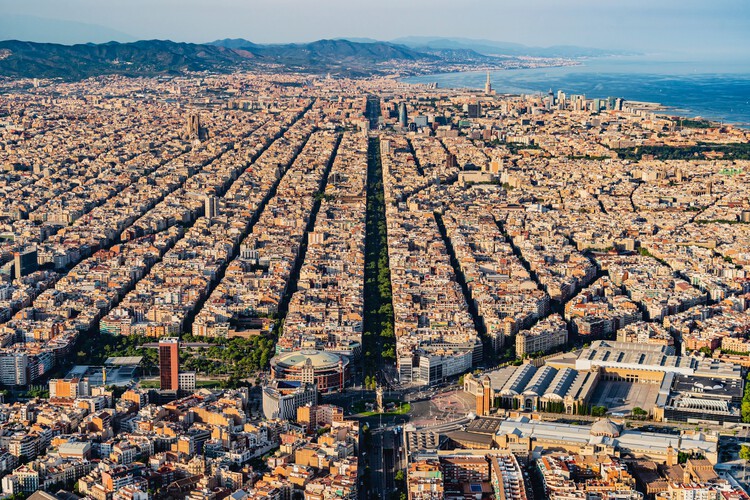
As the year comes to an end, long-term visions for urban resilience and the development of cultural infrastructure highlight how planning, architecture, and global discourse can shape future cities. The announcement of the program and speakers for the UIA World Congress of Architects 2026 in Barcelona frames architecture as a platform for international exchange on pressing urban and environmental challenges. At a territorial scale, the winning master plan for Hunnu City in Mongolia reflects strategic, long-term urban planning aligned with national development goals for 2050, emphasizing resilience and sustainable growth. New images of the proposed Las Vegas Museum of Art by Kéré Architecture and SOM illustrate how cultural institutions are being conceived as long-term civic anchors, while the completion of OODA's House of Nassr sports complex in Saudi Arabia demonstrates how large-scale cultural and recreational infrastructure can contribute to urban identity and community life.
On The Radar
SOM Presents Re-SPLAM, a Reclaimed Timber Pavilion for the 2025 Chicago Architecture Biennial
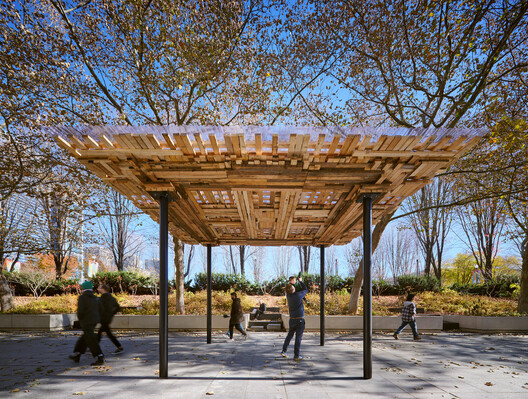
Re-SPLAM (Reclaimed Spatial Laminated Timber) is a pavilion designed and engineered by Skidmore, Owings & Merrill (SOM) in Chicago that extends the firm's research into sustainable timber systems and circular construction. Re-SPLAM was developed in collaboration with students from Washington University in St. Louis' Sam Fox School of Design & Visual Arts and constructed by the Mid-America Carpenters Regional Council and Norcon, using materials donated by the Rebuilding Exchange and Simpson Strong-Tie. Building on SOM's 2021 SPLAM installation, the 16-by-20-foot canopy demonstrates a structural system made entirely from reclaimed 2x4 lumber salvaged from residential buildings across the city, showing how variable and imperfect materials can be incorporated into high-performance architecture. Installed at the Chicago Architecture Biennial and on view in the South Boeing Gallery through February 28, 2026, the pavilion functions as a proof of concept for an optimized timber assembly that achieves the structural performance of a reinforced concrete slab at approximately one-fifth of the weight. Developed using computational design tools, each timber element was measured and cataloged to determine its most efficient placement, minimizing cutting and material waste while extending the life of wood typically destined for disposal or low-grade reuse. Located in Chicago's Millennium Park, the structure creates a 320-square-foot public gathering space beneath a layered timber canopy, offering a built demonstration of how reclaimed materials can support viable alternatives to carbon-intensive construction within a circular economy framework.
Snøhetta Wins Design Competition for the Skamarken Riverfront Development in Drammen, Norway
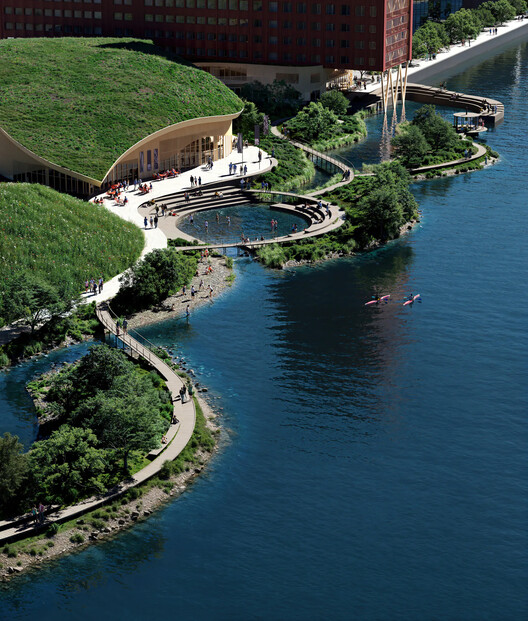
Snøhetta has been named the winner of the design competition for the redevelopment of the Skamarken area in Drammen, a former rail siding site located along the Drammenselva, just north of the refurbished Drammen Station and the new city bridge. Developed in collaboration with Asplan Viak and Bollinger & Grohmann, the proposal introduces a river-oriented urban landscape that reconnects the city with the water through islands, soft river edges, and publicly accessible outdoor spaces, increasing the site's green coverage from 4% to 70%. The design draws on the river's historical role as a defining element of Drammen, restoring ecological transitions while creating new spaces for recreation, social gathering, and seasonal activities. Conceived as an inclusive meeting place and a new urban landmark, Skamarken combines landscape, architecture, and adaptive reuse, including the transformation of the existing Statens hus through extensive material reuse and the addition of a compact tower to minimize land use. Green roofs, permeable surfaces, native vegetation, and climate-resilient design strategies address extreme weather conditions. The project also integrates circular construction, energy reuse, and water management solutions that support long-term environmental performance and public engagement.
Estudio Arqtipo Runs an Experimental Material Laboratory in Buenos Aires, Argentina
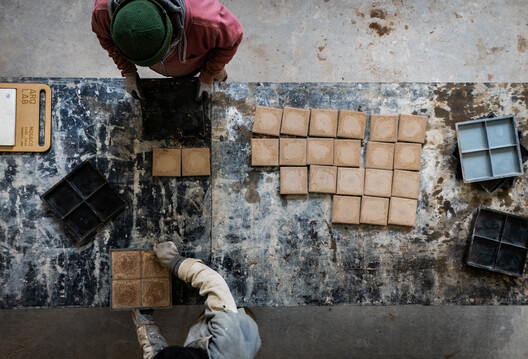
ARQLAB is the experimental material laboratory of Estudio Arqtipo in Buenos Aires, Argentina, dedicated to researching materials and technologies to develop design products that respond to contemporary needs. The laboratory examines and rethinks traditional management and production processes in light of sustainability challenges and the principles of the circular economy, testing alternative ways of building through the exploration and reinterpretation of existing materials, as well as through research into the physical implications of public policies. ARQLAB also promotes knowledge transfer and outreach initiatives that strengthen connections between academia and local territories, supporting collective knowledge production and strategies that contribute to transformation and political engagement around the right to fair access to housing. Current developments include products made from post-consumer materials that have proven technically effective, offer a range of textures and colors, and are lighter and more cost-efficient than conventional alternatives.
This article is part of our new This Week in Architecture series, bringing together featured articles this week and emerging stories shaping the conversation right now. Explore more architecture news, projects, and insights on ArchDaily.


