




-
Architects: A Parallel Architecture
- Area: 3700 ft²
- Year: 2023


Snøhetta's Shanghai Grand Opera House has entered its final construction phase. Preparations are underway for the building's official opening on October 17, 2026, kicking off a performance season featuring 82 performances across 47 acclaimed productions. Snøhetta's spiralling design for the new cultural venue was selected via an international competition in 2016. In 2019, the architecture firm, along with East China Architectural Design & Research Institute (ECADI), Theatre Projects, and Nagata Acoustics, was formally commissioned to deliver the building from concept to completion. The project was originally set to be completed in 2025, as part of a broader cultural master plan aimed at reinforcing Shanghai's role as an international centre of culture and innovation.
Austria has announced Koncesija / Konzession / Concession(e) as its contribution to the 20th International Architecture Exhibition – La Biennale di Venezia. Curated by architects Adna Babahmetović and Ajna Babahmetović together with curator Sebastian Höglinger, the project proposes temporarily granting the Austrian Pavilion to Bosnia and Herzegovina through a cooperative concession. Selected through Austria's open competition process, the pavilion examines questions of national representation, diplomacy, and architectural exchange by responding to the absence of a Bosnian national pavilion in the Giardini, where the Biennale's historic national pavilions are located.

In the twenty-first century agenda, adaptive reuse is understood as a creative and meaningful approach to the development of the built environment. In the face of an era marked by adaptation and transformation, the shaping of human experiences aligns with the principle of "reuse, reduce, recycle." From the authenticity of place to the inherent value of materials, working in dialogue with the past makes it possible to envision new futures that engage with the uses, traditions, and beliefs of earlier eras. By considering each building as a collection of tangible and intangible elements that shape its identity, adaptive reuse interventions require a deep understanding not only of construction methods, structural systems, and spatial rhythms, but also of the cultures that built, inhabited, and will one day occupy these places.


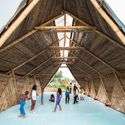
Bamboo is often praised before it is understood. It grows quickly, carries a long history of building cultures, and appears to offer architecture an immediate ecological language. In photographs, it can seem almost self-explanatory: light, natural, renewable, and already aligned with a more sustainable future. Yet this apparent clarity is also what makes bamboo difficult to discuss with precision. Once it becomes a symbol of environmental responsibility, the material itself can disappear behind the image it produces.
This is the risk of bamboo's contemporary revival. It can be imagined too easily as a green substitute for industrial materials, a regional atmosphere, or a softer alternative to the harder languages of steel and concrete. In each case, bamboo is admired before its conditions are understood. The more important question is not whether bamboo is sustainable in a general sense, but what kind of architectural culture it requires: what forms of knowledge, maintenance, regulation, labor, and time are needed for its sustainability to become real.


Studio Campo Baeza, based in Madrid, together with Quito-based Maoda, has won the international competition to design the new National Museum of Ecuador (MUNA) in Quito. Their proposal, titled Echoes of the Sun, was selected by a national and international jury from 17 finalist entries in the second phase of the competition. The public competition initially attracted 148 teams from around the world, with 20 shortlisted to develop design proposals before the winning scheme was announced during a public ceremony in Quito on July 6, 2026.