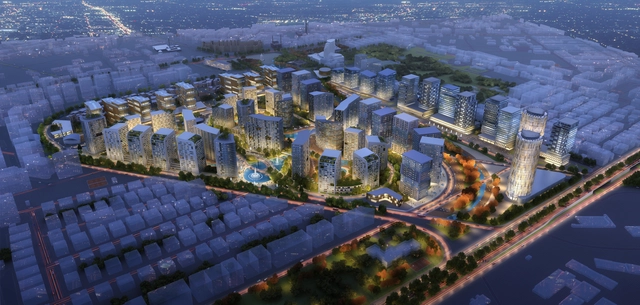
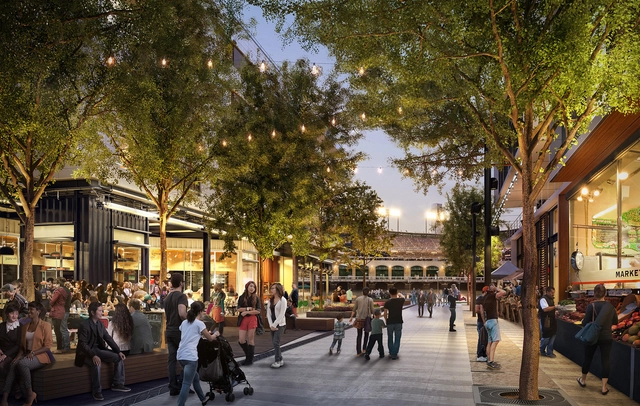
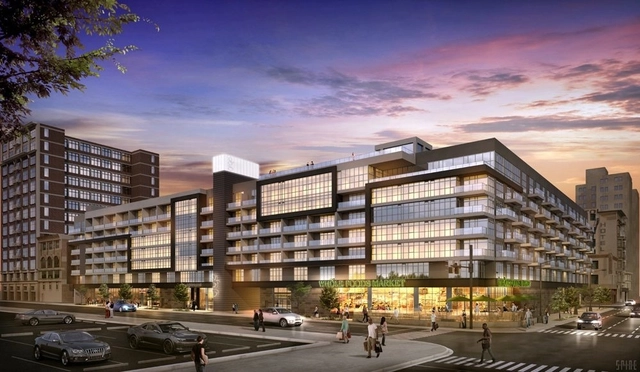
ADEPT and Mandaworks have been declared the winners of a design competition for an urban development in the Kolkajen-Ropsten area of Stockholm's Royal Seaport. Dubbed the “Royal Neighbour,” the masterplan is anticipated to provide more than 12,000 new homes, supply 35,000 jobs in the next two decades, and create a new cultural area.
Ask a random person in the street about their favorite hobbies, and it’s unlikely that they’ll say “urban planning and traffic management” - yet when video games began to take off in the late 1980s city-building was one of the first breakout hits, in the form of Maxis’ SimCity series. The huge success of the “Sim” series in general drove conversations about the value of simulation, as part of the general 1990s optimism about virtual worlds being the future. Sim games became the subject of academic critiques of their philosophy of the world, while city builders became a lot more than a game: in 2002, SimCity 3000 was used as a semi-serious test for mayoral candidates in Warsaw.
After a slump caused by a difficult transition to 3D graphics, city builders are back in vogue. Following what is widely considered as a disappointing SimCity reboot in 2013, Finland’s Colossal Order recently released Cities: Skylines to critical and financial success. But simulations require assumptions; they are, after all, written by people who have their own conscious and unconscious views on how and why cities work. The limitations around designing a video game - the fact that each asset must be modeled and textured, and that each transport option requires a huge amount of work to simulate - mean that Cities: Skylines is as stripped down and streamlined an articulation of urban philosophy as Le Corbusier’sVille Radieuse or the New Urbanists' models, and just as interesting. We investigate 10 things this game tells us about 21st century urbanism, after the break.
View from Entertainment District Live Block. Image Courtesy of Populous
The Milwaukee Bucks have just unveiled Populous' initial renderings of their downtown revitalization plan for Milwaukee’s sports and entertainment district, anchored by a multi-purpose arena. The first step in their vision, the arena hopes to be a modern expression of Wisconsin’s heritage and a vibrant cornerstone to the growth of downtown Milwaukee.
Thirty-two projects have been announced as the winners of the Inaugural Knight Cities Challenge, sharing in a prize pool of $USD5 million. An initiative of the John S. and James L. Knight Foundation, the challenge received an overwhelming number of entries, with winners selected from a pool of over 7000 submissions. Each of the projects proposed strategies for the civic and economic development of one of the 26 cities in which the Knight Foundation invests, including Detroit, Akron Ohio, San JoseCalifornia, LexingtonKentucky, and BiloxiMississippi.
The winning proposals each addressed one or more of the Knight Foundation’s “three drivers of city success”: (1) Talent: Ideas that help cities attract and keep the best and brightest, (2) Opportunity: Ideas that create economic prospects and break down divides, (3) Engagement: Ideas that spur connection and civic involvement.
Developed for an international planning and architectural competition, this proposed masterplan for the Città della Scienza by Vincent Callebaut Architectures, coffice - studio di architettura e urbanistica, and Studio d'Architettura Briguglio Morales fuses sustainability with history to propose a self-sufficient urban ecosystem in Italy. Operating on the principle of living facades, the Città della Scienza revitalizes the forgotten military district into a vibrant, continually regenerating living city.
Read on after the break for a closer look at the plan.
Recent graduates Bumjin Kim of MIT and Minyoung Kim of Columbia University have won first place in ARCHmedium's Lisbon Open Room competition for their project "Urban Platform".
One of 67 teams to enter the competition's "Young Architects" category, the team developed a modular urban intervention for Lisbon, Portugal, with the intention of "[providing] a more flexible space" for the city's urban centre. Learn more about the winning project and view selected images after the break.
Courtesy of City of Milwaukee Department of City Development
The City of Milwaukee has announced the four finalists in a competition to redevelop the city's lakefront, naming OJB, James Corner Field Operations, multidisciplinary firm AECOM, and Wisconsin-based consulting firm GRAEF. Selected from 24 entrants, the shortlisted teams are competing for a chance to revitalize the Milwaukee lakefront as part of the Lakefront Gateway Project masterplan. Each firm must now submit specific proposals for the Plaza project in time for a June deadline, after which all proposals will be made available to the public and judged by a selection committee. Learn more about the project after the break.
CannonDesign's plan for Jaypee Sports City features a continuous 10-mile park woven through a dense urban fabric of high- and low-rise developments. This entirely walkable parkland links all the city’s neighborhoods and social amenities. Image Courtesy of CannonDesign
Since the end of the Second World War, one of the biggest agents for social change has been the "Boomer" generation, those born in the postwar years who thanks to a spike in birth rates in those years represent a disproportionate amount of the population. But as this group ages, what will their effect on our cities be? In this article, originally published by Metropolis Magazine as "How Boomers Will Shape the Future of Our Cities," principle at CannonDesign Peter Ellis outlines what his generation will need from the places they live as they get older.
I am an architect, and a designer of cities. I am also among the Boomer generation, the 65-year-plus demographic that, due to our increasing numbers, is creating a giant bubble at the upper end of the population charts.
We are not, however, aging like the generations that preceded us. “We will be able to give many people an extra decade of good health, based on what we are able to do in the lab now,” says Brian Kennedy, President and CEO of the Buck Institute for Research on Aging in Novato, California. The primary triggers for most disease can be controlled, enabling people to remain productive well into their eighties, nineties, and beyond.
How will this “revolution” in human longevity impact our cities? Unlike our parents, Boomers have not moved to retirement communities, preferring, rather, to stay as long as they are able in their urban neighborhoods—where they can continue to lead active lives.
The Curtin University Master Plan has become the first project to receive a 5 Star Green Star-Communities Rating by the Green Building Council of Australia (GBCA). Helmed by AECOM and Donaldson and Warn architects, the plan sets forth a strategy for the renewal of the University's main campus in Bentley, Perth, aiming to create a "vibrant urban community" that combines commercial, retail, residential, educational, and transport infrastructure. Sustainability is a cornerstone of the project, which seeks to be adaptable to, and respectful of, its site and heritage.
The 5-star rating honours Australian Excellence in "innovation, design excellence, environmental sustainability, economic prosperity and liveability". Learn more about the project and view selected images after the break.
SO-IL, in collaboration with FREAKS freearchitects, has been selected as the first-prize winner of a competition to reinvent the historic Site Verrier in France. Located in the Northern Vosges Natural Park, the updated plan addresses three elements of the site's industrial past while providing a dynamic space for cultural interaction and historic exploration of Site Verrier's glass factory days.